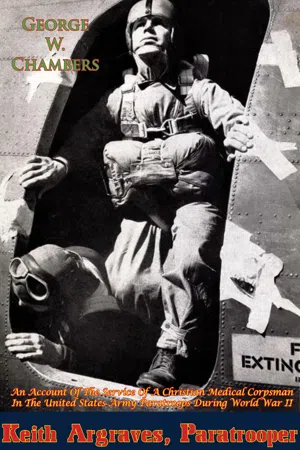
The fascinating true story of Keith Argraves, a man of faith, who served as a medic and paratrooper during World War II.
Keith Argraves served in the 506th Parachute Infantry Regiment, he enlisted in 1941 and through much effort finally succeeded in being accepted into the all-volunteer elite paratroopers as a medic. Steeled with faith in God he refused to carry a gun into action. His first taste of action was in North Africa flying into Oran and tending the wounded at the fighting around Taffarui airport. He was later captured by German soldiers of the Afrika Korps after volunteering to go on a "suicide mission" to demolish enemy assets. His adventures in the prisoner of war camps have become legend and read life fiction, but they are indeed fact.
eBook - ePub
Keith Argraves, Paratrooper
An Account Of The Service Of A Christian Medical Corpsman In The United States Army Paratroops During World War II
- 117 pages
- English
- ePUB (mobile friendly)
- Available on iOS & Android
eBook - ePub
Keith Argraves, Paratrooper
An Account Of The Service Of A Christian Medical Corpsman In The United States Army Paratroops During World War II
About this book
Information
Subtopic
European HistoryIndex
HistoryCHAPTER 1—A REAL PARATROOPER
“HERE, Argraves, is just what you want!”
The speaker, a buddy of Keith Argraves, at Camp Grant, Illinois, held out a newspaper from Rockford. In it was just a short article telling of medical men being accepted into the ranks of the newly formed paratroops, but it added fuel to the flame which had already kindled in the stocky soldier’s heart. On previous occasions Keith and his buddies had talked about the branch of service they wanted to enter to help their Uncle Sam win his global war. Somehow, he had been attracted to the soldiers of the sky, men who drift down out of the blue behind enemy lines. From his early boyhood Keith had been drawn to that which promised adventure, and the paratroops seemed to assure him all that could be desired along this line. Then, too, these hardy ‘troopers wore boots. They were different from the regular soldiers. Besides, there was the consideration of an extra $50.043 a month in pay. Yes, Keith wanted to be a paratrooper.
“Yes, sir, that’s what I want!” remarked Keith as he took the paper and started for company headquarters. Reaching there, he received permission to see the commanding officer, and soon found himself facing him.
“Sir, I have just learned that the paratroopers are taking medics,” he said, after going through the introductory formalities. “I want to be assigned to that outfit, and I have come to ask your help.”
“I cannot assign you to the paratroops, Private Argraves,” replied the kind officer, “but I will do all that I can to help you.”
“Thank you, sir!” Saluting smartly, Keith left headquarters, walking, as it were, on air.
“I’m going to make it,” he told himself. “I’m going to be a medic in the paratroops!”
At the close of basic training, the company was lined up for assignment. Keith waited expectantly as the names were read and the men were informed of their respective destinations. At last his name was called!
“Private Keith Argraves will report for duty at Barnes General Hospital, Vancouver, Washington,” the commander stated.
At Vancouver, Washington! Why, that was just a few miles from his home in Portland, Oregon! That wouldn’t be so bad, but—. Say, that wasn’t what he wanted! He wanted to be a medic in the paratroops, not in a regular army hospital! He was almost indignant.
At the earliest possible moment he got permission to speak to his commander.
“Sir,” he said, respectfully, but firmly, as his cheeks flushed with the emotional strain, “I want to be a medic in the paratroops, not in a hospital.”
The commander looked at the husky young soldier. “All right, Private Argraves,” he said. “However, the best I can do for you is to send you to some place close to the paratroop training center. I will try to do that for you.”
“Thank you, sir,” responded the grateful soldier.
Later Keith was assigned to the Fourth Division, Twenty-second Infantry, at Fort Benning, Georgia. Here the paratroopers were in training! This was his big opportunity to get into what he considered the best outfit in Uncle Sam’s army.
He lost no time in attempting to get in. Time after time he went to the main post at Fort Benning. He talked to various commanding officers, but each time he was told that the ranks were full, and that no more men were needed. However, he was persistent in his efforts. Finally, at his sixth visit, he was sent to the dispensary for a physical examination. He passed with flying colors.
“You will have to wait until you are called,” he was told.
A sergeant from the paratroop personnel must have been impressed by this sturdy young man who was so anxious to become a paratrooper. He said: “I will send you to a man who can tell you whether or not you have to just wait. You are in the wrong place. You will have to have another physical examination.”
Gladly the young man followed the instructions given by this helpful sergeant. He took and passed the physical examination. Then he filled out and signed the application papers that were needed.
In filling out those papers, Keith revealed something of the strong religious convictions which were to characterize his experience in the stirring months to come. He had been reared by God-fearing parents, members of the Seventh-day Adventist Church. One of the distinguishing marks of this body of Christians is that they observe the seventh day of the week as the Sabbath. Keith had been fully persuaded of the biblical soundness of his mother’s faith, and had been baptized as a member of the Seventh-day Adventist Church. Before entering the service of his country, he had determined to live up to his conscientious convictions.
Every time he had applied for acceptance into the paratroops he had stated that as an observer of the seventh-day Sabbath he would have to be released from duty on that day. Thus he had been placing a serious obstacle in the way of his acceptance into that branch of the army. This final application was no exception.
Hoping for the best, Keith returned to his outfit. Day after day he waited for his call to the paratroops, but it did not come. Days ran into weeks, and a month passed by with no word of his acceptance. Furlough time came, and he went to Portland, Oregon, for a much desired visit with his parents, his sister Karmon, and his many friends.
On Sunday morning, after he had spent five happy days at home, a Western Union messenger boy paid a hurried call. “Telegram for Private Keith Argraves,” he announced.
Keith took the yellow envelope, and hastily tore it open. It was an order to report back to camp, and indicated that he was to come immediately.
“What does this mean?” asked Keith. “I am due a longer furlough. Can it be that I am to be shipped overseas at once?”
He was strongly tempted not to respond, and to stay out his original furlough time. But orders are orders, especially when they come from army headquarters.
So Keith returned to camp. Arriving there, he found that he had been called to report for duty the next day. And, yes, it was to the paratroops! Thrilled to the core as he read the official order signed by the high command, he sought out the major in charge of medical training. That officer was upset.
“If I had known about this, I would have stopped it, and you would not have left here,” he snapped.” However, if you fail in the parachute troops, don’t report back here!”
“Sir, if I fail, I will never come back to this outfit,” replied Keith respectfully. “I could never look these fellows in the face.”
The happy soldier packed his belongings for the transfer. But before he made the final break with his old unit, there was one important matter to care for. It was the problem of being excused from duty on the Sabbath. This would be especially difficult in paratroop training. The course was difficult, much more so than the regular army training. Men were not allowed to miss more than two classes in succession at any time, and a full day’s absence would mean that Keith would have to miss eight classes!
Making his way over to the outfit to which he had been called, Keith sought out the commanding officer. Briefly he stated his problem. The reply was discouraging.
“Private Argraves, you can’t make it,” the officer declared. “You can’t miss eight classes every week, and make it.”
“Sir, I would like to try,” replied the eager youth. The officer thought a moment. “All right, we’ll let you try,” he said.
“Thank you, sir,” responded the happy young man.
The next day Keith reported for duty in the paratroops. He was issued his new uniform, boots and all. That extra pay of $50.00 a month was his now, too! Proudly he stood at attention with his fellow soldiers of the sky, a part of what he believed was the best outfit in Uncle Sam’s whole army. He was a real paratrooper, at last. But little did he realize what would be the nature of the adventure that lay before him.
CHAPTER 2—TRAINING FOR ACTION
YES, IT was tough. This was no place for a “softy” or a “quitter”! Keith had seen the rugged troopers as they came in from their four-and five-mile runs. Now, as one of the four hundred and twenty new men starting the rigorous training, he was learning what made those men strong and tough as nails.
Not only must muscles be toughened, but skill in packing and handling the parachutes must be acquired. The men must become accustomed to falling from great heights. They were dropped from high steel towers, with ‘chutes already opened.
Thrilling? Yes, indeed, it was thrilling. But the time came when that thrill took on the nature of a chill. Keith will never forget his first jump. He took two and one half hours to pack that ‘chute, a task he later accomplished in twenty minutes. He even talked to the thing, on which so much was to depend. Another man was heard to say, as he tenderly patted the parachute at the foot of his locker, “If you could eat, I would certainly feed you!”
Finally they were ready, and Keith and his buddies clambered into the waiting plane. They joked with each other to hide their real feelings, but all were nervous. Steadily the craft rose, and soon reached an altitude of 1,500 feet. The earth, far below, looked like a beautiful pattern on a crazy quilt—the roads, the farms, and —. Then came the command, “Stand up! Hook up! Check equipment! Go!”
Now they had to jump! Out they went, in “sticks” (groups) of three, with a few seconds between. Keith had a hollow, sinking feeling in the pit of his stomach while he made his way to the door of the plane. Forgetting the instruction to keep his eyes open, he closed them tightly, and made a wild leap into space, just as if he were jumping into a river. Then came a jerk on his parachute harness; and opening his eyes, he looked up, saw that all was in order, and floated down safely to a good landing.
On the next day came the second jump. This time Keith opened his eyes and saw more of what was going on. The third day brought another jump. And on the fourth day there were two more jumps. After the last two jumps the men rested, enjoyed two days of leave, and then had a graduation exercise. Of the four hundred and twenty men who started the training, only one hundred and ten qualified.
When a man had failed in any assigned task, he was soon sent out to another outfit. It was no disgrace to fail in attempting to qualify as a paratrooper, but the disqualified one was not allowed to linger with the others, lest he should break down their morale.
At the graduation exercises the speaker congratulated those who had qualified, and then made a statement that almost startled the men. “After all this training, only two per cent of your preparation is done. You have the ninety-eight per cent yet to do!” he declared.
Although six weeks of strenuous training had been completed, yet the men found out that the speaker was right. Their physical training was intensified. There was tumbling, Indian-club work, wrestling, and running. The men would run fifteen minutes, and rest two minutes. Finally, they could run for two and three hours at a stretch. Keith discovered that even the cadence in walking was more rapid in the paratroops than in the infantry.
From Fort Benning the men were sent to Fort Bragg, North Carolina. There the training continued—day marches, night marches, and jumps. Sometimes the men came down in very inconvenient places. Keith landed in trees, and also in water. One man was caught and hung on a telephone wire. Still another came down through the skylight of a laundry!
The training was not without...
Table of contents
- Title page
- TABLE OF CONTENTS
- DEDICATION
- INTRODUCTION
- CHAPTER 1-A REAL PARATROOPER
- CHAPTER 2-TRAINING FOR ACTION
- CHAPTER 3-BAPTISM OF FIRE
- CHAPTER 4-NARROW ESCAPES
- CHAPTER 5-SUICIDE MISSION
- CHAPTER 6-PRISONERS OF WAR
- CHAPTER 7-DEATH STALKS THE CAMP
- CHAPTER 8-A BREAK FOR FREEDOM
- CHAPTER 9-FLIGHT!
- CHAPTER 10-WITH THE GUERRILLAS
- CHAPTER 11-IN HORROR CAMPS
- CHAPTER 12-LIBERTY OR DEATH!
- CHAPTER 13-IN THE SHADOW
- CHAPTER 14-TESTS OF CHARACTER
- CHAPTER 15-HOMEWARD BOUND
- CHAPTER 16-A HAPPY LANDING
- ILLUSTRATIONS
- REQUEST FROM THE PUBLISHER
Trusted by 375,005 students
Access to over 1.5 million titles for a fair monthly price.
Study more efficiently using our study tools.
Frequently asked questions
Yes, you can cancel anytime from the Subscription tab in your account settings on the Perlego website. Your subscription will stay active until the end of your current billing period. Learn how to cancel your subscription
No, books cannot be downloaded as external files, such as PDFs, for use outside of Perlego. However, you can download books within the Perlego app for offline reading on mobile or tablet. Learn how to download books offline
Perlego offers two plans: Essential and Complete
- Essential is ideal for learners and professionals who enjoy exploring a wide range of subjects. Access the Essential Library with 800,000+ trusted titles and best-sellers across business, personal growth, and the humanities. Includes unlimited reading time and Standard Read Aloud voice.
- Complete: Perfect for advanced learners and researchers needing full, unrestricted access. Unlock 1.5M+ books across hundreds of subjects, including academic and specialized titles. The Complete Plan also includes advanced features like Premium Read Aloud and Research Assistant.
We are an online textbook subscription service, where you can get access to an entire online library for less than the price of a single book per month. With over 1.5 million books across 990+ topics, we’ve got you covered! Learn about our mission
Look out for the read-aloud symbol on your next book to see if you can listen to it. The read-aloud tool reads text aloud for you, highlighting the text as it is being read. You can pause it, speed it up and slow it down. Learn more about Read Aloud
Yes! You can use the Perlego app on both iOS and Android devices to read anytime, anywhere — even offline. Perfect for commutes or when you’re on the go.
Please note we cannot support devices running on iOS 13 and Android 7 or earlier. Learn more about using the app
Please note we cannot support devices running on iOS 13 and Android 7 or earlier. Learn more about using the app
Yes, you can access Keith Argraves, Paratrooper by George W. Chambers in PDF and/or ePUB format, as well as other popular books in History & European History. We have over 1.5 million books available in our catalogue for you to explore.