eBook - ePub
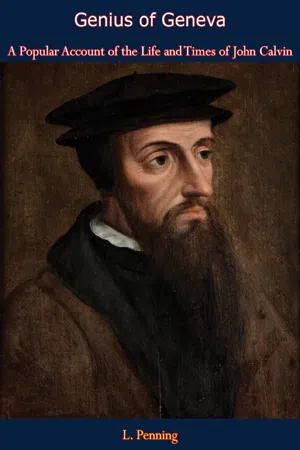
Genius of Geneva
A Popular Account of the Life and Times of John Calvin
- 263 pages
- English
- ePUB (mobile friendly)
- Available on iOS & Android
eBook - ePub
About this book
The present volume is the English translation of the original Dutch language biography of John Calvin (July 10, 1509 - May 27, 1564), a French theologian, pastor and reformer in Geneva during the Protestant Reformation. Born Jehan Cauvin in Noyon, Picardy, France, Calvin was a principal figure in the development of the system of Christian theology later called Calvinism, aspects of which include the doctrines of predestination and of the absolute sovereignty of God in salvation of the human soul from death and eternal damnation, in which doctrines Calvin was influenced by and elaborated upon the Augustinian and other Christian traditions. Various Congregational, Reformed and Presbyterian churches, which look to Calvin as the chief expositor of their beliefs, have spread throughout the world.
Trusted by 375,005 students
Access to over 1.5 million titles for a fair monthly price.
Study more efficiently using our study tools.
Information
Topic
Theology & ReligionSubtopic
ReligionCHAPTER I—THE DARK NIGHT
FORTUNATELY we have left behind us the damp houses and tortuous streets of Paris. And yonder—outside the gates—between the trees, rises stately and impressive, the abbey Saint-Germain des Prés, where the kindly abbot, William Briçonnet, sways his sceptre.
Like a fortress the abbey is surrounded by deep moats to prevent surprise from any sudden and unexpected attack; and a sweet resting-place it affords to the man, who worn out by the moil and toil of the great city, wishes here to end his days in tranquillity and peace.
There in the great hall with its costly library, sits a solitary man. The friendship of Briçonnet brought him to the place. And on the parchment, that is lying before him on the massive writing-table, he writes: “Anno 1509.”
For it is the year 1509.
His hand trembles with age as he writes.
Yes, that solitary man is old; along that face run deep furrows; his hair is blanched by the seventy-four winters which have passed over it.
He stands up, stiff from sitting, goes to the window and stares through the cross-leaded panes into the Herbary, where grow the simples, used by the monks skilled in medicine, for sick and suffering humanity.
Now you see that the man is short of stature; he does not even reach to the shoulder of his king, who is called Louis XII.
Nevertheless, he is a king—O deny him not that title!
As a king he rules in the domain of minds, as Louis rules in the domain of the French kingdom.
That face of his attracts us; at the first sight of it we feel sympathy for the man; those eyes express intelligence, reconciliation, love.
Speak, noble old man! Of what are you thinking?
He does not answer; more and more thoughtful grows his face; all the remembrances of a long life, perhaps, are passing before his mind’s eye.
He was eighteen years of age when European Christendom turned pale with terror at the tidings that Constantinople had fallen under the furious attacks of the Turk’s crooked sword; he was not forty-four, when the Sultan snatched Moldavia away from the Polish kingdom.
The pitiful end of Charles the Bold, who, stripped naked, was found at Nancy, sticking frozen in the ice, was not unknown to him. Laurence Koster and John Gutenberg, the inventors of printing, were his contemporaries, and his life’s sun was already declining in the western horizon, when Columbus discovered America.
A new world—son of Rome! cover your face!
For the army of Franciscan and Dominican monks, that went to America to convert the heathens, murdered those heathens by thousands and made the survivors ten times worse than they ever were before.
Hark! there is another cry going up to heaven: the cry of a hero and martyr, who is fast bound to the strangling-post. It is Savonarola, who preferred the gallows to a Cardinal’s hat, offered by the hand of a pope, and whose only crime was, that he preached a poor sinner and a rich Christ.
THE POPES!
Is it unknown to you, O son of Rome! that Europe once saw the unheard-of spectacle of two, three popes, who at the same time laid claim to the chair of St. Peter, and hurled at each other the thunders of the Vatican? That Innocent VIII made himself notorious by introducing into Germany trials for witchcraft, and as being the father of sixteen illegitimate children?
And Alexander VI, who died six years before—did he do anything else than neglect, to his own advantage, the interests of the Church, which are dear to your heart? Was his son not a Cain, a fratricide? And did not the people consider him guilty of incest with his own daughter?
Degenerate, corrupt, sick to her very life’s core has the Church become; the immorality of the monks and the shameless ambition of the priests cry to God; the traffic in indulgences and image-worship has assumed revolting proportions.
True it is that the incursion of the Turks and the fall of Constantinople caused Greek literature to seek refuge in Italy and Western Europe; in those regions it became a rich source of civilisation and brought with it treasures of knowledge.
A revival of knowledge is discernible; new universities are founded; the names of Reuchlin and Erasmus will be spoken of with honour even after centuries to come.
In another department, too, Art shows what she can do, when her efforts are approved by God.
It is fifty-nine years since, in the city of Rome, the foundations were laid of St. Peter’s Church, and they will have to go on building for more than a century before that imposing production of human art and of Michael Angelo’s genius will be completed. This old man has seen the unfinished church, and, dumb with astonishment and admiration, he claps his hands together in ecstasy at the sight of the splendour before him.
Yet appearances are deceptive; this St. Peter’s Church, built in honour of the Almighty and true confession of faith, is a lie; and the hundred and forty-four million guilders, which the building of the church will cost, will, for the greatest part, have to be covered by the sale of indulgences.
The atmosphere is sultry, oppressive; the air is infected; centuries before, the necessity had been felt of a reformation.
The noblest minds have pleaded for that reformation; every nation of the Christian West has had its martyrs, whose conscience-cry has re-echoed through the dark night like a wail for help.
But the reformation has not come; councils, convened for that object, broke up without result; and the synod of Constance could do no more than erect a stake, on which to burn God’s holy witness, John Huss.
The piety of the old man, spoken of in the beginning of this chapter, is renowned. The Roman Catholic Church, that burns heretics, lets scoffers live; yet in the seat of scoffers this old man, this le Fèvre (or Fabri) has never sat. He is a faithful son of his church; never has any one sung the Mass with more reverence than he; kneeling before the images he reads his prayers.
But in his soul, which none can see save God, it seethes and foams—it is the storm, by God awakened; the storm that is beginning to blow over Western Europe, and, breaking the dry branches, foretells the spring.
Le Fèvre is not unacquainted with the history of the Middle Ages. Better than any one else does he know how Dante, who with angels and devils alike held intercourse, met on his terrible journey to hell more than one pope in the abodes of the damned—and that more than one mouth uttered the awful words: “The Pope is Antichrist!”—O, this is not unknown to him!
The old man sits down again.
Once more we are struck by the shortness of his stature, the meanness of his appearance, his insignificance. And yet Erasmus, the great scholar of Rotterdam, who even in the saddle pursues his studies, once said of this man: “That Le Fèvre—that pious, good, and learned man, who has rendered such great services to science and to all learned men, deserves to remain always young!”
This same Le Fèvre shall, with the strength of a Samson, attack the Sorbonne and fell it to the ground. There he sits and muses. Then suddenly the eyes under those grey brows light up, and over that furrowed face runs a thrill of silent, pent-up enthusiasm.
Of what is he thinking? Is his patriotic heart aglow at the thought that his king Louis XII has just destroyed the power of the proud Republic of Venice?
Is it the brilliant light of national glory, which makes his old heart beat faster?
He is thinking, indeed, of a brilliant light, and taking up the pen to write the preface to his fivefold version of the Psalms, he speaks thereof.
But yet it is another, a higher, a more blessed light, the splendour of which makes his old eyes rejoice; it is the discovery of a new world, compared to which the discovery of Columbus, of seventeen years before, sinks into insignificance.
And he writes:
“For a long time I have devoted myself to classical studies, and scarcely touched upon theology, for it is of exalted nature and must not be taken in hand without serious reflection.
“But in the distance such a brilliant light has already shone upon my eyes, that in comparison with what theology offered, the humanities seemed to me darkness, and the study of theology to diffuse such a sweet fragrance, that on earth there is nothing that can be compared to it.”
It is remarkable, that in the year 1509 the regeneration of the noble Le Fèvre took place, and, in the same year, the last and greatest of the Reformers of the sixteenth century was born.
CHAPTER II—THE SON OF FISHERS AND SAILORS
LE FÈVRE had spoken of a brilliant light—no, Gerard Calvin, the father of the Reformer, perceived little of that heavenly light. The man had something else to do. With him it was working hard all day; he wanted to get on in the world; to be independent, a substantial citizen of the town of Noyon—that was his ambition.
Gerard Calvin was born in the little fishing village of Pont l’Evêque, not far from Noyon. Following the old road, in half an hour you reach the town, the towers of which rise up pleasantly above the high trees. And in the background the eye is agreeably struck by an undulating line of little hills.
Calvin was in heart and soul a son of his country, a real Picardian: of that race, from which sprang the celebrated hermit, Peter of Amiens, who, by his flaming words, had once set all Christian Europe on fire.
The Picardians have a warm temperament. They are warlike; the spirit of contradiction rests on them; they are the Frisians of the French nation: resolute, hardy, obstinate, and with strong democratic tendencies. In them the Reformation and the Revolution found their staunchest defenders; this province was the cradle of the French Protestantism, which attacked the Roman Catholic Church in her very vitals, and of the Ligue, that with blood and steel strove to root out Protestantism. Gerard Calvin had seaman’s blood in his veins. Although his father was a cooper—the family of the Calvins were a seafaring people, with a love for adventure. And that seaman’s blood was of service to his son, the Reformer, for none of his forefathers ever went through such a storm as he did before his little barque reached the haven in safety.
Gerard Calvin knew what he was about when he turned his back upon the little fishing village. In his father’s workshop he had learned something more than how to knock the staves round the barrels. He was a writer; clever moreover, quick and discerning. And his heart yearned for the town.
He was suited for Noyon. And Noyon was the cradle of his fortunes. He became successively apostolical notary, procurator fiscal, clerk of the Ecclesiastical Court of Justice, secretary of the Diocese, and promoteur of the Chapter.
“He has so many irons in the fire,” wrote one of his opponents, at a later period, “that all his life long he never knew which way to turn.”
He took ev...
Table of contents
- Title page
- TABLE OF CONTENTS
- LIST OF ILLUSTRATIONS
- CHAPTER I-THE DARK NIGHT
- CHAPTER II-THE SON OF FISHERS AND SAILORS
- CHAPTER III-THE GREAT DAY OF THE REFORMATION
- CHAPTER IV-TWO METHODS OF PEDAGOGY
- CHAPTER V-A BATTLE AND ITS CONSEQUENCES
- CHAPTER VI-THE GLIMMERING LIGHT
- CHAPTER VII-THE CAPTIVE POPE AND THE TRIUMPHANT GOSPEL
- CHAPTER VIII-THE ASHES OF THE MARTYR
- CHAPTER IX-AT THE FEET OF THE LAWYER
- CHAPTER X-THE CAPPEL TRAGEDY
- CHAPTER XI-WANDERINGS
- CHAPTER XII-IN THE FIERY FURNACE OF PERSECUTION
- CHAPTER XIII-THE WHOLE ARMOUR
- CHAPTER XIV-BATTLE AND DEFEAT
- CHAPTER XV-IN THE SHADOW OF STRASBOURG CATHEDRAL
- CHAPTER XVI-A FRENCH VOICE AT A GERMAN SYNOD
- CHAPTER XVII-ON THE TOP OF THE MOUNTAIN
- CHAPTER XVIII-THE GENERAL IN THE MIDST OF HIS HEROES
- CHAPTER XIX-“AS FOR MAN, HIS DAYS ARE AS GRASS”
- CHAPTER XX-THE LOFTY WAVES OF ADVERSITY
- CHAPTER XXI-THE GERMAN EMPEROR’S PRIDE BROUGHT DOWN
- CHAPTER XXII-AN EVENTFUL CELEBRATION OF THE LORD’S SUPPER
- CHAPTER XXIII-THE GENEVA STAKE
- CHAPTER XXIV-STRUGGLE AND VICTORY
- CHAPTER XXV-THE TRIUMPH OF THE GOSPEL
- CHAPTER XXVI-FROM THE THRONE TO THE MONK’S CELL
- CHAPTER XXVII-THE GREAT MASTER
- CHAPTER XXVIII-DAYS OF JOY AND SORROW
- CHAPTER XXIX-A TORCH OF SCIENCE
- CHAPTER XXX-IN GREAT OPPRESSION
- CHAPTER XXXI-THE MASSACRE OF VASSY AND ITS CONSEQUENCES
- CHAPTER XXXII-A REFORMED FEMALE JUDGE
- CHAPTER XXXIII-THE SWORD OF THE HUGUENOTS
- CHAPTER XXXIV-“BLESSED ARE THE DEAD THAT DIE IN THE LORD”
Frequently asked questions
Yes, you can cancel anytime from the Subscription tab in your account settings on the Perlego website. Your subscription will stay active until the end of your current billing period. Learn how to cancel your subscription
No, books cannot be downloaded as external files, such as PDFs, for use outside of Perlego. However, you can download books within the Perlego app for offline reading on mobile or tablet. Learn how to download books offline
Perlego offers two plans: Essential and Complete
- Essential is ideal for learners and professionals who enjoy exploring a wide range of subjects. Access the Essential Library with 800,000+ trusted titles and best-sellers across business, personal growth, and the humanities. Includes unlimited reading time and Standard Read Aloud voice.
- Complete: Perfect for advanced learners and researchers needing full, unrestricted access. Unlock 1.5M+ books across hundreds of subjects, including academic and specialized titles. The Complete Plan also includes advanced features like Premium Read Aloud and Research Assistant.
We are an online textbook subscription service, where you can get access to an entire online library for less than the price of a single book per month. With over 1.5 million books across 990+ topics, we’ve got you covered! Learn about our mission
Look out for the read-aloud symbol on your next book to see if you can listen to it. The read-aloud tool reads text aloud for you, highlighting the text as it is being read. You can pause it, speed it up and slow it down. Learn more about Read Aloud
Yes! You can use the Perlego app on both iOS and Android devices to read anytime, anywhere — even offline. Perfect for commutes or when you’re on the go.
Please note we cannot support devices running on iOS 13 and Android 7 or earlier. Learn more about using the app
Please note we cannot support devices running on iOS 13 and Android 7 or earlier. Learn more about using the app
Yes, you can access Genius of Geneva by L. Penning, B. S. Berrington in PDF and/or ePUB format, as well as other popular books in Theology & Religion & Religion. We have over 1.5 million books available in our catalogue for you to explore.