First published in 1958, this book tells the spellbinding story of "one of the remarkable priests of God who leaped behind enemy lines and into the midst of combat with no weapon other than the sword of the spirit, no protection other than the shield of faith.
"Here is the story of the airborne troopers told by the one who knew them best and with insights only a priest could possess.
"It is sometimes humorous, sometimes tragic, often heroic, but always honest and inspiring as seen through the understanding and sympathetic eyes of the paratrooper padre." (Lt.-Gen. Thomas F. Hickey)
Richly illustrated throughout with photos.
eBook - ePub
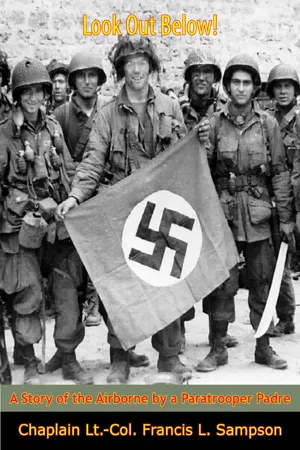
Look Out Below!
A Story of the Airborne by a Paratrooper Padre
- 212 pages
- English
- ePUB (mobile friendly)
- Available on iOS & Android
eBook - ePub
About this book
Information
Topic
StoriaSubtopic
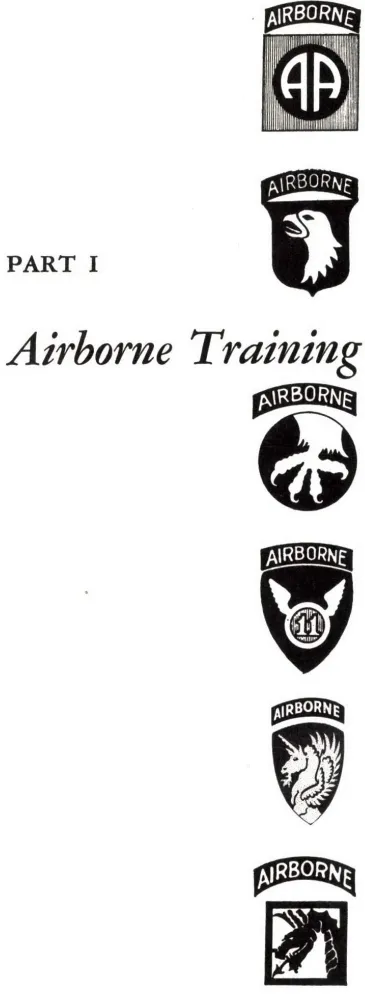
Storia europeaPART I — AIRBORNE TRAINING
Parachute School at Fort Benning
IN 1942 the Chaplain School was located at Harvard University. Although I was only one year ordained, my bishop, Most Reverend Gerald T. Bergan of Des Moines, had granted me permission to enter the Army, and I was taking the indoctrination course for chaplains at Harvard. At this time the Army asked for volunteer chaplains for the paratroops. Like a zealous young business man starting out in a strange town, I was ready to join anything out of a sheer sense of civic duty. Frankly I did not know when I signed up for the airborne that chaplains would be expected to jump from an airplane in flight. Had I known this beforehand, and particularly had I known the tortures of mind and body prepared at Fort Benning for those who sought the coveted parachute wings, I am positive that I should have turned a deaf ear to the plea for airborne chaplains. However, once having signed up, I was too proud to back out. Besides, the airborne are the elite troops of the Army, and I already began to enjoy the prestige and glamour that goes with belonging to such an outfit.
I literally basked in the praise bestowed upon me by the other chaplains, who didn’t know that I had signed up without realizing that I would be required to jump. Had they guessed my predicament, the whole school would have had a good laugh at my expense. It has remained, however, my own deep dark secret until now.
The day I arrived at Fort Benning to begin jump training, I received a wire from my brother in The Dalles, Oregon, stating that my mother was very ill. On my way west I called up from Chicago, only to learn that she had died that day. Her body was brought back to Luverne, Minnesota, the place of her birth and childhood; the place she always called “home,” the place she loved above all others. My mother had always worked hard, very hard. As dad was the manager of a small-town hotel, mother took care of the food end of the business and for years did the cooking. Her life was filled with many worries and heartaches, but she always kept her keen sense of humor and Irish wit. The help and guests of the hotel loved her, for her kind and affable nature made the place a home rather than a lodging house. With scarcely a wrinkle in her face or a grey hair in her head, she looked like a young girl as she lay in her coffin.
She had often expressed the wish that her hair might turn grey; she wanted to look matronly, like the mother of three grown men. The failure of her hair to turn grey can in no way be attributed to the boyhood behavior of her three sons, for if ever a mother had been given cause for worry, and if worry is truly the requisite for grey hair, then my mother’s should have been as white as snow. She had often dwelt on the thought that I would one day say her Funeral Mass, and she had spoken of it in a manner of real anticipation and delight. I suppose only the mother of a priest can understand that.
After the funeral, I prepared to return to the Fort Benning jump school, and I discovered that the prospect of jumping from a plane did not seem nearly as hazardous as it had before my mother’s death. I realized then that the great mental hazard in parachute jumping was more the subconscious concern for one’s family and dependents than for one’s own safety; not, of course, that the latter was ever absent. This fact has been demonstrated over and over again, and I think it could be authenticated by almost every parachutist. I am sure the wives and mothers of paratroopers suffered the fearful anticipation of the next jump more keenly than did the jumpers. As a matter of fact, after several successful jumps the paratrooper gains a certain degree of confidence that is not shared by those who must wait at the phone for the familiar voice, “Made it O.K., darling. The landing was perfect”; or for the dreaded professional voice, “This is the Fort Benning Station Hospital. Your husband....”
I vowed when I was going through the agony of jump school that I would never say anything good about it. It was even tougher than it was reputed to be. In all fairness, however, it must be admitted that the desired results were actually obtained, and the qualities of physical fitness, determination, and aggressiveness nursed at Benning bore fruit in Normandy, in Holland, then at Bastogne, and much later, in another war, in Korea. I shall try in the next few pages to be as objective about the airborne jump school as the memory of my sweating body, bruised skin and bones, aching muscles, abused dignity, and deflated ego will permit. If a note of acidity is detectable in my description of the jump school, I would ask the reader kindly to remember that it is entirely premeditated and intentional.
When I reported in at the school, the adjutant told me that the two previous chaplains to enroll were now in the hospital, one with a broken leg, the other with an injured back. My expression must have been both comic and tragic, for he looked at me and laughed, then said encouragingly, “But three or four chaplains have already gone through the school successfully.”
I made a noise in my throat that was meant to be a chuckle and said with an assurance I was far from feeling, “I guess if they can make it, I can.”
The school was divided into four weeks of intensive training called Stages A, B, C, and D. With seventy-seven other officers I reported May first to the chief instructor of A Stage. The training was conducted by sergeants who gloried in the fulfillment of an enlisted man’s dream...to be in a position of authority over commissioned officers. Most of the sergeants were former professional athletes or acrobats. The word and order of a training sergeant was as absolute as any order of a commanding officer to his subordinates. One lieutenant colonel who spoke sharply to a training sergeant and refused to obey the sergeant’s orders was made to apologize in the presence of the entire class assembled and was then dismissed from the school. They meant business here; they played no favorites, and any man who failed to fulfill the rugged requirements was washed out. Colonels were dropped as readily as second looeys; doctors and chaplains were given the boot as ruthlessly as line officers. Those who failed thereafter spoke of the school in terms of bitterness and hatred; even those who eventually made the grade would always recall the four eternal weeks with more repugnance and revulsion than pride.
Calisthenics and long runs constituted A Stage. I thought that I was in fairly good physical condition when I arrived at Benning, but the first morning of calisthenics—more than three hours of it—convinced me that I was as flabby and soft as any sergeant-major in the Quartermaster Corps. We finished the morning with a forty-minute run under a broiling Georgia sun, leaving almost a fourth of the class stretched out at intervals along the road. Some had quit in anger; others ran until physically incapable of going farther; some were out cold. The “meat wagon” (ambulance, to the civilian) picked them up.
Those who finished the run arrived at the barracks at the stroke of twelve and, drenched in sweat, completely exhausted, tired, and worn out even beyond the ability to curse the school, flopped on their bunks, unable to make the effort to go across the road for dinner. Food wasn’t interesting. A shower required energy to take off fatigues. We only wanted rest, rest, r-e-s-t. Most of us dozed in our sweaty and smelly fatigues until they blew that infernal whistle again at one p.m.
We had the same schedule in the afternoon as in the morning, except that there was a little judo thrown in, plus several tries at the obstacle course. We always finished up with the inevitable run. I did rather badly with the calisthenics. I never could seem to get the hang of climbing the rope, and the Indian-club exercises left my arms limp and lifeless long before the sergeant said, “Enough.” I finally learned to do fifty push-ups, but I was almost the last man in the class to do it. I could recommend to the Trappist monks the duck-waddle and squat jumps as a penance more agonizing than any hair-shirt. The only thing that kept me from being washed out of A Stage was the fact that I never dropped out of a run.
Only the toughest of the students would sacrifice precious hours of sleep for a movie at night. In the evening after supper, saying the Breviary in the quiet of the chapel was restful; but I do hope there is some truth to the old legend about the angels finishing the rosary for those who fall asleep from fatigue while saying it. Mass at six a.m. would begin another day just like the last.
The crowded barracks of seventy-eight officers had slipped to a comfortable thirty-eight by the end of the first week. Many of them had quit the first couple of days, but not before telling the sergeants and everyone connected with the school what they thought of it—and in terms not permitted in these pages.
B Stage, the second week of training, was much more interesting. During this stage we employed the many ingenious gadgets designed to simulate parachute jumping. The first prop was the fuselage of a plane from which the wings had been removed. They seated twenty-two of us in it at a time, and we were shown how to stand up properly in a plane, how to hook up the strap that pulls the top off the parachute pack, how to check the equipment of the man in front of us, how to respond to the orders of the jump master, and how to make a proper exit from the plane. We began to get cocky; jumping was going to be simple.
Then they took us to the landing trainer. This is a fiendish device by which the student is hooked up in a jumper’s harness attached to a roller that slides down a long incline. At any moment he chooses, and always when you least expect it, the sergeant pulls a lever that drops you to the ground while you are traveling about twenty miles an hour. The idea is to hang on to your risers, duck your head between your knees as soon as you touch the ground, and go rolling along like a ball. Failure to duck quickly enough means that you go sliding along the cinders on your face. If you displeased the sergeant by your performance, he generally made you double-time around the training area several times, holding your risers aloft and telling everyone what you did wrong. I was given eight laps and had to shout to every man I passed, “I’m a bad chaplain, I dropped my risers!”
At no time during jump school were we permitted to walk; always double-time. Nor were we allowed to lean against anything or have our hands in our pockets. For violations of these rules push-ups were the punishment. One morning while a sergeant was giving a demonstration, I happened to yawn. “All right, Chaplain, give me fifty push-ups.” I got through forty-two and couldn’t budge another muscle to save my life. I continued to lie on the ground exhausted, supremely indifferent to the jibes of the sergeant and the laughter of the other officers.
The mock-up tower was a thirty-eight foot platform with a long cable extending on an incline to a big soft pile of sawdust. After the hook-up to the cable, the sergeant would give the signal to jump. The exit, the drop, and the jerk from the cable closely simulated an actual jump. The ride to the sawdust pile was fun at first, but each succeeding jump from this tower seemed much farther from the ground. We had more men quit the school during this phase than we did later on during the actual jump from an airplane in flight. The sergeant failed to hook up one man properly for his jump from the tower, and the man fell all the way to the ground. Fortunately he only sustained a fractured foot, but our confidence in the sergeant in charge was considerably shaken.
The “trainasium” was another of the elaborate props—a forty-foot-high maze of bars, catwalks, ladders, and so forth. There was only one other in the world like it, and that was at the parachute school in Germany. We hoped the Germans had as many accidents on theirs as we had on ours.
The afternoons of B Stage were spent in the packing sheds, where we learned to pack our own chutes. This was supposed to give us confidence in the chutes, but most of us would have preferred to leave the job to a professional packer. Our first five jumps would be made with chutes we packed ourselves. This really worried me, for I had no confidence in the bulging, lopsided, twisted thing that had taken me an hour and a half to pack. The sergeant told us, however, that you could jump a chute thrown in a barracks bag and it would open. The occasional “streamers” in the preceding classes didn’t seem to warrant such confidence.
C Stage and the 250-foot “free towers” were next. We took turns in being hoisted to the top of the tower and released. Floating down from that height is pleasant, but the closer you get to the ground the faster you seem to drop. The earth seems to be rushing up to meet you...must remember the proper landing technique...feet a few inches apart, toes pointing down, chin in, hands on risers, body neither tense nor relaxed. The instructor’s voice over the loudspeaker from the tower, “Don’t stretch for the ground! Make a half turn to the right!” It was too late; I landed like a sack of flour. But the body is a wonderful thing; it can collapse and fold up like an accordion, thus absorbing without injury the greatest part of a bad landing. I was quite satisfied with myself even though the instructor was not, for I could get up and haul the chute back to the tower without help. I could speak with the voice of experience to the next fellow in line still sweating out his first drop from the free tower.
There was a young second lieutenant in our class, a Polish lad, who had taken the whole course in stride. He was small—about a hundred and thirty pounds I’d guess—and the calisthenics and runs had seemed ridiculously easy for him. When given fifty push-ups for leaning against a post, he asked the sergeant, “With which hand do you want me to give them?” Most of us could scarcely do the required fifty with both hands, but he did them with his left hand and was almost as fresh when he finished as when he began.
On Saturday morning at the close of C Stage a two-hundred-pound rugged first lieutenant in charge of the officers going through this stage said that he would like to have the chance of separating the men from the boys in the judo pit; and that if any of us thought that we could stay with him three minutes, he’d be glad to give us the opportunity. The young Polish officer stepped out. “I’d like a chance to try, sir.” We felt that he had gotten in over his head this time, for the instructor was really clever and fast and had about seventy pounds advantage. But in less than thirty seconds the instructor was flat on his back. Our morale jumped a hundred per cent, and the young lieutenant became the hero of the school, for no one, including the sergeant instructors, liked the arrogant instructor of C Stage. We learned later that after completing his jump training the young Polish officer became the instructor in charge of C Stage.
D Stage was devoted to actually jumping from a plane and qualifying with five such jumps as a parachutist. Confessions Saturday afternoon and evening were very heavy, for besides the officers’ class there was a class of 800 enlisted men prepared to make their five qualifying jumps. Many of the men a long time away from the sacraments began to see the light. I doubt that any sermon could more effectively bring men to a realizatio...
Table of contents
- Title page
- TABLE OF CONTENTS
- DEDICATION
- FOREWORD
- PREFACE
- ACKNOWLEDGMENTS
- INTRODUCTION
- AUTHOR’S INTRODUCTION
- PART I - AIRBORNE TRAINING
- PART II - THE WAR AGAINST GERMANY
- PART III - A POW IN STALAG II-A
- PART IV - PEACE AND “POLICE ACTION”
- PART V - SALUTE TO THE TROOPERS
- EPILOGUE
- REQUEST FROM THE PUBLISHER
Trusted by 375,005 students
Access to over 1.5 million titles for a fair monthly price.
Study more efficiently using our study tools.
Frequently asked questions
Yes, you can cancel anytime from the Subscription tab in your account settings on the Perlego website. Your subscription will stay active until the end of your current billing period. Learn how to cancel your subscription
No, books cannot be downloaded as external files, such as PDFs, for use outside of Perlego. However, you can download books within the Perlego app for offline reading on mobile or tablet. Learn how to download books offline
Perlego offers two plans: Essential and Complete
- Essential is ideal for learners and professionals who enjoy exploring a wide range of subjects. Access the Essential Library with 800,000+ trusted titles and best-sellers across business, personal growth, and the humanities. Includes unlimited reading time and Standard Read Aloud voice.
- Complete: Perfect for advanced learners and researchers needing full, unrestricted access. Unlock 1.5M+ books across hundreds of subjects, including academic and specialized titles. The Complete Plan also includes advanced features like Premium Read Aloud and Research Assistant.
We are an online textbook subscription service, where you can get access to an entire online library for less than the price of a single book per month. With over 1.5 million books across 990+ topics, we’ve got you covered! Learn about our mission
Look out for the read-aloud symbol on your next book to see if you can listen to it. The read-aloud tool reads text aloud for you, highlighting the text as it is being read. You can pause it, speed it up and slow it down. Learn more about Read Aloud
Yes! You can use the Perlego app on both iOS and Android devices to read anytime, anywhere — even offline. Perfect for commutes or when you’re on the go.
Please note we cannot support devices running on iOS 13 and Android 7 or earlier. Learn more about using the app
Please note we cannot support devices running on iOS 13 and Android 7 or earlier. Learn more about using the app
Yes, you can access Look Out Below! by Chaplain Lt.-Col. Francis L. Sampson in PDF and/or ePUB format, as well as other popular books in Storia & Storia europea. We have over 1.5 million books available in our catalogue for you to explore.