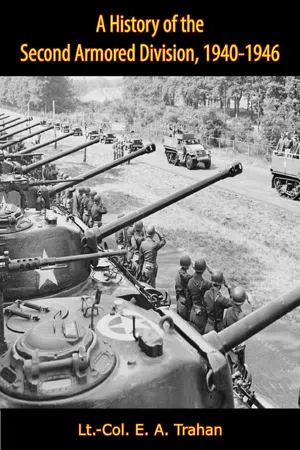
Originally published in 1946, this book is an official unit history for the 2d Armored Division in World War II, which was activated on 15 July 1940 and participated in campaigns in Normandy, Northern France, Rhineland, Ardennes-Alsace, Central Europe, and Sicily.
Elements of the Division first saw action in North Africa, landing at Casablanca in November 1942, and later took part in the fighting at Beja, Tunisia, but as a whole did not enter combat until the invasion of Sicily, when it made an assault landing at Gela in July 1943 and saw action at Butera, Campobello, and Palermo.
After the Sicilian campaign, the Division trained in England for the cross-Channel invasion, landed in Normandy D plus 3 on 9 June 1944, and went into action in the vicinity of Carentan. The Division raced across France in July and August, drove through Belgium, and attacked across the Albert Canal in September, crossing the German border at Schimmert to take up defensive positions near Geilenkirchen. In October, it launched an attack on the Siegfried Line from Marienberg, broke through, crossed the Wurm River, and seized Puffendorf and Barmen in November. It was holding positions on the Roer when it was ordered to help contain the German Ardennes offensive.
The Division helped reduce the Bulge in January 1945, fighting in the Ardennes forest in deep snow, and cleared the area from Houffalize to the Ourthe River of the enemy. After a rest in February, the Division drove on across the Rhine in March, and was the first American Division to reach the Elbe at Schonebeck in April, where it was halted, on orders. In July 1945, the Division entered Berlin—the first American unit to enter the German capital city.
Known as the "Hell on Wheels" division, the 2d Armored Division was one of the most famous American units in World War II.
Richly illustrated throughout with photos of the 2d Armored Division, General George Patton, battle photographs and maps.
- 256 pages
- English
- ePUB (mobile friendly)
- Available on iOS & Android
eBook - ePub
A History of the Second Armored Division, 1940-1946
About this book
Information
Subtopic
European HistoryIndex
HistoryCHAPTER I
THE SECOND UNITED STATES ARMORED DIVISION was activated on 15 July 1940, with Brig. General Charles L. Scott Commanding. At its first formation ninety-nine officers and 2202 enlisted men received their orders as the original complement.
The Division’s tank elements were formed from the original American Tank Corps of World War I. The 66th Armored Regiment was a direct outgrowth of units first formed in 1917, when an American Tank Corps was organized for the A.E.F. in France. Three Battalions, the 326th and 327th Tank Battalions which saw action in the St. Mihiel area in the first World War, and the 301st Tank Battalion, which was formed from the 65th Engineers at Camp Devens, Mass., were parent units of the 66th Armored Regiment. Consolidation of the existing tank organizations after the first World War, produced, in 1921, the First Tank Group which in 1929 became the 1st and 2nd Tank Regiments. From these Regiments the two tank Regiments in the Division were formed, namely the 66th Infantry (light tanks) and the 67th Infantry (medium tanks). The 66th became part of a Provisional Tank Brigade formed in 1939, and when the 2nd Armored Brigade, as part of the 2nd Armored Division, was constituted, the Regiment was redesignated 66th Armored Regiment (light). It was under command of Colonel Alvin C. Gillem. Further changes occurred in Table of Organization in 1942 and the final form of the Regiment evolved. The colors of the Regiment proudly carry the battle streamers of World War I engagements—the Battle of the Somme Offensive, St. Mihiel and the Meuse-Argonne. Its motto is “SEMPER IN HOSTES”—ALWAYS INTO THE ENEMY.
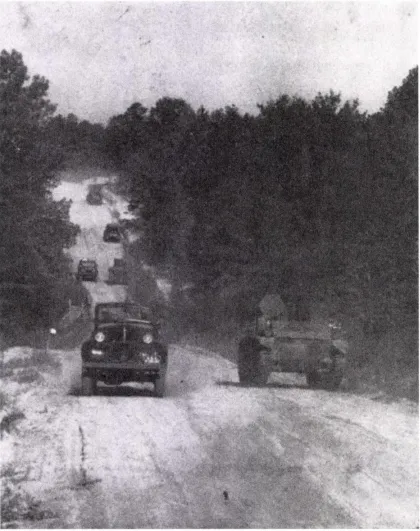
The Division takes to the field on its first exercise after formation. This was on the Ft. Benning Reservation in Aug. 1940.
The 67th Armored Regiment was a direct descendant of the 301st Heavy Tank Battalion that led the 27th Division in its Somme attack during the first World War. After the war, the 301st was reorganized into the 17th Heavy Tank Battalion. In 1929 the 17th inactivated, except for one company which was redesignated a company of the 2nd Tank Regiment at Fort Benning, Georgia. This company in 1932 became Co. F of the 67th Infantry (medium tanks) and later was incorporated as part of the 67th Armored Regiment (medium) of the 2nd Armored Brigade of the 2nd Armored Division. Its commanding officer at that time was Colonel Douglas T. Green. Later changes in the Division Table of Organization brought the Regiment into its present form. Its distinguished antecedents of World War I may well be proud of the part this Regiment has played in operations of World War II. Its motto—“MORT ET DESTRUCTIO”—DEATH AND DESTRUCTION.
The third Armored Regiment, the 68th (light) which was a part of the original tank brigade of the Division, was formed from the same components as the 66th. It was later inactivated and largely absorbed by the 66th and 67th Armored Regiments, when the Division was reorganized in 1942.
The Infantry component of the Division, the now famous “Fighting 41st,” also dates its history back to the period of World War I.
The 41st U.S. Infantry came into being at Fort Snelling, Minnesota, in July, 1917. The initial strength of the unit was 13 officers and 650 enlisted men. Colonel Marcus D. Cronin was the first regimental commander.
The Regiment remained at Fort Snelling for approximately the first four months of its existence. In October, 1917, the 41st Infantry (less the 2nd Battalion and Company D) was transferred to Fort Crook, Nebraska. Company D was sent to Flat River, Missouri, to guard certain lead mines. The 2nd Battalion (less Company F) was sent to Fort Brady, Michigan, to guard the Saulte Sainte Marie locks. Company F was moved to Fort Wayne, Michigan.
In March, 1918, Company D rejoined the 1st Battalion at Fort Crook and in April Company F rejoined the 2nd Battalion at Fort Brady.
The Regiment (less 2nd Battalion; was transferred to Camp Funston, Kansas, on 8 June 1918. At about the same time the strength of the Regiment was greatly augmented by the assignment of 1800 recruits from Jefferson Barracks, Missouri. Two months later, in August, the 2nd Battalion rejoined the Regiment. At Camp Funston the 41st Infantry Regiment formed part of the 10th Division, the orange and blue color scheme of the crest’s annulet which was under command of General Leonard Wood. The Regiment, momentarily expecting orders for France, trained diligently. In October an advance detail of four officers from the 41st Infantry was sent overseas to Gendecort, France, to attend II Corps School. The orders to move the Regiment to France, however, never materialized because of the signing of the Armistice in November.
After the First World War, the 41st Infantry remained at Camp Funston, Kansas, for almost a year before being moved again. On 4 November 1919, the Regiment moved. The artillery of the 2nd Armored Division was formed to its fourth station, Camp Upton, Long Island, New York. On 31 December 1920, at Camp Upton, New York, the Regiment (less Company B) was inactivated. Company B was at Fort Howard, Maryland, having been there on duty since 19 November 1920.
The 41st Infantry was reorganized as a regular Army Inactive Unit with headquarters in Syracuse, New York, in the late 1920’s. For many years the bulk of the officers a...
Table of contents
- Title page
- TABLE OF CONTENTS
- PREFACE
- DIVISION COMMANDERS
- INTRODUCTION
- CHAPTER I
- CHAPTER II
- CHAPTER III
- CHAPTER IV
- CHAPTER V
- CHAPTER VI
- CHAPTER VII
- CHAPTER VIII
- TROOP ASSIGNMENTS
- DIVISION STATISTICS
- DISTINGUISHED UNIT CITATIONS SECOND ARMORED DIVISION
- MAPS
- REQUEST FROM THE PUBLISHER
Trusted by 375,005 students
Access to over 1.5 million titles for a fair monthly price.
Study more efficiently using our study tools.
Frequently asked questions
Yes, you can cancel anytime from the Subscription tab in your account settings on the Perlego website. Your subscription will stay active until the end of your current billing period. Learn how to cancel your subscription
No, books cannot be downloaded as external files, such as PDFs, for use outside of Perlego. However, you can download books within the Perlego app for offline reading on mobile or tablet. Learn how to download books offline
Perlego offers two plans: Essential and Complete
- Essential is ideal for learners and professionals who enjoy exploring a wide range of subjects. Access the Essential Library with 800,000+ trusted titles and best-sellers across business, personal growth, and the humanities. Includes unlimited reading time and Standard Read Aloud voice.
- Complete: Perfect for advanced learners and researchers needing full, unrestricted access. Unlock 1.5M+ books across hundreds of subjects, including academic and specialized titles. The Complete Plan also includes advanced features like Premium Read Aloud and Research Assistant.
We are an online textbook subscription service, where you can get access to an entire online library for less than the price of a single book per month. With over 1.5 million books across 990+ topics, we’ve got you covered! Learn about our mission
Look out for the read-aloud symbol on your next book to see if you can listen to it. The read-aloud tool reads text aloud for you, highlighting the text as it is being read. You can pause it, speed it up and slow it down. Learn more about Read Aloud
Yes! You can use the Perlego app on both iOS and Android devices to read anytime, anywhere — even offline. Perfect for commutes or when you’re on the go.
Please note we cannot support devices running on iOS 13 and Android 7 or earlier. Learn more about using the app
Please note we cannot support devices running on iOS 13 and Android 7 or earlier. Learn more about using the app
Yes, you can access A History of the Second Armored Division, 1940-1946 by Lt.-Col. E. A. Trahan in PDF and/or ePUB format, as well as other popular books in History & European History. We have over 1.5 million books available in our catalogue for you to explore.