- 186 pages
- English
- ePUB (mobile friendly)
- Available on iOS & Android
eBook - ePub
Up Periscope!
About this book
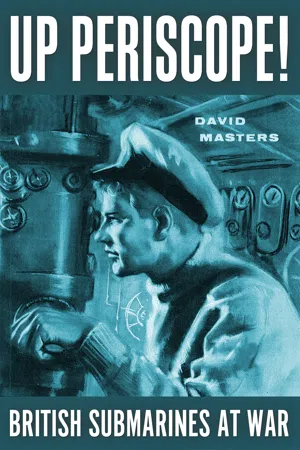
Up Periscope!, first published in 1943, is a fast-paced account of submarines of the British Royal Navy during World War II. Each of the book's 21 chapters presents an action or adventure of military significance or representative of those experienced by the submarine fleet during the war as seen by the captain and his crew. Included too are depictions of life aboard the submarines, fighting and hunting methods, rescuing survivors of sunken ships, and stories of chase and escape. Featured submarines include the
Spearfish, Triumph, Tigris, Sealion, Tuna, Utmost, and
Cachalot.
Information
Subtopic
European HistoryIndex
History1. RETURN OF THE SPEARFISH
Just after the outbreak of war, Lieutenant J. H. Eaden gave orders to cast off the Spearfish, and she slipped quietly away to patrol off the Norwegian coast. In a twenty-knot breeze under a lowering sky, she went steadily on her course. Altering helm to avoid being seen by a merchantman during the night, she dived before dawn to proceed beneath the surface for a couple of hours when, finding the seas empty, she came up to go ahead on her main engines.
By midday the wind and seas were increasing. There was no break in the heavy cloud. Once or twice during the day she changed course or dived to avoid being seen by merchant ships, and by midnight a northerly gale caused her to stagger and roll heavily.
Next morning the seas were running too high for her to proceed at periscope depth, for the waves washing over the periscope made observation impossible, so she steamed on the surface, diving occasionally to dodge any merchantmen she sighted.
By 1 o’clock in the early morning her look-out picked up the beam of a lighthouse on the Norwegian coast. Two hours later a big fishing fleet was sighted, so the Spearfish dived and rested a few hours on the bottom.
Just after 6 a.m. some of her pumps were started to enable her to go up to have a look round. Raising her periscope, her commander saw many trawlers flying the Danish flag with picturesque white hulls and red triangular sails. An artistic eye might have appreciated their pictorial quality, but the quiet eyes of Lieutenant Eaden appraised them from a submariner’s point of view. The red sails were like danger signals, warning the Spearfish to avoid them—which was exactly what her commander did, for about 8 o’clock in the morning he took her to a lower level.
Ninety minutes later he went up to see what was going on. It was a bit of a shock when he barely missed bumping the keel of a trawler. “I nearly put my after periscope through the bottom,” he said afterwards.
Lowering his periscope, he continued on his batteries for a couple of hours before taking her to the bottom where she settled down while her crew rested.
Darkness lay over the seas when the Spearfish surfaced. The crew got busy, fans were started to blow out the boat and change the atmosphere, the main engines were set to recharging the batteries, and the navigator manipulated the sextant to fix his position by the stars.
Early on Sunday morning, just before 4 o’clock, the recharging was completed. The crew had eaten their main meal of the day—or night—and the hatch closed as the Spearfish slid under the surface to a safe depth. Within half an hour the operator listening at the hydrophones heard a sound.
Sounds coming to the listening ears in a submarine call for instant investigation. They may mean danger, on the other hand they may indicate that a target is somewhere in the vicinity.
Then the keen ears of the listener detected a faint noise which told of a vessel moving ahead.
Other ears, enemy ears, were listening just as intently for the sounds made by the Spearfish and enemy hands were waiting to strike her a mortal blow. But the men in the submarine did not know. They could not see. They could only guess.
All doubts about the danger of those strange sounds were resolved in a big explosion which made the Spearfish vibrate like a tuning fork. At once her commander took her to the bottom and stopped all machinery.
The Spearfish was in a nasty position. She was caught in shallow water which made her very vulnerable, whereas a hundred fathoms would have given her a chance to go deep and steal quietly away.
The best method of escaping the hunter was for the Spearfish to lie low and keep absolutely quiet in the hope that the enemy would grow tired and relinquish the chase.
From time to time those peculiar sounds came to the listeners in the submarine. Two hours passed, then Lieutenant Eaden made up his mind to go up to see if anything was in sight.
“Diving stations,” he ordered, and instructed the engineer to pump out the main ballast tanks to take them to periscope depth.
Before the pumps had been working five minutes a heavy explosion shook the Spearfish. Instantly the commander ordered the pump and all other machinery to be stopped. Even the gyroscope of the gyrocompass upon which the submarine depended ceased to spin.
“See whether there is any damage and report to me,” the captain ordered.
“The fuses of the steering motor are blown, sir,” said the engineer. This, the only damage, was a simple matter to put right.
Ordering the crew to rest and keep quiet, Lieutenant Eaden waited to see what would happen. His hydrophones were sensitive enough to disclose that two vessels were hunting the Spearfish. There were other sounds which told of the hunters methodically sweeping for the submarine.
Just before 8 o’clock the hydrophones picked up the faint sound of a turbine.
Lieutenant Eaden thought things over. They were in grave danger. The enemy who had been hunting them for six hours was stubborn and patient and would not easily be foiled. The hydrophones had told him all they could during the morning. To listen longer would merely increase the nervous tension inside the boat. The crew were behaving normally, yet it was difficult to refrain from listening and wondering what the noises portended, so he ordered the man on listening watch to go off duty.
“I decided on complete silence and remaining stopped on the bottom as the only hope of survival,” he said afterwards.
Although the operator no longer listened at the hydrophones, the sounds could not be kept out of the boat. They penetrated the hull for all the crew to hear.
The sound of a depth charge came to them just before 1.30 and five followed within the next three-quarters of an hour. Some were nearer than others, but none was near enough to shake the Spearfish.
The incredible coolness of the men stood out when depth charging began. They knew that death might engulf them at any moment, but their sporting instincts were so strong that one of the men suggested a sweepstake to be won by the man who guessed nearest to the time when the next depth charge would explode. The stake was fixed at sixpence a time, to be settled on pay day, and a seaman quietly walked through the boat among the resting men to note their times and names—they had the calm courage to wager their bets on the next charge which might blow them all into eternity as though it were a football pool or a greyhound race!
For a time there was silence. Then just before 3 o’clock the attack started again. Twenty-eight times in an hour the Spearfish shook under the force of the explosions.
Again there was silence. The pressure of the air in the submarine began to rise. The men lay about quietly, eating, wondering, dozing, reading, talking in whispers. Then another sound came to their ears, a deadly, ominous sound. They looked at each other. No one spoke. Something slid along the jumping wire —which was rigged, as in all submarines, to enable an obstruction to slide clear of the hull. No one knew what it was, whether it was a grapnel seeking to hook them so that a charge could be sent down to destroy them, or whether it was the wire of a sweep. They listened tensely. No one moved. Something thumped the hull aft. There followed a series of bumps as though a heavy weight suspended on a wire were jerking along just touching the hull.
Then at 5.20 p.m. came an appalling explosion. The hull of the Spearfish seemed to close in on the crew as though under a gigantic press and then spring outward again. The lights were shattered. In the darkness the shaken men heard the deadly sounds of spurting water and the sibilant hiss of escaping air.
Swiftly the chief engine-room artificer, S. N. Peel, sensed that the main motor cooler was damaged. The darkness was absolute, but his skilled fingers barely hesitated as they reached out to shut it off. At the same instant Petty Officer A. P. Blackmore dropped the main motor fuses to cut them out, thus preventing a fire which would quickly have consumed the oxygen in the boat and killed all the crew. Stoker Philpotts lent a hand. Elsewhere two stokers, James W. Smith and Alfred Backers, hearing the high-pressure air escaping, felt round for the valves to isolate the leaks, while stoker James Slade and engine-room artificer Jack M. Smith dealt with other air leaks. Their initiative and courage in the dark were superb.
The voice of Lieutenant Eaden came to them out of the darkness. It was quite normal, as though nothing unusual had happened, a steadying, reassuring voice: “Go quietly to diving stations, use the secondary lighting and investigate damage. Don’t make any noise,” he ordered.
The men moved to their posts. Soon the emergency lights came on and reports of the damage began to reach the captain.
“The port main motor cooler has burst and the switchboard is covered with water, sir,” said F. H. Westnutt the engineer. Hissing air told of serious leaks in the high-pressure air system. Water ran down the ventilator from the main battery, but bad as things seemed, the commander found comfort, for he realized there was no immediate danger of the Spearfish flooding, that her structure, over which the shipwrights had toiled to make it as strong and perfect as possible, was still intact.
“Fit new light bulbs and sweep up the broken glass,” the commander ordered. “And try to stop the leaks of the high-pressure air.”
When these things were done, the crew were ordered to rest again. The brain of the captain worked quickly to circumvent his enemies. The Germans may not have known they had scored a hit, in which case, if the men in the Spearfish kept very quiet and made no sounds which could be picked up, the hunters might move off. One thing was certain to Lieutenant Eaden: their only chance was to remain silently on the bottom as long as possible.
“The crew behaved magnificently, up to the highest standards of the submarine service,” he said, when the ordeal was over.
Another depth charge exploded at a distance, then one near enough to shake the Spearfish as though she weighed no more than a few pounds instead of hundreds of tons. At intervals came more explosions until they totaled a dozen, some at a distance, others near enough to rock the submarine. After which things quietened down awhile.
“Issue a tot of rum,” ordered the captain at 6 o’clock. They all took it appreciatively. It was eleven hours since the first explosion shook the ship, and during that time they had been under great strain.
The air began to get fouler. To conserve it, the captain ordered all the crew to He or sit down. His keen eye noticed that several men were breathing more heavily than usual. It was then that Lieutenant D. A. Pirie, who remained as cheery as any man aboard, bethought himself of a bottle of sweets which he possessed. They were passed round and proved a boon to the men.
Within half an hour of receiving their tot of rum, the bow of the ship rose sharply and dropped again. They had no illusions. Even Lieutenant Eaden thought that the enemy had managed to get a wire sweep under their bow, but all they could do was to wait and wonder. Again the bow lifted and fell back with a thud. The men looked at each other. Again and again they underwent this nerve-racking ordeal. Yet the anticipated explosions did not take place. They could not quite understand it.
Later the captain concluded that this action of the bow must have been caused by the Spearfish swinging to the tide—and he was probably right, for had the enemy got a heavy sweep under the submarine they would not have survived.
Knowing the increasing foulness of the air would force them to the surface within an hour or two, the captain dealt with his secret papers and ordered a big charge of explosive to be rigged ready to destroy the ship and its secrets.
At 7.20 that evening he called the officers and crew together. “I would first of all like to congratulate you on your steadiness and fine behavior,” he said.
“What I propose to do is to blow the ship to the surface at 20.30. If the enemy is in sight we shall engage them. If not, we shall make our way home.”
“Aye, aye, sir!” exclaimed the weary men, smiling approval. When the captain said he would blow the ship to the surface, he merely meant to blow the water out of the main ballast tanks to give her sufficient buoyancy to rise. The men who had been lying about so quietly, thinking and wondering what was going to happen, jumped at the chance of getting at the enemy. If they were to die, at any rate they would die fighting in the true Nelson tradition.
Tired and strained as they were, they got busy, with many a quip among themselves, making preparations to fight the enemy as soon as the Spearfish surfaced. Two of the torpedo tubes in the bow were loaded up to give them quick shots at the enemy if the opportunity served, they made ready the shells for the 3-inch gun and saw that the Lewis gun was fully prepared to start blazing away instantly. The exertion in the vitiated air tired them, but they put the final touches to the big charge that would prevent their ship from being captured by the enemy, before donning their life-belts in readiness for anything that might befall.
Half an hour before blowing the tanks, another examination was made of the damage. The hull leaked in several places, fuel and oil tanks were leak...
Table of contents
- Title page
- TABLE OF CONTENTS
- DEDICATED TO HIS MAJESTY’S SUBMARINES
- PREFACE
- AUTHOR’S NOTE
- 1. RETURN OF THE SPEARFISH
- 2. AN EPIC PATROL
- 3. THE QUALITY OF MERCY
- 4. A LUCKY LOOPHOLE
- 5. TORPEDOING THE KARLSRUHE
- 6. ESCAPE OF THE TRIUMPH
- 7. A CHANCE IN A MILLION
- 8. URSULA
- 9. TRIUMPHS OF THE CACHALOT
- 10. THE EXPLOITS OF THE TIGRIS
- 11. FOUR RESCUES
- 12. A MESSAGE IN CODE
- 13. DISABLED
- 14. BEGINNER’S LUCK
- 15. THE SEALION’S ADVENTURES
- 16. TRAPPED IN A MINEFIELD
- 17. CRUSHED BY THE SEA
- 18. ATTACKS AND ESCAPES
- 19. PATROLS OF THE UTMOST
- 20. MEDITERRANEAN ADVENTURES
- 21. GENERAL CLARK’S
- SUBMARINE ADVENTURE
Trusted by 375,005 students
Access to over 1.5 million titles for a fair monthly price.
Study more efficiently using our study tools.
Frequently asked questions
Yes, you can cancel anytime from the Subscription tab in your account settings on the Perlego website. Your subscription will stay active until the end of your current billing period. Learn how to cancel your subscription
No, books cannot be downloaded as external files, such as PDFs, for use outside of Perlego. However, you can download books within the Perlego app for offline reading on mobile or tablet. Learn how to download books offline
Perlego offers two plans: Essential and Complete
- Essential is ideal for learners and professionals who enjoy exploring a wide range of subjects. Access the Essential Library with 800,000+ trusted titles and best-sellers across business, personal growth, and the humanities. Includes unlimited reading time and Standard Read Aloud voice.
- Complete: Perfect for advanced learners and researchers needing full, unrestricted access. Unlock 1.5M+ books across hundreds of subjects, including academic and specialized titles. The Complete Plan also includes advanced features like Premium Read Aloud and Research Assistant.
We are an online textbook subscription service, where you can get access to an entire online library for less than the price of a single book per month. With over 1.5 million books across 990+ topics, we’ve got you covered! Learn about our mission
Look out for the read-aloud symbol on your next book to see if you can listen to it. The read-aloud tool reads text aloud for you, highlighting the text as it is being read. You can pause it, speed it up and slow it down. Learn more about Read Aloud
Yes! You can use the Perlego app on both iOS and Android devices to read anytime, anywhere — even offline. Perfect for commutes or when you’re on the go.
Please note we cannot support devices running on iOS 13 and Android 7 or earlier. Learn more about using the app
Please note we cannot support devices running on iOS 13 and Android 7 or earlier. Learn more about using the app
Yes, you can access Up Periscope! by David Masters in PDF and/or ePUB format, as well as other popular books in History & European History. We have over 1.5 million books available in our catalogue for you to explore.