This book was first published in 1942 as a tribute to Irish-born RAF fighter pilot and flying ace, Brendan Finucane (1920-1942), who died fighting for Britain during World War II.
Known amongst his colleagues as "Paddy," Finucane was credited with 28 aerial victories—five probably destroyed, six shared destroyed, one shared probable victory, and eight damaged—and was also noted for being the youngest person ever given command of a fighter wing in the history of aerial combat, namely the Hornchurch Wing.
"IF SOMEONE asked me to describe Wing Commander Brendan Finucane R.A.F. in two words, I would say "bright and shining." He seemed always to radiate light and lift of the spirit—his frequent smile, the way the corners of his generously drawn mouth went up—his witty friendly eyes—even his crisp dark red hair seemed always lifted by a breeze from "the upper air" he loved so well, the upper air in which from his eighteenth birthday until the day of July seventeenth, nineteen hundred and forty-two, he spent the greater part of his waking life. This smiling friendliness, this winning manner, caused him to be known as "Paddy" to all the world."—JAMES REYNOLDS
eBook - ePub
Wing Commander Paddy Finucane (Brendan Finucane) R.A.F., D.S.O., D.F.C.
A Memoir
- 39 pages
- English
- ePUB (mobile friendly)
- Available on iOS & Android
eBook - ePub
About this book
Information
Subtopic
European HistoryIndex
HistoryWING COMMANDER PADDY FINUCANE
[BRENDAN FINUCANE]
R.A.F., D.S.O., D.F.C.
IF SOMEONE asked me to describe Wing Commander Brendan Finucane R.A.F. in two words, I would say “bright and shining.” He seemed always to radiate light and lift of the spirit—his frequent smile, the way the corners of his generously drawn mouth went up—his witty friendly eyes—even his crisp dark red hair seemed always lifted by a breeze from “the upper air” he loved so well, the upper air in which from his eighteenth birthday until the day of July seventeenth, nineteen hundred and forty-two, he spent the greater part of his waking life. This smiling friendliness, this winning manner, caused him to be known as “Paddy” to all the world.
I first met Paddy in nineteen hundred and thirty-six when he was nearing his sixteenth birthday. A Saturday picnic it was, held on a rise of the Hill of Howth which commands the grandly sweeping panorama of the Wicklow Mountains, the gleaming white houses of Dalkey Strand, even the foam-ruffled edge of Killiney Bay itself where it curves in from the sea the like of a Saracen’s sword.
The picnic was an outing for boys from O’Connell School in Dublin, which Paddy attended.
The day was a pure wonder, clear and cool, not a cloud in the sky. A touch of life and the joy of living was given by the white canvas of sailing yachts, and the browns and greys, even green of wide-beamed fishing schooners far out in the Irish Sea. Gulls screamed and dipped into the water. There was a great peace over all, lovely to look back on, now. After we had consumed mountains of hot potato-cakes dripping with lashins of Kerry butter supplied by a man who went the rounds of the hill with a bar row on which was a charcoal stove, we downed our last bottle of ginger-beer, muttered a “God bless Guinness,” and stretched out on the turf—a little rest before the afternoon sports of obstacle races, vaulting, and rugby match should commence.
Paddy confided to me his two ambitions: boxing, at which he was very good, being lithe and a quick mover, and flying. Of the latter he said grinning, “To be always darting about in the upper air in a plane of my own, now that would be wizard.”
It was the first time I had heard his favorite word to express the utmost in pleasure, but it was not to be the last.
We discussed the manoeuvers of a plane flashing like a silver arrow in the path of the sun, making for Holyhead. As we watched, excitement widened his eyes; he spoke, more to himself than to me, “I want to fly more than anything, and I will one day.”
Paddy as a small boy became familiar with the heroes of Gaelic legend; aided by his swift intelligence they waxed warm and glowingly alive in his mind. He seemed equally enchanted by the Iliad of Homer, and the exploits and adventures of ancient Greek heroes.
Paddy possessed a splendid memory; never forgot what he read. He said to me one day, “Do you know, I might easily be that Greek lad Icarus—I’m that eager to try my wings.” As it turned out it was Icarus, and his quest of the reaches of the sky, which runs like a bright thread through Paddy’s rare poems.
I say rare, for there are very few he ever finished. He would jot down a line here and there, but he was so busy shooting Nazi planes out of the sky he had little time to finish poems.
In his last letters to me, and in his last letter to his mother, a sense of strain is apparent, a mounting tiredness lies ominously between the lines. I know he felt his responsibility as a wing commander intensely. In one letter he said “If I could only finish this muck, single-handed if I could, and get on with my life.”
The last time I heard directly from him he spoke of an accident caused by “leppin” a stone wall, returning from a comrade’s wake—a broken bone in his foot, painful and defeating. He so hated the idea of being grounded for six weeks by a cause in no way related to his fighting. Paddy put it like this in his letter: “When I was grounded by my broken foot it ached like hell, there was no sleep in me nights on end, I wrote a sonnet—I send you the first line—when it is polished a bit I’ll send you the finished job.”
Typewritten and clipped to the letter, it is this:
“I feel the shadow of wings across my face, Icarus wings, faltering in my flight.”
Probably he never finished it, I doubt it ever reached the “polishing” stage. In my opinion the sonnet is finished, for these two lines evoke the freedom, the shattering beauty of the infinite, the inevitability which places all airmen in a realm apart.
Many reviewers, since Paddy’s death, have spoken of how unassuming he was. It is very true, for he had the stark inspired simplicity of a youth with a star for achievement al-ways before his eyes.
Singleness of purpose linked Paddy’s thoughts. Early in life a guerdon of wisdom was tossed him by the gods, and he wore it gracefully to the last. Always, it has seemed to me, if any boy in this world had the “call” to fight an evil enemy with every fiber in his body—it was Paddy Finucane of Dublin-on-the-Liffey.
Paddy had no great hopes of outwitting death in this war, of that I am convinced.
Well do I remember the last time I saw him. We had dinner together in a Greek restaurant, came out into the shadows of Soho Square under a London street lamp, said good-by, I off to Dublin, he to Richmond in Surrey where his family lives.
We had stopped long over our wine, talking of Greece, of the lives of great heroes; the ancient, the medieval and the modern style of heroism just beginning to sweep across our vision.
I had a feeling all during dinner, that behind his thoughtful eyes lay the desire to play an immense part in the approaching big fight, a very much alive look, and an awareness. Paddy had at this time joined the R.A.F., and he was eager and champing at the bit to be off and away into the upper air.
Standing talking in low voices in the wine dark shadows of Soho Square we heard a droning; looking up we saw a formation of British planes winging away towards Dover: the night patrol. The sky was luminous with many stars; against the stars the formation made a pattern of strong black lace; the meshes seemed woven of strength and protection.
After the planes had faded into the dark horizon, Paddy quoted a line I had told him once, said on just such a night by a splendid Irish country woman in front of her thatched coteen at Adare in the County Limerick: “Sure the queen of heaven tonight has more stars than she knows what to do with.” He added, “Often and often I’m put to it not to collide with the stars up there, and me dodging in and out the clouds. Stars now, have a great hold over me.”
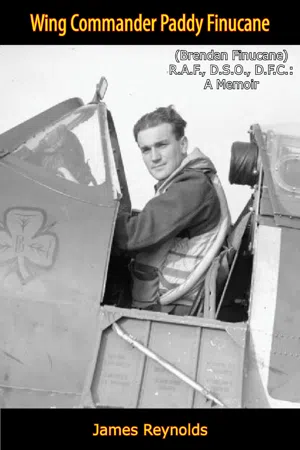
Slowly his smile faded, that fey look the Irish have veiled his eyes, and he said. “Do you know, even the big green shamrock—my fighting shamrock I paint on my plane—probably won’t save me for long. All I ask of St. Kevin is that I’m cut off clean—no ragged ends.”...
Table of contents
- Title page
- TABLE OF CONTENTS
- ACKNOWLEDGMENTS
- DEDICATION
- ICARUS
- WING COMMANDER PADDY FINUCANE
- “PADDY’S” BRIEF BIOGRAPHY
- REQUEST FROM THE PUBLISHER
Trusted by 375,005 students
Access to over 1.5 million titles for a fair monthly price.
Study more efficiently using our study tools.
Frequently asked questions
Yes, you can cancel anytime from the Subscription tab in your account settings on the Perlego website. Your subscription will stay active until the end of your current billing period. Learn how to cancel your subscription
No, books cannot be downloaded as external files, such as PDFs, for use outside of Perlego. However, you can download books within the Perlego app for offline reading on mobile or tablet. Learn how to download books offline
Perlego offers two plans: Essential and Complete
- Essential is ideal for learners and professionals who enjoy exploring a wide range of subjects. Access the Essential Library with 800,000+ trusted titles and best-sellers across business, personal growth, and the humanities. Includes unlimited reading time and Standard Read Aloud voice.
- Complete: Perfect for advanced learners and researchers needing full, unrestricted access. Unlock 1.5M+ books across hundreds of subjects, including academic and specialized titles. The Complete Plan also includes advanced features like Premium Read Aloud and Research Assistant.
We are an online textbook subscription service, where you can get access to an entire online library for less than the price of a single book per month. With over 1.5 million books across 990+ topics, we’ve got you covered! Learn about our mission
Look out for the read-aloud symbol on your next book to see if you can listen to it. The read-aloud tool reads text aloud for you, highlighting the text as it is being read. You can pause it, speed it up and slow it down. Learn more about Read Aloud
Yes! You can use the Perlego app on both iOS and Android devices to read anytime, anywhere — even offline. Perfect for commutes or when you’re on the go.
Please note we cannot support devices running on iOS 13 and Android 7 or earlier. Learn more about using the app
Please note we cannot support devices running on iOS 13 and Android 7 or earlier. Learn more about using the app
Yes, you can access Wing Commander Paddy Finucane (Brendan Finucane) R.A.F., D.S.O., D.F.C. by James Reynolds in PDF and/or ePUB format, as well as other popular books in History & European History. We have over 1.5 million books available in our catalogue for you to explore.