British General J. F. C. Fuller is one of the greatest military thinkers of this century, and has been called the Clausewitz of our time. This book is Fuller's direct and clear-eyed account of the most terrible war of the modern era. When first published in 1948, it received notices such as these:
"The strategic and tactical phases of the war are brilliantly expounded...on that score, the book stands as probably the best comprehensive work on the war to appear so far."—The New Yorker
"The narrative, valuable as it is, is not the most important part of General Fuller's book. What really matters is the author's comments on the events he describes, and these provide us with a clear statement of what he thinks not only about particular operations but about the conduct of the war as a whole. The result is a hard-hitting politico-military pamphlet, in which none of the punches are pulled."—The Spectator
"[Fuller] knows how to handle a narrative full of incident; he is thoroughly at home in a subject in which he has kept himself up to date; and...he is one of the very rare original students of warfare whom this country has produced."—Times Literary Supplement
Fuller's biographer, Bryan Holden Reid, has described The Second World War as "an analysis of the breakdown, as Fuller saw it, of the vital relationship between grand strategy and grand tactics—the end and the means....Too often books on the Second World War detail the movements of formations about the battlefield and give space to strategical commentary without assessing the manner in which the war was actually fought. On the tactical level, The Second World War can still be read with profit."
Expertly combining detailed military history and analysis with Clausewitzian insights based on his own theories of warfare, Fuller produced a modern military masterpiece in The Second World War.
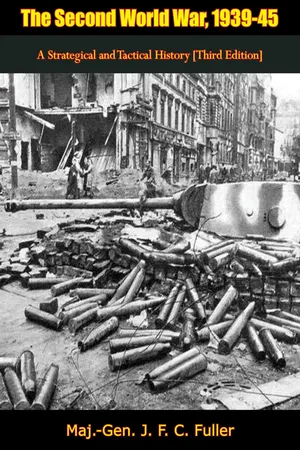
eBook - ePub
The Second World War, 1939-45
A Strategical and Tactical History [Third Edition]
- 412 pages
- English
- ePUB (mobile friendly)
- Available on iOS & Android
eBook - ePub
The Second World War, 1939-45
A Strategical and Tactical History [Third Edition]
About this book
Information
Subtopic
European HistoryIndex
HistoryTHE SECOND WORLD WAR 1939-45
CHAPTER I — BACKGROUND OF THE WAR
(1) Immediate Causes of the War
Saturday, 28th June, 1919, “La journée de Versailles,” writes Harold Nicolson in Peacemaking 1919, “Clemenceau is already seated under the heavy ceding as we arrive. ‘Le roi,’ runs the scroll above him, ‘gouverne par lui-même.’ He looks small and yellow. A crunched homunculus...The Gardes Républicains at the doorway flash their swords into their scabbards with a loud click. ‘Faites entrer les Allemands’ says Clemenceau. They are conducted to their chairs, Clemenceau at once breaks the silence. ‘Messieurs,’ he rasps, ‘la séance est ouverte.’ He adds a few ill-chosen words. ‘We are here to sign a Treaty of Peace.’ Then St. Quentin advances towards the Germans and with the utmost dignity leads them to the little table on which the Treaty is expanded. They sign.
“Suddenly from outside comes the crash of guns thundering a salute. It announces to Paris that the second Treaty of Versailles has been signed by Dr. Müller and Dr. Bell. ‘La séance est levée,’ rasped Clemenceau. Not a word more or less.
“We kept our seats while the Germans were conducted like prisoners from the dock, their eyes still fixed upon some distant point of the horizon.
“We still kept our seats to allow the Big Five to pass down the aisle. Wilson, Lloyd George, the Dominions, others. Finally, Clemenceau, with his rolling satirical gait. Painlevé, who was sitting one off me, rose to greet him. He stretched out both his hands and grasped Clemenceau’s right glove. He congratulated him. ‘Oui,’ says Clemenceau, ‘c’est une belle journée.’ There were tears in his bleary eyes.
“Marie Murat was near me and had overheard. ‘En êtes-vous sûre?’ I ask her. ‘Pas du tout,’ she answers, being a woman of intelligence.”{1}
Thus to the thunder of guns the First World War was buried and the Second World War conceived, and though the fundamental causes of the latter—as of the former—may be traced back through steam engines and counting houses to the instincts of tribal man, its immediate cause was the Treaty of Versailles. Not because of its severity, nor because of its lack of wisdom, but because it violated the terms of the Armistice of 11th November, 1918. It is important to remember this, for it was this dishonourable action which enabled Hitler to marshal the whole of Germany behind him and to justify in the eyes of the German people each infringement of the treaty he made.
Briefly, the story is as follows: On 5th October, 1918, the German Government addressed a note to President Wilson accepting his Fourteen Points and asking for peace negotiations. Three days later the President replied, enquiring whether he was to understand that the object of the German Government in entering into discussion was to be only to agree upon the practical details of the application of the terms laid down in his Fourteen Points, Four Principles and Five Particulars? On receiving an affirmative answer, after further correspondence, on 5th November, the President transmitted to the German Government his final reply, in which he said that the Allied Governments “declare their willingness to make peace with the Government of Germany on the terms of peace laid down in the President’s Address to Congress of 8th January, 1918 (the Fourteen Points), and the principles of settlement enunciated in his subsequent Addresses.”
“The nature of the Contract between Germany and the Allies resulting from this exchange of documents,” writes John Maynard Keynes (later Lord Keynes), “is plain and unequivocal. The terms of the peace are to be in accordance with the Addresses of the President, and the purpose of the Peace Conference is ‘to discuss the details of their applications.’ The circumstances of the Contract were of an unusually solemn and binding character; for one of the conditions of it was that Germany should agree to Armistice Terms which were to be such as would leave her helpless. Germany having rendered herself helpless in reliance on the Contract, the honour of the Allies was peculiarly involved in fulfilling their part and, if there were ambiguities, in not using their position to take advantage of them.”{2}
They did not fulfil their part. Instead, having rendered Germany helpless, first they abandoned the procedure followed in former peace conferences—including that of Brest-Litovsk—of engaging in oral negotiations with enemy plenipotentiaries; secondly they maintained the blockade throughout the Conference; and thirdly they scrapped the terms of the Armistice, for as Harold Nicolson points out: “Of President Wilson’s twenty-three conditions, only four can with any accuracy be said to have been incorporated in the Treaties of Peace.”{3}
As regards the first point, Signor Nitti, the Italian Prime Minister at the time of the signing of the Treaty, says in his book Peaceless Europe:
“...it will remain for ever a terrible precedent in modern history that, against all pledges, all precedents and all traditions, the representatives of Germany were never even heard; nothing was left to them but to sign a treaty at a moment when famine and exhaustion and threat of revolution made it impossible not to sign it...In the old law of the Church it was laid down that everyone must have a hearing, even the devil: Etiam diabulus aidutur (Even the devil has the right to be heard). But the new democracy, which proposed to install the society of nations, did not even obey the precepts which the dark Middle Ages held sacred on behalf of the accused.”{4}
As regards the second point, it should be remembered what Mr. Winston Churchill said in the House of Commons on 3rd March, 1919—namely:
“We are holding all our means of coercion in full operation, or in immediate readiness for use. We are enforcing the blockade with vigour. We have strong armies ready to advance at the shortest notice. Germany is very near starvation. The evidence I have received from the officers sent by the War Office all over Germany shows, first of all, the great privations which the German people are suffering, and, secondly, the great danger of a collapse of the entire structure of German social and national life under the pressure of hunger and malnutrition. Now is therefore the moment to settle.”{5}
It is clear from this that signature at the pistol point was what was intended.
Once the Conference assembled, writes Keynes, “Then began the weaving of that web of sophistry and Jesuitical exegesis that was finally to clothe with insincerity the language and substance of the whole Treaty. The word was issued to the witches of all Paris:
Fair is foul, and foul is fair,
Hover through the fog and filthy air.
The subtlest sophisters and most hypocritical draftsmen were set to work, and produced many ingenious exercises which might have deceived for more than an hour a cleverer man than the President.”{6}
Further, he writes:
“The future life of Europe was not their concern; its means of livelihood was not their anxiety. Their preoccupations, good and bad alike, related to frontiers and nationalities, to the balance of power, to imperial aggrandisements, to the future enfeeblement of a strong and dangerous enemy, to revenge, and to the shifting by the victors of their unbearable financial burdens on to the shoulders of the defeated.
“Two rival schemes for the future policy of the world took the field—the Fourteen Points of the President, and the Carthaginian Peace of M. Clemenceau. Yet only one of these was entitled to take the field; for the enemy had not surrendered unconditionally, but on agreed terms as to the general character of the Peace.”{7}
Thus were the dragon’s teeth sown, out of which was destined to sprout an even more disastrous conflict than the one this treaty of violation brought to a close.
One man at least—though a party to the proceedings—saw what the future held in store. On 25th March, 1919, Mr. Lloyd George issued a memorandum to the Peace Conference entitled, “Some Considerations for the Peace Conference before they finally draft their terms.” In it he wrote:
“...You may strip Germany of her colonies, reduce her armaments to a mere police force and her navy to that of a fifth-rate power; all the same, in the end, if she feels that she has been unjustly treated in the peace of 1919, she will find means of exacting retribution from her conquerors...The maintenance of peace will...depend upon there being no causes of exasperation constantly stirring up the spirit of patriotism, of justice or of fair play to achieve redress...injustice, arrogance, displayed in the hour of triumph, will never be forgotten or forgiven.
“For these reasons I am, therefore, strongly averse to transferring more Germans from German rule to the rule of some other nation than can possibly be helped. I cannot conceive any greater cause of future war than that the German people, who have certainly proved themselves one of the most vigorous and powerful nations in the world, should be surrounded by a number of small states, many of them consisting of people who have never previously set up a stable government for themselves, but each of them containing large masses of Germans clamouring for reunion with their native land. The proposal of the Polish Commission that we should place 2,100,000 Germans under the control of a people of a different religion and which has never proved its capacity for stable self-government throughout its history, must, in my judgment, lead sooner or later to a new war in the East of Europe...”{8}
This warning went unheeded. Instead, Germany was made to acknowledge her guilt for the whole war, and was debited with its entire cost. Her economic resources were ransacked and ruined, and a large slice of West Prussia was handed to Poland to create the Polish Corridor.
It is not necessary here to enter into detail, for all that need be mentioned is, that to enforce the impossible reparations demanded as well as to disrupt Germany, on 11th January, 1923, France occupied the Ruhr. This led to the financial ruin of Germany and to staggering unemployment.
What this violation of the Treaty stood for was appreciated by many people in England. Sir John Simon pronounced it to be “in fact an act of war”; Mr. Charles Roberts, M.P., that “the irrevocable steps are being taken, the ultimate result of which can only be the one of bringing about in future that great international war which, in my view, will mean the downfall of civilization...”; and Captain R. Berkeley, M.P., that “If ever there was a case in which an act stood on the borderland of an act of war...this act of the French Government in marching into the Ruhr is such an act.” The Liberal Magazine said: “The prospect of another war in a few years’ time grows more definite and certain”; and the Liberal Year Book, “Day by day European war is being made more and more certain...There is little time left for preventive measures; indeed, it may even now be too late—it may be that the wound inflicted on the German mind is already deep enough to last until the power to retaliate has been recovered.”
The second French aim was the dismemberment of Germany by creating a block of independent Catholic States from Austria to the Lower Rhine. To accomplish this, while the Ruhr was occupied, an intensive propaganda was simultaneously carried out for the separation of the Rhineland and the conversion of Bavaria into an independent Catholic monarchy under the vassalage of France. By October, 1923, the separatist movement in Bavaria had so far advanced that, under French direction, the Bavarian Prime Minister decided to proclaim the independence of Bavaria on 9th November—the fifth anniversary of the establishment of the German Republic. Whereupon the man of destiny appeared—Adolf Hitler.
During the war Hitler had been a lance-corporal in the 16th Bavarian Infantry. After the Armistice he joined a minute political faction of six members who called themselves the German Labour Party, and soon after becoming its head he renamed it the National Socialist German Labour Party. Strongly opposing separation and standing for “People and Fatherland,” on 9th November he and General Ludendorff at the head of some three thousand followers marched on the Feldherrenhalle in Munich, were stopped, fired upon and dispersed. Hitler was arrested and sentenced to five years detention in the Fortress of Landsberg. There he spent thirteen months in prison and wrote the first volume of Mein Kampf. Thus, as M. Follick writes, “The new Germany” was “brought into being by France herself: by French tyranny, by French violence, by French oppression.”{9}
Germany had found a leader; a man awaiting only some great event to recruit his legions. This event was the economic blizzard of 1929-1931—the offspring of the financial policies of the victorious Powers. In 1928 the National Socialists (Nazis) held but twelve seats in the Reichstag, but the slump, which was then on its way, once again created...
Table of contents
- Title page
- TABLE OF CONTENTS
- MAPS AND DIAGRAMS
- PREFACE TO THIRD IMPRESSION
- PREFACE TO THE FIRST EDITION
- CHAPTER I - BACKGROUND OF THE WAR
- CHAPTER II - GERMAN INITIATIVE, ITS INITIAL SUCCESSES AND FAILURE
- CHAPTER III - CHANGE OF THE GERMAN LINE OF OPERATIONS
- CHAPTER IV - JAPANESE INITIATIVE, ITS INITIAL SUCCESSES AND FAILURE
- CHAPTER V - LOSS OF GERMAN INITIATIVE
- CHAPTER VI - LOSS OF JAPANESE INITIATIVE
- CHAPTER VII - ESTABLISHMENT OF ALLIED INITIATIVE IN THE WEST
- CHAPTER VIII - INITIATIVE OF THE TWO FRONTS
- CHAPTER IX - CONSUMMATION OF ALLIED INITIATIVE IN EUROPE
- CHAPTER X - CONSUMMATION OF ALLIED INITIATIVE IN THE PACIFIC
- CHAPTER XI - FOREGROUND OF THE WAR
- APPENDIX
- REQUEST FROM THE PUBLISHER
Trusted by 375,005 students
Access to over 1.5 million titles for a fair monthly price.
Study more efficiently using our study tools.
Frequently asked questions
Yes, you can cancel anytime from the Subscription tab in your account settings on the Perlego website. Your subscription will stay active until the end of your current billing period. Learn how to cancel your subscription
No, books cannot be downloaded as external files, such as PDFs, for use outside of Perlego. However, you can download books within the Perlego app for offline reading on mobile or tablet. Learn how to download books offline
Perlego offers two plans: Essential and Complete
- Essential is ideal for learners and professionals who enjoy exploring a wide range of subjects. Access the Essential Library with 800,000+ trusted titles and best-sellers across business, personal growth, and the humanities. Includes unlimited reading time and Standard Read Aloud voice.
- Complete: Perfect for advanced learners and researchers needing full, unrestricted access. Unlock 1.5M+ books across hundreds of subjects, including academic and specialized titles. The Complete Plan also includes advanced features like Premium Read Aloud and Research Assistant.
We are an online textbook subscription service, where you can get access to an entire online library for less than the price of a single book per month. With over 1.5 million books across 990+ topics, we’ve got you covered! Learn about our mission
Look out for the read-aloud symbol on your next book to see if you can listen to it. The read-aloud tool reads text aloud for you, highlighting the text as it is being read. You can pause it, speed it up and slow it down. Learn more about Read Aloud
Yes! You can use the Perlego app on both iOS and Android devices to read anytime, anywhere — even offline. Perfect for commutes or when you’re on the go.
Please note we cannot support devices running on iOS 13 and Android 7 or earlier. Learn more about using the app
Please note we cannot support devices running on iOS 13 and Android 7 or earlier. Learn more about using the app
Yes, you can access The Second World War, 1939-45 by Maj.-Gen J. F. C. Fuller in PDF and/or ePUB format, as well as other popular books in History & European History. We have over 1.5 million books available in our catalogue for you to explore.