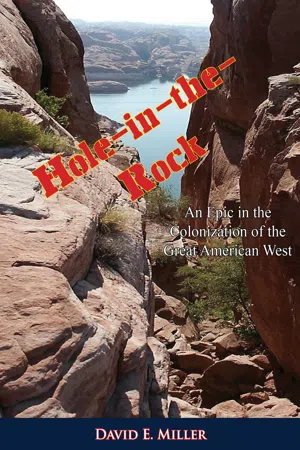
First published in 1962, David E. Miller's award-winning work on the Hole-in-the-Rock episode was arguably his greatest achievement as a historian. One of the great set-pieces of Mormon history, the San Juan Mission had become clouded by myth and hagiography when Miller first became attracted to its study in the 1950s, and few reliable sources were at that time available.
Not content with exhausting archival material, Miller contacted all locatable descendants of the members of the original party, and thereby brought to light a great number of previously unexploited sources. The Hole-in-the-Rock study achieved additional depth from his intimate knowledge of the actual trail acquired on repeated traverses by Jeep and on foot.
A member of the LDS Church, Miller wrote of the Mormons with sympathy and understanding, but with a commitment as well to the critical standards of the historical profession.
A must-read for anyone interested in American History.
- 296 pages
- English
- ePUB (mobile friendly)
- Available on iOS & Android
eBook - ePub
About this book
Information
Subtopic
American Civil War HistoryIndex
HistoryCHAPTER I—THE MISSION CALL
It is the voice of the Lord to me to go and I am going by the help of the Almighty.—Jens Nielson
Brigham Young was probably the greatest colonizer America has produced. Under his leadership the L.D.S. Church not only moved to the valley of the Great Salt Lake but from this point branched out in all directions, discovering, exploring, and settling not merely the Great Basin but also the whole intermountain West. The pioneers of this colonizing movement truly made the “desert blossom as the rose”—and a good deal of the exploring and colonizing was carried on in real desert country. A common and practical custom developed by the church was to call members on missions to colonize a region which Church leaders wanted occupied. When called, most families gladly responded, often leaving well-established homes, farms and other business enterprises and taking all their possessions into rough, unknown, untried country. There was no assurance that the new home would prove satisfactory, that sufficient water would be available for crops, or that rivers would not flood the settlements once established. But the missionaries called seem not to have been too much concerned about such economic and temporal matters. They usually considered their call an opportunity to serve the church, and once they had accepted there would be no turning back until the mission had been accomplished.
Sometimes the assignment seemed virtually impossible; sometimes the obstacles were almost too overwhelming. But nothing seemed really impossible for the pioneers, and thousands now recount with pride the fact that their progenitors were among those called by the church to plant colonies in Arizona, California, Nevada, Idaho, Wyoming, Colorado, New Mexico, eastern central or southern Utah, and even in foreign countries. Rightly are they proud of these pioneer forefathers, who in conquering the wilderness provided an example and heritage almost beyond comprehension.
When Brigham Young died in 1877 the colonization program which he had launched had not been completed. Among the areas not yet settled was south-eastern Utah, although for several years church expansion had been in that general direction. Settlements at Price and elsewhere in Carbon County would be made in 1879; the site of Moab, settled and abandoned during the 1850’s, would be reoccupied in 1880; Escalante had been established in Potato Valley during 1875-76; Kanab (established in 1864 and abandoned in 1866) was resettled in 1870; outposts along the Paria River were in various stages of development between 1865 and 1875. The abandoned Elk Mountain Mission at Moab was the only Utah settlement which had been attempted east of the Colorado River.
A study of this colonization program indicates that it was a church policy to plant settlements in all available areas—to occupy all usable farm and grazing land. This expansion was natural and inevitable, since the Mormon settlers were always looking beyond the horizon for more and better acres. It has been truly said that few farmers ever have all the land they want; and the chief activity in pioneer Utah was farming. To acquire more and better land was a major motive behind the whole westward movement, and in this respect the Mormon pioneers were no exception.
For various reasons the church encouraged this natural growth and expansion. It was felt that the economic well-being of the individual would be better achieved through a colonization program; furthermore, the rapidly growing Utah communities needed outlets to relieve their growing pains.
It was in addition to this spontaneous, natural expansion that church leaders found it desirable at times to organize official colonizing “missions” for the purpose of occupying definite areas. Such action was deemed necessary when the region to be colonized was too remote for natural expansion or so thoroughly unknown that little or no interest had been shown in it. Such was the case with the San Juan “Four Corners” area: Mormon colonists were just not moving into it of their own accord.
Church leaders seem to have been quite anxious to obtain the San Juan area before it could be settled by non-Mormons. Mining booms in south-western Colorado had resulted in rather extensive migration to that region; stockmen were moving into the area and it was also becoming known as a rendezvous for outlaws. But Mormon settlers were slow to go in that direction.
The late 1870’s was a period of rather extreme antagonism and increasing friction between Mormons and non-Mormons in Utah, both because of the increase in momentum of the federal campaign against polygamy{1} and because of the struggle between the two groups for political control of Salt Lake City and the whole territory of Utah. It is understandable that church leaders would be very conscious of the increasing numbers of non-Mormons in their midst and would be interested in occupying all available “border lands” if for no other reason than to keep non-Mormons from obtaining them. Although this may not be considered the primary objective of or reason for the San Juan Mission, it certainly must be accounted as an important factor.
That this was one purpose of the proposed colonization is definitely indicated by a letter from Erastus Snow to L.D.S. Church leaders John Taylor and Council. Under the date of November 6, 1879, after the major migration to the San Juan (that is, the Hole-in-the-Rock expedition) had gotten under way, Snow says in part:{2}
Silas S. Smith has started for San Juan with forty or fifty men and some boys and quite a few families, with Boats &c. intending to hew their way threw [sic] the Canyons and open a straight or more direct route to San Juan and as he thinks also to the head of Little Colorado & he needs all the strength he has and more too for the task he has in hand; and less cannot secure the San Juan region in Utah, to say nothing of the region higher up that stream, and its many Tributaries in Colorado & N. Mexico....
To secure the San Juan region for Mormon colonization, to settle it before others could do so, was certainly a major church objective and members of the expedition evidently recognized this. Charles Redd, who obtained much of his information from his father, Lemuel H. Redd, Jr. (an important member of the company), makes this significant statement: “A buffer settlement was needed, it was felt, against encroachment by stockmen from Colorado and the South-west and Indians of this unpenetrated, unknown area.”{3} Possibly incidental but still important was the fact that church members moving to this border country might act as missionaries among the “Gentiles.”
Another very definite reason for establishing a settlement on the San Juan was pointed out by George B. Hobbs in his account of the undertaking. He says:{4}
One of the objects of the colonizing of San Juan County by the leaders of the Mormon Church was to select a place where the converts from the Southern States might make new homes in Utah and still be in a warmer climate than where they had recently been settling in the San Luis Valley, Colorado...
Many converts to the L.D.S. Church who had migrated from the Southern States to Colorado were not completely satisfied in their new homes, as, among other disadvantages, the winters were too cold. It was felt that some attempt should be made by the church to locate sites more suitable for these people. That this was an important factor in leading to the San Juan settlement is indicated by correspondence of church leaders. On May 9, 1878, John Morgan, president of the L.D.S. Southern States Mission, wrote as follows to Apostle Erastus Snow regarding the south-central Colorado region and problems pertaining to the migration of Southerners to that location:{5}
There will be considerable migration from the Southern States this season to that section and it seems to be a great necessity for some of the Utah Saints to go to them to locate and learn them how to carry on their farming operations and other duties as saints;
The people who go from here are to a great extent almost helpless in regard to caring for themselves in that country and in addition they have not had an opportunity of becoming acquainted with the manner of lives of the saints, and need much instruction on those points, they...need a few of the old time saints to assist them in getting in a good foundation temporally and spiritually.
If it could be that a few families could be located in their midst from Utah it would be an immense advantage to them; there is good land, plenty of water, wood, etc. etc, and would be desirable Location for those who wished to give their attention to agricultural pursuits, or grazing....
About a month later (June 11, 1878) Apostle Snow wrote to President Taylor as follows:{6}
...I would add that from the accounts given me by Bro. Ivins and my Son, lately returned from the Rio Grand, and from other sources, I am satisfied there are many good locations for settlements on the upper branches of that stream as well as on the Tributaries of the San Juan in Southern Colorado and Northern New Mexico and if it is deemed advisable to encourage our Emigrants from the Southern States or elsewhere to occupy that region, there should be some substantial good men sent there to locate them and preside over them.
Additional testimony is available to prove that this purpose was definitely part of the San Juan colonizing plan.
The primary objective of the San Juan Mission, however, was to cultivate better relations with the Indians and lay the foundations for future permanent Mormon settlements. It had always been church policy to maintain friendly relations with the Indians: besides the fact that Brigham Young had found it cheaper to feed than to fight them, one of the fundamental teachings of the church has always been that Indians are part of the House of Israel and will eventually embrace the gospel and become a “white and delightsome” people.{7} This doctrine and mission program certainly tended to dictate a friendly policy, and underlying the whole program of the San Juan Colonization was this basic idea of bringing the Gospel to the Lamanites.
In spite of this attitude of friendliness toward the Indians there had been considerable friction between the two peoples. As Mormon settlements were being established in southern Utah and northern Arizona during the 1850’s, 1860’s and 1870’s, roving Navajos and Paiutes, long accustomed to plundering their neighbors, found the flocks and herds of the newly arrived whites an irresistible booty. Being well acquainted with all possible crossings of the Colorado, small parties of Indians often raided the outlying settlements, drove off stock and disappeared into secret hideouts south-east of the river, beyond the reach of their pursuers. At times this plundering assumed rather important proportions. One writer states that in 1867 a herd of some twelve hundred stolen animals was pushed across the Colorado at the Crossing of the Fathers and that in one year more than a million dollars’ worth of horses, cattle and sheep was looted from the impoverished Utah frontier.{8}
A natural outgrowth of this cattle rustling was spasmodic border warfare that resulted in numerous armed clashes and many killed on both sides. During the late 1860’s this warfare became so fierce that some Mormon outposts such as Kanab and Pipe Springs had to be temporarily abandoned. The diplomatic skill of Jacob Hamblin, Thales Haskell, and others was taxed to the limit in attempts to bring peace to the southern Utah border. The perseverance of Hamblin and his associates succeeded in winning the confidence of the Navajos, with the result that during the early 1870’s peaceful and legal trading replaced looting and border raids. However, in 1874 three Navajo brothers were killed in an unfortunate tangle with Utah cattlemen and the whole southern frontier was threatened with full-scale Indian warfare.
Albert R. Lyman, in “The Fort on the Firing Line,” has very effectively described this phase of Utah history and shown the relationship between these Mormon-Indian hostilities and the evolution of what was to become the San Juan Mission. Says Lyman:{9}
The decision of the Church leaders was to plant a little colony of Mormons in the very heart of all this incipient danger; right on the turbulent border between the Navajos and Paiutes, and squarely on the trail of the fugitive desperado wolf pack from all over the west. It was a perilous venture, as the years were to prove, its objectives to be achieved through great sacrifice, hardship and danger. With few in numbers the little colony would ...
Table of contents
- Title page
- TABLE OF CONTENTS
- DEDICATION
- PREFACE
- MAPS
- CHAPTER I-THE MISSION CALL
- CHAPTER II-THE EXPLORING EXPEDITION, 1879
- CHAPTER III-THE ESCALANTE SHORT CUT: BACK DOOR TO SAN JUAN
- CHAPTER IV-THE TREK BEGINS
- CHAPTER V-EXPLORATIONS FROM THE FORTY-MILE SPRING
- CHAPTER VI-FROM FORTY-MILE TO THE HOLE-IN-THE-ROCK
- CHAPTER VII-FOUR SCOUTS EXPLORE: GEORGE B. HOBBS’ ACCOUNT
- CHAPTER VIII-DOWN THROUGH THE HOLE
- CHAPTER IX-THROUGH “IMPASSABLE” COUNTRY TO CLAY HILL PASS
- CHAPTER X-TRAIL’S END
- APPENDIXES
- BIBLIOGRAPHY
- REQUEST FROM THE PUBLISHER
Trusted by 375,005 students
Access to over 1.5 million titles for a fair monthly price.
Study more efficiently using our study tools.
Frequently asked questions
Yes, you can cancel anytime from the Subscription tab in your account settings on the Perlego website. Your subscription will stay active until the end of your current billing period. Learn how to cancel your subscription
No, books cannot be downloaded as external files, such as PDFs, for use outside of Perlego. However, you can download books within the Perlego app for offline reading on mobile or tablet. Learn how to download books offline
Perlego offers two plans: Essential and Complete
- Essential is ideal for learners and professionals who enjoy exploring a wide range of subjects. Access the Essential Library with 800,000+ trusted titles and best-sellers across business, personal growth, and the humanities. Includes unlimited reading time and Standard Read Aloud voice.
- Complete: Perfect for advanced learners and researchers needing full, unrestricted access. Unlock 1.5M+ books across hundreds of subjects, including academic and specialized titles. The Complete Plan also includes advanced features like Premium Read Aloud and Research Assistant.
We are an online textbook subscription service, where you can get access to an entire online library for less than the price of a single book per month. With over 1.5 million books across 990+ topics, we’ve got you covered! Learn about our mission
Look out for the read-aloud symbol on your next book to see if you can listen to it. The read-aloud tool reads text aloud for you, highlighting the text as it is being read. You can pause it, speed it up and slow it down. Learn more about Read Aloud
Yes! You can use the Perlego app on both iOS and Android devices to read anytime, anywhere — even offline. Perfect for commutes or when you’re on the go.
Please note we cannot support devices running on iOS 13 and Android 7 or earlier. Learn more about using the app
Please note we cannot support devices running on iOS 13 and Android 7 or earlier. Learn more about using the app
Yes, you can access Hole-in-the-Rock by David E. Miller in PDF and/or ePUB format, as well as other popular books in History & American Civil War History. We have over 1.5 million books available in our catalogue for you to explore.