The first major study of Stresemann following declassification of his papers in the previous year. Written by Hans W. Gatzke, then a Professor at John Hopkins, who was intrigued by the enigmatic Gustav Stresemann (1878-1929), a German politician and statesman who served briefly as Chancellor in 1923 and Foreign Minister 1923-1929, during the Weimar Republic. He was co-laureate of the Nobel Peace Prize in 1926. His most notable achievement was the reconciliation between Germany and France, for which he and Aristide Briand received the Nobel Peace Prize. During a period of political instability and fragile, short-lived governments, he was generally seen as the most influential cabinet member in most of the Weimar Republic's existence. During his political career, he represented three successive liberal parties; he was the dominant figure of the German People's Party during the Weimar Republic.
The study is based on the unpublished papers of Dr. Gustav Stresemann, which came into Allied possession at the end of World War II as part of the vast collection of German Foreign Ministry documents. They were opened to research in the spring of 1953, as the result of a U.S.-British agreement.
"A valuable contribution, enhanced by Mr. Gatzke's penetrating insights and sureness of style."—Fritz Stern, Columbia University
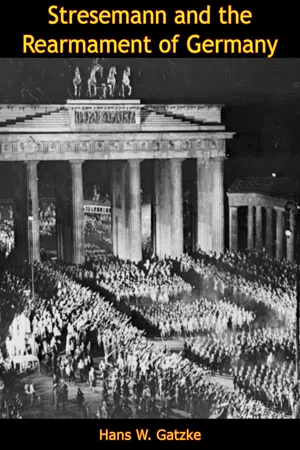
- 114 pages
- English
- ePUB (mobile friendly)
- Available on iOS & Android
eBook - ePub
Stresemann and the Rearmament of Germany
About this book
Information
Subtopic
European HistoryIndex
HistoryREQUEST FROM THE PUBLISHER

Thank you so much for reading our book, we hope you really enjoyed it.
As you probably know, many people look at the reviews before they decide to purchase a book.
If you liked the book, could you please take a minute to leave a review with your feedback?
60 seconds is all I’m asking for, and it would mean the world to us.
Thank you so much,
Arcole Publishing
{1} J. H. Morgan, Assize of Arms (London, 1945), set out to do this, but only the first and more general of his two projected volumes has appeared, and the publication of the more important second volume has been abandoned. See also: Telford Taylor, Sword and Swastika (New York, 1952), ch. II; Walter Görlitz, Der Deutsche Generalstab (Frankfurt a. M., 1950), ch. IX; and John Wheeler-Bennett, The Nemesis of Power (London, 1953), chs. II and III.
{2} Görlitz Generalstab p. 359, and B. H. Liddell Hart, The German Generals Talk (New York, 1948), pp. 13-14, hold that pre-Hitlerian rearmament had been “overrated,” a view not shared not by Morgan, Taylor, and Wheeler-Bennett.
{3} See Hans Rothfels’ introduction to Helm Speidel, “Reichswehr und Rote Armee,” Vierteljahrshefte für Zeitgeschichte, I, No. 1 (January 1953), p. 16.
{4} The many biographies of Stresemann, while differing in quality, are alike in their exclusive emphasis on the peaceful aspects of his policy and personality. Written by friends or admirers, their value to the historian is slight. The most informative is Walter Görlitz, Gustav Stresemann (Heidelberg, 1947). For the rest consult the bibliographical essay below, pp. 117 ff. The book worthy of the subject has yet to be written.
{5} Felix E. Hirsch, “Stresemann in Historical Perspective,” Review of Politics, XV, No. 3 (July 1953), pp. 375 ff.
{6} Gustav Stresemann, Vermächtnis. Der Nachlass in drei Bänden, ed. by Henry Bernhard (Berlin, 1932-33).
{7} Germany, Auswärtiges Amt, Politisches Archiv, “Nachlass des Reichsministers Dr. Gustav Stresemann,” microfilm, National Archives, Washington, D.C. (cited hereafter as Stresemann, “Nachlass”). For an analysis of these papers, see Hans W. Gatzke, “The Stresemann Papers,” Journal of Modern History, XXVI, No. 1 (March 1954), pp. 49-59. Henry L. Bretton, Stresemann and the Revision of Versailles (Stanford, 1953), had access to the “Nachlass” and devotes a brief chapter to “Disarmament and Revision,” pp. 138-149.
{8} Professor Raymond J. Sontag, who has seen these documents, has answered in the affirmative this writer’s question about Stresemann’s awareness of Germany’s illegal rearmam...
Table of contents
- Title page
- TABLE OF CONTENTS
- DEDICATION
- PREFACE
- I-INTRODUCTION
- II-FROM RUHR TO LOCARNO
- III-THE END OF MILITARY CONTROL
- IV-THE REICHSWEHR AND RUSSIA
- V-THE PERFECTION OF GERMAN REARMAMENT
- VI-CONCLUSION
- BIBLIOGRAPHICAL NOTE
- REQUEST FROM THE PUBLISHER
Trusted by 375,005 students
Access to over 1.5 million titles for a fair monthly price.
Study more efficiently using our study tools.
Frequently asked questions
Yes, you can cancel anytime from the Subscription tab in your account settings on the Perlego website. Your subscription will stay active until the end of your current billing period. Learn how to cancel your subscription
No, books cannot be downloaded as external files, such as PDFs, for use outside of Perlego. However, you can download books within the Perlego app for offline reading on mobile or tablet. Learn how to download books offline
Perlego offers two plans: Essential and Complete
- Essential is ideal for learners and professionals who enjoy exploring a wide range of subjects. Access the Essential Library with 800,000+ trusted titles and best-sellers across business, personal growth, and the humanities. Includes unlimited reading time and Standard Read Aloud voice.
- Complete: Perfect for advanced learners and researchers needing full, unrestricted access. Unlock 1.5M+ books across hundreds of subjects, including academic and specialized titles. The Complete Plan also includes advanced features like Premium Read Aloud and Research Assistant.
We are an online textbook subscription service, where you can get access to an entire online library for less than the price of a single book per month. With over 1.5 million books across 990+ topics, we’ve got you covered! Learn about our mission
Look out for the read-aloud symbol on your next book to see if you can listen to it. The read-aloud tool reads text aloud for you, highlighting the text as it is being read. You can pause it, speed it up and slow it down. Learn more about Read Aloud
Yes! You can use the Perlego app on both iOS and Android devices to read anytime, anywhere — even offline. Perfect for commutes or when you’re on the go.
Please note we cannot support devices running on iOS 13 and Android 7 or earlier. Learn more about using the app
Please note we cannot support devices running on iOS 13 and Android 7 or earlier. Learn more about using the app
Yes, you can access Stresemann and the Rearmament of Germany by Hans W. Gatzke in PDF and/or ePUB format, as well as other popular books in History & European History. We have over 1.5 million books available in our catalogue for you to explore.