- 129 pages
- English
- ePUB (mobile friendly)
- Available on iOS & Android
eBook - ePub
Leningrad in the Days of the Blockade
About this book
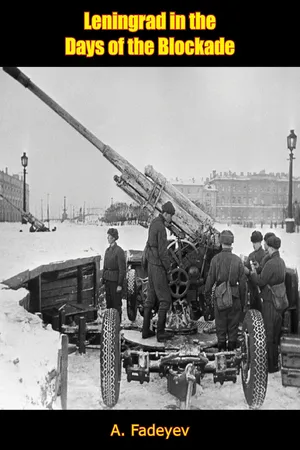
The 900 day siege of Leningrad (now St. Petersburg) on the Baltic was perhaps one of the most iconic clashes of Nazi versus Soviet clashes to take place during the Second World War. Two and a half million Russians were trapped and encircled by Germand and Finnish forces, but despite freezing cold, scant supplies and little if any food, the city held out. In this book, noted Soviet author Alexander Alexandrovitch Fadeyev gives an eyewitness account of the horrific conditions of the city in the iron jaws of the Wehrmacht.
Information
Subtopic
European HistoryIndex
HistoryBEARING THE NAME OF KIROV
HERE IS WHAT WE WERE TOLD BY COMRADE MUZHEINIK, AN OLD worker at the great plant famous in Russian history, the Putilov Works, now better known throughout the country as the Kirov Works.
“They say that the peasant is firmly rooted to the soil, to his own native part of the country. That’s true, of course. But what I say is this: Nobody is so attached to his own place of work, his own factory, as our brother the Russian worker. I’ve been at these works since 1914, when I was not so very old. My father worked here before me and other Muzheiniks as well, and I’ll not leave the Works till I die, unless of course I’m officially thrown out. When the Germans began to draw near to our Leningrad, how many of us, Kirov workers, went into the Home Guard? A whole division! Many of them have been killed, but even now there are units in the army where we—Kirov workers—are in the majority....”
What Muzheinik told me formed only a single chapter of the glorious history of the Leningrad Home Guard. Yes, it was indeed the magnificent Home Guard of Leningrad which at the decisive moment protected the city with the bodies of its warriors. Armed with first-class material, trained for a whole decade for war, equipped with the experience of two years of war in Western Europe and in the Balkans, the German Fascist army was nevertheless checked by the Home Guard of the factory workers, office employees and intellectuals of Leningrad. And not only checked—it sustained incalculable losses in men and material, it was compelled to dig in, and in spite of that was forced back on several sectors of the front. That is a historical fact which cannot be concealed, a historical fact which will make future generations stand bareheaded in awe.
“We sent our folk into the Home Guard, but ourselves we thought: ‘Suppose the enemy drives his way into the city and cuts us off from the Works, what then?’ We were determined not to surrender the Works. We decided on a circular defence. We fortified the whole neighbourhood so that if necessary we could carry on by ourselves. And besides the Home Guard we formed other fighting units. Whatever else the others might do, we Kirov workers were not going to abandon the plant....Sometimes we stop to think: how many of us, Kirov workers, are there? There are a good many more, all told, than the factory lists show. Here, outside the Narva gate, there are whole generations of Kirov-Putilov workers, all of us getting our living from the plant, all of us one big family. You can’t count how many we are. Judge for yourself: in spite of all our men in the Home Guard, the plant is still working. We evacuated almost all the equipment and the great mass of the workers was evacuated with it, and yet the plant is still working.”
“I daresay the workers were not too willing to leave their homes, were they?” I asked. “Everybody knows that several thousands were evacuated by air—they couldn’t have taken a great many of their possessions with them, could they?”
“It all depended,” Muzheinik answered with a smile. “But I’ll say this: they certainly travelled light. You ask—why? Because the Kirov workers knew that neither Leningrad nor the Works would ever be taken by the Germans and that they could count on coming back to their own homes. We’re still evacuating, you know, as many as we can—children, old people, the sick. If they make a to-do we say to them: ‘Don’t be afraid; you’ll come back as soon as can be. The Works have held out, they’re holding out now, they’ll hold out to the end.’”
Muzheinik repeated this in a tone of conviction that inspired respect. He went on: “Then we say to them: ‘You’re going to your own people—there are Kirov workers where you’re going. We and they are one.’ And we’re proud that those fellows of ours there are not only turning out as much as they did here but twice as much, three times as much. We’re proud of them and we envy them. Look at this shop! It’s gigantic. But it’s deserted,” he said sadly. “Do you know what shop it is? It’s the turbine shop. I started to work here in 1914....Let them bang away at it as much as they like, it’ll still stand,” Muzheinik said proudly, and sighed.
All this he told us, a group of writers, the majority of whom were in military uniform, when we were inspecting the Works. The Works was almost a city in itself, stretching over a vast area. It presented, this veteran monument of the Russian working class, a magnificent and tragic spectacle. During the blockade it had been subjected almost ceaselessly to bombardment from the air, and thousands of shells had fallen within the area. Covered with wounds and scars, it still held out, still fought back. It was, it might be said, the second echelon of the front, but a second echelon of such importance that it drew the whole of the enemy’s fire.
Heavily fortified, it was nevertheless clean and tidy. Shops stretched over all the enormous area, some of them deserted, others in active production. Wherever one cast one’s eyes the evidence of destruction was visible—shattered walls and roofs, smashed windows, shell craters and gaping holes in the walls! But the factory chimneys still belched smoke. Of course by comparison with former times the place did not and could not live, so to speak, a full-blooded life. But it continued to function vigorously, a huge munitions factory served by thousands of workers. And the whirring of the lathes, the roar of the furnaces, the rattle of the rolling mills and the shrill sounds of the little engines shunting backwards and forwards on the factory rails were sweeter and more caressing in our ears than the loveliest music.
The foundry, one of the biggest shops in the plant, bore the marks of a great many heavy shells, some fairly recent, others quite new. But this was a vast shop, where work did not cease either by day or night.
Once a shop was set on fire. Konstantin Skobnikov, the foreman of the shop, a man of forty-three, gave the order to carry on and himself dashed out at the head of a group of workers to put the fire out. As nimbly as a boy he climbed out on to the roof, followed by others. They toiled there, taking no thought of time, until they were almost insensible. Only after the shop had been saved did Skobnikov discover that his hands were torn and bleeding and his face badly scorched.
“But, you see, the devil take it, I built this shop,” he told us with a smile on his intelligent, energetic, sunburned face. “It’s my own child, so to say. Yes, I built it twelve years ago and since then I’ve worked here continuously. The best, most mature years of my life have been spent here.”
“Do you remember, Konstantin Mikhailovich, how we cleaned it up in the spring?” said one of the workers, a greyhaired old fellow, who accompanied us on our tour of inspection.
“There was certainly enough rubbish in the shop and hereabouts,” Skobnikov said, and laughed. “And everything covered with ice—my word! I must admit that when we began the job of clearing up, the thought in the mind of many of us was: will it ever be possible to get the place clean? We had to shift mountains of rubbish.”
“There was a period, then, when the shop was idle?”
“There was. It was a time when I lived alone in it.”
“In the shop?”
“Yes, I lived right here. My family had been evacuated. That winter I had a small stove, I used to warm myself by it. It was so quiet in the shop you heard only the howling of the wind. The windows had been blown out, the snow had piled up and deadened everything, it was all very strange—it seemed as if my shop would never come to life again.”
“What did you do during those long days and nights?”
“I was busy in the daytime—wasn’t there work enough for us to do in Leningrad? In the evening I sat by myself and thought or read a book.”
“What did you think about—what did you read?”
“There was a lot to think about,” Skobnikov said gravely. “Human beings showed what they were like in those days. I don’t suppose people had ever before witnessed such a revelation of greatness of soul on the one hand and of moral degradation on the other....I remember when the shop was working in December, in spite of the fearful cold and hunger...we had a wonderful old man with us here. He mixed the sand for the moulds—he was a skilled man at the job; he was, as a matter of fact, one of those elderly craftsmen who work like an artist and cannot himself explain how he does things. If you asked him what proportions he used in his mixtures he would reply: ‘There’s no definite proportions, I can sense things, I can tell by the feel what to add and how much.’ People think a man like that must have a secret which he keeps all to himself; but the whole secret is in his hands. For instance, instead of the sand for our moulds that had been specially brought to us, we were obliged to use sand from pits in the suburbs here. Everybody said it wouldn’t do. And indeed none of the moulders could do anything with it. But the old man had a try and everything turned out all right....And then his strength began to fail. Every day, we saw, he became weaker. But he didn’t give up work, and he began to teach his old woman how to mix the sand. He kept on explaining things to her, demonstrating, making her try for herself. And he’d get angry with her. Oh, what a stupid you are!’ he would say, and then fall to instructing her all over again. Then one day a boy came running to me and said: ‘He’s calling.’ I understood at once whom he meant. I went along and found the old man lying on the sand he knew so well how to mix. His old woman, her eyes dry, was standing beside him. There were other old workers standing around too. He was very feeble by now. ‘Well, Konstantin Mikhailovich, I’m dying....My old woman will take my place——’ And he turned away from us and kept his eyes on the old woman and begged her not to forget what he had taught her about mixing the sand....She repeated everything he said and kept on saying: ‘Don’t be afraid, I won’t forget.’ She was still dry-eyed. It was a scene which might have brought tears to anybody’s eyes, though in truth they say that the tears of the people of Leningrad are frozen by now. But there he was instructing her and suddenly he broke off, leaving a phrase unfinished, and died....Those were the sort of things one witnessed. And yet in another case somebody had sunk so low that he could steal a comrade’s last piece of bread....” He was silent. “What did I read? I read Balzac and Stendhal and learned a good deal from them about human beings.”
Konstantin Skobnikov, the son of an engine-driver, had finished his secondary-school education in 1917 and his course at a technological institute in 1925. He was a trained engineer of great practical experience. He spoke to us of the remarkable inventiveness which an engineer had to display in the peculiar circumstances of the siege of Leningrad, when there was an acute shortage of so many essential materials—materials without which production, by all the existing rules, should have been unthinkable; of how the furnaces in the steam-power shop had been recast so as to permit the use of either coal or wood, whichever was available; of iron smelted without coke; of substitutes for vegetable oils. These were the most elementary of problems, great and small, which were solved by the resource of Leningrad’s engineers and economists.
I was able to observe the work of many of Leningrad’s economists. ...
Table of contents
- Title page
- TABLE OF CONTENTS
- THE CITY OF GREAT ARCHITECTS
- NO. 5, RYBINSKAYA STREET
- THE STREET IN APRIL
- BY TRAM TO THE FRONT
- “A GOOD DUG-OUT; A PITY IT’S ON THE SEVENTH FLOOR”
- MY COUSIN
- THE CHILDREN
- THE SCHOOL
- THE ROAD OF LIFE
- BEARING THE NAME OF KIROV
- “OCTOBER’S CHILD”
- “LIEUTENANT-COLONEL F. WILL NOT BUDGE”
- TORPEDO CUTTERS
- THE SUBMARINE MAYAKOVSKY
- BALTIC STYLE
- EPRON
- THE LENINGRAD FRONT IN THE SUMMER OF 1942
- EXTERMINATORS
- KATYA BRAUDE
- THE DEFENDERS OF KHANKO
- “A LABOUR OF MERCY”
- JUNE-JULY
- IMMORTAL LENINGRAD
- REQUEST FROM THE PUBLISHER
Trusted by 375,005 students
Access to over 1.5 million titles for a fair monthly price.
Study more efficiently using our study tools.
Frequently asked questions
Yes, you can cancel anytime from the Subscription tab in your account settings on the Perlego website. Your subscription will stay active until the end of your current billing period. Learn how to cancel your subscription
No, books cannot be downloaded as external files, such as PDFs, for use outside of Perlego. However, you can download books within the Perlego app for offline reading on mobile or tablet. Learn how to download books offline
Perlego offers two plans: Essential and Complete
- Essential is ideal for learners and professionals who enjoy exploring a wide range of subjects. Access the Essential Library with 800,000+ trusted titles and best-sellers across business, personal growth, and the humanities. Includes unlimited reading time and Standard Read Aloud voice.
- Complete: Perfect for advanced learners and researchers needing full, unrestricted access. Unlock 1.5M+ books across hundreds of subjects, including academic and specialized titles. The Complete Plan also includes advanced features like Premium Read Aloud and Research Assistant.
We are an online textbook subscription service, where you can get access to an entire online library for less than the price of a single book per month. With over 1.5 million books across 990+ topics, we’ve got you covered! Learn about our mission
Look out for the read-aloud symbol on your next book to see if you can listen to it. The read-aloud tool reads text aloud for you, highlighting the text as it is being read. You can pause it, speed it up and slow it down. Learn more about Read Aloud
Yes! You can use the Perlego app on both iOS and Android devices to read anytime, anywhere — even offline. Perfect for commutes or when you’re on the go.
Please note we cannot support devices running on iOS 13 and Android 7 or earlier. Learn more about using the app
Please note we cannot support devices running on iOS 13 and Android 7 or earlier. Learn more about using the app
Yes, you can access Leningrad in the Days of the Blockade by A. Fadeyev, R. D. Charques in PDF and/or ePUB format, as well as other popular books in History & European History. We have over 1.5 million books available in our catalogue for you to explore.