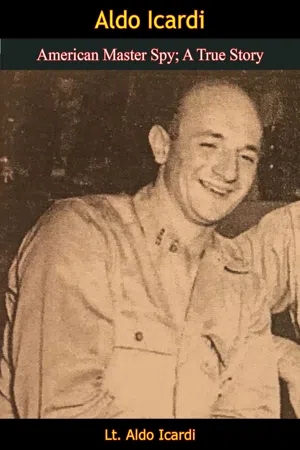
Aldo Icardi (1921-2011) was a U.S. Army second lieutenant during World War II who was sent as a specially-trained soldier by the U.S. Army's Office of Strategic Services (OSS) on a special mission into enemy-occupied territory in Italy to organize resistance movements. During this mission, which was code-named "Chrysler," its commander Major John William V. Holohan disappeared, and Lt. Icardi, along with radio operator Carl G. LoDolce and three Italians, was charged with his murder. The Italians, who spent three years in jail, were later acquitted, and Icardi and LoDolce were convicted in absentia of murder and sentenced to life and 17 years respectively, but neither man could be extradited back to Italy, so did not serve time. In 1955, Icardi was indicted by a federal grand jury for perjury, but was acquitted in 1956. The Italian Communist commander Vincenzo Moscatelli later admitted that he was responsible for Major Holohan's death and that Icardi had nothing to do with it.
With this book, which was first published in 1954, Aldo Icardi seeks to set the record straight on all the newspaper stories that circulated in the wake of the killing, and ever since.
A gripping true-life story.
"This book is the true story, as well as I know it, of what actually happened to Major Holohan. It is my defense against the charges of murder. And it is the story of the most dangerous and exciting eight months I have ever lived."—Aldo Icardi
- 259 pages
- English
- ePUB (mobile friendly)
- Available on iOS & Android
eBook - ePub
About this book
Information
Subtopic
European HistoryIndex
HistoryPART ONE—Major Holohan Disappears
ONE
I hurriedly stuffed my army clothes into an overnight bag: hat, shoes, uniform, lieutenant’s bars, everything. I checked the bag in a pay locker at the railroad station in Washington, D. C., and hurried to a taxi.
The driver made good time through the teeming rush-hour traffic and dropped me off at the Dodge Hotel just a few minutes after six. People were bustling in and out of the hotel, the doorman was flagging cab after cab; but I hardly noticed. I kept peering up the street, trying to spy a Buick sedan. Every second seemed to drag.
At five minutes past six, a big black Buick pulled up to the curb exactly according to instructions. A tall, heavy-set man got out of the back seat. He wore a dark blue suit and a black Homburg hat. He had a red rose in his lapel. This was the man I was waiting for.
He left the door of the car open, walked over to me, and said, “Did George make the train?”
I answered, “Yes. I am Bill.” The big man nodded toward the car. I climbed in and he got in after me.
We drove in silence for several hours, through Washington, into the suburbs, and out over rolling Maryland hills. No one said a word. The big man with the red rose sat looking out the window. The driver never turned his head.
Somewhere in Maryland, we pulled on to a winding driveway that led to a large country estate. I was ushered in to a reception room on the first floor. This room was thirty or forty feet long and about twenty-five feet wide. Three great windows occupied most of the right hand wall. Rows of folding chairs filled about half of the floor area. There was another door at the opposite end of the room. Small groups of civilians—about fifteen men in all—were scattered about the room.
At this point, I still didn’t know what I was doing here. I had volunteered for an assignment that was described only as “secret and dangerous.” I was to tell no one about it. I was itching to know what I was getting into, and I decided to find out if I could. I was walking over to one of the groups to join the conversation, when a smartly uniformed Major entered the far door and strode over to a platform in front of the chairs.
“Will you all be seated, please?” he said. The small groups broke up quickly, and the buzz of conversation subsided. The Major cleared his throat. “Gentlemen,” he said. “Welcome to OSS!”
So this was it! Espionage! I was shocked and bewildered. The Major continued, “You are here to be trained in espionage work. We will try to teach you everything an OSS agent must know to survive. That includes demolition, personal hand-to-hand combat, how to use weapons, how to kill.”
“Each of you has been assigned a cover name. Now build a cover story around it; develop a false background, but a sensible explanation of who you are, where you are from, what you do for a living. In your conversations, keep your cover story consistent and work at making it believable. While you are creating your cover story, try to break down the cover story of your companions. Analyze their conversation, pick out the inconsistencies, eavesdrop on telephone conversations, read their mail, pick their pockets, rummage through their luggage and clothes drawers. This is no place for panty-waists. This is war! And this is spying. You have to learn to be sneaky, foul, and treacherous. No holds are barred. At the end of this course we shall have a night of reckoning. Then you will be asked to tell what you have learned about your classmates, and they will tell what they have learned about you.”
The Major went on to outline the complete course of study. As he talked, I became more and more conscious of the vast implications of my assignment; and, when he had finished his remarks, I went to him and asked exactly what sort of duty I could expect.
The idea of becoming a spy had never occurred to me; and I wasn’t sure I was prepared for the job. I figured that I must have been chosen because I knew the Italian language, but I didn’t feel that I knew it well enough for espionage. Frankly, I was scared, and I told the Major so. He seemed amused at my concern, but assured me that selection for this school did not necessarily mean that I would go into the field and work as a spy. Many of us apparently were taking this training in preparation for related OSS jobs. We might end up as administrators, translators, supply officers, or doing any number of other tasks that must be done in any military organization. At that time, I wouldn’t have believed that later on I would actually volunteer for duty behind enemy lines, and that spying and constant danger would become an accepted, almost daily routine. I did not even suspect those future events, and the Major’s reassurances quieted my fears.
Intensive study and work began the next morning. We had to learn to send and receive at least 12 words per minute in International Telegraph Code, so that if we were on a mission and lost our radio operator, we could at least communicate with headquarters. We also learned the philosophy and theory of codes and ciphers; we learned that any code could be broken, but that it takes time, and usually the information is worthless by the time an enemy breaks a code.
We learned how to break into a house: how to pick locks, how to enter through windows quietly, how to jimmy doors, and how to blow safes.
We learned how to handle dynamite and plastic explosives; how to destroy buildings, bridges, railroad tracks, ammunition dumps, gasoline deposits. We learned about special explosives which could be put into an automobile gas tank easily; we learned how to handle a new magnetic weapon which could be placed against the side of a ship to blow it up; we learned about an electric-eye mechanism which was placed on a railroad car so that, when a train entered a tunnel, the dynamite attached to the mechanism would explode and jam the tunnel with the broken wreckage of the train.
We learned to use and to draw maps. We learned to travel with only a small compass, and by the stars, to travel across broken country away from the main roads without getting lost. We learned how to identify landmarks and targets so that our intelligence would be of military value.
We studied hand to hand combat from an expert: the fabulous Major Fairburn, who had been Chief of Police of the Shanghai Police Department for many years. He taught us to fight with a knife and with a gun. He taught us to kill with our bare hands, to kill swiftly, quietly, and efficiently, without danger to ourselves. He designed a special training course, scattered with hidden booby traps, which we had to go through. We had to meet and overcome mock dangers that in actual field work could mean death if we did the wrong thing.
We learned all about weapons—what types were available where the war was being fought; how to take them apart and put them together; how to repair them; and how to use them.
Finally we learned “battle order”. Battle order covers every facet of the organization and composition of a country’s armed forces. We learned how many regiments of a given kind made a panzer (armored) division, how many battalions of field artillery were included in a German infantry division, how many vehicles and the kind that were included in each unit, how many men comprised a regiment, division, and army, how they were armed, how they were supplied, and how they could be moved. We learned to identify the enemy’s organic units by shoulder insignia, by unit direction markers, by organizational numbers on vehicles and equipment. We learned everything we could possibly cram in our heads about the enemy military organization so that, out in the field in actual espionage work, we could accurately report the movement and location of specific enemy formations. Information like this is the most important kind of intelligence; it has crucial significance to commanders at the battle front. When a general knows what units are in front of him in the line, and what units are coming up to the line or leaving the line, he can plan his battles to take advantage of every enemy weakness, to avoid every enemy strength. We spent days and days on battle order at OSS school.
The course wound up with a crucial practical examination that, for me, was a tame preview of things to come. Each student prepared false social security and draft cards, driver’s license, identification cards, and other documents that supported his cover story. Then he went to Baltimore, got a job in a defense plant, and stole as many military secrets as he could.
I applied for a job as an armed guard at the Maryland Drydock Co. I showed up at the employment window at about nine o’clock in the morning with my forged identification and my phony name and background. They had some laboring jobs available and one opening for an armed guard. The latter sounded like a good job for a spy, so I told the man I was an expert marksman and had experience as a guard in a tank plant in Detroit. He said, “Good! We can probably use you. We’re not usually lucky enough to get experienced people for jobs like that. Fill out this application.”
An interviewer spent almost an hour with me filling out a ten page questionnaire. The mass of details they wanted might have scared a spy away, but it was obvious that before they could check all the data on that form, the war would be over. The interviewer moved quickly to make an appointment for a physical examination for me. He said that I could go to work on the four o’clock shift that afternoon, if I hurried to the doctor’s office before eleven o’clock. I was anxious, so I hurried to the doctor’s office. I had been told to be back at the employment office at two o’clock. I was there. They bustled me into a photographic studio and mugged me. Then they took me to another building where my finger prints were taken. I had gone through the security mill in less than half a day, but my security had not been checked. All they had was the information necessary to check my security.
At four o’clock I started guarding this shipyard. Eight hours later I walked out the gate with the .38 caliber revolver, the badge, and the cap that I had been issued, as well as a whole pocketful of important military secrets.
My job was on the inside of the plant, and I was free to circulate everywhere. The superintendent’s office seemed like the best place to start spying. I learned his name and dreamed up a phony message for him to explain my presence in his office if I should be questioned. I stuffed this in an envelope, put his name on the outside, and headed for his office.
No one was in his office when I got there. But the door was open, so I walked in. I didn’t have to look far for what I wanted. There, spread out on his desk, was a detailed layout of the whole shipyard. It contained the location, the stage of work, and the scheduled completion date of every ship in the drydock. I sat down at the desk, took some of the superintendent’s stationery and copied down this information. With this safely tucked in my shoes, I returned to my job.
Later on, I struck up a conversation with a welding foreman at a water fountain. There, in front of a huge poster warning about the danger of loose talk, he told me about a passenger liner that was being converted in this yard for military use. It was scheduled to leave Norfolk a week later to take several thousand marines to the Pacific. About six other workmen corroborated this story—it was general information and a favorite topic of conversation. Before I left the yard at midnight, I had learned every detail about that ship.
I returned to OSS school bubbling with pride in my accomplishments. Then I learned that my classmates were just as successful as I had been. Every one learned facts which the enemy would have given his eye teeth to know. Fortunately, none of us was an enemy agent. We were all loyal Americans merely practicing the deadly business of spying, and all our loot was harmlessly burned.
The practical experience in spying was not the end of our exam. We had been promised that the last night of our training would be open house, and that we should bring back all the liquor we wanted from Baltimore. We were to drink heavily at this farewell party, then try to penetrate each other’s cover stories, to learn the truth if we could about the names and backgrounds of our classmates. The object was to find out if we would talk too much while we were drinking and expose ourselves. A loose tongue could wreck the best and most careful operator.
About half way through the evening festivities, our commanding officer started around to talk to each of us. He wanted to know what we had learned about the others, whether anyone had said or done something that in combat might give him away to the enemy.
This was a rugged test for me. It was unnatural for me to be prying into other people’s business. And it was unnatural for me to drink so much. At college a few beers had always been my limit; but for this test I drank rum and Coke. I was well intoxicated by the time the Major came to my end of the table. However, no one had yet been able to uncover my exact identity, nor my background, nor what section of the country I actually came from. For a few moments I was quite proud of myself. Then the rum and Coke struck! I was suddenly a very very sick man, and dashed for the John. Everything that was in my stomach roared up. I was miserable; but I tried to return to the party. I couldn’t. I went to my room and collapsed in deep sleep. I recall awakening, sometime later, for just a moment. I heard my roommates talking; one said, “Ike really conked out didn’t he? But at least he didn’t talk.” I sank back to sleep, satisfied that I had passed on the final test.
TWO
North Africa was hot, dirty, and dull. When I arrived there, sometime in November, 1943, OSS was in the throes of reorganization. The build-up and planning for the first major OSS job, the Sicilian invasion, had taken place in Algiers. With the successful invasion of the Italian mainland at Salerno, the bulk of Italian OSS operations with its personnel moved out of Algiers and into the Royal Palace at Caserta near Naples. There was just a skeleton force of OSS in Algiers when I arrived there: this was to be built, worked, and molded into the effective spearhead of the Southern France invasion which would take place eight months later in July, 1944. I was scheduled to develop and participate in part of that operation; but these plans for me changed very soon.
At this time, I was in what was known as “SO”, Special Operations, which was one of three major divisions into which the entire OSS organization was divided.
One of these three divisions was called “OG”, or Operational Groups. An Operational Group usually consisted of about thirty men who were experts in weapons, demolition work, and guerilla warfare. They were usually dropped in U.S. military uniform hundreds of miles behind enemy lines for the purpose of arming and organizing partisan bands of guerilla fighters.
“SI”, or Secret Intelligence, was a second major division of OSS. This was the real espionage group, as most people think of espionage. Men in this division infiltrated enemy territory for the purpose of collecting and sending back to headquarters strategically important information that our military commanders could use in planning battles.
I belonged to a third group, called Special Operations. “SO” units consisted of no more than five men who were specialists in demolition and sabotage work. They were dropped a short distance behind enemy lines for the purpose of destroying radio stations, communications lines, gasoline deposits, ammunition dumps, bridges, and other military targets. We were strictly soldiers; we were always to dress in full military uniform, do our job, then hide and wait for our combat forces to overrun our hiding place.
A Special Operations group existed at Algiers on paper; but, actually, there were only a few of us there with that specialty and no definite program had been set up for us. After seeing the sights of Algiers, and taking time out to learn how to parachute successfully from an airplane—just for something to do more than any other reason, I quickly became bored with life and myself. In that condition I jumped at the chance, at the end of 1943, to act as interpreter for an Italian general who was traveling to Naples and Bari. Bari was headquarters for General Badoglio and King Victor Emmanuel III, who had surrendered to the Allies in the fall of 1943. During this trip from Algiers to Naples the leaders of Italian OSS operations learned of my ability to speak Italian. Sin...
Table of contents
- Title page
- TABLE OF CONTENTS
- DEDICATION
- AUTHOR’S NOTE
- PART ONE-Major Holohan Disappears
- PART TWO-Espionage
- PART THREE-After the War
- APPENDIX
- REQUEST FROM THE PUBLISHER
Trusted by 375,005 students
Access to over 1.5 million titles for a fair monthly price.
Study more efficiently using our study tools.
Frequently asked questions
Yes, you can cancel anytime from the Subscription tab in your account settings on the Perlego website. Your subscription will stay active until the end of your current billing period. Learn how to cancel your subscription
No, books cannot be downloaded as external files, such as PDFs, for use outside of Perlego. However, you can download books within the Perlego app for offline reading on mobile or tablet. Learn how to download books offline
Perlego offers two plans: Essential and Complete
- Essential is ideal for learners and professionals who enjoy exploring a wide range of subjects. Access the Essential Library with 800,000+ trusted titles and best-sellers across business, personal growth, and the humanities. Includes unlimited reading time and Standard Read Aloud voice.
- Complete: Perfect for advanced learners and researchers needing full, unrestricted access. Unlock 1.5M+ books across hundreds of subjects, including academic and specialized titles. The Complete Plan also includes advanced features like Premium Read Aloud and Research Assistant.
We are an online textbook subscription service, where you can get access to an entire online library for less than the price of a single book per month. With over 1.5 million books across 990+ topics, we’ve got you covered! Learn about our mission
Look out for the read-aloud symbol on your next book to see if you can listen to it. The read-aloud tool reads text aloud for you, highlighting the text as it is being read. You can pause it, speed it up and slow it down. Learn more about Read Aloud
Yes! You can use the Perlego app on both iOS and Android devices to read anytime, anywhere — even offline. Perfect for commutes or when you’re on the go.
Please note we cannot support devices running on iOS 13 and Android 7 or earlier. Learn more about using the app
Please note we cannot support devices running on iOS 13 and Android 7 or earlier. Learn more about using the app
Yes, you can access Aldo Icardi by Lt. Aldo Icardi in PDF and/or ePUB format, as well as other popular books in History & European History. We have over 1.5 million books available in our catalogue for you to explore.