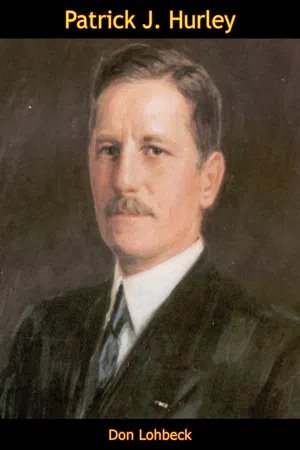
First published in 1956, this is the biography of Patrick Jay Hurley (1883-1963), a highly decorated American soldier, statesman, and diplomat who served as the U.S. Secretary of War (1929-1933), President Roosevelt's personal representative in the Near and Middle East (1943), and U.S. ambassador to China (1944-1945). It details the historic events with which Major-General Hurley came in contact; the absorption of the American Indian; the civilizing of the frontier; the Great Depression; the industrialization of the American nation; the Second World War; and, ultimately, his entrance into the contest for world power.
A fascinating read.
"The life of Patrick J. Hurley is the story of America, the land of opportunity. From the coal fields of the frontier land of Indian Territory, to a foremost place in the cabinet of the President of the United States, to a position as trusted confidant and personal diplomatic representative of the Commander-in-Chief—in his life is brought to fulfillment the American dream that integrity and ability, fortified by hard work and ambition, will receive rewards that no bond of poverty or class can nullify."—Prologue
- 462 pages
- English
- ePUB (mobile friendly)
- Available on iOS & Android
eBook - ePub
Patrick J. Hurley
About this book
Information
Topic
StoriaSubtopic
Storia europeaPART I: 1883-1916
The beginning is half of the whole.—PLATO
* * * * *
MY FATHERS sleep on the sunrise plains,
And each one sleeps alone.
Their trails may dim to the grass and rains,
For I choose to make my own.
I lay proud claim to their blood and name,
But I lean on no dead kin;
My name is mine, for the praise or scorn,
And the world began when I was born
And the world is mine to win.
—The Westerner, BY CHARLES BADGER CLARK
* * * * *
CHAPTER 1—THE LAND AND THE PEOPLE
AT THE TIME of the white man’s arrival in America, the most culturally advanced among the American Indians was that group known as the Muskhogee. This group of Indians, occupying the gulf states, included the Creek, Seminole, Chickasaw and Choctaw tribes—with the Cherokee (an Iroquois offshoot), they became known as The Five Civilized Tribes.
Conflict between the whites and the Indians was inevitable, and by the time of the American Revolution it was open. It was their differing attitudes toward the land that made the conflict unavoidable. To the Indians, with an economy based primarily on hunting, it was essential that use of the land be available to all—and the hunting grounds were owned communally by the whole Tribe. The white man, with his agricultural economy, demanded individual ownership of specified tracts of land. These differing needs created a situation in which two incompatible ways of life attempted to occupy the same territory.
As the conflict was inevitable, so was the result predictable; the increasing numbers and superior technology of the white man soon deprived the Indian of his land. In order to give the Indians some protection, and to provide them with permanent homes, a system of reservations was established and the various tribes were confined to specific locations—but this did not work out as planned, for as the available land was occupied, the land-hungry white settlers reached out for the reservation lands; the Indians were hustled from one reservation to another in advance of the white settlers and, as a result, instead of offering the Indians protection, any opportunity they might have had to adopt white customs and integrate themselves into the conquering civilization was frustrated and destroyed.
By 1830, under pressure from land speculators and settlers, Congress passed a Removal Bill providing that Indian-held lands in the Eastern States be exchanged for land west of the Mississippi—and that the Indians be removed to this new land, Indian Territory. The Indians of the Five Civilized Tribes had little desire to forsake their homeland for the hazards of the unknown West. They resisted the forced removal, which was accomplished only by brutal military force in a long drawn out process that brought disaster to the tribes.
In wagons and with steamboats, as may be found necessary, the United States agree to remove the Indians to their new homes at their expense and under the care of discreet and careful persons, who will be kind and brotherly to them.
said the Treaty of Removal with the Choctaws. But, in fact, scarcely a single one of the many caravans moving the Indians westward escaped the fatal effects of starvation or epidemic, and this tortuous migration comprises a gruesome chapter in American history.
By 1840, approximately 40,000 Indians had been removed to Indian Territory—the last home of the Five Civilized Tribes.
The western lands set aside for the Indians’ use was considered, by white estimate, to be worthless—the Great American Desert. However, the white man’s uncontrollable march to empire soon set aside the good intent of this Permanent Indian Frontier policy. Long caravans of covered wagons carrying migrants to Oregon, refugees to Mormon territory, and gold seekers to California soon drove a wedge through Indian Territory—and, as the Great Plains were transformed into a roadway to the Pacific, it was discovered that here was rich, fertile, virgin soil—waiting for the plow, the seed, the pioneer. And wherever there was land to till there were white men waiting to take it.
The admission of Texas to the Union in 1845 set up a wall against Indian expansion southward; in 1861, Kansas became a state—a barrier hemming in from the north. Indian Territory, the home of the Five Civilized Tribes, became a frontier within a nation.
The Civil War brought further hardships to the Civilized Tribes. Confused and bewildered, the Indians had been persuaded by sympathy and trickery to enter into treaties of alliance with the Confederacy. So, in the cruelty of reconstruction, Indian Territory was not spared. The United States Government treated the Civilized Tribes as defeated enemies—all rights guaranteed under previous treaties were declared forfeit; new agreements, in which the Indians were forced to cede to the United States title to the western half of their “permanent home,” were presented for signature.
Ostensibly, Indian Territory was still reserved to the Indians, but an increasing number of white squatters had drifted in and stayed. In addition, thousands of would-be settlers and land speculators demanded that the Territory be opened to white settlement. Closer and closer came the white flood that was finally to engulf the hunting grounds of the Civilized Nations.
Agitation for the breaking-up of the Indians’ communal holdings, whether motivated by selfish or humanitarian reasons, resulted in the passage by Congress of the Dawes Severalty Act of 1887. Under provisions of this Act (and subsequent agreements) each Indian head of a family was allotted 160 acres of the tribal land for his individual use; the land remaining after these allotments was to be sold—the funds obtained reverting to the tribe.
With the end of the communal way of life, the power of the chiefs and tribal councils was also weakened. The Indians became a hapless minority on their own land.
In the early 1880’s, however, Indian Territory was still Indian country and white squatters were an alien and intruding people, who not by purchase nor by trade could secure ownership of the land which was still held communally in the name of the tribe. White men living in the Territory had no vote; they had no voice in the government under which they lived. It was an Indian way of life—dictated by Indian laws, customs and traditions—that prevailed.
Industry was almost totally lacking, because, with ownership of land prohibited, there was little incentive for capital investments. The early white settlers, who could only live in the Territory as tenants of the Indians, were limited to ranching on tribal leases, sharecropping on Indian farms or mining coal on restricted Indian properties as virtually the only means of employment.
White civilization lay on all sides, waiting impatiently to absorb the Indian lands into the rapidly growing nation—but, in the 1880’s, this was still the wild frontier, the Indians’ home.
Into this land, in that portion occupied by the Choctaw Nation, in the summer of 1882, along the old Texas Road winding northward from Denison, Texas, came an open wagon bearing the family and possessions of an Irish immigrant—Pierce O’Neil Hurley.
Born in County Waterford, Ireland, in 1835, Pierce Hurley had grown up to be a passionate fighter in the cause of Irish freedom. Sporadic outbursts of Irish nationalism were constantly flaring into uniformly unsuccessful attempts at rebellion against the British Crown and during one such flurried encounter with English troops, a soldier was killed; Pierce Hurley was wounded. The Irish rebel became a hunted man, and he decided that wisdom dictated he should continue his quest for freedom in more peaceful surroundings. There was never a question of where to go; for those with an adventurous spirit and with an unquenchable hatred of tyranny and oppression there was a golden land of freedom and opportunity, the United States of America.
The close of the Civil War brought turbulent times to this land of freedom. To the Civilized Tribes it brought the loss of their western lands; to the Southern States it brought Reconstruction. The Congressional elections of 1866 had put the Radical Republicans in power, and through control of Congress they controlled the government—and ruled the South with a heavier hand than the kings of England dared lay upon the Irish isle.
It was a scene of misery, bitterness, hatred, vengeance and martial law that the fugitive Irish immigrant faced when, bringing with him “little else than his shirt and a bullet wound as the memento of his ill-advised clash with the armed forces of Her Majesty,” in the late 1860’s he arrived on the shores of Texas.
The problems that Pierce Hurley was required to meet, as he sought to rebuild his life in Texas during the volcanic period of the post-war years, can better be imagined than described—few records exist. He was sturdily built, with Irish charm and an infectious smile—an armigerous individualist with an intense and burning desire for personal freedom. He drifted through Texas, farming and punching cattle. In Gonzales, Texas, he applied for citizenship; in Paris, Texas, it was granted. Moving again, this time southward to Caldwell County, Pierce Hurley met a young Irish girl named Mary Kelly.
Of the early life of Mary Kelly nothing is known excepting that she was born on May 21, 1857, and attended a girls’ boarding school in San Antonio. Her family had spent some time in Van Zandt County, and she was related to the Caldwell and Lockhart families who founded the towns of Caldwell and Lockhart, Texas.
In the late 1870’s Mary Kelly and Pierce Hurley were married in San Marcus, Texas. They moved west as far as New Mexico, but by 1881 were back at Luling, Texas, farming on land purchased “for 10¢ an acre.” Texas, however, did not provide Pierce Hurley with the success and abundance that fabled American opportunity had offered, so, in the summer of 1882, he and his family (which now included two daughters and a son) trekked northward, across the Red River and into Indian Territory.
Whites were by this time permitted to enter the lands of the Five Civilized Tribes, and it was in what is now Coal County, Oklahoma, but was then the Choctaw Nation, that the Hurleys stopped. On a small farm rented from a prominent leader of the Choctaws, the weary Irish family sent down the roots of their new life.
The Indians had not forgotten the Jacksonian era of deceit and oppression, and the remembrance did not help to ease the lot of the white settlers in this land where they could be but temporary residents. Life in Indian Territory in the 1880’s was raw and brutal for the white man. This was still the frontier and frontier law prevailed. Grievances were settled with fists or guns, and personal and factional feuds were pursued to the death by both whites and Indians.
The small farm the Hurleys rented provided the necessities of life for the growing family, but three successive years of drouth, and a fire that destroyed the family house, made another move unavoidable. Pierce Hurley, according to his son, “was the best bronc-buster in the Red River valley,” but ranch work was not the work for a man with a family to raise. There was only one other job at hand, so Pierce Hurley went to work as a pick and shovel day laborer in the coal mines at Lehigh, a few miles away from the rented farm.
In the marriage of Pierce Hurley and Mary Kelly the two utterly different but strangely complementary facets of Irish temperament were brought together.
Pierce O’Neil Hurley was a man of mercurial temper. In the elemental environment of Indian Territory he soon “was renowned as a two-fisted scrapper, ever ready to do battle for any cause he upheld.” His vigorous insistence on personal independence had led to his fight against British authority in Ireland—and his search for freedom of thought and action led him to travel, penniless, thousands of miles from home, to shun the comparative ease to be found in the Irish colonies of the eastern American cities, and to make his way to the last frontier. His refusal to accept domination was also tinged with a rebellion against conforming to the accepted customs of the society in which he lived; and his scorn for arbitrary authority was also, in a way, a disregard for the opinions and estimates of his compatriots. “Whatever crushes individuality is despotism, by whatever name it may be called,” was the philosophy that he carried to an extreme. An Irish Republican in the heart of Dixie—from any perspective, that signifies an individualist.
Though he had left his native land, and was never to return, Pierce Hurley was an Irishman until he died. The legends, the poetry, the history of Ireland he carried with him always. The children of the mining camp long remembered the colorful stories of battles and heroes that followed when “Pat’s father brought out his Irish flags.” Material success and social status meant nothing to him. In Ireland every man had royal blood, and even kings had lived in cottages and plowed their own fields and tended their own stock. The unpleasant details of today’s living could always be escaped through retelling the tales of yesterday or relaying plans for tomorrow.
Pierce Hurley was that type of Irishman who could drown his pain and sorrows in a convivial carouse, and forget his disappointments in a bloody (but not too unfriendly) brawl. His sparkling wit and humor went a long way toward counterbalancing his quick temper—and his smile was never more radiant than when he was about to lay an opponent fiat on his back. The kind of Irishman in whose soul the love for independence burned deep in a smouldering fire that sometimes erupted in violence, sometimes in searing verse or brooding mystical folklore—he was one of the reasons why the fight for freedom, though stomped into oblivion time and time again, still rose anew throughout the history of the Emerald Isle.
Mary Kelly Hurley was the other Ireland. A quiet, devout and patient woman, it never entered her mind to run from trouble—problems were to be faced and solved, not evaded. She accepted her lot, however hard, but worked to improve it. It was not in her nature to risk everything in an heroic but futile gesture; she would build today on the carefully laid foundation of yesterday. Like her husband, she regarded the glorious ideals—but first she bore her children, maintained her home, and established the morality and developed the character of those entrusted to her care. She had an unshakable faith in certain fundamentals of life that our age has forgotten or denied—that honor, integrity, honesty and a willingness to work are the marks of superior character.
She had been educated at a Catholic institution, and where Pierce Hurley had his flags and legends, Mary Hurley had her religious symbols and her prayers. She never suffered from despair. In the worst adversity that poverty, nature or the rugged society in Indian Territory could throw against her, she was always gentle and cheerful. It was her soft strength that curbed the volatility of her husband and made a Christian home in the savage frontier land. By example, and by careful teaching, she instilled in her children an inability to compromise in matters of conscience or morals. She taught them to be willing to give to others the same love and respect that they wished to receive; to despise false pride, hypocrisy and snobbishness—to detest the bully.
This stalwart woman would have been equally at home on any frontier, anytime, anywhere in the world. Hers was the streng...
Table of contents
- Title page
- TABLE OF CONTENTS
- INTRODUCTION
- A PROLOGUE
- THE MOTIVATION
- PART I: 1883-1916
- PART II: 1916-1940
- PART III: 1941-1944
- PART IV: 1944-1945
- PART V: 1945-1956
- THE DECISION
- CONCLUSION
- REQUEST FROM THE PUBLISHER
Trusted by 375,005 students
Access to over 1.5 million titles for a fair monthly price.
Study more efficiently using our study tools.
Frequently asked questions
Yes, you can cancel anytime from the Subscription tab in your account settings on the Perlego website. Your subscription will stay active until the end of your current billing period. Learn how to cancel your subscription
No, books cannot be downloaded as external files, such as PDFs, for use outside of Perlego. However, you can download books within the Perlego app for offline reading on mobile or tablet. Learn how to download books offline
Perlego offers two plans: Essential and Complete
- Essential is ideal for learners and professionals who enjoy exploring a wide range of subjects. Access the Essential Library with 800,000+ trusted titles and best-sellers across business, personal growth, and the humanities. Includes unlimited reading time and Standard Read Aloud voice.
- Complete: Perfect for advanced learners and researchers needing full, unrestricted access. Unlock 1.5M+ books across hundreds of subjects, including academic and specialized titles. The Complete Plan also includes advanced features like Premium Read Aloud and Research Assistant.
We are an online textbook subscription service, where you can get access to an entire online library for less than the price of a single book per month. With over 1.5 million books across 990+ topics, we’ve got you covered! Learn about our mission
Look out for the read-aloud symbol on your next book to see if you can listen to it. The read-aloud tool reads text aloud for you, highlighting the text as it is being read. You can pause it, speed it up and slow it down. Learn more about Read Aloud
Yes! You can use the Perlego app on both iOS and Android devices to read anytime, anywhere — even offline. Perfect for commutes or when you’re on the go.
Please note we cannot support devices running on iOS 13 and Android 7 or earlier. Learn more about using the app
Please note we cannot support devices running on iOS 13 and Android 7 or earlier. Learn more about using the app
Yes, you can access Patrick J. Hurley by Don Lohbeck in PDF and/or ePUB format, as well as other popular books in Storia & Storia europea. We have over 1.5 million books available in our catalogue for you to explore.