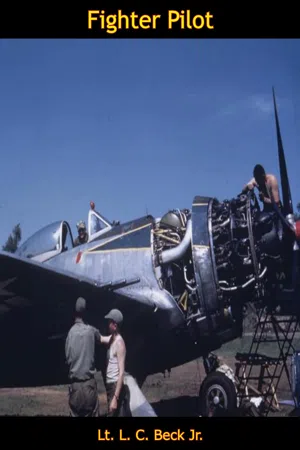
Fighter Pilot is the incredible story of a World War II fighter pilot, 1st Lieutenant Levitt Beck, Jr., who was shot down in German-occupied France and hidden by members of the French underground. There he wrote this story of his life practically up until the moment he was discovered. He perished in Buchenwald concentration camp, but his manuscript was delivered to his parents after the war, who took on the responsibility of seeing it published posthumously in 1946.
Lt. Beck was shot down near Havelu, Eure-et-Loir, France on 29 June 1944 on an Armed Reconnaissance mission to the Mantes-la-Jolie/Gassicourt area. Although he initially managed to evade capture, he was eventually taken prisoner and, together with more than 167 other Allied airmen, was on a convoy that left Paris on August 18, 1944. He was interned at the Buchenwald concentration camp on August 20, 1944, where he became ill from maltreatment and undernourishment and died of "Lungentuberculosis" (phthisis; pulmonary consumption) in the camp hospital on October 31, 1944, aged 24.
His remains were never found and he continues to be listed as MIA (Missing in Action). He is believed to have been cremated in Buchenwald the day following his death. He memorialized at the Luxembourg American Cemetery, Luxembourg City, Great-Duchy of Luxemburg.
- 139 pages
- English
- ePUB (mobile friendly)
- Available on iOS & Android
eBook - ePub
Fighter Pilot
About this book
Information
Subtopic
European HistoryIndex
HistoryCHAPTER ONE—The Fourth of July
July 4th, 1944
Anet, France
My very dear Mom and Dad:
I am writing this letter in my little room over a French café, in Anet, France. I am hiding here until the plans for my escape and return to England take place. They have not changed as yet, and I am praying that they will remain the same and will go through. I shall at least have had the chance to get back to England.
This is a very special day in the States and I am thinking of some very special folk, probably a little more fondly, than usual. Maybe it’s the little boy cropping out in me again, and the fact that I am so very far away from you all, that home and memories of everything that goes with it, have stood out so vividly in my mind.
How much I would give to live again those July 4ths on Bellaire Blvd. in Houston, Texas, from 1920 to 1932, when my brother, Floyd Meredith and I used to get up at the crack of dawn and begin the day’s blitz. Each with our cigar box of fire-crackers, carefully separated to make them last longer, a few pieces of punk, matches and maybe a cap pistol and the usual ammunition.
I always wanted to do just as Floyd Meredith did, as he, in my estimation, was nothing short of a General.
I am reminded again of that first July 4th, 1932, in Huntington Park, California, when I was awakened by a new friend, Bob Dunn. I remember how it hurt, when I realized that I would never again hear the voice of my brother or have his companionship. When Bob called through my bedroom window, “Get up, it’s the 4th”, I buried my face in my pillow with a smothered sob and said, “What’s the use?”
There have been eleven July 4ths since that day and Bob became one of my best friends. This twelfth Fourth finds me in quite a spot. Memories of home and friends are tugging on the heart strings and I must admit I am downright homesick.
This may turn out to be a more lengthy letter than I think. As you know, I am in enemy lines and have had to stay inside this room, so as not to be seen—even by the French people. They would not turn me in, but they might talk about “the Americaine”, and the Germans might hear.
My reason for writing this letter and all that I have since I have been here, is to let you know just what happened on my last mission, the 29th of June, and to write some of the things I want to say about us, the “Fighter Pilots” of the Army Air Forces, of the French Underground and its work, and some things too, about home and memories of you.
The idea has been growing within me these last few days that I should like to take all these experiences and others I have had, and have my book, “Fighter Pilot”, published after the war is over. There is the thought too, that “Lady Luck” may not be able to ride all the way with me. So, while I have a few days to wait for the French Underground to complete their plans for my escape back to England, I see no reason why I shouldn’t write every day, all that I can, so that just in case my luck has run out, you will know what has happened to your wandering son.
I may be taken prisoner, and if so, I have no idea what they will do to me. I shall be wearing my French clothing over my officer’s clothes and I suppose they could shoot me for that. If I have to stand in front of the firing squad I shall not be afraid or sorry. I shall grin at the stupid Germans and know that soon they will all be dead too.
Mom, I have told you before, before I came over here, that I didn’t feel like giving my life for my country, that I just wasn’t that patriotic. Well, I am now, and I shall be very proud to die for my country. You can’t realize just how I feel perhaps, but you must believe me with all your heart.
And you, Dad, you can throw back your shoulders and say, “My son gave his life fighting for America. He died a brave man and I am proud to say—He was my son!!”
That is the only way I shall think of you as feeling, Pop. Your guts were born in me and I’m very proud that they were. You can think of me only as your son, or you can think of me as a “Son of the United States.” If I were afraid to die I would never want to face you or any other American again, as long as I might live.
When I came over here I more or less promised you both that I wouldn’t try to be a hero or anything, but just a plain “Fighter Pilot”. I have done just that. I haven’t tried to make the headlines and I haven’t thought of giving up my life unless it were in the line of duty. I guess I could be a hero if I wanted to. It would seem rather useless however, to throw my life away when I could do much more damage to the enemy by living.
I hope you can understand how I feel and by so doing know that I am happy.
Night before last I listened to the radio and as I turned the dial I heard the announcer say, “This is America calling...this is America calling.” Then they played “Yankee Doodle.” I couldn’t help but cry. I think it is the first time I have cried in some years, but my feelings were just too strong. The song just seemed like America itself, and here was I, an American, in France, inside German lines, yet nothing could keep America away from me. I listened to the program and wished with all my heart that I could thank them for that broad cast. It gave me inward strength, a feeling of pride, respect and a duty-bound feeling for my America.
I wish so much I could write just how I felt then. It would be a great piece of writing, but I just haven’t the skill for putting on paper something which is so much greater than myself. It is too big a thing for me. I shall always have the thrill of remembering that moment though, and the joy of knowing that I really am patriotic. I am glad to find it out and although I don’t care for the word itself, I have the feeling.
I just stopped writing to watch a terrific air battle, the Americans against the German guns. I can’t explain how it made me feel other than to simply say I’m immensely proud to tell the French people:
“I am an American.”
With the rain pouring from a somewhat clear sky, filled with the black puffs of the German 88’s, the Thunderbolts screamed down to release their 1000 pound bombs. I saw towering clouds of smoke running up to the layer of white clouds. The whole sky seemed to darken a bit as the roar of the engines died out. I must admit, my eyes were a bit wet and my throat seemed tight...God, how I’d like to be up there with them!
From my third-story window I’ve watched and although it hurt to just sit by, I was so glad they came near enough for me to see. It’s a queer feeling to sit on the ground and see your American pals being shot at. I wanted to run out and kill every gunner I could find, but I realize that if it were possible, the French would have tried it. I must wait until I can get back to England and get another kite to fight in—the kind of fighting I know best.
CHAPTER TWO—My First “Victory”
WE WERE TO fly the “early one” that morning of June 29th. We dashed down in the murky dawn, that only England can boast about, for breakfast and briefing. Both very satisfying, we took off and headed for our target, just a few miles south-west of Paris, along the Seine river. My flight carried no bombs, as we were to be top cover for the squadron on their bomb run. It was a group (three squadrons) mission.
Just before we reached the first target, a bridge, the flak opened up and we did some evasive action to go around it. None of it came very close to my flight, but we were not giving them very much of a target to shoot at, I guess. The clouds made it rather hard to keep the others down below in sight, so I dropped down to about 12,000 feet. We lost the rest of the squadron for a while and then I spotted them to the west, being shot at. I started over there with my flight and as we neared the others, someone in my flight called:
“Break, Beck, flak. Break left!”
I did, and then, Eddie, I believe, said:
“It’s a 190.”
I turned 180 degrees and saw the 190 in the middle of three 47s—Cramer, Eddie and Unger. I gave it full boost and started back after the little devil. He looked very small among the Thunderbolts and I had no trouble recognizing him as a 190. He was breaking up and then I think he saw me coming after him as he turned around and we were then going at each other head on. For a brief second I thought of breaking up into a position where I could drop on his tail, but he was the first Jerry I’d ever seen and I wasn’t going to let him live that long if I could help it.
I knew, however, that his chances of shooting me, at head on, would be just as good but I was a little too eager and mad to give a damn. I squeezed the trigger and I think the first round hit him because I saw strikes on his cowl, wing roots and canopy all the way in. I guess I’d have flown right through him, but he broke up a little to the left and I raked his belly at very close range. I thought to myself:
“Becky, there’s your first victory”
Just to make sure, though, I turned with him and started down but I didn’t seem to be going very fast. I rammed the throttle with the palm of my hand but was rather astonished to feel it already up against the stop. I flipped on the water switch but that didn’t seem to do any good either. I looked down at my instruments and then it was very clear. My engine had been shot out. I felt a little panicky at first but settled down and started “checking things.”
Nothing I did seemed to have any effect, so I called:
“Eddie, I think I may have to bail out.”
Oil started licking back over the cockpit. Here we go again, I thought. Just like Cherbourg. She is even worse this time, I guess. The damned engine was just turning over and that was about all. I knew I could never make the channel but I was still trying, I guess, because I was messing around with the throttle and everything I could get my hands on...6000 feet now.
I still had my eye on my “victory”, though. He was going down in a spiral to the left, smoking very badly. Wham! Something hit me in the back and threw me forward. I didn’t need to look to know what it was. I broke to the left pulling streamers off everything and there he was. A sleek little 190 sitting on my tail—gray and shiny, spitting out flames of death up at me. It wasn’t a very pretty sight, I must say—looking down his cannons—I knew then that I was no longer fighting to get the ship running again. I was fighting for my life!!
I was pretty scared for an instant, but it seems that just when I get that feeling inside and almost think I’m a coward, something snaps. It did, and I was once again the mad fighting American I had been, with an engine. I forgot for the time being that my engine was dead, I guess, because I watched him flash past and then jerked my kite around to the right to a point I knew he would be. I hadn’t looked out the front of the canopy for some time and now as I did, all I saw was the reflection in the glass, covered with oil, of my gun-sight. I cursed and pulled the trigger, shooting in the dark, but at least I felt better. I kicked the ship sideways to have a look out of the side and there was Jerry—just a hundred yards up front. I swung the nose around to about the right position, I thought, and fired. I don’t know whether I hit him or not, but he seemed in pretty much of a hurry to get the hell away.
I pressed the “mike” button and said:
“I’m bailing out.” But all I heard was deathly silence. I knew then that my radio had been blown to bits by the Jerry on my tail.
I thought that I’d better jump at about 4000 feet, so I undid my safety belt and just then my ship shuddered and I heard terrific explosions all around me. I looked out of the only clear space left in the canopy, and saw more flak than I’d ever dreamed possible in one small area. I couldn’t see which way to break so I just went to the right, because the ship did, I guess. I knew then that to bail out would mean sure capture and I still had just a wee bit of hope left for my chances of getting away. I decided to stick with the ship and try a trick that “Benny” and I had talked about one night before he was killed.
I opened the canopy a crack so I could see the ground and when I did, I saw the longest clear stretch of land I think I ever saw in France. It was just about the right distance away, I thought, for me to make my dive to the deck and then scoot over there, at tree top level, and belly in.
I remembered that I had taken my safety belt off, so I started trying to put it on and still keep my eye on Jerry at the same time—also fly the ship—without an engine. Some fun, and if you want to try your ability at being versatile, it is a good trick.
I got under Jerry without his seeing me, I guess, and then down among the trees; I had to keep a keen eye out of the cockpit, so I gave up the idea of buckling my belt again, and decided that I would stretch my luck a bit more, by doing the impossible. I really had no choice, but to hell with the belt. Here comes Jerry again. I had about 275 MPH, so I felt pretty “safe”, you might say. I would wait until he got in range, then break and throw off his aim and then belly in. It was very simple, when you happen to be the luckiest guy in the whole air force. I put one hand on the instrument panel...
Table of contents
- Title page
- TABLE OF CONTENTS
- DEDICATION
- ILLUSTRATIONS
- I SEE IT NOW
- FOREWORD
- AUTOBIOGRAPHY
- CHAPTER ONE-The Fourth of July
- CHAPTER TWO-My First “Victory”
- CHAPTER THREE-My Escape From Crash
- CHAPTER FOUR-Underground Plans for My Escape
- CHAPTER FIVE-View From My Window
- CHAPTER SIX-A Rough Little Encounter
- CHAPTER SEVEN-Part of Our Job
- CHAPTER EIGHT-“Ole A Flite”
- CHAPTER NINE-High Stakes
- CHAPTER TEN-The Real Test
- CHAPTER ELEVEN-D-Day
- CHAPTER TWELVE-Robot Bombs
- CHAPTER THIRTEEN-Day Dreaming
- CHAPTER FOURTEEN-French Comrades
- CHAPTER FIFTEEN-Farewell Letters
- FELLOW OFFICERS WITH LT. L. C. BECK
- A PILOT’S THOUGHTS
- THE LAST CHAPTER
- EXCERPTS FROM LETTERS
- SCROLL RECEIVED BY LT. L. C. BECK’S PARENTS.
- REQUEST FROM THE PUBLISHER
Trusted by 375,005 students
Access to over 1.5 million titles for a fair monthly price.
Study more efficiently using our study tools.
Frequently asked questions
Yes, you can cancel anytime from the Subscription tab in your account settings on the Perlego website. Your subscription will stay active until the end of your current billing period. Learn how to cancel your subscription
No, books cannot be downloaded as external files, such as PDFs, for use outside of Perlego. However, you can download books within the Perlego app for offline reading on mobile or tablet. Learn how to download books offline
Perlego offers two plans: Essential and Complete
- Essential is ideal for learners and professionals who enjoy exploring a wide range of subjects. Access the Essential Library with 800,000+ trusted titles and best-sellers across business, personal growth, and the humanities. Includes unlimited reading time and Standard Read Aloud voice.
- Complete: Perfect for advanced learners and researchers needing full, unrestricted access. Unlock 1.5M+ books across hundreds of subjects, including academic and specialized titles. The Complete Plan also includes advanced features like Premium Read Aloud and Research Assistant.
We are an online textbook subscription service, where you can get access to an entire online library for less than the price of a single book per month. With over 1.5 million books across 990+ topics, we’ve got you covered! Learn about our mission
Look out for the read-aloud symbol on your next book to see if you can listen to it. The read-aloud tool reads text aloud for you, highlighting the text as it is being read. You can pause it, speed it up and slow it down. Learn more about Read Aloud
Yes! You can use the Perlego app on both iOS and Android devices to read anytime, anywhere — even offline. Perfect for commutes or when you’re on the go.
Please note we cannot support devices running on iOS 13 and Android 7 or earlier. Learn more about using the app
Please note we cannot support devices running on iOS 13 and Android 7 or earlier. Learn more about using the app
Yes, you can access Fighter Pilot by Lt. L. C. Beck Jr. in PDF and/or ePUB format, as well as other popular books in History & European History. We have over 1.5 million books available in our catalogue for you to explore.