The life and thought of an important but neglected nineteenth-century Congregational preacher and theologian.
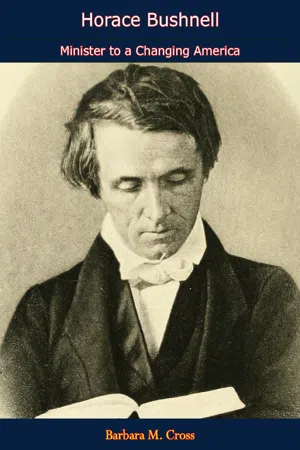
"My purpose in this book has been to analyze the religious thought of Horace Bushnell and the emergence of his theology from his society and tradition. Because Bushnell had to interest and address the Protestant middle class of nineteenth-century America, the book has partly become a study of the concerns and values of this group; because Bushnell was a Congregational minister, it is also an interpretation of the adjustment of Christianity to a specific time and place. Undermined by apathy, science, republican enthusiasm, and middle-class pride, American religion in the nineteenth century faced a crisis that threatened to destroy it as a viable intellectual belief. Bushnell met this crisis so successfully that his work became a turning point in American Protestantism. I have traced here the interplay between secular pressures and religious thought; I have also tried to show how the Christian faith maintained its own challenge and imperatives during all adjustments."
- 170 pages
- English
- ePUB (mobile friendly)
- Available on iOS & Android
eBook - ePub
About this book
Trusted by 375,005 students
Access to over 1.5 million titles for a fair monthly price.
Study more efficiently using our study tools.
Information
Topic
Theology & ReligionSubtopic
ReligionA Bibliographical Comment
The following summary notes only the books that proved particularly helpful in preparation of this study. My doctoral dissertation, from which the present work was adapted, contains a complete bibliography and can be found in Widener Library, Cambridge, Massachusetts.
The Spirit in Man, edited by Mary Bushnell Cheney (New York, 1903), contains selections from the important sermons that Bushnell left unpublished. The complete manuscript of the crucial sermon “God Reigns for the Largest Love” adds valuable material, however. The five handwritten Journals of the trip to Europe, though largely dutiful records of the dimensions of churches visited, are interesting as the only record in diary form which Bushnell kept. Mary Bushnell Cheney’s Life and Letters of Horace Bushnell (New York, 1880), presents his correspondence, writings, and personal life from a daughter’s point of view.
For understanding of the religious tradition in which Bushnell worked, Perry Miller’s The New England Mind (New York, 1939) and Jonathan Edwards (New York, 1949) are essential. Frank H. Foster’s A Genetic History of New England Theology (Chicago, 1907) is lucid, though rather narrowly focused on the question of free will. Joseph Haroutinian’s Piety vs. Moralism: The Passing of New England Theology (New York, 1932) traces the complex theological changes that subtly transformed the Calvinism of the Puritans into a rationalistic moralism. Two works by European scholars made it possible to set Bushnell’s contributions to theology in broader perspective. Heinrich Brunner’s Die Mystik und das Wort (2d ed.; Tübingen, 1928) discriminates between Christian faith and Schleiermacher’s mysticism, and Anders Nygren’s Agape and Eros, translated by A. G. Herbert (London, 1932), brilliantly defines the disparity between Pauline agape and pagan eros.
Contemporary ideas affecting Bushnell’s thought include the theories of Unitarians and transcendentalists, the restatements of orthodoxy, and the new beliefs resulting from science. Perry Miller’s The Transcendentalists (Cambridge, Mass., 1950) presents and interprets the contending issues and theories cent...
Table of contents
- Title page
- TABLE OF CONTENTS
- Dedication
- Acknowledgments
- Introduction
- I. Origins
- II. A Christianity for Common Sense
- III. The Preferences of the Romantic Sensibility
- IV. A Fastidious People
- V. The Security of Christian Nurture
- VI. The Expedient of Eloquence
- VII. The Experience of Words
- VIII. Science and Faith
- IX. The Law of Sacrifice
- X. The Uses of Theology
- A Bibliographical Comment
Frequently asked questions
Yes, you can cancel anytime from the Subscription tab in your account settings on the Perlego website. Your subscription will stay active until the end of your current billing period. Learn how to cancel your subscription
No, books cannot be downloaded as external files, such as PDFs, for use outside of Perlego. However, you can download books within the Perlego app for offline reading on mobile or tablet. Learn how to download books offline
Perlego offers two plans: Essential and Complete
- Essential is ideal for learners and professionals who enjoy exploring a wide range of subjects. Access the Essential Library with 800,000+ trusted titles and best-sellers across business, personal growth, and the humanities. Includes unlimited reading time and Standard Read Aloud voice.
- Complete: Perfect for advanced learners and researchers needing full, unrestricted access. Unlock 1.5M+ books across hundreds of subjects, including academic and specialized titles. The Complete Plan also includes advanced features like Premium Read Aloud and Research Assistant.
We are an online textbook subscription service, where you can get access to an entire online library for less than the price of a single book per month. With over 1.5 million books across 990+ topics, we’ve got you covered! Learn about our mission
Look out for the read-aloud symbol on your next book to see if you can listen to it. The read-aloud tool reads text aloud for you, highlighting the text as it is being read. You can pause it, speed it up and slow it down. Learn more about Read Aloud
Yes! You can use the Perlego app on both iOS and Android devices to read anytime, anywhere — even offline. Perfect for commutes or when you’re on the go.
Please note we cannot support devices running on iOS 13 and Android 7 or earlier. Learn more about using the app
Please note we cannot support devices running on iOS 13 and Android 7 or earlier. Learn more about using the app
Yes, you can access Horace Bushnell by Barbara M. Cross in PDF and/or ePUB format, as well as other popular books in Theology & Religion & Religion. We have over 1.5 million books available in our catalogue for you to explore.