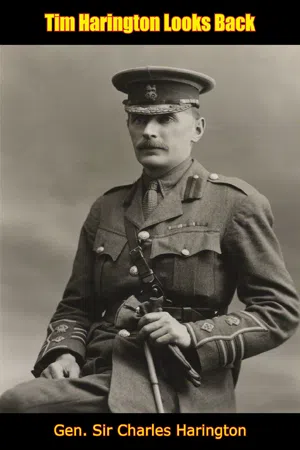
General Sir Charles Harington Harington, who received the nickname "Tim" after being gazetted to The King's Regiment and joining the Serapis at Aden in 1892, was a British Army officer who served in the Directorate of Mobilization in 1914 and then became Plumer's BGGS in the 2nd Army in France. After World War I, he became DCIGS to Henry Wilson, then GOC Allied Forces of Occupation in Constantinople during the Chanak Affair, which partly led to the downfall of Lloyd George's administration.
It was in October 1920 that Harington was sent by Mr. Winston Churchill—then Secretary of State for War—to Constantinople to succeed General (later Field-Marshal Lord) Milne. The Force at Constantinople (28th Division) was to be reduced to six battalions, a cavalry regiment and some gunners, and Harington was to see the treaty ratified. He was also to lead a Greek division at Ismid, and a Greek regiment at Beicos opposite Therapia on the Bosphorus.
Tim Harington Looks Back is his very own full and frank account of his fascinating life—from his early beginnings, to his military career, to being received by His Majesty the King.
- 246 pages
- English
- ePUB (mobile friendly)
- Available on iOS & Android
eBook - ePub
Tim Harington Looks Back
About this book
Information
Subtopic
British HistoryIndex
HistoryChapter I — EARLY DAYS. SCHOOL AND SANDHURST
I HAVE only written one book and that was the Life of my old beloved Chief, Field-Marshal Lord Plumer, to whom I was Chief of Staff in the Great War, and I certainly had no intention of ever writing another. I have, however, recently retired from the Army after a long and happy innings of forty-seven years, and as, during that time, I have had rather a unique experience, I have agreed, at the request of many friends, to write this account of it. These memoirs contain no literary skill; they are merely the honest memories of a long and interesting life.
I suppose all “Memoirs” start from one’s earliest recollections. I was born at Oaklands, Chichester, on. 3 1st May, 1872 and, although I left there at the age of four, I have always remembered seeing a soldier in a red coat from my nursery window.
When I was C.-in-C. at Aldershot sixty years afterwards, I happened to be at Chichester on a Staff Exercise, and I called at the old house and asked if I might go over it; I found my old nursery window with the same old bars. My red-coated soldier must have been a recruit from the Royal Sussex Depot.
My name was originally Poe, a family well known in Ireland in past years. My father, who died forty years ago during the South African War, had spent the greater part of his life as an indigo planter in Behar, in the good days of indigo when the sportsmanship, generosity and hospitality of the planters was unsurpassed. When I was four years old my father took his mother’s name of Harington, and that is why I have the latter both as a Christian and as a surname. It is somewhat embarrassing at city dinners and public occasions when the announcer will have both.
After attending a private school, I was sent, in 1880, to Gresson’s School at West Mansion, Worthing. Frank Gresson—who was in the Oxford XI and played for Sussex and who until quite recently has kept on the school (then at The Grange, Crowborough), was the head boy, and his father was the headmaster. I remember Gresson’s School principally for two things. The first is that I swam across the baths unaided the first time I was ever put into the water; I always think that this gave me my love of swimming. In later years I did a lot of long-distance swimming, including the swimming of the Bosphorus from Europe to Asia and back. The second thing I remember is the start of my cricket, which has meant so much to me through life. I can see the cricket master now, pegging down my right foot in a net so that I could not run away from fast bowling. I have often thought how much I owed to that man.
Whilst at Gresson’s, I was sent in for a Mathematical Scholarship at Harrow. At the end of the first day’s examinations the names of those not required to attend on the second day were announced. I have a lively recollection that my name was one of the first to be read out!
From Gresson’s I went, in 1886, to Cheltenham, where I had a very happy time. Dr. Kynaston was the headmaster. He was succeeded by Dr. James.
I remember those days principally for cricket and racquets. I was in the eleven of 1890 and used to go in first with Claude Champain. We put up 100 for the first wicket against Clifton, and I got a good score against Marlborough, only to be reminded a few years ago by Dr. Alington, when headmaster of Eton, that he, then in the Marlborough XI, missed me in the slips before I had scored. God bless him for it!
Marlborough had a player called Shorland, who had a sister at the Ladies’ College at Cheltenham, so, on the second morning of the match before play began, the other twenty-one players accompanied Shorland to see his sister at the Ladies’ College. The headmistress was the famous Miss Beale, who will always be remembered for what she did for that college. She was known to be “severe”. We rang the bell, little knowing what was going to happen. Shorland told the maid that he had come to see his sister, and had brought a few friends! Miss Beale came to the front door and saw us all in our flannels and college blazers, and she took no time to make a firm decision. Without a moment’s hesitation she said: “Mr. Shorland, I shall be pleased to allow you to see your sister, but I will admit none of your friends!” and, quite rightly, she shut the door on us!
When I was at Cheltenham College we won both the Ashburton Shield at Bisley and the Public Schools Gymnastics. Needless to say I had nothing to do with either. My only part was to help drag the winners up from the station in some very old-fashioned carriages. One of my greatest friends was Reymond de Montmorency, the famous golfer, who died recently; he was a master at Eton for many years.
As I write on Cheltenham, all sorts of stories come back to memory, none of them very edifying. Two of them have to do with hymns. In my time there was a junior master named Chalice, and we used to wait for the verse in “The King of Love my Shepherd is” which mentions “Thy pure Chalice floweth,” to yell out “Chalice” with such force that the hymn had to be stopped. In a certain match versus Marlborough two of the Marlborough XI were named Wood and Stone, who had both, I think, made a century against us on the previous day: Whether the hymn which contains “Bow down to Wood and Stone” was chosen purposely I shall never know, but we were quick enough to spot it and, with both elevens in the Chapel at the time, we did not forget either Wood or Stone!
When I first went to Cheltenham I passed into a class under a master who had started to grow a beard that term. After a few weeks we all sent him a razor and got 500 lines for doing so, but no doubt it was worth it!
Those were the very early days of Tit Bits and other papers starting prizes for Beauty Competitions. One of the masters had recently married a very pretty wife and he had sent in her photograph and got third prize. We each attended class the next day with a copy of Tit-bits and each got 1,000 lines. Again I suppose it was worth it!
One day a horrible order came out that if one was going up for Woolwich or Sandhurst that year one could not play for the eleven. It was a terrible blow, but I got round it, thanks to the real kindness of certain masters, who took me in extra work of various kinds at all sorts of odd hours from 7 a.m. onwards, in order that I might play for the eleven. I was then in the Army Class under an old cricketer, the Rev. Hattersley Smith, known to, all as “Hatter.” I think it was the only time he had the Army Class. The exam for Sandhurst took place. I was sent up for a trial run as I had some more chances. The results came out the day we were playing the M.C.C. at Lord’s. I had seen the list but I only looked at the second half; and I went to Lord’s’ to be greeted with all sorts of congratulations. Apparently I had passed in 20th (I passed out 120th), and I had never known it. I found out afterwards that there was another “Harington” up from Wellington; I think I must have got most of his marks. I am surer the “Hatter” was equally surprised. As far as I can remember he was on the selection board of the M.C.C.; anyhow I was then and there proposed as a playing member of the M.C.C., and I actually joined my regiment in. January, 1892, as a member of the M.C.C., tie and all—a proud moment.
I have many other happy recollections of Cheltenham College, and especially of “Woofie”, the old Gloucestershire professional, and College coach. I have met so many old Cheltonians throughout the world. I am very proud to be a member of the College Council and I take the greatest interest in the old school. I also have the honour to be a Governor of Wellington College.
I went back to Cheltenham last year on Speech Day. The Duke of Beaufort, Lord-Lieutenant of Gloucester, gave away the prizes, and the Duchess opened the thirteen magnificent new class-rooms presented by the Old Cheltonian Society as part of our centenary celebrations. It happened that there are thirteen Cheltonians, past and present, who have won the Victoria Cross and so it has been decided to call each class-room after one of them.
I enjoyed seeing the old College again, and visiting my old haunts, and I watched the cricket against the old Cheltonians, the match I had played in forty-nine years before.
I attended the Old Cheltonian Dinner and met many old friends. One of them, the holder of a V.C., sat next to me at dinner and asked me what they had taught me at Cheltenham. I replied that they had got me into Sandhurst somehow. But what I hope and believe is that they taught me the true meaning of “Loyalty” and “Unselfish Service”, and I venture to think that it was his own loyalty to his gallant little Gurkhas which helped him through the heroic action that earned him the coveted V.C.
This officer, Major-General Neame, V.C., is now holding a high position as D.C.I.G.S., and we are also proud that General Sir John Dill, who commanded the 1st Corps in the B.E.F., is now C.I.G.S. We have many old Cheltonians holding high positions in the war.
Next morning, Sunday, there was a beautiful service in the College Chapel which was packed with boys and their parents. The sermon was preached by the Dean of Hereford, who as Canon Waterfield was Principal of the College for twenty years. He preached on “Memories”; and a more beautiful and moving sermon I have never heard. I tried to picture his “Memories” of the old College. He had seen the laying of every brick of the Chapel, which was built to celebrate our fiftieth anniversary and was opened in 1893. As he pointed out, not a boy he was addressing was born when he left the College twenty years ago. He was there during both the South African War and the Great War.’ The memorials in the Chapel are all erected to those whom he called “The Boys”. The memorial to our 670 Old Cheltonians who gave their lives in the Great War is at the entrance to the Chapel. We of the older generation had known those men and are truly proud of them.
Though, as the Dean said, it might be possible for the younger generation today to ask, with some reason, what they had to remember except that the older ones had left the world in a worse state than before, the lives and services rendered by these Old Cheltonians to their King and Country could not fail to be an inspiration to those whom he was addressing.
I looked down from my Council stall on those youngsters with the world before them, and on the proud but anxious faces of the parents about to see their sons launched on this troubled world and, as we sang that beautiful poem “England”, I knew that those grand lads, and their fellows in our other great schools, would spare no effort to keep our Empire great, and ever foremost in upholding Peace, Justice and Duty. That was in June, 1939. One little thought then that we were within three months of the storm breaking and that those young lads were going to start their careers amidst the horrors of war.
The war hit our College very hard. In the depths of secrecy, known only to our President, Lord Lee of Fareham, and to the headmaster, the Office of Works seized the College.
But the Office of Works addressed this carefully guarded super-secret document to the late headmaster, Mr. Pike, who had very unfortunately died several months before, and it was opened by his widow! So typical of our Government Departments. At the time of writing, several months after the outbreak of war, no Government officials from Whitehall had occupied the College. All our Houses were empty and the only thing that has happened is that all sorts of things had been stored in our Chapel. The College was transferred to Shrewsbury where it enjoyed the help and hospitality of our late headmaster—Mr. Hardy. The Governors protested strongly against this treatment of a school which has given of its best to the Army, and at long last the College returned to Cheltenham at the commencement of the Summer Term (1940)
The College, naturally, suffered severely from this upheaval both financially and in numbers. A new headmaster, Mr. Elliot-Smith from Harrow, to whom we wish every success in the task which he has undertaken, has recently been appointed. I am glad to note that central feeding has recently been introduced which will effect a great improvement and economy. We note with regret that Lord Lee or Fareham has, for reasons of health, been forced to resign the Presidency of the Council after twenty-two years. He has been succeeded by Dr. Allen, Bishop of Dorchester.
In September, 1890, I went to Sandhurst. Colonel (afterwards General. Sir Henry) Clive was the Commandant. He was a Grenadier Guardsman and afterwards Colonel of The King’s Regiment, the position which I now have the honour to hold.
I enjoyed my time at Sandhurst, in what was then “F” Company, commanded by Major Kenney Herbert. David Henderson, Spens, MacBean, Cooper-Key and Wynyard were amongst the instructors. I was in the cricket eleven and had quite a good season. I played lots of racquets and learnt a lot from Spens and Cooper-Key. I rose to be a sergeant, which led to my only conversation with H.R.H. The Duke of Cambridge. He was inspecting the College and came to “F” Company of which I was Right Guide. The right-hand man was A. T. Morse, who afterwards went into the Inniskilling Dragoons and was, I think, the tallest man in the Army. H.R.H. said to him: “How tall are you?” and he replied: “Six feet eight,” or whatever he was; thereupon H.R.H. turned to me and said: “Makes you look very ‘small, doesn’t it?” Nothing to what I felt, which was smaller than the man, in Bateman’s picture, going to interview an important person in the War Office and getting smaller and smaller as he was passed from room to room.
I remember very well being in charge of a squad of cadets left in for the final of the cup given for building barrel-pier rafts on the lake. My squad did splendidly and we completed the raft on land well ahead of the rival squad. Unfortunately, when the examiners came to inspect the raft and ordered it to be turned on its side for examination, every single barrel fell out!
Anyhow we beat the Shop at cricket that year, and I got five wickets in the last innings, much to my surprise.
Another thing I remember is making a ninety-one break at billiards and when I went back as an instructor years afterwards an old servant came up and told me he had marked that break. It was always one of my ambitions in life to make 100 break, and I never accomplished it until I was Governor of Gibraltar.
Chapter II — REGIMENTAL LIFE IN THE KING’S REGIMENT
AFTER leaving Sandhurst I was gazetted, on 7th January, 1892, to The King’s Regiment, of which I am now Colonel. I went out to join at Aden in one of the old troopships, the Serapis. We had a terribly rough journey through the Bay of Biscay. Two or three men were killed, and some boats were washed away. There were a lot of us going out to join. There were no cabins, we only had hammocks in what was known as the Pandemonium. I joined at Aden the very day it appeared on the tape, or whatever you got the news on in those days, that Tim Harrington, another Irish blackguard, had got two years’ imprisonment! I have been called “Tim” ever since that day!
I enjoyed my time in Aden. Everything was new and I had never been East before. I got a lot of racquets and swimming. I got unpleasantly near a shark at the Crater; I have never swum as fast for the shore before or since, and never been so thankful to reach it. Since those days they have built special balling places protected from sharks. One day, from the club verandah at Steamer Point, I saw a native fisherman anchor his boat and begin to wade ashore with the water never above his waist. A shark got him and tore off both his legs.
Another incident at Aden I remember well—my first company training. I, a very frightened second lieutenant, had to instruct the men of my company how to load a camel. This was the first camel I had ever seen outside the Zoo. All the men were old soldiers and knew all about camels. I had learnt it all up, as I thought, out of some manual on loading camels and other forms of pack transport. The camel was duly loaded as I hoped, when of course the Commanding Officer appeared round the corner with my Company Commander to watch the result of my instruction. The crucial moment arrived and I gave the order for the camel to get up. It did. Every single thing that had been loaded on it fell off in all directions. Everybody, including the C.O., enjoy...
Table of contents
- Title page
- TABLE OF CONTENTS
- ILLUSTRATIONS
- Chapter I - EARLY DAYS. SCHOOL AND SANDHURST
- Chapter II - REGIMENTAL LIFE IN THE KING’S REGIMENT
- Chapter III - THE SOUTH AFRICAN WAR
- Chapter IV - QUARTERED IN IRELAND
- Chapter V - R.M.C. AND STAFF COLLEGE
- Chapter VI - WAR OFFICE AND ALDERSHOT
- Chapter VII - THE GREAT WAR
- Chapter VIII - THE SECOND ARMY
- Chapter IX - ITALY
- Chapter X - RETURN TO FLANDERS
- Chapter XI - D.C.I.G.S.
- Chapter XII - TURKEY. THE STORY OF MUDANIA AND CHANAK
- Chapter XIII - YORK
- Chapter XIV - WESTERN COMMAND-INDIA
- Chapter XV - ALDERSHOT
- Chapter XVI - GIBRALTAR
- Chapter XVII - PERSONALITIES
- Chapter XVIII - TOC H
- Chapter XIX - THE BRITISH SOLDIER
- APPENDICES
- REQUEST FROM THE PUBLISHER
Trusted by 375,005 students
Access to over 1.5 million titles for a fair monthly price.
Study more efficiently using our study tools.
Frequently asked questions
Yes, you can cancel anytime from the Subscription tab in your account settings on the Perlego website. Your subscription will stay active until the end of your current billing period. Learn how to cancel your subscription
No, books cannot be downloaded as external files, such as PDFs, for use outside of Perlego. However, you can download books within the Perlego app for offline reading on mobile or tablet. Learn how to download books offline
Perlego offers two plans: Essential and Complete
- Essential is ideal for learners and professionals who enjoy exploring a wide range of subjects. Access the Essential Library with 800,000+ trusted titles and best-sellers across business, personal growth, and the humanities. Includes unlimited reading time and Standard Read Aloud voice.
- Complete: Perfect for advanced learners and researchers needing full, unrestricted access. Unlock 1.5M+ books across hundreds of subjects, including academic and specialized titles. The Complete Plan also includes advanced features like Premium Read Aloud and Research Assistant.
We are an online textbook subscription service, where you can get access to an entire online library for less than the price of a single book per month. With over 1.5 million books across 990+ topics, we’ve got you covered! Learn about our mission
Look out for the read-aloud symbol on your next book to see if you can listen to it. The read-aloud tool reads text aloud for you, highlighting the text as it is being read. You can pause it, speed it up and slow it down. Learn more about Read Aloud
Yes! You can use the Perlego app on both iOS and Android devices to read anytime, anywhere — even offline. Perfect for commutes or when you’re on the go.
Please note we cannot support devices running on iOS 13 and Android 7 or earlier. Learn more about using the app
Please note we cannot support devices running on iOS 13 and Android 7 or earlier. Learn more about using the app
Yes, you can access Tim Harington Looks Back by Gen. Sir Charles Harington in PDF and/or ePUB format, as well as other popular books in History & British History. We have over 1.5 million books available in our catalogue for you to explore.