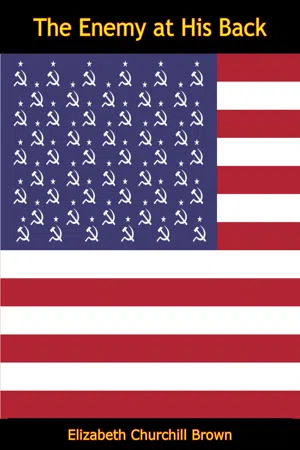
This work discusses the communist schedule for taking over America and its potential loss of liberty. The author's goal is to succeed in awakening the American people to the immediate mortal danger and have better knowledge on how to protect ourselves from communism.
"Elizabeth Churchill Brown's book is one of the clearest and most factual expositions of Communist influence on American foreign policies and actions that I have read. This book should be read in all American homes and schools and should be required reading by every American in Government Service."—General Albert C. Wedemeyer
- 213 pages
- English
- ePUB (mobile friendly)
- Available on iOS & Android
eBook - ePub
The Enemy at His Back
About this book
Information
Subtopic
European HistoryIndex
HistoryChapter I—EARLY BATTLES OF THE PACIFIC—FIRST PEACE FEELERS
U.S. Navy wins initiative from Japan 6 months after Pearl Harbor.
U.S. Air Force wins superiority over Japanese in 1943.
Loss of Saipan is loss of war for Japanese.
“Peace Party” comes to life and maneuvers the fall of Tojo cabinet.
Peace feelers are sent to China.
Battle of Leyte Gulf, October 1944, dooms Japan.
Chiang shows peace offers to General Wedemeyer.
THE Pacific war, from Pearl Harbor to VJ-day, was dramatic in its swiftness of action. The recovery of our forces from the disaster of Pearl Harbor, and the speed with which the defensive was transferred into the offensive, has no precedent.
But even more remarkable was the fact that this quick succession of victories was won with an acute shortage of men and supplies. The Pacific war was Washington’s step-child. No sooner had it begun than high officials established the policy that the defeat of Hitler, who had not attacked the United States, had first priority. The commanders in the Pacific would have to get along on what was left over from men and materials to be sent to Russia and England. Four-star general, George C. Kenney, commander of the Allied air forces in the Southwest Pacific, labeled it “the shoestring war.” General MacArthur, one of the first on record to use the word “They,” was quoted in a report as saying, “‘they’ were guilty of ‘treason and sabotage’ in not adequately supporting the Pacific…”{7}
Admiral Leahy, employing his usual restrained language, wrote in his book, “I Was There”:
“The Navy generally and the Army in the Far East under Douglas MacArthur would have preferred to employ sufficient forces in the Pacific to move more aggressively against Japan, but they loyally adhered to the general strategy prescribed by President Roosevelt.”{8}
By the Admiral’s precise statement, “the Army in the Far East under Douglas MacArthur,” I assumed that the Army Chief of Staff in Washington, George C. Marshall, must have concurred with President Roosevelt against the advice of the naval officers. Admiral Leahy confirmed this to me.
It was also known that Harry Hopkins “sometimes had the last word in military matters,” {9} which leads us to believe that Marshall and Hopkins were the two men on whom the President relied most for military advice.
It was not until MacArthur arrived in Australia after his dramatic escape from Bataan in early March 1942, that he was informed he was “low man on the totem pole” as far as priorities were concerned. Lea and Henschel in their book, “Douglas MacArthur” quote the General as saying “It was the greatest shock and surprise of the whole damn war.”{10} MacArthur had been promised help from Washington and expected to find vast American forces assembled for the relief of the Philippines, but instead found that Australia itself was about to become “another Bataan.”
MacArthur’s shock came from the fact that he had received numerous messages on Bataan that help of all kinds was being sent to him. A fact he did not know was reported by General John R. Deane in “Strange Alliance.” General Deane wrote that President Roosevelt sent a letter to all United States war agencies, dated March 7, 1942, stating that he wished all material promised to the Soviet Union to be shipped “at the earliest possible date regardless of the effect of these shipments on any other part of the war program.”{11} Strange to say, the American officials in Moscow at that early period were having a hard time forcing our help down the Soviet comrades’ throats. The Russians were insulting, evasive, and hard-to-give-to. General Deane in the same book candidly expressed his feeling about this outrageous situation.{12} “When it was ‘Kick-Americans-in-the-pants’ week,” he wrote, “even the (Russian) charwomen would be sour.”
By Washington’s decision to give aid to Russia first, General MacArthur was given only 20 percent of the men and supplies which were sent to Europe. This, together with the fact that our Naval commanders in the Pacific had to wage war with a seriously damaged fleet makes it almost a miracle that victories came so quickly in the early stages.
Yet on May 8, 1942, exactly five months and one day after the debacle of Pearl Harbor, the United States Navy won its first victory at the Battle of Coral Sea. This was made possible by the heroic delaying action of our soldiers on Bataan. Admiral King writes in his book, “Fleet Admiral King” that this battle “marked the first reverse and serious loss which the Japanese had had in carrying out their plan for war in the Pacific.”{13}
Six months after Pearl Harbor, June 7, 1942, the Battle of Midway was the second score for the U.S. Navy. The importance of this battle to both the United States and the Japanese was expressed by Admiral King when he wrote that it “was the first decisive defeat suffered by the Japanese Navy in 350 years” and that it “restored the balance of naval power in the Pacific.”{14}
Incredibly, the Japanese war plans left no margin for error. Their initial strike was to be sudden, and victory was to be won in March 1943, one year and four months from Pearl Harbor.{15} They had arranged their schedule down to the last man, the last mile and the last minute. Since there was to be no setback or error, no provision was made for such an event. Flushed with early victories, their greed was unbounded and they gobbled up miles of the Pacific like a hungry monster—far beyond their intended goals. Once they met in serious battle with the American fleet, the Japanese fell apart like a house of cards. Here is a translated excerpt from a captured Japanese report written by the Commander-in-Chief of the First Air Fleet, Admiral Nagumo. It is contained in “The Japanese Story of the Battle of Midway,” published by the U.S. Office of Naval Intelligence. You will see that the Japanese Navy was having real trouble as early as May and June 1942.
“Although the flight training program (in preparation for the battle) was conducted without any major incident…practically no one got beyond the point of basic training. Inexperienced fliers barely got to the point where they could make daytime landings on carriers. It was found that even some of the more seasoned fliers had lost some of their skill. No opportunity was available to carry out joint training, which, of course made impossible any co-ordinated action between contact units, illumination units, and attack units. The likelihood of obtaining any satisfactory results from night attacks, therefore, was practically nil…The records during these tests (mock torpedo attacks) were so disappointing that some were moved to comment that it was almost a mystery how men with such poor ability could have obtained such brilliant results as they had in the Coral Sea.”{16}
From this time on, the Japanese took a pounding from the Americans far beyond their worst fears. In August 1942, only eight months after Pearl Harbor, American Marines and the Navy began their first big amphibious operations on Guadalcanal. Three months later, on the 14th of November, the Battle of Guadalcanal was won. But even this important victory had a difficult time in getting its start, hitting a snag in the Pentagon. The preceding February, Admiral King wrote to General Marshall informing him of his plan for taking “stepping stone” islands preliminary to the proposed landing on Guadalcanal, and asking for his approval of the use of Army troops in the operation. In reply, General Marshall wrote:
“In general, it would seem to appear that our effort in the Southwest Pacific must for several reasons be limited to the strategic defensive for air and ground troops.”{17}
Here we see that Marshall was strictly adhering to the policy of “defensive” warfare in the Pacific. But Admiral King, a tough “salt,” immediately challenged Marshall’s letter and wrote back that defense was not enough—that we should set up strong points in preparation for an offensive.
The Admiral won his first crucial skirmish in Washington. He got his troops. And by February 1943 the Americans were securely established in Guadalcanal and the Buna area. “…it gained for the United States a strategic initiative which was never relinquished.”{18}
Post-war accounts reveal that the prospects for a comparatively quick defeat of Japan became obvious to informed officials both in the United States and in Japan at a surprisingly early date. Admiral King in 1942 noted that President Roosevelt himself was aware of the possibility of early victory.
Mentioned in a footnote of his book is the following:
“The President’s observation—‘defeat of Germany means the defeat of Japan, probably without firing a shot or losing a life’—indicated in a simplified form his understanding that by the application of sea power, Japan could be forced to surrender without an invasion of her home islands.” (Emphasis is theirs.){19}
It is interesting that the author of the footnote emphasized the phrase “without an invasion of” her home islands. This was to be another of the issues on which “the Army” and the Naval officers were to disagree.
One of the most revealing books written from the Japanese view is that of Toshikasu Kase, a former member of the Japanese Foreign Office, at one time a member of their embassy staff in Washington, and later Ambassador awaiting admission of Japan to the United Nations. In “Journey to the Missouri,” Mr. Kase penned an astonishing paragraph. He and the British Ambassador to Tokyo were good friends and, after the war had started, the Japanese diplomat secretly visited the interned Sir Robert Craigie on several occasions. Mr. Kase wrote that in July 1942—
“…On my last visit to the British embassy, however, I was entrusted by Foreign Minister Togo with a highly confidential message. I was instructed to give Sir Robert a discreet hint regarding the eventual restoration of pe...
Table of contents
- Title page
- TABLE OF CONTENTS
- DEDICATION
- ABOUT THE AUTHOR
- FOREWORD
- THIS IS WHAT YOU CALL ACKNOWLEDGMENTS
- INTRODUCTION
- Chapter I-EARLY BATTLES OF THE PACIFIC-FIRST PEACE FEELERS
- Chapter II-HOW COMMUNIST PROPAGANDA AFFECTS OUR FOREIGN POLICY
- Chapter III-YALTA AND THE ADVISERS
- Chapter IV-OKINAWA-SUZUKI-EUGENE DOOMAN TESTIFIES
- Chapter V-THE “RESIGNATION” OF MR. GREW
- Chapter VI-POTSDAM AND THE ADVISERS
- Chapter VII-THE ATOMIC BOMB AND SURRENDER
- CHAPTER VIII-THE MACARTHUR HEARINGS
- APPENDIX
- BIBLIOGRAPHY
- REQUEST FROM THE PUBLISHER
Trusted by 375,005 students
Access to over 1.5 million titles for a fair monthly price.
Study more efficiently using our study tools.
Frequently asked questions
Yes, you can cancel anytime from the Subscription tab in your account settings on the Perlego website. Your subscription will stay active until the end of your current billing period. Learn how to cancel your subscription
No, books cannot be downloaded as external files, such as PDFs, for use outside of Perlego. However, you can download books within the Perlego app for offline reading on mobile or tablet. Learn how to download books offline
Perlego offers two plans: Essential and Complete
- Essential is ideal for learners and professionals who enjoy exploring a wide range of subjects. Access the Essential Library with 800,000+ trusted titles and best-sellers across business, personal growth, and the humanities. Includes unlimited reading time and Standard Read Aloud voice.
- Complete: Perfect for advanced learners and researchers needing full, unrestricted access. Unlock 1.5M+ books across hundreds of subjects, including academic and specialized titles. The Complete Plan also includes advanced features like Premium Read Aloud and Research Assistant.
We are an online textbook subscription service, where you can get access to an entire online library for less than the price of a single book per month. With over 1.5 million books across 990+ topics, we’ve got you covered! Learn about our mission
Look out for the read-aloud symbol on your next book to see if you can listen to it. The read-aloud tool reads text aloud for you, highlighting the text as it is being read. You can pause it, speed it up and slow it down. Learn more about Read Aloud
Yes! You can use the Perlego app on both iOS and Android devices to read anytime, anywhere — even offline. Perfect for commutes or when you’re on the go.
Please note we cannot support devices running on iOS 13 and Android 7 or earlier. Learn more about using the app
Please note we cannot support devices running on iOS 13 and Android 7 or earlier. Learn more about using the app
Yes, you can access The Enemy at His Back by Elizabeth Churchill Brown in PDF and/or ePUB format, as well as other popular books in History & European History. We have over 1.5 million books available in our catalogue for you to explore.