- 233 pages
- English
- ePUB (mobile friendly)
- Available on iOS & Android
eBook - ePub
Spies, Dupes, and Diplomats
About this book
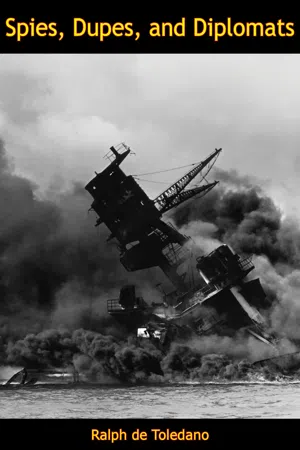
This compelling story brings to light buried facts about Russian espionage, Pearl Harbor, the Amerasia Case, the Institute of Pacific relations, and the Far Eastern Division of the State Departments during World War II.
Information
Subtopic
European HistoryIndex
HistoryAPPENDICES
APPENDIX I—Service’s Report to Stilwell
Report No. 40
U.S. ARMY Observer Section, APO 879
October 10, 1944
Subject: The Need for Greater Realism in our Relations with Chiang Kai-shek.
To: General Stilwell, Commanding General, USAF-CBI
1. You have allowed me, as a political officer attached to your staff, to express myself freely in the past regarding the situation in China as I have seen it. Although in Yenan I am only a distant observer of recent developments in Chungking and Washington, I trust you will permit the continued frankness which I have assumed in the attached memorandum regarding the stronger policy which I think it is now time for us to adopt toward Chiang Kai-shek and the Central Government.
2. It is obvious, of course, that you cannot act independently along the lines suggested. The situation in China and the measures necessary to meet it have both military importance and far-reaching political significance; the two aspects cannot be separated. Because of this interrelation, and because of the high level on which action in China must be taken, there must be agreement and mutual support between our political and military branches. But this will be ineffective without clear decision and forceful implementation by the President.
3. It is requested that copies of this report be transmitted, as usual, to the American Ambassador at Chungking and Headquarters, USAF-CBI, for the information of Mr. Davies.
/s/ JOHN S. SERVICE
Enclosure:
Memorandum, as stated.
MEMORANDUM
Our dealings with Chiang Kai-shek apparently continue on the basis of the unrealistic assumption that he is China and that he is necessary to our cause. It is time, for the sake of the war and also for our future interests in China, that we take a more realistic line.
Kuomintang Government is in crisis. Recent defeats have exposed its military ineffectiveness and will hasten the approaching economic disaster. Passive inability to meet these crises in a constructive way, stubborn unwillingness to submerge selfish power-seeking in democratic unity, and the statements of Chiang himself to the Peoples Political Council and on October 10, are sufficient evidence of the bankruptcy of Kuomintang leadership.
With the glaring exposure of the Kuomintang’s failure, dissatisfaction with Chiang is growing rapidly. The prestige of the Party was never lower, and Chiang is losing the respect he once enjoyed as a leader.
In the present circumstances, the Kuomintang is dependent on American support for survival. But we are in no way dependent on the Kuomintang.
We do not need it for military reasons. It has lost the southern air-bases and cannot hold any section of the seacoast. Without drastic reforms—which must have a political base—its armies cannot fight the Japanese effectively no matter how many arms we give them. But it will not permit those reforms because its war against Japan is secondary to its desire to maintain its own undemocratic power.
On the other hand, neither the Kuomintang nor any other Chinese regime, because of the sentiment of the people, can refuse American forces the use of Chinese territory against the Japanese. And the Kuomintang’s attitude prevents the utilization of other forces, such as the Communist or Provincial troops, who should be more useful than the Kuomintang’s demoralized armies.
We need not fear Kuomintang surrender or opposition. The Party and Chiang will stick to us because our victory is certain and it is their only hope for continued power.
But our support of the Kuomintang will not stop its normally traitorous relations with the enemy and will only encourage it to continue sowing the seeds of future civil war by plotting with the present puppets for eventual consolidation of the occupied territories against the Communist-led forces of popular resistance.
We need not fear the collapse of the Kuomintang Government. All the other groups in China want to defend themselves and fight Japan. Any new government under any other than the present reactionary control will be more cooperative and better able to mobilize the country.
Actually, by continued and exclusive support of the Kuomintang, we tend to prevent the reforms and democratic reorganization of the government which are essential for the revitalization of China’s war effort. Encouraged by our support the Kuomintang will continue in its present course, progressively losing the confidence of the people and becoming more and more impotent. Ignored by us, and excluded from the Government and joint prosecution of the war, the Communists and other groups will be forced to guard their own interests by more direct opposition.
We need not support the Kuomintang for international political reasons. The day when it was expedient to inflate Chiang’s status to one of the “Big Four” is past, because with the obvious certainty of defeat, Japan’s Pan-Asia propaganda loses its effectiveness. We cannot hope that China under the present Kuomintang can be an effective balance to Soviet Russia, Japan, or the British Empire in the Far East.
On the contrary, artificial inflation of Chiang’s status only adds to his unreasonableness. The example of a democratic, non-imperialist China will be much better counterpropaganda in Asia than the present regime, which, even in books like “China’s Destiny,” hypnotizes itself with ideas of consolidating minority nations (such as the “Southern Peninsula”), and protecting the “right” and at the same time national ties of its numerous emigrants (to such areas as Thailand, Malaya and the East Indies). Finally, the perpetuation in power of the present Kuomintang can only mean a weak and disunited China—a sure cause of international involvements in the Far East. The key to stability must be a strong, unified China. This can be accomplished only on a democratic foundation.
We need not support Chiang in the belief that he represents pro-American or democratic groups. All the people and all other political groups of importance in China are friendly to the United States and look to it for the salvation of the country, now and after the war.
In fact, Chiang has lost the confidence and respect of most of the American-educated, democratically-minded liberals and intellectuals. The Chen brothers, Military, and Secret police cliques which control the Party and are Chiang’s main supports are the most chauvinist elements in the country. The present Party ideology, as shown in Chiang’s own books “China’s Destiny” and “Chinese Economic Theory,” is fundamentally anti-foreign, and anti-democratic, both politically and economically.
Finally, we feel no ties of gratitude to Chiang. The men he has kept around him have proved selfish and corrupt, incapable and obstructive. Chiang’s own dealings with us have been an opportunist combination of extravagant demands and unfilled promises, wheedling and bargaining, bluff and blackmail. Chiang did not resist Japan until forced by his own people. He has fought only passively—not daring to mobilize his own people. He has sought to have us save him—so that he can continue his conquest of his own country. In the process, he has “worked” us for all we were worth.
We seem to forget that Chiang is an Oriental; that his background and vision are limited; that his position is built on skill as an extremely adroit political manipulator and a stubborn, shrewd bargainer; that he mistakes kindness and flattery for weakness; and that he listens to his own instrument of force, rather than reason.
Our policy toward China should be guided by two facts. First, we cannot hope to deal successfully with Chiang without being hard-boiled. Second, we cannot hope to solve China’s problems (which are now our problems) without consideration of the opposition forces—Communist, Provincial and liberal.
The parallel with Yugoslavia has been drawn before but is becoming more and more apt. It is as impractical to seek Chinese unity, the use of the Communist forces, and the mobilization of the population in the rapidly growing occupied areas by discussion in Chungking with the Kuomintang alone as it was to seek the solution of these problems through Mikhailovitch and King Peter’s government in London, ignoring Tito.
We should not be swayed by pleas of the danger of China’s collapse. This is an old trick of Chiang’s.
There may be a collapse of the Kuomintang government; but it will not be the collapse of China’s resistance. There may be a period of some confusion, but the eventual gains of the Kuomintang’s collapse will more than make up for this. The crisis itself makes reform more urgent—and at the same time increases the weight to our influence. The crisis is the time to push—not to relax.
We should not let Chiang divert us from the important questions by wasting time in futile discussion as to who is to be American commander. This is an obvious subterfuge.
There is only one man qualified by experience for the job.{94} And the fact is that no one who knows anything about China and is concerned over American rather than Chiang’s interests will satisfy Chiang. [All italics Service’s.]
We should end the hollow pretense that China is unified and that we can talk only to Chiang. This puts the trump card in Chiang’s hands.
Public announcement that the President’s representative had made a visit to the Communist capital at Yenan would have a significance that no Chinese would miss—least of all the Generalissimo. The effect would be great even if it were only a demonstration with no real consultation. But it should be more than a mere demonstration; we must, for instance, plan on eventual use of the Communist armies and this cannot be purely on Kuomintang terms.
Finally, if these steps do not succeed, we should stop veiling our negotiations with China in complete secrecy. This shields Chiang and is the voluntary abandonment of our strongest weapon.
Chinese public opinion would swing violently against Chiang if he were shown obstructive and non-cooperative with the United States. We should not be misled by the relatively very few Kuomintang die-hards; they are not the people. The Kuomintang Government could not withstand public belief that the United States was considering withdrawal of military support of recognition of the Kuomintang as the leader of Chinese resistance.
More than ever, we hold all the aces in Chiang’s poker game. It is time we started playing them.
October 10, 1944
JOHN’S SERVICE
2
The above memorandum was written just a few weeks before General Stilwell was removed as American commander in China and adviser to Chiang, something which Chiang had asked long before. There was no question of whom Service, writing to his chief, Stilwell, meant by saying “There is only one man qualified by experience for the job.”
Testimony of Henry Wallace, who reported Chiang’s request for Stilwell’s removal to President Roosevelt, and of Joseph Alsop who accompanied Wallace on his China Mission, throws rather a different light on the matter.
Before the McCarran Committee on 17 October 1951, Wallace said:
“General Joseph W. Stilwell, the American commander in the China-Burma-India theater, was wholly preoccupied with the campaign in Burma. The Chinese armies being attacked by the Japanese had received no American aid to strengthen them. The Generalissimo complained to me that even the air support for them was limited by General Stilwell’s policies...the Generalissimo said to me very frankly that he lacked confidence in General Stilwell while he had high confidence in General Chennault. His stated reason for lack of confidence in General Stilwell was Stilwell’s poor understanding of political problems.
In any case it was very clear to me, from the tone and language of the Generalissimo, that he and Stilwell could not co-operate. It seemed to me further it was an unmanageable situation to have an American commander in China who did not enjoy the Generalissimo’s confidence and could not achieve friendly co-operation with him. The military situation in China was already critical. In fact, Chiang Kai-shek gave me the impression...of hardly knowing which way to turn. [He gave] me a personal message to President Roosevelt...I was deeply moved by the cry of a man in great trouble and I was moved to start in to help him as soon as possible...
Testimony of Joseph Alsop before the McCarran Committee, 18 October 1951:
This recommendation to dismiss General Stilwell...was the heaviest blow to the Communist cause in China that could be struck at that time.
Basically this was true because General Stilwell was strongly gripped with certain attitudes highly favorable to the Chinese Communist cause and because with his vast authority as theater commander was able to give effect...
Table of contents
- Title page
- TABLE OF CONTENTS
- DEDICATION
- I-Love-and Death-Is a Falling Star
- II-All Quiet on the Western Front
- III-No Dogs or Chinese Allowed
- IV-Comintern to Fourth Bureau
- V-Shanghai Gesture: Red Version
- VI-Sorge at Work
- VII-Ring around Shanghai
- VIII-Japan Is the Focus
- IX-Mission to Tokyo
- X-Tokyo Marching Orders
- XI-Price $40,000
- XII-Prelude to Pearl Harbor
- XIII-Links of American Policy
- XIV-Amerasia, I: 1700 Stolen Documents
- XV-Amerasia, II: Justice in Reverse
- XVI-IPR: Carter’s Pink Pill
- XVII-Strategy of Defeat
- APPENDICES
- REQUEST FROM THE PUBLISHER
Trusted by 375,005 students
Access to over 1.5 million titles for a fair monthly price.
Study more efficiently using our study tools.
Frequently asked questions
Yes, you can cancel anytime from the Subscription tab in your account settings on the Perlego website. Your subscription will stay active until the end of your current billing period. Learn how to cancel your subscription
No, books cannot be downloaded as external files, such as PDFs, for use outside of Perlego. However, you can download books within the Perlego app for offline reading on mobile or tablet. Learn how to download books offline
Perlego offers two plans: Essential and Complete
- Essential is ideal for learners and professionals who enjoy exploring a wide range of subjects. Access the Essential Library with 800,000+ trusted titles and best-sellers across business, personal growth, and the humanities. Includes unlimited reading time and Standard Read Aloud voice.
- Complete: Perfect for advanced learners and researchers needing full, unrestricted access. Unlock 1.5M+ books across hundreds of subjects, including academic and specialized titles. The Complete Plan also includes advanced features like Premium Read Aloud and Research Assistant.
We are an online textbook subscription service, where you can get access to an entire online library for less than the price of a single book per month. With over 1.5 million books across 990+ topics, we’ve got you covered! Learn about our mission
Look out for the read-aloud symbol on your next book to see if you can listen to it. The read-aloud tool reads text aloud for you, highlighting the text as it is being read. You can pause it, speed it up and slow it down. Learn more about Read Aloud
Yes! You can use the Perlego app on both iOS and Android devices to read anytime, anywhere — even offline. Perfect for commutes or when you’re on the go.
Please note we cannot support devices running on iOS 13 and Android 7 or earlier. Learn more about using the app
Please note we cannot support devices running on iOS 13 and Android 7 or earlier. Learn more about using the app
Yes, you can access Spies, Dupes, and Diplomats by Ralph de Toledano in PDF and/or ePUB format, as well as other popular books in History & European History. We have over 1.5 million books available in our catalogue for you to explore.