- 489 pages
- English
- ePUB (mobile friendly)
- Available on iOS & Android
eBook - ePub
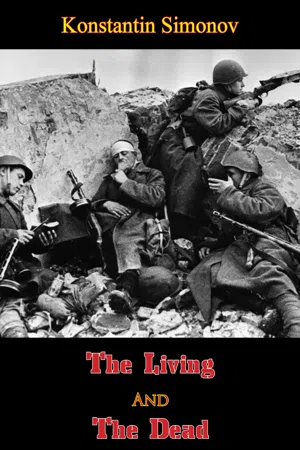
The Living And The Dead
About this book
The combination of traditional Tolstoyan verbiage with the time-worn universal theme of war has not prevented this Russian author (Days and Nights) and journalist from creating an intense and absorbing World War II documentary of the first months at Russia's Western Front, as the Germans advance relentlessly toward Moscow. More than an accurate, exciting record of the actual battles, retreats, and encirclements, the novel is meaningfully overcast with an aura of war—any war of any nation—not only its horrors, but its rewards, its spirit, and above all, its blind disregard for any ""disparity between the living and the dead"". In microcosm, the hero of the book is Vanya Sintsov, a young military journalist who joins the front ranks to fight, is wounded and captured, and escapes, but without his survival guarantee—the Party Card and Identity Papers. The struggle to redeem his official status as a soldier through his own actions takes him from unit to unit, from comrade to comrade, never doubting his country's victory, but often despairing at human nature. Sinstov, with all his faith and failings, is still only an opitome; it is the Russian Army and all its emergency supporters that is the true epic hero. Aided by Ainsztein's fine translation, Simonov has managed, in a gargantuan complex of characters and events, to capture that elusive dust that inexorably settles on a people at war. Long but rewarding—both for historical accuracy and artful fiction.-Kirkus Reviews
Information
Subtopic
European HistoryIndex
HistoryThe Living and the Dead
Chapter One
Like millions of other families, the Sintsovs were taken by surprise by the outbreak of the war. For although almost everybody had known for a long time that war was imminent, yet when it came, it descended upon people like a silent avalanche of snow in the dead of night. Obviously it is quite impossible for human beings to face such a stupendous calamity fully prepared.
Sintsov and Masha learned about the outbreak of the war in the little sun-baked square outside Simferopol Railway Station. They had just gotten off a train and were standing beside an old Lincoln convertible, whose chauffeur was waiting for other passengers to fill the vacant seats before driving them to the Red Army Sanatorium at Gurzuf.
They had asked the chauffeur whether there was any fruit or tomatoes for sale in the local market when a loud speaker blared out all over the square the news that the war had begun, and at once their lives were sliced into two disconnected halves: one half had ended a minute ago, when there had been no war, and the second half was the one they were living now.
Sintsov and Masha carried their suitcases to the nearest bench. Masha sat down, buried her face in her hands and sat motionless, as though devoid of all feeling, while Sintsov, without saying a word to her, went off to the Town Commandant’s Office to get his travel warrants altered for their return journey from Simferopol to Grodno, where for the last eighteen months he had been editorial secretary of an army newspaper.
The all-embracing nature of the calamity of war was made worse in the case of the Sintsov family by the circumstance that he and his wife were in Simferopol, some seven hundred miles away from the war, whereas their year-old baby girl had remained in the frontier town of Grodno. She was there and they were here, and no power in the world could take them back to her in less than four days. And Political Instructor{1} Sintsov had spent enough time in the army to realize the full extent of the disaster that had hit his family.
When Sintsov entered the Town Commandant’s Office, he found that five or six other military people had preceded him. Waiting in a line, he tried to imagine what was happening at Grodno. “It is too near the frontier,” he had to admit to himself. “Much too near the frontier. It is much too exposed to bombing raids. Of course, children are likely to be evacuated at once from such a place.” He seized on this hope, because he imagined that it might have a calming effect on Masha.
When he returned to Masha and told her everything was in order, that at midnight they would start on their return journey, she raised her head and looked at him as though he were a stranger.
“What is in order?” she asked.
“I am saying that our travel warrants are in order,” Sintsov repeated.
“That’s fine,” Masha said without showing any further interest, and again buried her face in her hands.
She could not forgive herself for having gone off on a holiday without her daughter. She had agreed to leave her behind after a great deal of persuasion from her mother, who had especially traveled to Grodno from Moscow to make it possible for her and her husband to take their holiday together. Sintsov, too, had spent much time persuading her that it was right to leave their baby daughter behind, and had felt very hurt when on the day of their departure she had looked into his eyes and said, “Perhaps we should not go?” Had she not listened to her mother and her husband, she would have been at this very moment in Grodno. The idea of being in Grodno at such a time did not frighten her; what alarmed her was the realization that she was not there. She was so possessed by a feeling of guilt toward her baby that she hardly thought of her husband.
With a frankness that was typical of her she told him about the way she felt.
“And why should you think about me?” Sintsov replied without feeling hurt. “Besides, everything will be all right.”
Masha could never stand it when her husband tried to set her mind at rest with reassurances about matters he knew no more about than she did.
“Stop talking to me as if I were a child,” she said. “What will be all right? What do you know about it?” And her lips trembled with anger.
“I had no right to leave her! Do you understand? I had no right to leave her!” she repeated, and with her tightly clenched fist she went on hitting her knee with such force that it hurt. “I hate myself!”
She stopped reproaching herself when they finally boarded their train, and fell into a silence which she broke only to reply mechanically “Yes” or “No” to Sintsov’s questions. Throughout their journey to Moscow she behaved as though she were an automaton, although she drank tea, looked silently out of the window, and then lay down in her upper berth, where, with her face turned toward the wall, she remained motionless for hours. All through the journey her fellow passengers never stopped talking about the war, but Masha behaved as though she did not hear them. She was going through a great and difficult inner struggle which she could not share with any other person, not even with her husband.
They were approaching Moscow when she spoke to Sintsov for the first time since they had left Simferopol. “Let’s get out and get some fresh air,” she said to him as soon as the train came to a halt at Serpukhov.
They left their carriage and she took her husband’s arm.
“I have just realized why I have hardly thought of you all this time,” she said to Sintsov. “We shall find Tanya, we shall send her away with mother, and I shall stay with you in the army.”
“You’ve already made up your mind?” Sintsov asked her.
“Yes, I have.”
“And what if you have to change it?”
She shook her head and did not reply. Then he told her, trying to put it as calmly as he could, that finding Tanya and her joining the army were two separate problems.
“I will not separate them!” Masha interrupted him.
But he persisted with his argument that it would be more reasonable for her to stay in Moscow while he continued with his journey to Grodno, the place where he was stationed. If the army families had been evacuated—and he felt convinced that they had been evacuated—then Masha’s mother was certain to make her way with Tanya back to Moscow, where she had her home. It was therefore the most sensible thing for Masha to wait for them in Moscow, for otherwise they might miss one another, he told her.
“They may already be there,” he told Masha. “They may have got there from Grodno during the time it has taken us to get here from Simferopol.”
Masha gave Sintsov another distrustful look and was again silent until they reached Moscow. They hurried to her mother’s apartment in Usachevka, in which they had so recently spent two carefree days before setting out for Simferopol. Nobody had returned from Grodno. Sintsov had hoped to find a telegram waiting for them, but there was none.
“I’m off to the R.T.O. to get a travel warrant,” Sintsov told Masha. “I may be able to board the night train. And you try to ring up the editorial office. You never know, you may get through.”
He produced a notebook from his tunic pocket, tore out a page, and wrote on it the telephone number of his army newspaper editorial office in Grodno.
“Wait—don’t rush so. Sit down for a minute,” Masha stopped her husband. “I know you are against my coming with you. But what am I to do?”
Sintsov once again told her that she must not come with him. To his previous arguments he added a new one. Didn’t she realize, he asked her, that even if she managed to get back to Grodno and join the army there—and he doubted whether the army would have her—she would only make it all the more difficult for him?
Masha listened to him and her face grew paler and paler.
“And why don’t you understand,” she suddenly screamed, “that I, too, am human? That I want to be wherever you are? Why are you thinking only of yourself?”
“What do you mean, only of myself?” Sintsov asked lamely.
But instead of answering him, Masha burst into tears for the first time since they had learned the terrible news and sobbed bitterly. At last she stopped crying, blew her nose angrily, rested her tearstained cheek on her fist, and told her husband in a business-like voice to hurry to the station or he might be too late.
“And promise to get a travel warrant for me too,” she concluded.
Her obstinacy made him lose his temper. He told her brutally that no civilians, and certainly no women, would be allowed aboard a train traveling to Grodno; that fighting around Grodno had been mentioned in yesterday’s communiqué, and therefore it was time for her to face facts as they really were.
“All right,” Masha said. “If they refuse you a travel warrant for me, there is nothing we can do about it. But I want you to try. I know I can trust you to try. Will you try?”
“Yes, I will,” he replied reluctantly. He never lied to her; should they issue him a travel warrant for Masha, he would have to take her with him.
An hour later he telephoned and, with a feeling of relief, could tell her that he had secured a place for himself aboard a train leaving at eleven o'clock the same night for Minsk. There were no direct trains to Grodno and he had been told at the R.T.O.’s office that they had orders to allow only military personnel aboard trains leaving in that direction.
Masha did not reply.
“Why are you silent?” he shouted into his receiver.
“Never mind. I tried to telephone Grodno. I was told that for the time being no calls went through,” she replied.
“Please put all my things into one suitcase,” he said.
“Yes, I will,” she answered.
“I shall now try to see somebody at the Central Political Directorate,”{2} Sintsov said. “My editorial office may have moved; I’ll try to find out where. I should be home in two hours’ time. Don’t fret.”
“I am not fretting,” Masha replied in the same colorless voice, and hung up first.
Masha packed her husband’s belongings and all the time she was doing the packing, she kept asking herself the same question: How could she have gone on a holiday without taking her daughter with her? She had not lied to Sintsov when she had told him that she could not separate her thoughts about her daughter from those about him and herself. She felt that she must find her daughter and send her to a safe place, and then remain with her husband at the front line.
But how was she to get a travel warrant? What could she do?
Suddenly, as she was closing her husband’s suitcase, she remembered that she had somewhere written down the telephone number of Colonel Polynin, with whom her brother Pavel had fought in the battles of Khalkhin-Gol.{3} Polynin had telephoned her mother’s apartment just as Masha and her husband had happened to be there on their way from Grodno to Simferopol. He had told Masha that he had just flown in from Chita, where he had met her brother, and that he had promised him to visit his mother, Tatyana Stepanovna.
Masha had informed him that Tatyana Stepanovna was in Grodno and had asked for his telephone number, so that her mother should be able to call him up at the Central Aviation Inspectorate on her return to Moscow. But where was his telephone number? She searched feverishly for a long time, but finally she found the bit of paper with Polynin’s number and phoned him.
“Colonel Polynin speaking,” an angry voice replied.
“Good evening. This is Pavel Artemyev’s sister speaking. I must see you on an important business,” Masha said.
It took Polynin quite some time to realize who she was and what she wanted. When he finally did, he told her after a long, unfriendly pause that provided her business did not require much time, he could see her in an hour’s time. He would meet her at the entrance.
Masha was not at all certain how Polynin could help her, but an hour later she was waiting outside the large military building. She thought she could remember Polynin, but she could not recognize him among the people entering and leaving the building. Finally a very young sergeant came out and walked up to her.
“Are you waiting for Comrade Colonel Polynin?” he asked Masha, and explained that the colonel had been called to the Defense Commissariat, that he had left five minutes ago, and that he wanted Masha to wait for him. The sergeant advised her to wait in a little square on the other side of the trolley stop. As soon as the colonel returned, he would call her.
“And when will he be back?” Masha asked, because she remembered that her husband would soon be back in the apartment. But the sergeant only shrugged his shoulders.
Masha waited for two hours and was on the point of catching a trolley when Polynin got out of a small staff car. Masha recognized him at once, although his handsome face had changed—it looked much older and worried. She felt that he was counting every second.
“Please don’t be offended,” he said, “but I’d rather we had our conversation right here. My office is full of people waiting for me. What has happened?”
Masha told him in as few words as she could what had happened to her and what she wanted him to do for her. They stood close to each other at the trolley stop with people pressing and jostling them.
“Well,” Polynin said when she had finished, “I think your husband is right. The families of military personnel are being evacuated from those parts insofar as it can be done. This includes the families of our airmen. If I learn anything from one of them, I shall call you at once. Your husband is also quite justified in telling you that this is not the time to travel to Grodno.”
“All the same, I beg you to help me,” Masha insisted.
Polynin angrily crossed his arms on his chest.
“Do you realize what you...
Table of contents
- Title page
- TABLE OF CONTENTS
- Chapter One
- Chapter Two
- Chapter Three
- Chapter Four
- Chapter Five
- Chapter Six
- Chapter Seven
- Chapter Eight
- Chapter Nine
- Chapter Ten
- Chapter Eleven
- Chapter Twelve
- Chapter Thirteen
- Chapter Fourteen
- Chapter Fifteen
- Chapter Sixteen
- Chapter Seventeen
- Chapter Eighteen
- Chapter Nineteen
- Acknowledgement
- REQUEST FROM THE PUBLISHER
Trusted by 375,005 students
Access to over 1.5 million titles for a fair monthly price.
Study more efficiently using our study tools.
Frequently asked questions
Yes, you can cancel anytime from the Subscription tab in your account settings on the Perlego website. Your subscription will stay active until the end of your current billing period. Learn how to cancel your subscription
No, books cannot be downloaded as external files, such as PDFs, for use outside of Perlego. However, you can download books within the Perlego app for offline reading on mobile or tablet. Learn how to download books offline
Perlego offers two plans: Essential and Complete
- Essential is ideal for learners and professionals who enjoy exploring a wide range of subjects. Access the Essential Library with 800,000+ trusted titles and best-sellers across business, personal growth, and the humanities. Includes unlimited reading time and Standard Read Aloud voice.
- Complete: Perfect for advanced learners and researchers needing full, unrestricted access. Unlock 1.5M+ books across hundreds of subjects, including academic and specialized titles. The Complete Plan also includes advanced features like Premium Read Aloud and Research Assistant.
We are an online textbook subscription service, where you can get access to an entire online library for less than the price of a single book per month. With over 1.5 million books across 990+ topics, we’ve got you covered! Learn about our mission
Look out for the read-aloud symbol on your next book to see if you can listen to it. The read-aloud tool reads text aloud for you, highlighting the text as it is being read. You can pause it, speed it up and slow it down. Learn more about Read Aloud
Yes! You can use the Perlego app on both iOS and Android devices to read anytime, anywhere — even offline. Perfect for commutes or when you’re on the go.
Please note we cannot support devices running on iOS 13 and Android 7 or earlier. Learn more about using the app
Please note we cannot support devices running on iOS 13 and Android 7 or earlier. Learn more about using the app
Yes, you can access The Living And The Dead by Konstantin Simonov, R. Ainsztein in PDF and/or ePUB format, as well as other popular books in History & European History. We have over 1.5 million books available in our catalogue for you to explore.