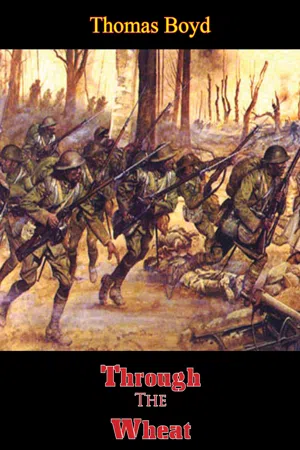
The first book published by author Thomas Boyd, about the experiences of a young American Marine during World War I. The book gained immediate critical acclaim upon its publication, with F. Scott Fitzgerald calling it "a work of art" and "arresting."
"Through the Wheat records the experiences of William Hicks of the marines, who never distinguished himself, but who never flinched....The effect of attack after attack, numberless tragedies day after day, unceasing danger, was to deaden his senses completely. His companions concluded, not without reason, that he was mad. He wandered about under fire with perfect composure—not because he was more brave than his fellows, but because he was psychologically dead....Thomas Boyd [has written] the least partisan and the most brilliant of doughboy reminiscences."—New York Times.
"A remarkable first novel."—The Nation.
- 137 pages
- English
- ePUB (mobile friendly)
- Available on iOS & Android
eBook - ePub
Through The Wheat
About this book
Information
Subtopic
Military BiographiesIndex
HistoryVIII
IN the ravine Hicks was busy trying to place his Maxim in a position from which it would sweep a portion of the field. He had succeeded in making it remain upright on its haunches, and was now experimenting with it in various positions, so that he could swing it back and forth as he fired, and cover the maximum of ground. The water-cooler had been set at its side and the long rubber hose was attached to the machine-gun. A belt filled with cartridges was inserted in the chamber, and the affair was ready to be fired.
“‘At’s some gun you got there, Hicksy, old boy. What do you ‘spect to do with it? You don’t aim to kill nobody, do you?” Pugh had recovered and was in good humor. As he talked, a black stubble of beard that grew grotesquely on the chin of his elf-like face rose and fell.
“No, Jack. I’m just keepin’ it for a souvenir.”
“Hell, y’ain’t got no souvenir. Lookit, Hicksy.” He produced a small pearl-handled pistol. “Got this offen one of them Dutchmen. Lookit here.’ He placed his hand in his blouse and brought out a pair of field-glasses. “Got this from another one. Now all I want to do is to git wounded and I’ll take these babies back and sell ‘em for beaucoup francs to them S. O. S. birds.”
“Don’t talk about getting wounded, Pugh,” Harriman requested. “It’s bad luck. Remember what Kitty Kahl said the other night?”
“Naw, how’d I know what Kitty Kahl said? He didn’t say nothin’ to me.”
“He said that he’d either win a decoration or get killed.”
“I don’t care if he did. I want a bon-bless-ey so I can git outta this damn hole.”
“Say, Hicks,” Lepere called, “you’d better take down that confounded gun. The Boche will see it and then we’ll all get killed.”
“Oh, they won’t see it.”
“You can’t tell. One of their aviators is liable to come over here any time.”
“Tyah tyah tyah tyah, you talk like you come from where they have possums for yard dogs, Lepeah,” Pugh sneered. “Hicksy, let’s you and me go out salvagin’. There’s a lot of salmon and stuff in some of them boys’ packs that’ll never want it no more.”
“You mean some of the fellows that have been killed?” Hicks asked. “I don’t like to do that. It seems too ghoulish.”
“I don’t cah what it seems like. I’m hawn-gry. Le’s go.”
“Maybe Bedford’ll stop us.”
“Naw, he won’t. He’s too damned scared to git out of his hole.”
They climbed out of the ravine and started back through the woods.
“Hicksy 1 Be damned! Lookit that!”
“Where, where? What is it?”
“Look!” Pugh pointed his finger toward a large tree. Its knees on the ground and its forehead pressed stiffly against the bark of the tree, a body kneeled.
“Let’s go back.”
“Naw, I wanta git some of that salmon.”
It was easy enough without touching the bodies to collect armfuls of canned salmon from the packs of the dead men. Soon they had all they could carry. Besides the salmon, Pugh had collected several razors and a carton of talcum.
They had but reached the ravine when the bottom seemed to drop from the sky, dumping a deluge of shells. For a moment the men were stunned by the fierceness of the bombardment. Hicks and Pugh emptied their arms of the cans and dived for a burrow, reaching it simultaneously. Another flock of shells struck in and around the ravine. It was not until after they had exploded that the report of their having been fired was heard.
“Oh-, Hicksy, can’t you get in a little closer and give me some room,” Pugh yelled. “Them’s the whizz-bangs they’ve been tellin’ us about.”
The shells, with their terrific “bz—BANG, bz—BANG” poured in upon the men.
“Stretcher bearer on the left!” some one screamed above the racket. The plea went unheeded.
“God damn it, there’s a man half killed up there. Stretcher bearer on the le-f-f-t.”
“I didn’t know there was anybody fool enough to yell for one of them lousy stretcher bearers. Hicksy, le’s you and me go up.”
While the shells fell and burst directly in front of him, behind him, and on each side, a huge fellow whose proportions made him an easy target, walked conscientiously along the ravine. In his hand was a bag containing first-aid implements. To Hicks, as he passed, the huge fellow, with the red cross on his arm, looked like a doting father who felt the necessity forcibly to reprimand a child. A few minutes later Hicks saw him, with the wounded man thrown over his shoulder as if he were a bag of salt, making his way along the ravine and through the woods to the dressing station.
Bang—CRASH. The ravine reverberated from the explosion. Another volley had been hurled into it.
“Stretcher bearer on the left. Stretcher bearer on the left,” some one called. From time to time the cry was repeated, each time less hopefully, more stridently.
Fiercely whining, a shell bore down upon the ground under which Hicks and Pugh were crouched. It landed softly. They waited, breathless, for it to burst. Hicks was convulsed. Oh, if only it would explode and end the suspense. Hicks found himself wanting the shell to burst, imploring it!
The smoke in the air was stifling them, burning out their lungs. Their eyes were shot with blood, and tears streamed unceasingly down their cheeks. Their throats felt as if they had swallowed handfuls of fine dust.
“I’ll choke, I’ll die,” Hicks thought with every breath. He felt for his mask, knocked off his helmet, and adjusted the mask to his head. Frenzied, he bit his teeth into the hard-rubber mouthpiece, and breathed deeply. Oh, what a relief; the picrine could not penetrate the chemicals of the mask! He breathed again; gulped, rather. Immediately his throat and lungs were on fire. The mask was more of a hindrance than a help.
Incomprehensibly, the bombardment stopped.
Men ran from their burrows and clambered over the ravine in an effort to escape the blinding, choking smoke.
“Stop, men,” Lieutenant Bedford called hoarsely. “Come back here and be ready to stand off an attack.”
Reluctantly they returned and placed themselves in a position from which they could fire across the field. Hicks drew out his canteen. It was empty.
“Water, got any water, Pugh?”
“No, jist drained the last drop.”
Hicks walked down the ravine. “Anybody got any water to spare?”
No one had. No one had any water. He walked back beside Pugh. As he approached, Pugh called:
“Oh, Hicksy, you’d better go over and ask them Dutchmen for another gun. One of their shells swiped that pretty one you had up here.”
The Maxim which Hicks had diligently striven to get into shape was gone—where, no one knew.
“I don’t care. If they come over now I wouldn’t have strength enough to pull a trigger. I’m all in, Pugh.”
Fearfully the men waited for the attack. It grew dark, but none came. Out in the field a cow slowly moved across the broken ground. In the dusk Lieutenant Bedford was stumbling along the ravine, calling for volunteers to go on a water detail.
From one of the holes King Cole’s voice croaked: “I’ll go, lieutenant. I’ll go.” He sounded like a bullfrog.
“I’ll go, too; be glad to,” Hicks offered. “God, me too,” complemented Pugh.
“I only want two men. Pugh, you stay here. All right, Hicks and Cole, collect up the canteens and then I’ll tell you where to go.”
“Je’s, these canteens make a lot of noise. The Squareheads can hear us for a mile. Hadn’t we better put something around them!” Hicks asked Lieutenant Bedford.
“Yes, have the men unhook their canteen covers and put them on. Now be careful when you go, for the German lines are only a few hundred yards. You follow this ravine until you come to a place where it splits. Take the one to the right. It leads into a little town where there’s a pump.”
They started off, feeling their way over the huge boulders that lay in the ravine. When they were no more than a hundred yards from the platoon, a shell severed the air over their heads and burst in the field to their right. They fell flat on their faces. After the shell had exploded they got up and started again. Another shell burst ten yards in front of them. They ran forward again, the canteens jangling over their shoulders. This time the shell burst just to their left, throwing up a mass of dirt which showered down on them.
“Goodby, canteens; I’m goin’ to throw mine away and run,” said Cole.
“Yes, you are. And we die of thirst. Come on, it’s not far now.”
They hurried blindly on. Another shell screeched over their heads and struck the edge of the ravine to their right. They were violently thrown against the opposite side.
“I sure do admire that boy’s aim. Let’s go, Hicks.”
Abruptly the ravine shallowed out and they found themselves running for the village, their bodies wholly exposed. As they approached, a door in one of the buildings of the badly battered town was thrown open and a voice called: “Here you are, fellows. Come in this way.”
“Hell, if you think you had it hard, you ought to have been with us.”
Hicks and Cole, resting after they had filled the canteens with water from a creaky pump in the village square, were seated in a room of the building through which they had entered the town. At the window near the door a thin-snouted Hotchkiss machine-gun was pointed out over the field. Beside it, his head lying against the saddle, a man was reclining. It was he who had spoken.
“Think of carrying one of these guns over your shoulder and walking through heavy rifle fire the whole length of that field! Pretty tough. Pretty tough.”
“Oh, forget about it; it’d a been worse if you’d a been killed.”
“I don’t know so much about that!”
“And when we got in this town. Boy, we sure did clump them Dutchmen over the head! Firin’ out of the windows, they were, and us comin’ in in plain sight. But we knocked ‘em for a gool, a cock-eyed gool. I thought them God-damned Squareheads could fight.” He chuckled and stretched his body. “But you oughta seen ‘em run when we swarmed in here.”
“I guess they fought well enough to knock off most of us.”
Hicks shuffled his feet restlessly. “Guess we’d better be gettin’ back, King.”
It had grown quite dark and along the lines of restless men white rockets were fired, to flare for a moment, covering a part of the ground with an intense brightness and then expiring on the ground with a short hiss.
The platoon was not in sight when they returned to the mouth of the ravine. But as the clanking of their canteens was heard, men hurried from their burrows and surrounded Hicks and Cole.
“Here, give me mine.”
“Mine’s the one with the dent in the side, Cole.”
“That’s not my canteen. Here, let me find it.”
“Git the hell away from here or you’ll never git anything to drink. Who the devil went after this water, anyway?”
Sergeant Harriman stood in the background, much to the surprise of Hicks, who had expected him to rush forward demanding that he be given his canteen first of all. The canteens were passed out and Harriman’s was the next to the last one.
“Thank you, Hicks,” said Harriman warmly.
“Go easy on that water now; we can’t go running to that town every five minutes, you men,” Sergeant Ryan called.
Along the ravine the water gurgled from the canteens into the mouths of the men. Their most pressing want satisfied, their thoughts soon turned to the matter of food, which they had been without for two days, save ...
Table of contents
- Title page
- TABLE OF CONTENTS
- I
- II
- III
- IV
- V
- VI
- VII
- VIII
- IX
- X
- XI
- XII
- XIII
- XIV
- REQUEST FROM THE PUBLISHER
Trusted by 375,005 students
Access to over 1.5 million titles for a fair monthly price.
Study more efficiently using our study tools.
Frequently asked questions
Yes, you can cancel anytime from the Subscription tab in your account settings on the Perlego website. Your subscription will stay active until the end of your current billing period. Learn how to cancel your subscription
No, books cannot be downloaded as external files, such as PDFs, for use outside of Perlego. However, you can download books within the Perlego app for offline reading on mobile or tablet. Learn how to download books offline
Perlego offers two plans: Essential and Complete
- Essential is ideal for learners and professionals who enjoy exploring a wide range of subjects. Access the Essential Library with 800,000+ trusted titles and best-sellers across business, personal growth, and the humanities. Includes unlimited reading time and Standard Read Aloud voice.
- Complete: Perfect for advanced learners and researchers needing full, unrestricted access. Unlock 1.5M+ books across hundreds of subjects, including academic and specialized titles. The Complete Plan also includes advanced features like Premium Read Aloud and Research Assistant.
We are an online textbook subscription service, where you can get access to an entire online library for less than the price of a single book per month. With over 1.5 million books across 990+ topics, we’ve got you covered! Learn about our mission
Look out for the read-aloud symbol on your next book to see if you can listen to it. The read-aloud tool reads text aloud for you, highlighting the text as it is being read. You can pause it, speed it up and slow it down. Learn more about Read Aloud
Yes! You can use the Perlego app on both iOS and Android devices to read anytime, anywhere — even offline. Perfect for commutes or when you’re on the go.
Please note we cannot support devices running on iOS 13 and Android 7 or earlier. Learn more about using the app
Please note we cannot support devices running on iOS 13 and Android 7 or earlier. Learn more about using the app
Yes, you can access Through The Wheat by Thomas Boyd in PDF and/or ePUB format, as well as other popular books in History & Military Biographies. We have over 1.5 million books available in our catalogue for you to explore.