eBook - ePub
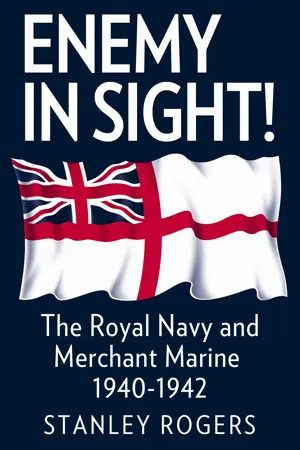
Enemy in Sight
The Royal Navy and Merchant Marine 1940-1942
- 208 pages
- English
- ePUB (mobile friendly)
- Available on iOS & Android
eBook - ePub
About this book
Enemy in Sight, first published in 1943, is an authoritative book on the activities of the British Royal Navy and Merchant Marine in the 1940-1942 period of World War Two. Author Stanley Rogers describes all the naval battles of that time, including the sinking of the formidable German battleship
Bismarck, the history of the aircraft carrier
Illustrious, the capture of a German U-Boat, the Dunkirk rescue flotilla, German E-Boats, stories of survival at sea, and much more, making
Enemy in Sight a valuable historical resource and essential reading on the Allied navies and their crews in the Second World War. Included are 16 pages of photographs.
Information
Subtopic
European HistoryIndex
HistoryPART ONE
CHAPTER I — The Destruction of Bismarck
On May 26, 1941, the people of Britain were stunned by the news that the battle-cruiser Hood, the largest ship in the Royal Navy, had been sunk in a naval action off Greenland. Hood was the pride of the Navy, and the news of her loss cast a deep gloom over the country.
Hood, reputed to be the largest warship in the world, had been completed in 1920, and was therefore a comparatively old ship. Laid down under the Emergency War Program at John Brown’s yard on the Clyde in September 1916, she was not completed until four years later. Her cost was over six million pounds, and she underwent extensive alterations to modernize her in 1930. Designed to meet the lessons of the battle of Jutland, she carried eight 15-inch guns and twelve 5.5-inch guns for a secondary armament. At her water-line was a belt of 12-inch armor-plate 562 feet long and 9-1/2 feet deep. Of her total displacement of 42,100 tons, her armor accounted for one-third. Such a ship was believed invulnerable from a broadside torpedo attack. This, then, was the wonder ship that was believed to be almost indestructible and able to stand up to any battleship afloat. Yet a single 15-inch shell fired from an enemy battleship destroyed her.
Out of the maze of rumor and fact a clear and logical explanation gradually appeared, and, though the blow to British pride was softened in the light of the knowledge that the destruction of Hood was due chiefly to a lucky hit, it did nothing to lessen the grief at her loss, though when the loss was avenged by the destruction of Bismarck three days later it seemed as though the score had been evened, especially as the enemy had lost in this one ship one-quarter of his capital ship strength, while the Royal Navy, with fifteen capital ships, could better spare the loss.
Bismarck was the fourth vessel of that name built for the German Navy and the largest warship ever launched in a German yard. A sister-ship to the then uncompleted Tirpitz, with a nominal displacement of 35,000 tons (believed to be actually nearer 45,000 tons) and with a main armament of eight 15-inch guns, she was laid down at the famous Blohm and Voss yards at Hamburg in 1936 and launched in February 1939.
With a secondary armament of twelve 5.9-inch and sixteen 4.1-inch guns, she could fire a somewhat heavier weight of metal than Hood. The thickness of her protective armor was a well-kept secret, but it must have been considerable, since she received at least half a dozen torpedo hits without showing any indications of sinking. In appearance she was unorthodox, compared with the more conservative British design, with her ‘clipper’ bows, upswept fore-deck sheer line, counter stern, large single funnel, and massive superstructure. In her last and only action she carried about two thousand men, including supernumeraries on a training course for sea experience. She was under the command of Admiral Gunther Lutjens, a sailor of the old German Navy who had been converted to the Nazi creed and had become a loyal supporter of Hitler.
Early in 1941 there was much enemy raider activity in the North Atlantic. Convoys were attacked by enemy war ships working at such extreme ranges that it had never been possible to identify them, but they were believed to be cruisers or the pocket-battleship Admiral Scheer, sister-ship to the scuttled Graf Spee. Some ships’ captains reported that the 26,000-ton battleships Scharnhorst and Gneisenau were out in the North Atlantic preying on shipping, and a little later the battleship Malaya sighted at long range two enemy warships believed to be that famous pair and even fired a salvo at them, without, however, ever getting to close quarters. This was in February, and late in March R.A.F. reconnaissance planes discovered two large enemy battleships alongside the docks at Brest. Careful study of photographs brought back revealed these ships as Scharnhorst and Gneisenau. Their presence at Brest coincided with a lull in the Atlantic convoy attacks, a respite which lasted for several weeks. It was part of the work of Coastal Command planes to keep watch on the north coasts of Europe to report the movements of enemy shipping, especially those of warships. So far as was known the only other big ship in commission, Bismarck, was safely out of harm’s way in Kiel harbor, but about the middle of May this formidable vessel was discovered to be at Bergen, in Norway, and obviously there for some sinister reason. She was discovered by a Coastal Command aircraft while on a reconnaissance over Norwegian harbors. Flying high over Bergen, the pilot at once noticed a very large battleship and a cruiser anchored in the roads, and they were identified as Bismarck and Prinz Eugen, a Hipper class cruiser of 10,000 tons.
To naval men this was significant news, for the presence of such an important ship as Bismarck away from her home base could only mean that the tiger had come out of its lair for one purpose and that not a peaceful one. Therefore orders were given to watch the battleship, since it was surmised that she was bound on a raiding cruise. For several days the two warships lay in Bergen harbor, but one morning a naval aircraft found that the enemy had disappeared. The two warships had slipped away under cover of darkness, but in which direction it was impossible to tell. Those gentlemen of the Admiralty who order the movements of His Majesty’s ships decided that the best guess was the North Atlantic and accordingly sent secret orders to the cruisers Norfolk (Captain A. J. L. Phillips), wearing the flag of Rear-Admiral W. F. Wake-Walker, and Suffolk (Captain R. M. Ellis) to take up positions in Denmark Strait, between Iceland and Greenland. As Denmark Strait is over two hundred miles wide at its narrowest point the prospect of intercepting any ship passing through those waters seemed extremely remote, especially as the weather at that period (late in May) was known to be bad, with visibility down to a mile or less. Ice-floes broken away from the polar ice-pack, and forming a menace to navigation, were still coming down from the Arctic Ocean, thus giving the cruisers’ company an added incentive to keep a sharp look-out.
It was not forgotten that if Bismarck and her consort were heading for the North Atlantic convoy lanes, sailing on a Great Circle course between American and Canadian ports and Britain, they might pass through the even wider stretch of ocean between Scotland and Iceland, and all naval ships operating in those waters were warned to keep a look-out. There were, indeed, at that time so many big ships of the Royal Navy in the Atlantic that the enemy had little chance of avoiding discovery for long.
At this point it will assist us to visualize the situation if the names of the warships and their dispositions are set down, so that they may be referred to in following the action that took place when the enemy was encountered. Norfolk and Suffolk, as we have seen, were watching Denmark Strait. They were both heavy cruisers of about 10,000 tons displacement. South of Iceland were Hood and Prince of Wales, the latter one of the new 35,000-ton battleships commissioned in 1941 and later sunk by a Japanese torpedo attack in the Far East. South of Greenland the new 23,000-ton aircraft-carrier Victorious was cruising with her destroyer escort, and several hundred miles to the east another new 35,000-ton battleship, King George V, wearing the flag of the Commander-in-Chief, Admiral Sir John Tovey, was also cruising in search of the enemy. Two hundred miles south of the flagship was the battleship Rodney (34,000 tons), one of the most powerful ships in the Navy. And later this formidable armada was joined by a force comprising the 32,000-ton battle-cruiser Renown, the aircraft-carrier Ark Royal, and the heavy cruiser Sheffield, under the command of Admiral Somerville. A grand total of six capital ships, two aircraft-carriers, and four cruisers, also a number of destroyers. This widespread patrol over the vast wastes of the North Atlantic proved that the Navy was sparing no effort to catch and destroy the enemy before he had an opportunity to do any harm. These vessels were scattered apart over thousands of square miles of ocean.
Let us return to the Denmark Strait, where Norfolk and Suffolk were cruising in company with every look-out station manned and decks cleared for action. On Friday, May 23, dawn broke over a gray and stormy sea with the two cruisers rolling their decks under and the look-outs muffled up in duffle coats as they peered out through the driving snow and rain-squalls. It was a cold and lonely job, and, though the chances of finding the enemy so far north seemed poor indeed, the Navy could not afford to relax its vigilance, for there was also the peril of U-boats, and a keen watch was kept for the elusive periscope almost impossible to detect in such steep seas. The visibility during the day varied as snow-squalls blotted out the horizon. The two cruisers frequently lost sight of each other, and, though they were always in touch by radio, this was used as little as possible in order to avoid giving their presence away to the enemy.
The day wore on without sight of a ship, but about half-past seven in the evening the rain cleared, and there, about six miles away, appeared the gray mass of a monster battleship and another warship, recognized as a cruiser, pushing through the seas at high speed on a south-westerly course. Admiral Wake-Walker immediately sent out a radio to the Commander-in-Chief of all units of the Navy in the North Atlantic that Bismarck and Prinz Eugen had been sighted in Denmark Strait heading south-west at high speed. The two ships were soon lost in the mists, but Suffolk and Norfolk managed to shadow them all that night in spite of bad visibility and rough seas. Shadowing such a big ship as Bismarck had its risks, for there was always the danger of running into range of the battleship’s 15-inch guns, since it was impossible to keep a fixed distance in the changing visibility. Although the enemy could hardly have failed to see the two shadowing cruisers, he made no attempt to attack them, probably because he suspected a trap such as that laid to decoy the Italian squadron towards Admiral Cunningham’s heavy ships in the Battle of Matapan. The Germans continued to steam at high speed on the same course with the probable expectation of losing themselves in the wide Atlantic. Their object was to destroy convoys, not to risk action with the British battle fleet.
As Admiral Lutjens sped southward he was not aware that Hood and Prince of Wales were approaching him from the east, that the aircraft-carrier Victorious lay in wait farther south, and that other big ships were hurrying to intercept him. When he left Norway to raid convoys in the Atlantic he doubtless felt that with luck he could avoid decisive action with superior forces, but, as we shall see, his chances of escape were almost nil. It was a bold action for a lone battleship (we can discount the presence of the cruiser) to steam into an area certain to be bristling with enemy warships. Modern aircraft-carriers, with their radio-equipped planes, able to watch every square mile of the ocean, make it impossible for any ship to remain at sea undetected. Much time and money have been spent in experiments to discover the perfect camouflage, but there is no means of concealing the tell-tale smoke and the white wake which trails behind any ship that is under way.
During the night H.M.S. Hood (Captain R. Kerr), wearing the flag of Vice-Admiral L. E. Holland, and Prince of Wales (Captain J. C. Leach) sped westward at forced draft to intercept the enemy. As they plunged into the heavy seas the bows and fore-deck were swept with cascades of white water. At dawn officers and men were ordered to action stations, and a sharp look-out was kept for the enemy believed to be somewhere in the driving mists to windward. Officers and ratings, as is the custom before going into action, put on clean underwear and outer clothes, and in the cabins they stowed away all loose breakable objects such as framed photographs, glass, or anything that would splinter at the shock of the first broadside. Men in gun-turrets and on the bridge and control-tower put on lifebelts, anti-flash hoods, and steel helmets. Mugs of hot cocoa were brought up, and the hot drink was gratefully gulped down by men who were chilled through after long hours of watch duty. Through the narrow slits in the armored turrets and look-out towers powdery snow found its way, for the air was full of driving snow. Visibility had dropped to a hundred yards. The escorting destroyers whose duty it is to screen the costly battleships from torpedo attack were unable to keep station in the mountainous waves and had dropped out of sight astern. The battleships, however, seemed to disdain the gale and tore through the steep seas at a rate of nearly thirty knots. The eggshell hulls of the destroyers could not have stood up to the buffeting of the seas at that speed, and until the weather improved the battleships would go on alone and chance U-boats, for at all risks the foe must be met and challenged.
Shortly after dawn the skies cleared, though the seas were running high. The low clouds lifted, the snow-squalls had gone, and the horizon became a sharp black edge against a band of pale yellow sky. The visibility was perfect, and eager eyes aloft scanned the horizon for the first sign of the enemy. Suddenly the shrill voice of a boy in the highest look-out station of Prince of Wales was heard above the roar of the wind: “Enemy in sight!” And there on the northern horizon, clear and sharp, was silhouetted a monster battleship, followed by a smaller cruiser, steaming in line ahead and showing no smoke. The first impression of everyone who saw Bismarck was of her tremendous size. This impression seems to have been unanimous among the British sailors.
The range was estimated at thirteen miles. The long barrels of the big guns of Hood and Prince of Wales were trained on the enemy, and a few seconds later the signal came from the flagship to open fire. Instantly bright orange flashes spurted from the guns of the forward turrets of Hood as she fired the first salvo. Two seconds later Prince of Wales’ 14-inch guns crashed out a deafening salvo, just as Bismarck opened fire. The German shooting was good, and the first salvo fell uncomfortably close to the British ships. Hood and Prince of Wales were speeding toward the enemy on parallel courses firing salvos from the big forward guns as fast as they could be reloaded. Then the monstrous and inconceivable thing happened, the fatal hit which destroyed the pride of the Royal Navy. Observers from Prince of Wales, which was herself hit by a 15-inch shell from Bismarck, saw a great flame shoot up from the boat-deck of Hood, which was amidships. At the same time a signal was hoisted ordering Prince of Wales to carry on with the prearranged maneuver. Hood was in serious danger, though the watchers from Prince of Wales, who had their own hands full, did not yet fully realize how serious was the state of things in the flagship. The great fire amidships was shooting up tongues of flame in the center of a vast cloud of yellowish smoke hundreds of feet high. From the heart of the fire huge pieces of metal were hurled high above the stricken battleship. A second later she was almost totally obscured by a great cloud of smoke, through which her forward guns were still gamely firing. Suddenly a shattering explosion seemed to lift the 42,000-ton monster out of the sea, and when the smoke had cleared away Hood was gone.
Within a few minutes of the opening of the battle the flagship was lost, and with her 1418 officers and ratings, including Vice-Admiral Holland. There were only three survivors. They were picked up by one of the escorting destroyers which had arrived on the scene. The first phase of the battle was over, and the Royal Navy had received a serious blow. So far as could be seen, Bismarck was unharmed; certainly her fighting power remained untouched. How had the largest, most heavily armored, and supposedly most formidable fighting ship in the world been destroyed by Bismarck’s guns at long range and within only a few minutes of the start of the action?
Was it through some inherent fault in construction, or some secret weapon of the enemy’s such as a new type of armor-piercing shell? The probable explanation is simply that a 15-inch shell from Bismarck fired at a range of twelve miles by its necessarily high trajectory had dropped almost vertically on to the lightly armored section of the deck amidships, causing a fire in a magazine which spread to one of the main magazines with the inevitable consequences. Even giving the enemy his due for good shooting at such a long range when it is quite impossible to hit a given spot with certainty, it can surely be counted as simply a lucky shot, and the enemy must have had as big a surprise at the sudden disintegration of Hood as did the watchers on board Prince of Wales, which meanwhile continued firing, although she herself was in difficulties from a direct hit aft and had eventually to take avoiding action while temporary repairs were carried out. Meanwhile Suffolk and Norfolk hung on to the enemy, who altered his course to due south and was steaming at a...
Table of contents
- Title page
- TABLE OF CONTENTS
- PREFACE
- INTRODUCTION - Three Years of War
- PART ONE
- PART TWO
- Illustrations
Trusted by 375,005 students
Access to over 1.5 million titles for a fair monthly price.
Study more efficiently using our study tools.
Frequently asked questions
Yes, you can cancel anytime from the Subscription tab in your account settings on the Perlego website. Your subscription will stay active until the end of your current billing period. Learn how to cancel your subscription
No, books cannot be downloaded as external files, such as PDFs, for use outside of Perlego. However, you can download books within the Perlego app for offline reading on mobile or tablet. Learn how to download books offline
Perlego offers two plans: Essential and Complete
- Essential is ideal for learners and professionals who enjoy exploring a wide range of subjects. Access the Essential Library with 800,000+ trusted titles and best-sellers across business, personal growth, and the humanities. Includes unlimited reading time and Standard Read Aloud voice.
- Complete: Perfect for advanced learners and researchers needing full, unrestricted access. Unlock 1.5M+ books across hundreds of subjects, including academic and specialized titles. The Complete Plan also includes advanced features like Premium Read Aloud and Research Assistant.
We are an online textbook subscription service, where you can get access to an entire online library for less than the price of a single book per month. With over 1.5 million books across 990+ topics, we’ve got you covered! Learn about our mission
Look out for the read-aloud symbol on your next book to see if you can listen to it. The read-aloud tool reads text aloud for you, highlighting the text as it is being read. You can pause it, speed it up and slow it down. Learn more about Read Aloud
Yes! You can use the Perlego app on both iOS and Android devices to read anytime, anywhere — even offline. Perfect for commutes or when you’re on the go.
Please note we cannot support devices running on iOS 13 and Android 7 or earlier. Learn more about using the app
Please note we cannot support devices running on iOS 13 and Android 7 or earlier. Learn more about using the app
Yes, you can access Enemy in Sight by Stanley Reginald Harry Rogers in PDF and/or ePUB format, as well as other popular books in History & European History. We have over 1.5 million books available in our catalogue for you to explore.