Memoirs of British medical officer J. C. Dunn during World War I: "The first duty of a battalion medical officer in War is to discourage the evasion of duty...not seldom against one's better feelings, sometimes to the temporary hurt of the individual, but justice to all other men as well as discipline demands it."
"Sometimes, through word of mouth and shared enthusiasm, a secret book becomes famous. The War the Infantry Knew is one of them. Published privately in a limited edition of five hundred copies in 1938, it gained a reputation as an outstanding account of an infantry battalion's experience on the Western Front."—Daily Telegraph
"I have been waiting for a long time for someone to republish this classic. It is one of the most interesting and revealing books of its type and is a genuinely truthful and fascinating picture of the war as it was for the infantry"—John Keegan
'A remarkably coherent narrative of the battalion's experiences in diary form…a moving historical record which deserves to be added to the select list of outstanding accounts of the First World War"—Times Literary Supplement
"A magnificent tour de force, the length of three ordinary books."—London Review of Books
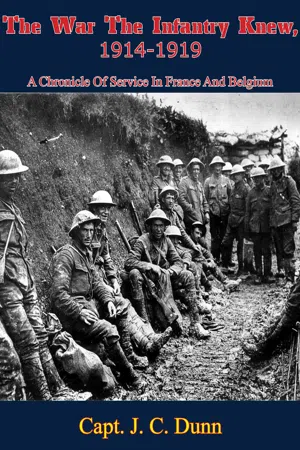
eBook - ePub
The War The Infantry Knew, 1914-1919
A Chronicle Of Service In France And Belgium
- 640 pages
- English
- ePUB (mobile friendly)
- Available on iOS & Android
eBook - ePub
About this book
Information
Subtopic
Military BiographiesIndex
HistoryCHAPTER I—July-August 1914
“The suddenness of a thunderbolt”—Mobilizing—Crossing the Channel—Rouen—Amiens
Contributors:—BOREHAM; GEIGER; HOLMES; OWEN; POWELL; RICHARDS; RODERICK; WILLIAMS; YATES—Sketch:—1
‘At{1} the outbreak of the Great War I was Company Sergeant-Major of B Company, 2nd Battalion The Royal Welch Fusiliers. I have often thought how, in April and May 1914 when we were engaged in platoon and company training, Captain Douglas Powell, in his lectures, would picture us with Germans as our opponents. Few of us dreamed at the time that in a few short months we should have them as such in reality. Even when events on the Continent were reaching a climax I do not think that we discussed our chances of having to take any part in them. To me personally the War came with the suddenness of a thunderbolt, and it was in this way.
July 30th, Thursday.—The Battalion was in Bovington Camp, at Wool in Dorsetshire, engaged in training and musketry. We were to return to Portland, our station, towards the end of July, stay there about a week, and then go to Salisbury Plain for manoeuvres. We Company Sergeant-Majors had just received the detail for the moves from the Adjutant, Captain C. S. Owen: I had not got back to my tent when the bugler sounded “Company sergeant-majors, at the double.” Back we went to the Orderly Room. This time the Orders were very brief: “Pack up, we march back to Portland tonight.” Then the thought flashed through my mind—War. The men were jubilant, as is usual in such circumstances. I’m not afraid to place it on record that I was not; the South African War had taught me that there was nothing at all to get jubilant about. It is strange what thoughts pass through one’s mind in times of crisis. The very first thing that came to mine was the recollection of being verminous in South Africa, and the intense horror of being so again. Then I began to think of other things. It would be about 7 in the evening when the order was issued, and we got to work at once.’
Pickets were sent out to round up the men who were out of camp, but of course there were the usual few absentees at tattoo: greatly surprised they were on returning to find only the party detailed to tidy up, and hand over the camp to Ordnance. (A correspondence about the equipment was to occupy Orderly Room for a good part of the winter.)
Yates, the Quartermaster, took the first train to Portland to prepare for the Battalion’s return, and to ration the expected Coast Defence troops. The local butcher and baker were surprised at the amount of the orders given them. The recruits and boys at the Verne had a heavy night’s work to get the barracks ready at such short notice. It was an all-night job for everyone concerned.
The Goat{2}, which had been unwell, died. “He must have known something.”
‘Williams{3} and I had gone to Bournemouth for dinner. On our return to Wool we noticed flames. My first idea was that the Canteen was on fire. However, on our pulling up, Knox Gore rushed to us and, in a voice quivering with emotion, informed us that we were ordered back to our peace stations, and were starting in ten minutes. My Company’s peace station was Dorchester, the other three Companies were in the Verne Fort at Portland.’
The march began at 11 o'clock. Fortunately the night was July 31st—fine. The Dorchester Company arrived at its quarters at 3 a.m. in great spirits. For the main body the march was long and dreary. The Band and Drums were unable to play the whole night without their music, but they put up a wonderful show. Day was breaking as we came down the hills to Weymouth, and, as daylight increased, the awful sleepiness always associated with night-marching wore off and the march became less irksome. When we sighted the harbour we had our first forecast of war. It was full of warships when last we saw it; now there were none. The Navy had been mobilized on July 15th as a long prearranged test of administration; it was being kept in commission pending the development of a recent and unexpected political crisis abroad. The Band and Drums had started to play again, and the good folks of Weymouth were roused about 6 o'clock by the Drums playing, “I do like to be beside the seaside.” The next sign of war was a guard that had been mounted at the bridge over an arm of the sea, beside the Whitehead Torpedo Factory, near Portland. A “state of war” was not yet in being, but because of “strained relations” the Coast Defences had been manned. It was strange what an impression of the very unusual these various signs made. Portland rises so abruptly from sea-level that the final climb of nearly 600 feet was not a very nice finish to a march of about 22 miles in marching order. Needless to say we were all very pleased when we reached the top. There those of us who had wives found them waiting wide-eyed and apprehensive of the reason of our returning so suddenly.
Preparation for the expected mobilization followed. Although the order had not been received, our regimental authorities anticipated it, so that when it did come there was less to do than otherwise would have been the case. Indeed, owing to an Orderly Room blunder anticipation went too fast: mobilization telegrams were sent out. The incident had to be explained away in Parliament when the Houses met the following week, and the Orderly Room telephone nearly fused with the questions that came in—and other official and semi-official remarks. Mobilization stores were got out, and the wagons were loaded in case of a sudden move. Our equipment was indifferent: the men had dixies instead of field-kitchens, better known as “cookers”; our machine-guns were on heavy antique gun-carriages instead of the tripod mounting. All this was because, having just arrived from India, we did not belong to any brigade or division, did not—on paper—belong to the Expeditionary Force of six divisions. The Battalion had been fitted-out with home-service clothing and equipment after our home-coming in March, the Band and Drums completed with their respective types of tunic: everything had to be packed away or handed back to Stores. Pay-books and identity-discs were checked up to date, and nominal rolls for everything were prepared. ‘Fortunately{4} for me, I had finished my tour of duty as Sergeants Mess President the previous quarter; Bill Barling had the job of packing up the Mess in addition to all his other work.
I’ve often reflected since then on how many things came true. When first we got the pay-books and identity-discs, about two years before the War, we smiled at the idea of ever having to use them. Behind the Commanding Officer’s table in the Orderly Room was a mobilization chart—another smile. What an awful bore it was to have to listen to the King’s Rules and Regulations relating to Active Service being read out each quarter! And when we had to make out family allotment forms the smile changed to a broad grin.
As the days passed the situation became more critical and the work of preparation more strenuous. I had just time to rush home, snatch a bit of food, then back to business. It was usual to be roused in the middle of the night and told by an orderly that I was wanted in the Orderly Room. I don’t think Jimmy Caldwell, the Orderly Room Sergeant, got much sleep at this time.’ We were getting orders continually, mostly over the telephone and rarely confirmed. A few officers’ private cars were invaluable. The Quartermaster could not have overtaken his work without someone to drive him about: ‘O. de L. was my friend these days.’ Because we were a spare unit our mobilization scheme was only in the rough, it had not been vetted.
‘If{5} there was any discussion on the prospects of war it was done chiefly by the women-folk—I generally found a group of them busy at it; I’m afraid I was rather rude to one good lady who was taking things badly and upsetting others.’
For the detached Company at Dorchester, once all transport and other arrangements had been made to set out for Portland as soon as the mobilization signal came through, these few days were a time of anxious waiting and rumour. Otherwise, the only excitement was the Assizes, presided over by Mr. Justice Darling, the wit of the Bench.
August 4th, Tuesday.—‘In{6} the evening Owen sent for me and showed me a telegram, and told me to take it to the Colonel. The C.O. was at Walwyn’s, where there was a dinner-party. They had not finished dinner when I was shown in. I think those few minutes, talking about nothing till the ladies had retired, were the most strained I have ever been through.’
‘About{7} 9 p.m. “Company sergeant-majors” sounded as I was having a drink with “Pip” Parsons, who remarked, “That’s it”: drank his beer, and requested the production of a dozen Germans. Then to work copying out Orders. When we had finished the Mess was closed, sad to relate.’
August 5th.—‘The{8} signal arrived at Dorchester at about 2.30 a.m., and we were under way by 3.15. We started in pouring rain, the men in the best of spirits, singing at the top of their voices. I have forgotten what they sang, but it certainly was not “Tipperary,” which was already out of date in Quetta the previous year.’ (“It’s a long way to Tipperary” was, however, soon associated in the public mind and in the journalism of the time with the marching of our Old Army.) ‘The rain eventually ceased. As we climbed the hill to the Verne, at about 8 a.m., I noticed a Red Cross flag flying from the Naval Hospital flagstaff at Portland, and so knew that war had been declared. The next hours were passed in a whirl of mobilization.’
Thomas, the Transport Officer, went off early in the morning with a party to Wareham, to take over horses as they were collected there by Remounts.
‘In{9} the afternoon we got Orders to start next day. The excitement became even more intense. As we seemed to be under the direct orders of the War Office there was no one we could possibly sound as to our destination. My wife was on a bed of sickness and unable to join me; my mother was, so far as I knew, held up in Switzerland; consequently it looked as if I should have to depart without seeing any of my small family.
In the evening the Garrison Gunners at the Verne took some of us to a sort of conning-tower where a good view out to sea was obtainable, and where, by some fire-direction system that seemed too good to be true in those days, they could put a shot into any square yard of sea within range. I am sure most of us expected a German cruiser to appear suddenly and be sunk; I know I did—and I don’t think anybody thought about submarines.’
August 6th.—When the day for departure arrived there were not many of the administrative staff who were at all sorry. After an early breakfast we paraded to leave the Verne Citadel: 20 officers and 580 rank and file. The Transport wagons were being left ready so that when the horses arrived they had only to hook in.
‘Just{10} as we turned out the first draft of Reservists from Wrexham marched in. They were allotted to Companies, and because a roll had to be rendered to Orderly Room at once, I sat down just as I was, in marching-order, and wrote it out. Several Reserve officers joined us on parade. A second party of Reservists, making about 300 altogether, arrived later in the morning.’
‘We{11} got off at last, at 7 o'clock, and marched down to the station. I have a vivid recollection of Norah Walwyn at the main gate with a kodak in her hands, but much too overcome with emotion to manipulate it. Our departure from Portland created little excitement among the local population, of whom few were about; I did, however, hear one humorist call out, “Bring us back some sausages, Bill.”’ We hung about for a considerable time before entraining. Nothing showed us where we were going. Excitement ran high. Once in the train, rumours and guesses at our destination circulated rapidly; consequently, when we arrived at Dorchester and were told to get out, it was rather an anti-climax. Room had to be found at the Verne for its scheduled garrison, a South Lancs Territorial battalion, so Dorchester was our actual mobilization point.
We were told that our stay was indefinite, and that we were all to go into billets, which was a new experience for us. It was not real billeting, however, because the officers went into one or other of the hotels, H.Q. was in the King’s Arms, and the men were in various public buildings.—A. Company’s first billet—Infant School, block floor with pack for a pillow.’ B Company, in the Corn Exchange, were also able to test the discomfort of sleeping on the hard wooden floor. ‘I{12} had the opportunity of a bed in a house but preferred to be close at hand; besides, it would be easier to get up off the floor than to turn out of a comfortable bed if I were wanted.’
August 7th.—The first fatigue was wiring-in the old Artillery Barracks which were to house enemy internees of military age; otherwise there was not much to do except take a route-march or two to accustom the men to their new boots, and do a little musketry drill.
August 8th.—The Reservists and the Transport, having marched from Portland, joined us. There were many stragglers, which was not to be wondered at because some of the men had been several years on the Reserve and were consequently soft, and some had the wrong size of boot. It was not possible to get boots from Store for these men, ‘so I{13} suggested to Captain Powell that, as there was a war on, we could commandeer boots for them. B Company did this, giving the shopkeeper a requisition.’ There was no need to ask who was a Reservist, his white skin distinguished him from the tanned, fit serving man...
Table of contents
- Title page
- TABLE OF CONTENTS
- GLOSSARY
- SKETCHES FROM MAPS
- CONTRIBUTORS
- CHAPTER I-July-August 1914
- CHAPTER II-August-September 1914
- CHAPTER III-September-October 1914
- CHAPTER IV-October-November 1914
- CHAPTER V-November 1914-August 1915
- CHAPTER VI-August-October 1915
- CHAPTER VII-October 1915-April 1916
- CHAPTER VIII-April-July 1916
- CHAPTER IX-July-August 1916
- CHAPTER X-August-November 1916
- CHAPTER XI-November 1916-March 1917
- CHAPTER XII-March-April 1917
- CHAPTER XIII-April-July 1917
- CHAPTER XIV-July-August 1917
- CHAPTER XV-September 1917-January 1918
- CHAPTER XVI-January-April 1918
- CHAPTER XVII-April-August 1918
- CHAPTER XVIII-August-November 1918
- CHAPTER XIX-November 1918 and after…
- APPENDIX
- ILLUSTRATIONS
- SKETCH MAPS
- REQUEST FROM THE PUBLISHER
Trusted by 375,005 students
Access to over 1.5 million titles for a fair monthly price.
Study more efficiently using our study tools.
Frequently asked questions
Yes, you can cancel anytime from the Subscription tab in your account settings on the Perlego website. Your subscription will stay active until the end of your current billing period. Learn how to cancel your subscription
No, books cannot be downloaded as external files, such as PDFs, for use outside of Perlego. However, you can download books within the Perlego app for offline reading on mobile or tablet. Learn how to download books offline
Perlego offers two plans: Essential and Complete
- Essential is ideal for learners and professionals who enjoy exploring a wide range of subjects. Access the Essential Library with 800,000+ trusted titles and best-sellers across business, personal growth, and the humanities. Includes unlimited reading time and Standard Read Aloud voice.
- Complete: Perfect for advanced learners and researchers needing full, unrestricted access. Unlock 1.5M+ books across hundreds of subjects, including academic and specialized titles. The Complete Plan also includes advanced features like Premium Read Aloud and Research Assistant.
We are an online textbook subscription service, where you can get access to an entire online library for less than the price of a single book per month. With over 1.5 million books across 990+ topics, we’ve got you covered! Learn about our mission
Look out for the read-aloud symbol on your next book to see if you can listen to it. The read-aloud tool reads text aloud for you, highlighting the text as it is being read. You can pause it, speed it up and slow it down. Learn more about Read Aloud
Yes! You can use the Perlego app on both iOS and Android devices to read anytime, anywhere — even offline. Perfect for commutes or when you’re on the go.
Please note we cannot support devices running on iOS 13 and Android 7 or earlier. Learn more about using the app
Please note we cannot support devices running on iOS 13 and Android 7 or earlier. Learn more about using the app
Yes, you can access The War The Infantry Knew, 1914-1919 by Capt. J. C. Dunn in PDF and/or ePUB format, as well as other popular books in History & Military Biographies. We have over 1.5 million books available in our catalogue for you to explore.