"The original purpose of this monograph was to tell the European half of the story of William Penn's relations with the Dutch Quakers who emigrated to Pennsylvania. But the predominance of the Dutch Quaker pioneers, as revealed by that story, in the settlement of Germantown made it desirable to follow them across the Atlantic and indicate the part which they played for at least a quarter-century in the affairs of the Quaker colony.
"Hence the study comprises, first, Penn's efforts on his three journeys to Holland and Germany to convert to Quakerism the Labadists, Pietists and Quietists whom he found there; second, the way in which small Quaker communities on the Continent had prepared the way for these visits; and finally, the rise and progress of those congregations of Dutch and German Quakers who, fleeing from persecution, accepted Penn's invitation to settle in Pennsylvania."—William I. Hull, Introduction
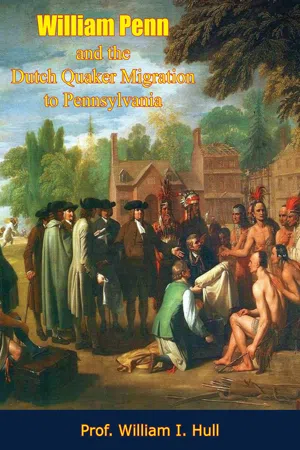
- 399 pages
- English
- ePUB (mobile friendly)
- Available on iOS & Android
eBook - ePub
William Penn and the Dutch Quaker Migration to Pennsylvania
About this book
Information
Topic
GeschichteWILLIAM PENN AND THE DUTCH QUAKER MIGRATION TO PENNSYLVANIA
CHAPTER I — PENN’S MISSION TO HOLLAND AND GERMANY
The connection of William Penn with Holland is believed by many of his biographers to have begun before he was born. His contemporary, the chronicler Samuel Pepys, writing under date of December 28, 1664, records: “To Sir W. Pen’s to his Lady, who is a well-looked, fat, short, old Dutch woman; but one that hath been heretofore pretty handsome, and is now very discreet, and I believe, hath more wit than her husband.” Lord Braybrooke, in his edition of Pepys’s Diary (1825), adds the footnote, “Margaret, daughter of John Jasper, a merchant at Rotterdam.” There are sundry other gossipy entries in Pepys’s Diary relating to William Penn’s mother, but no other clue to her origin.
Later research{3} appears to have established the fact that she was the daughter of John and Marie Jasper, who resided before 1641, at Ballycase, County Clare, Ireland. Whether her father was at any time “a merchant at Rotterdam”, we are not informed. Margaret Penn’s first husband was “Nicasius Vanderscure”, who resided at the time of the marriage (1641) at Kilrush, County Clare, Ireland. The records of the Dutch Reformed Church of Austin Friars, London, reveal this fact, and thus connect him, as does his name, with Dutch ancestors. His widow, “Margaret Van der Schuren”, married Captain William Penn, in 1643. It was perhaps this Dutch name of her first husband which she retained as a widow that caused Pepys to refer to her as a “Dutch woman”; while Lord Braybrooke’s knowledge of the family of Jaspers in Rotterdam may have caused him to assign John Jasper to that city—although, of course, John Jasper of Ireland may have been at one time “a merchant at Rotterdam.”
A careful search{4} in the Gereformeerde and Schotsche Tronw Registers and the Gereformeerde Doop and Begrafenis Registers, of Rotterdam, has revealed only the betrothals of Jan and Jacob Jasperszoon (1608); the baptism of Grietje, daughter of Willem Jasperse (1626); and the burial of Jan Jasperse’s wife and of Jasper Janszoon (1609). But no trace has been found of Margaret, daughter of Jan.
These Rotterdam records reveal the names of sundry members of the family of Margaret Jasper’s first husband, the Van der Scurens, in the first half of the Seventeenth Century. That her second husband, Sir William Penn, had important naval and military connections with Holland is inscribed in history; and tradition reports that a “Dutch Punch Bowl” made for him in Holland, in 1653, was possessed by W. Stuart, of Tempsford Hall, Sandy, in 1884.{5}
THE LABADISTS
William Penn’s first authentic connection with the Continent dates from 1671 when, at the age of twenty-six, he went with Benjamin Furly of Rotterdam and Thomas Rudyard of London to try his hand at winning to Quakerism the sect of the Labadists. The latter were an interesting Protestant Community, some of whose superficial resemblances to the Quakers led the Quaker founders to hope that they might be induced to unite with Quakerism. Their leader was Jean de Labadie, a Frenchman, born in Guienne in 1610, and educated at Bordeaux, in a Jesuit college; falling into disfavor with the Jesuits, in Paris, he sided with the Jansenist party and, becoming a canon in Amiens, he preached and worked against the Romish tendency in the Gallican church; driven from this post by Jesuit hostility, he went to Port Royal des Champs, where he read Calvin’s works and became a Protestant; appointed rector of the university at Montaubon, he filled this post for seven years, and then went as professor to Geneva; here, he is said to have exerted a great influence and become “a second Calvin.”
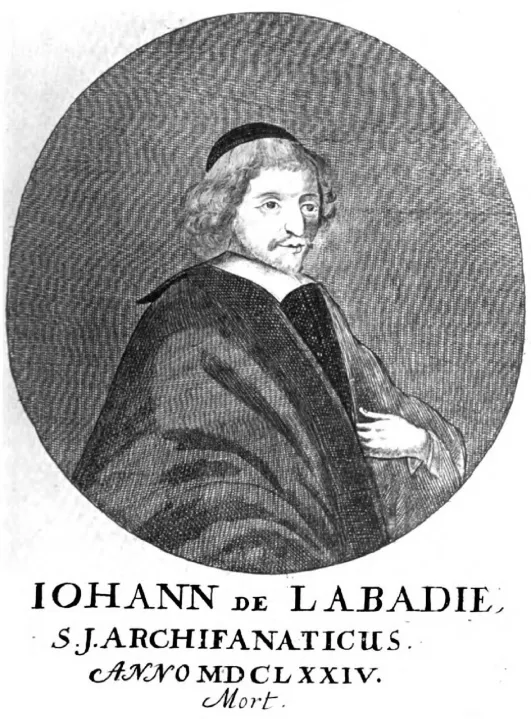
At the age of fifty, he received from the Walloon congregation in Middelburg a call to become its minister, and for seven years he served in that capacity, stirring up much opposition by refusing to subscribe to the Walloon confession of faith. Seven synods were held, between 1666 and 1669, to consider his “heresy”, which consisted principally in his rejection of linguistic and classical knowledge alone for the interpretation of the Bible, and insisted on the light shed on the mind of the reader by the Holy Spirit. This “Light Within”, as the Quakers called it, Labadie claimed to be as essential as the Bible itself and it was this doctrine that drew the Quakers’ attention to him. It was this doctrine, too, which led his opponents to class him as an “Archfanatic” and to associate him with Spinoza, Böhme and “Oxmann the Quaker and Anabaptist.”
Withdrawing from the Reformed Church, and founding the first Reformed sectarian church in Holland, Labadie and his followers removed to Amsterdam in August, 1669. His fame as an eloquent and popular preacher had been established throughout Holland by his innumerable sermons, which he had delivered, like the contemporary Quakers, in village, town and city, on every opportunity, and in every possible place on land and canal.
The Labadists’ doctrines were expounded in a French, treatise by Jean Samuel (translated into Dutch by Samuel, Schorel, and published in Amsterdam in 1669), and were similar to some of those which were taught by the Friends. For example, they renounced many of the traditional forms of worship, and co-ordinated with the Bible, or “exterior Word”, as the source of religious truth, the “interior Word”, or the direct illumination of the soul of man by the spirit of God through the Holy Ghost. These and other similarities between the Labadists and the Friends were to bring their leaders into contact at various times and places, and led the populace of Amsterdam to confuse the two sects and to denounce them indiscriminately as Quakers.
On Labadie’s arrival in Amsterdam, he rented a house for himself and his assistants and began the holding of religious meetings. To him came a distinguished convert, Anna Maria van Schurman, of Utrecht,{6} her nephew—a boy of eleven—her friend, Anna de Veer, their two maids, two widows with their children, and two older girls, all of whom lived on the lower floor of De Labadie’s house, while he and his assistants lived on the upper floor and the religious meetings were held in the large room on the floor between them. Some prominent Hollanders were converted to the Labadists’ faith, among them being the three Van Sommelsdijk sisters, Anna, Maria, and Lucia, of Friesland;{7} Luise Huyghens, of Rijsbergen; Aemilie van der Haar, of The Hague; a preacher, Adrian van Herder, and Conrad van Beuningen, Burgomaster of Amsterdam. These successes, added to their being confused with the despised Quakers; the charge that De Labadie, like Penn, was a Jesuit spy; and some unfortunate occurrences at the Labadist house, caused the clergy, the populace, and finally the magistrates of the city to turn against them.
Some of the occurrences referred to above may be cited as illustrative of those incidents, the misinterpretation of which often led to religious persecution, in the seventeenth century in Holland and at many other times and places. One of the elderly widows who had come from Middelburg to live in the Labadist house at Amsterdam, died after a three weeks’ illness, and her corpse was placed in a coffin beside the street-door; at this very time, the owner of the house sent some workmen to dig a drain in the back-garden, and the street urchins, associating the two facts and inferring a secret burial, raised the cry of “murder”, and collected a mob, which stoned the house and any of its inmates who showed themselves; as a result, the Labadists were confined to their house for three days and nights, at the end of which time the widow’s funeral had to be conducted under military escort. Again, one of the deacons, Ménuret by name, went insane, abused De Labadie violently, and finally died of brain fever, whereupon it was reported that De Labadie had kicked him to death; and although a public investigation resulted in De Labadie’s acquittal, the incident was one more cause of popular indignation.
The Labadist deacons, too, in their zeal, attempted to make converts by participating in the meetings of the theosophist, Gichtel, who held large prayer-meetings at night in the fields outside of the city; and they attempted also to convert the followers of Antoinette Bourignon, who became notorious in Amsterdam by publishing there, in 1669, in a French version, her treatise entitled, “The Grave of the false Theology.” Antoinette succeeded in collecting a large number of followers, who believed in her assumed power to heal the sick and cast out devils, and who followed her in 1671 to the island of North Strand, off the coast of Holstein.{8} The Labadists, however, were not so successful as some of the other “New Lights”; for as Anna Maria van Schurman complained: “We learned quickly enough how far our age had fallen from truth, for so few were willing to give themselves to Christ and to forego earthly comfort.”
Within the Labadists’ House in Amsterdam—“the Cloister”, as it was styled, “of the Evangelical Church”—spiritual joy reigned supreme and made itself manifest by dancing, singing and sundry exuberances of an animated life; but the sect was far indeed from gaining in the city, or in the nation, the 60,000 converts whom Anna Maria van Schurman in her enthusiasm claimed for it at one time. Finally, its head and adherents were ordered by the Amsterdam magistrates to permit none but “house-mates” to attend their religious meetings. This order—a kind of Conventicle Act—came at the critical time when some of De Labadie’s followers in Middelburg were about to join him in Amsterdam, and was the final cause of his accepting an invitation which had been extended by Anna Maria van Schurman’s old friend and admirer, the Princess Elisabeth of the Palatinate, who was the Protestant Abbess of Herford, and who invited the Labadist community to settle upon her estates at the latter place.
Accordingly, in the Spring of 1671, De Labadie and four other pastors, with about fifty followers, and escorted to the quay by a throng of citizens, set sail from Amsterdam for Bremen, whence they were to be conveyed by carriage to Herford. Here they were to be visited several times by Quaker missionaries; and even before they left Amsterdam an effort had been made to convert them to the Quaker faith.{9} A nucleus of twenty-eight members was left temporarily in Amsterdam, and an attempt at colonization was made, some years later, in what was supposed to be the Province of Pennsylvania; and in both the Old World and the New it was hoped for a time that these cousins-german of the Quakers would be united with the Society of Friends.
Gerard Croese records in his “History of the Quakers”{10} that “the first of the Quakers that came from Scotland to the Labadists in Amsterdam was George Keith,....After him, comes out of England Robert Barclay,....These men, one after the other, treat about this matter [union with the Quakers] with Labadie and the rest of them on whom the government of the society lay.” If these visits really occurred,{11} in Amsterdam, they must have been made in 1669–70; and they may have inspired the visit which Penn made the next year to the Labadist community at Herford.
The modern Westphalian and Prussian city of Herford was called by Penn and his contemporaries Herwerden.{12} In the journal of his “Travails” in 1677, Penn gives the following account of his visit to the Labadists in 1671 when they were still living there:
“The Princess [Elizabeth of the Palatinate] giveth them an invitation [to settle in Herford], and they came and were protected by her; but since some miscarriages falling out in that place, she thereupon in good measure withdrew her Favour from them, and they removed into another place [Wieuwerd]. I was moved to Visit this Man and his Company [at Herford] six years ago, and did see him and his two great Disciples, but they would not suffer me to see the People which I laboured for. In that day I saw the airiness and unstableness of the man’s spirit, and that a sect-master was his name. And it was upon me, both by word of mouth and writing, to let them know that the enemy would prevail against them to draw them into inconvenient things, if they came not to be stayed in the light of Jesus Christ, and to know the holy silence; and that at last they would come to fall out one with another, and moulder away; which is in some measure come to pass as I feared. For I clearly perceived, that though they had received some divine touches, there was a danger they would run out with them, and spend them like prodigals; not knowing then where to stay their minds for daily bread. Yea, though they were something angelical and like to the celestial bodies, yet if they kept not their station, they would prove fallen stars. They moved not in the motion of Him who visited them, but were filled with gross mixtures, and thereby brought forth mixed births, that is to say, things not natural but monstrous. In fine, they were shy of us, they knew us not; yet I believed well of some of the people, for a good thing was stirring in them.”{13}
Gerard Croese, who may have seen a copy of Penn’s “Travails” before his own book was published, reflects the Quaker attitude towards the Labadists as follows:{14} “But when the Quakers [i.e. Keith and Barclay] open’d their Mind b...
Table of contents
- Title page
- TABLE OF CONTENTS
- MONOGRAPHS IN THIS SERIES BY THE SAME AUTHOR
- ILLUSTRATIONS
- PREFACE
- CHAPTER I - PENN’S MISSION TO HOLLAND AND GERMANY
- CHAPTER II - PENN IN THE NETHERLANDS
- CHAPTER III - PENN IN THE RHINELAND
- CHAPTER IV - THE DUTCH QUAKER FOUNDERS OF GERMANTOWN
- CHAPTER V - THE TREK TO PENNSYLVANIA
- APPENDIX A - William Penn’s Itineraries in Holland and Germany
- APPENDIX B - THE DUTCH PIONEERS OF GERMANTOWN
- APPENDIX C - DUTCH AND GERMAN SETTLERS IN GERMANTOWN, 1683-1709
- APPENDIX D - THE KREFELD MARRIAGE CERTIFICATE OF 1681
- APPENDIX E - INSCRIPTIONS ON THE PASTORIUS MONUMENT, IN KREFELD, PRUSSIA; ERECTED, 1931.
- REQUEST FROM THE PUBLISHER
Trusted by 375,005 students
Access to over 1.5 million titles for a fair monthly price.
Study more efficiently using our study tools.
Frequently asked questions
Yes, you can cancel anytime from the Subscription tab in your account settings on the Perlego website. Your subscription will stay active until the end of your current billing period. Learn how to cancel your subscription
No, books cannot be downloaded as external files, such as PDFs, for use outside of Perlego. However, you can download books within the Perlego app for offline reading on mobile or tablet. Learn how to download books offline
Perlego offers two plans: Essential and Complete
- Essential is ideal for learners and professionals who enjoy exploring a wide range of subjects. Access the Essential Library with 800,000+ trusted titles and best-sellers across business, personal growth, and the humanities. Includes unlimited reading time and Standard Read Aloud voice.
- Complete: Perfect for advanced learners and researchers needing full, unrestricted access. Unlock 1.5M+ books across hundreds of subjects, including academic and specialized titles. The Complete Plan also includes advanced features like Premium Read Aloud and Research Assistant.
We are an online textbook subscription service, where you can get access to an entire online library for less than the price of a single book per month. With over 1.5 million books across 990+ topics, we’ve got you covered! Learn about our mission
Look out for the read-aloud symbol on your next book to see if you can listen to it. The read-aloud tool reads text aloud for you, highlighting the text as it is being read. You can pause it, speed it up and slow it down. Learn more about Read Aloud
Yes! You can use the Perlego app on both iOS and Android devices to read anytime, anywhere — even offline. Perfect for commutes or when you’re on the go.
Please note we cannot support devices running on iOS 13 and Android 7 or earlier. Learn more about using the app
Please note we cannot support devices running on iOS 13 and Android 7 or earlier. Learn more about using the app
Yes, you can access William Penn and the Dutch Quaker Migration to Pennsylvania by Prof. William I. Hull in PDF and/or ePUB format, as well as other popular books in Geschichte & Amerikanische Bürgerkriegsgeschichte. We have over 1.5 million books available in our catalogue for you to explore.