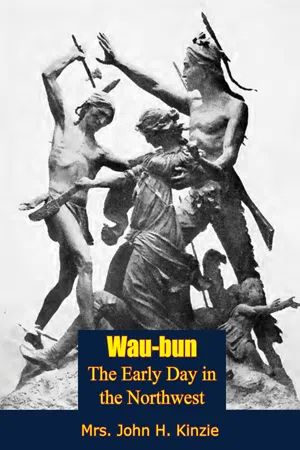
Originally published in 1856, and then edited (with notes and introduction) by Louise Phelps Kellogg and republished in 1930, there is no better description of early Chicago and the famous Fort Dearborn Massacre to be found anywhere than that contained in Wau-bun, The Early Day in the Northwest.
Among the familiar characters who come into the story are Governor James D. Doty, Jefferson Davis, John Lowe, Col. Wm. S. Hamilton, son of Alexander Hamilton, Eleazar Williams, Augustin Grignon, Jacques Porlier, Chief Four Legs, and many others.
The garrison life at Forts Howard and Winnebago, the dangerous passage of the rapids of the Fox River in the Mackinac boats, and the customs of the Wisconsin Indians of the period are all vividly told in this classic.
Unmissable American historical literature.
"Mrs. Kinzie's account of the early day in Wisconsin is delightful; it sparkles with humor and with the pleasure of youth in new and strange adventures. The spirit of happiness pervades it and the author's affectionate sympathy for her husband's Indian 'children' shines on every page. Her description of travel and its vicissitudes in Wisconsin of the early day is full of fun and jollity. She was what we would call today a 'good sport,' taking everything with philosophy and good will. The feast of good things is spread for the reader; all that remains is enjoyment of the narration."—Louise Phelps Kellogg, Introduction
- 341 pages
- English
- ePUB (mobile friendly)
- Available on iOS & Android
eBook - ePub
Wau-bun, The Early Day in the Northwest
About this book
Information
Topic
StoriaTHE “EARLY DAY” IN THE NORTHWEST
CHAPTER I — DEPARTURE FROM DETROIT
IT WAS on a dark, rainy evening in the month of September, 1830, that we went on board the steamer “Henry Clay,” to take passage for Green Bay. All our friends in Detroit had congratulated us upon our good fortune in being spared the voyage in one of the little schooners which at this time afforded the ordinary means of communication with the few and distant settlements on Lakes Huron and Michigan.
Each one had some experience to relate of his own or of his friends’ mischances in these precarious journeys—long detentions on the St. Clair flats—furious head-winds off Thunder Bay, or interminable calms at Mackinac or the Manitous. That which most enhanced our sense of peculiar good luck, was the true story of one of our relatives having left Detroit in the month of June and reached Chicago in the September following, having been actually three months in performing what is sometimes accomplished by even a sail-vessel in four days.
But the certainty of encountering similar misadventures would have weighed little with me. I was now to visit, nay, more, to become a resident of that land which had, for long years, been to me a region of romance. Since the time when, as a child, my highest delight had been in the letters of a dear relative,{1} describing to me his home and mode of life in the “Indian country,” and still later, in his felicitous narration of a tour with General Cass, in 1820, to the sources of the Mississippi—nay, even earlier, in the days when I stood at my teacher’s knee, and spelled out the long word Mich-i-li-mack-i-nac, that distant land, with its vast lakes, its boundless prairies, and its mighty forests, had possessed a wonderful charm for my imagination. Now I was to see it!—it was to be my home!
Our ride to the quay, through the dark by-ways, in a cart, the only vehicle which at that day could navigate the muddy, unpaved streets of Detroit, was a theme for much merriment, and not less so, our descent of the narrow, perpendicular stair-way by which we reached the little apartment called the Ladies’ Cabin. We were highly delighted with the accommodations, which, by comparison, seemed the very climax of comfort and convenience; more especially as the occupants of the cabin consisted, beside myself, of but a lady and two little girls.
Nothing could exceed the pleasantness of our trip for the first twenty-four hours. There were some officers, old friends, among the passengers. We had plenty of books. The gentlemen read aloud occasionally, admired the solitary magnificence of the scenery around us, the primeval woods, or the vast expanse of water unenlivened by a single sail, and then betook themselves to their cigar, or their game of euchre, to while away the hours.
For a time the passage over Thunder Bay was delightful, but, alas! it was not destined, in our favor, to belie its name. A storm came on, fast and furious—what was worse, it was of long duration. The pitching and rolling of the little boat, the closeness, and even the sea-sickness, we bore as became us. They were what we had expected, and were prepared for. But a new feature of discomfort appeared, which almost upset our philosophy.
The rain, which fell in torrents, soon made its way through every seam and pore of deck or moulding. Down the stairway, through the joints and crevices, it came, saturating first the carpet, then the bedding, until, finally, we were completely driven, “by stress of weather,” into the Gentlemen’s Cabin. Way was made for us very gallantly, and every provision resorted to for our comfort, and we were congratulating ourselves on having found a haven in our distress, when, lo! the seams above opened, and down upon our devoted heads poured such a flood, than even umbrellas were an insufficient protection. There was nothing left for the ladies and children but to betake ourselves to the berths, which, in this apartment, fortunately remained dry; and here we continued ensconced the livelong day. Our dinner was served up to us on our pillows. The gentlemen chose the driest spots, raised their umbrellas, and sat under them, telling amusing anecdotes, and saying funny things to cheer us, until the rain ceased, and at nine o’clock in the evening we were gladdened by the intelligence that we had reached the pier at Mackinac.
We were received with the most affectionate cordiality by Mr. and Mrs. Robert Stuart,{2} at whose hospitable mansion we had been for some days expected.
The repose and comfort of an asylum like this, can be best appreciated by those who have reached it after a tossing and drenching such as ours had been. A bright, warm fire, and countenances beaming with kindest interest, dispelled all sensations of fatigue or annoyance.
After a season of pleasant conversation, the servants were assembled, the chapter of God’s word was solemnly read, the hymn chanted, the prayer of praise and thanks giving offered, and we were conducted to our place of repose.
It is not my purpose here to attempt a portrait of those noble friends whom I thus met for the first time. To an abler pen than mine should be assigned the honor of writing the biography of Robert Stuart. All who have enjoyed the happiness of his acquaintance, or, still more, a sojourn under his hospitable roof, will carry with them to their latest hour the impression of his noble bearing, his genial humor, his untiring benevolence, his upright, uncompromising adherence to principle, his ardent philanthropy, his noble disinterestedness. Irving in his “Astoria,” and Franchere in his “Narrative,” give many striking traits of his early character, together with events of his history of a thrilling and romantic interest, but both have left the most valuable portion unsaid, his after-life, namely, as a Christian gentleman.
CHAPTER II — MICHILIMACKINAC
MICHILIMACKINAC! that gem of the Lakes! How bright and beautiful it looked as we walked abroad on the following morning! The rain had passed away, but had left all things glittering in the light of the sun as it rose up over the waters of Lake Huron, far away to the east. Before us was the lovely bay, scarcely yet tranquil after the storm, but dotted with canoes and the boats of the fishermen already getting out their nets for the trout and whitefish, those treasures of the deep. Along the beach were scattered the wigwams or lodges of the Ottawas who had come to the island to trade. The inmates came forth to gaze upon us. A shout of welcome was sent forth, as they recognized Shaw-nee-aw-kee,{3} who, from a seven years’ residence among them, was well known to each individual.
A shake of the hand, and an emphatic “Bon-jour—bon-jour,” is the customary salutation between the Indian and the white man,
“Do the Indians speak French?” I inquired of my husband.
“No; this is a fashion they have learned of the French traders during many years of intercourse.”
Not less hearty was the greeting of each Canadian engagé, as he trotted forward to pay his respects to “Monsieur John,” and to utter a long string of felicitations, in a most incomprehensible patois. I was forced to take for granted all the good wishes showered upon “Madame John,” of which I could comprehend nothing but the hope that I should be happy and contented in my “vie sauvage.”
The object of our early walk was to visit the Mission-house and school which had been some few years previously established at this place by the Presbyterian Board of Missions. It was an object of especial interest to Mr. and Mrs. Stuart, and its flourishing condition at this period, and the prospects of extensive future usefulness it held out, might well gladden their philanthropic hearts. They had lived many years on the island, and had witnessed its transformation, through God’s blessing on Christian efforts, from a worldly, dissipated community to one of which it might almost be said, “Religion was every man’s business.” This mission establishment was the beloved child and the common centre of interest of the few Protestant families clustered around it. Through the zeal and good management of Mr. and Mrs. Ferry, and the fostering encouragement of the congregation, the school was in great repute, and it was pleasant to observe the effect of mental and religious culture in subduing the mischievous, tricky propensities of the half-breed, and rousing the stolid apathy of the genuine Indian.
These were the palmy days of Mackinac. As the headquarters of the American Fur Company,{4} and the entrepôt of the whole Northwest, all the trade in supplies and goods on the one hand, and in furs and products of the Indian country on the other, was in the hands of the parent establishment or its numerous outposts scattered along Lakes Superior and Michigan, the Mississippi, or through still more distant regions.
Probably few are ignorant of the fact, that all the Indian tribes, with the exception of the Miamis and the Wyandots, had, since the transfer of the old French possessions to the British Crown, maintained a firm alliance with the latter. The independence achieved by the United States did not alter the policy of the natives, nor did our Government succeed in winning or purchasing their friendship. Great Britain, it is true, bid high to retain them. Every year the leading men of the Chippewas, Ottawas, Pottowattamies, Menomonees, Winnebagoes, Sauks, and Foxes, and even still more remote tribes, journeyed from their distant homes to Fort Malden in Upper Canada, to receive their annual amount of presents from their Great Father across the water. It was a master-policy thus to keep them in pay, and had enabled those who practiced it to do fearful execution through the aid of such allies in the last war between the two countries.
The presents they thus received were of considerable value, consisting of blankets, broadcloths or strouding, calicoes, guns, kettles, traps, silver-works (comprising arm-bands, bracelets, brooches, and ear-bobs), looking-glasses, combs, and various other trinkets distributed with no niggardly hand.
The magazines and store-houses of the Fur Company at Mackinac were the resort of all the upper tribes for the sale of their commodities, and the purchase of all such articles as they had need of, including those above enumerated, and also ammunition, which, as well as money and liquor, their British friends very commendably omitted to furnish them.
Besides their furs, various in kind and often of great value—beaver, otter, marten, mink, silver-gray and red fox, wolf, bear, and wild-cat, musk-rat, and smoked deer-skins—the Indians brought for trade maple-sugar in abundance, considerable quantities of both Indian corn and petitblé,{5} beans and the folles avoines,{6} wild rice; while the squaws added to their quota of merchandise a contribution in the form of moccasins, hunting pouches, mococks, or little boxes of birch-bark embroidered with porcupine-quills and filled with maple-sugar, mats of a neat and durable fabric, and toy-models of Indian cradles, snow-shoes, canoes, etc., etc.
It was no unusual thing, at this period, to see a hundred or more canoes of Indians at once approaching the island, laden with their articles of traffic; and if to these we add the squadrons of large Mackinac boats constantly arriving from the outposts, with the furs, peltries, and buffalo-robes collected by the distant traders, some idea may be formed of the extensive operations and important position of the American Fur Company, as well as of the vast circle of human beings either immediately or remotely connected with it.
It is no wonder that the philanthropic mind, surveying these races of uncultivated heathen, should stretch forward to the time when, through an unwearied devotion of the white man’s energies, and an untiring sacrifice of self and fortune, his red brethren might rise in the scale of social civilization—when Education and Christianity should go hand in hand, to make “the wilderness blossom as the rose.”
Little did the noble souls at that day rejoicing in the success of their labors at Mackinac, anticipate that in less than a quarter of a century there would remain of all these numerous tribes but a few scattered bands, squalid, degraded, with scarce a vestige remaining of their former lofty character—their lands cajoled or wrested from them, the graves of their fathers turned up by the ploughshare—themselves chased farther and farther towards the setting sun, until they were literally grudged a resting-place on the face of the earth!
Our visit to the Mission-school was of short duration, for the Henry Clay was to leave at two o’clock, and in the meantime we were to see what we could of the village and its environs, and after that dine with Mr. Mitchell, an old friend of my husband. As we walked leisurely along over the white, gravelly road, many of the residences of the old inhabitants were pointed out to me. There was the dwelling of Madame Laframboise, an Ottawa woman, whose husband had taught her to read and write, and who had ever after continued to use the knowledge she had acquired for the instruction and improvement of the youth among her own people. It was her custom to receive a class of young pupils daily at her house, that she might give them lessons in the branches mentioned, and also in the principles of the Roman Catholic religion, to whi...
Table of contents
- Title page
- TABLE OF CONTENTS
- DEDICATION
- PREFACE
- ILLUSTRATIONS
- INTRODUCTION
- CHAPTER I - DEPARTURE FROM DETROIT
- CHAPTER II - MICHILIMACKINAC
- CHAPTER III - GREEN BAY
- CHAPTER IV - VOYAGE UP FOX RIVER
- CHAPTER V - WINNEBAGO LAKE-MISS FOUR-LEGS
- CHAPTER VI - BREAKFAST AT BETTY MORE’S
- CHAPTER VII - BUTTE DES MORTS-LAKE PUCKAWAY
- CHAPTER VIII - FORT WINNEBAGO
- CHAPTER IX - HOUSEKEEPING
- CHAPTER X - INDIAN PAYMENT-MRS. WASHINGTON
- CHAPTER XI - LOUISA-DAY-KAU-RAY ON EDUCATION
- CHAPTER XII - PREPARATIONS FOR A JOURNEY
- CHAPTER XIII - DEPARTURE FROM FORT WINNEBAGO
- CHAPTER XIV - WILLIAM S. HAMILTON-KELLOGG’S GROVE
- CHAPTER XV - ROCK RIVER-HOURS OF TROUBLE
- CHAPTER XVI - RELIEF
- CHAPTER XVII - CHICAGO IN 1831
- CHAPTER XVIII - MASSACRE AT CHICAGO
- CHAPTER XIX - NARRATIVE OF THE MASSACRE, CONTINUED
- CHAPTER XX - CAPTIVITY OF J. KINZIE, SEN.-AN AMUSING MISTAKE
- CHAPTER XXI - A SERMON
- CHAPTER XXII - THE CAPTIVES
- CHAPTER XXIII - SECOND-SIGHT-HICKORY CREEK
- CHAPTER XXIV - RETURN TO FORT WINNEBAGO
- CHAPTER XXV - RETURN JOURNEY, CONTINUED
- CHAPTER XXVI - FOUR LEGS, THE DANDY
- CHAPTER XXVII - THE CUT-NOSE
- CHAPTER XXVIII - INDIAN CUSTOMS AND DANCES
- CHAPTER XXIX - STORY OF THE RED FOX
- CHAPTER XXX - STORY OF SHEE-SHEE-BANZE
- CHAPTER XXXI - A VISIT TO GREEN BAY-MA-ZHEE-GAW-GAW SWAMP
- CHAPTER XXXII - COMMENCEMENT OF THE SAUK WAR
- CHAPTER XXXIII - FLEEING FROM THE INDIANS
- CHAPTER XXXIV - FORT HOWARD-OUR RETURN HOME
- CHAPTER XXXV - SURRENDER OF WINNEBAGO PRISONERS
- CHAPTER XXXVI - ESCAPE OF THE PRISONERS
- CHAPTER XXXVII - AGATHE-TOMAH
- CHAPTER XXXVIII - CONCLUSION
- REQUEST FROM THE PUBLISHER
Trusted by 375,005 students
Access to over 1.5 million titles for a fair monthly price.
Study more efficiently using our study tools.
Frequently asked questions
Yes, you can cancel anytime from the Subscription tab in your account settings on the Perlego website. Your subscription will stay active until the end of your current billing period. Learn how to cancel your subscription
No, books cannot be downloaded as external files, such as PDFs, for use outside of Perlego. However, you can download books within the Perlego app for offline reading on mobile or tablet. Learn how to download books offline
Perlego offers two plans: Essential and Complete
- Essential is ideal for learners and professionals who enjoy exploring a wide range of subjects. Access the Essential Library with 800,000+ trusted titles and best-sellers across business, personal growth, and the humanities. Includes unlimited reading time and Standard Read Aloud voice.
- Complete: Perfect for advanced learners and researchers needing full, unrestricted access. Unlock 1.5M+ books across hundreds of subjects, including academic and specialized titles. The Complete Plan also includes advanced features like Premium Read Aloud and Research Assistant.
We are an online textbook subscription service, where you can get access to an entire online library for less than the price of a single book per month. With over 1.5 million books across 990+ topics, we’ve got you covered! Learn about our mission
Look out for the read-aloud symbol on your next book to see if you can listen to it. The read-aloud tool reads text aloud for you, highlighting the text as it is being read. You can pause it, speed it up and slow it down. Learn more about Read Aloud
Yes! You can use the Perlego app on both iOS and Android devices to read anytime, anywhere — even offline. Perfect for commutes or when you’re on the go.
Please note we cannot support devices running on iOS 13 and Android 7 or earlier. Learn more about using the app
Please note we cannot support devices running on iOS 13 and Android 7 or earlier. Learn more about using the app
Yes, you can access Wau-bun, The Early Day in the Northwest by Mrs. John H. Kinzie, Dr. Louise Phelps Kellogg in PDF and/or ePUB format, as well as other popular books in Storia & Storia della guerra civile americana. We have over 1.5 million books available in our catalogue for you to explore.