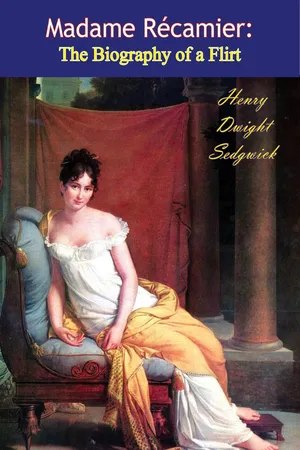
First published in 1940, this is a biography of Jeanne-Françoise Julie Adélaïde Récamier (1777-1849), a French socialite whose salon drew Parisians from the leading literary and political circles of the early 19th century.
Known as Juliette, she was the wife of a Parisian banker 30 years her senior and one of the most prominent women of her time. Beautiful, accomplished, and with a love of literature, Juliette was shy and modest by nature. From the earliest days of the French Consulate to almost the end of the July Monarchy, her salon in Paris was one of the chief resorts of literary and political society that followed what was fashionable. The habitués of her house included many former royalists and others, such as Bernadotte (later Charles XIV of Sweden and Norway) and Gen. Jean Moreau, who were opposed to the government of Napoleon.
In 1805 Napoleon's policies caused her husband major financial losses, and in the same year Napoleon ordered her exiled from Paris. She stayed with her good friend Mme de Staël, one of Napoleon I's principal opponents, in Geneva and then went to Rome (1813) and Naples, where she was on exceedingly good terms with Gen. Joachim Murat and his wife Caroline Bonaparte, who were then intriguing with the Bourbons.
Following Napoleon's defeat at Waterloo in 1815 she returned to Paris, where despite her reduced circumstances after 1819 she maintained her salon and continued to receive visitors at the L'Abbaye-aux-Bois, a 17th-century convent, in which she took a separate suite and to which she retired in 1819.
"To be beloved was the history of Mme Récamier. Beloved by all in her youth, for her astonishing beauty—beloved for her gentleness, her inexhaustible kindness, for the charm of a character which was reflected in her sweet face—beloved by young and old…such will be the renown of this charming woman!"—MADAME DE HAUTEFEUILLE
- 273 pages
- English
- ePUB (mobile friendly)
- Available on iOS & Android
eBook - ePub
About this book
Information
Subtopic
British HistoryIndex
HistoryHISTORICAL GLOSS III—THE RESTORATION (1814-1830)
LOUIS XVIII was almost sixty, as well as fat and gouty, when he was called to the throne. He was intelligent, and cultivated, and had borne twenty years of exile and wandering with amiable resignation. But touches of arrogance and fatuity did him harm, and when Napoleon first abdicated the Allies came pretty near to putting somebody else on the throne. Talleyrand, most adroit of men, secured his selection.
Under the compulsion of public opinion Louis XVIII granted a constitution, la Charte. But his family, and in especial his brother and heir, the Comte d’Artois, supported by a host of ecclesiastics and old émigrés, wished to restore the old régime as it existed before the Revolution; and the sudden return of Napoleon from Elba was disconcerting. However, he maintained a fairly liberal government, with the Duc de Richelieu, and then Decazes, Prime Ministers, until he met bad luck. He had no children; the Comte d’Artois had two, the Duc d’Angoulême had none, and the Duc de Berry was expected to replenish the line. In 1820, this younger son was murdered by a Jacobin, a violent anti-Royalist. That foolish act brought the ultra-Royalists into power; Villèle became Prime Minister, Mathieu de Montmorency Minister of Foreign Affairs, and Chateaubriand, in due course, Ambassador to England.
Louis XVIII died in 1824, and was succeeded by his brother, Charles X, a very agreeable, affable gentleman with charming manners, but with his face set backward. In 1829 he appointed Prince Jules de Polignac, a reactionary after his own heart, as Prime Minister. The new government attempted to overthrow the constitution, and make the King virtually absolute. Paris rose in rebellion, the elder branch of the Bourbons was driven into exile, and Louis Philippe, Duc d’Orléans, was set upon the throne, as the Roi des Français.
CHAPTER XXIII—Benjamin Constant
ON NAPOLEON’S fall, Mme Récamier returned to No. 32 Rue Basse-du-Rempart, and reopened her salon. We hear nothing of M. Récamier, except that his business was doing well again, or of M. Bernard, or of M. Simonard; these three old men, however, lived in the same house, and Mme Lenormant’s readers experience a strange, weird, Maeterlinckian feeling, to know that they were there, invisible, inaudible, unobserved by any-body, while Mme Récamier was thronged by admirers. She kept her carriage, her box at the opera, and every evening, after the performance there was finished, she received her company.
Her salon, then as it had been before, was the meeting place of all political opinions. Because of her sympathy for the defeated, a quality that entered into her manners and gave them a golden charm, she made Bonapartists, Republicans, Jacobins, particularly welcome, and filled them with gratitude. The aristocrats of the old régime were also there in numbers, the Marquis de Boisgelon, his daughter Mme de Bérenger, the Marquise de Catellan, the Marquise d’Aguesseau, and her daughter, Mme Octave de Ségur, the Marquis d’Osmond and his daughter, the Comtesse de Boigne, the Duchesse des Cars, and her daughters, the Marquise de Podenas, M. Sigismond de Nadaillac, de Chauvelin, de Broglie, Armand and Paul de Bourgoing, and such. There were often notables, Louis David, Sismondi, Humboldt, Metternich, Pozzo di Borgo, Talma, the Duc de Doudeauville, and, of course, old friends, Mathieu and Adrien de Montmorency, Prosper de Barante, Camille Jordan and others. It is said that one evening Chateaubriand read aloud Le dernier des Abencerages to a company among which were Mme de Staël, the Duke of Wellington, General Bernadotte, General Macdonald, Camille Jordan and the Duchesse de Luynes. But out of all this company, so far as the biography of Mme Récamier is concerned, one man suddenly leaps to the front.
Benjamin Constant has come into our story before as the lover of Mme de Staël, but now he must be presented at greater length. Perhaps he is most familiarly remembered as the ancestor of a line of eminent and patriotic Frenchmen, or as the author of Adolphe, the earliest example of those purely psychological novels, since produced by Paul Bourget and others, novels “from the cheerful ways of men cut off...and wisdom at one entrance quite shut out.” Some people, however, think of him as the friend of Zélide, others as one of the lovers of Mme de Staël. In his day he was famous for his political writings and for his conversation; Chateaubriand said he was the wittiest man since Voltaire, a mind at once romantic, ironical, poetic and serious.
As to his education I quote from his autobiography Le Cahier rouge:
“The first tutor I can remember clearly was a German named Stroelin, who used to beat me and then smothered me with caresses so that I should not complain to my father. I kept my word, but the beatings were discovered in spite of me and he was sent away...At seven I had a French preceptor, M. de La Grange, who was a professed atheist. Apart from that, so far as I can remember, he was commonplace, very ignorant, and exceedingly vain. He wished to seduce the daughter of the musician from whom I took lessons, and had many scandalous adventures. Finally he took me to lodge in a bawdy-house to be less hampered in his pleasures. My father came in a towering rage from his regiment, and M. de La Grange was sent away...My father then put me in the house of my music master...I had at my disposition a library hard by, where there were all the novels in the world, and all the irreligious books then fashionable. I used to read eight or ten hours a day every book that came into my hands and my brain and my eyes felt the effects of this all my life...At this time an ex-lawyer, a Frenchman (who had left France for some disreputable matter, and who was living in Brussels with a young woman whom he passed off as his housekeeper) wished to open a school, came forward and talked so well that my father thought he had found an admirable man...M. Gobert and his mistress, however, became the subject of public scandal, and my father was informed of it. I witnessed the scenes that followed, and quitted this third tutor with the conviction that for the third time the men who had been en-trusted with my education and correction were themselves very ignorant and immoral.”
His mother died when he was a little child, and his father, a Swiss soldier in the service of Holland, gave him a most Bohemian education. Benjamin was a tall, loose-limbed, lanky young man, with greenish-gray, near-sighted eyes, curly reddish hair, and an amazingly intelligent and acute mind. One acquaintance described him as “tall, erect, good-looking, his long hair falling in curls on his neck, with an extraordinary expression of mockery in his smile and in his eyes, epigrammatic and very witty,” and said that he discussed political questions with concise, lucid, forceful logic, tingeing his arguments with sarcasm. He was ambitious, ironical, skeptical, enthusiastic, egotistical and eccentric.
His life had been full of amorous adventures. At twenty he had become an intimate friend of Zélide, Mme de la Charrière, the famous Dutch lady, when she was forty-seven. Both delighted in talk and both talked well. He would sit on the foot of her bed half through the night and pass the hours in Platonic conversation. He addressed her as “mille fois bonne, mille fois chère, mille fois aimée.” This friendship had lasted seven years when in September, 1794, he made a visit to Mme de Staël at Coppet. Mme de la Charrière did not anticipate any cause for jealousy. Constant wrote back to her:
“I do not find it ‘difficult to toss her a compliment,’ as you put it. On the contrary I find it difficult, since I’ve known her better, not to launch forth into ceaseless praises of her, not to show to all to whom I speak both my interest and admiration. I have rarely met such a vision of amazing and attractive qualities, such brilliancy, such accuracy—such a broad and tolerant benevolence—such generosity, such courtesy so gentle and so tireless, such simplicity, such lack of constraint in intimate society. She is the second woman I have met for whom I could count the world well lost, since she is a world in herself. You know who the first was.”
Such language about one woman to another shows all too obviously that his romantic friendship for Mme de la Charrière was finished; and soon afterward all barriers between Benjamin Constant and Mme de Staël were down.
These two marked natures both excited and rasped each other. Her enthusiasms, her exultations, her tantrums lifted him up and cast him down till he was almost beside himself. Near the beginning of this liaison, poor, good Mathieu de Montmorency had been greatly troubled, though not in the least jealous. He wrote to a friend:
“Let me tell you that he [B. C.] has come to me in a state of mental disorientation, a prey to furious political views, which do not seem to have root either in his heart or in his convictions. All this, taken in conjunction with certain small not unimportant details, such as his clothes, the look on his face, and the behavior of a maniac, leave me dumbfounded, when I think of the feelings he can inspire in our friend’s heart [Mme de Staël] Dec. 4,1796.”
Nevertheless, Germaine’s and Benjamin’s close relation continued for years. In 1804 Constant wrote in his Journal:
“I have never seen a better woman, one with more pity or with greater capacity for devotion; and I have never seen one who made such continual demands on other people without being aware of it...All one’s time—minutes, hours, years—must be at her disposition. And when she lets herself go, there is a scene like tempests and earthquakes. She is a spoiled child.”
However, in spite of convulsions of grief and rage, the liaison lasted with various intermissions for years longer. In the meantime Constant records in his Journal occasional meetings with Mme Récamier:
“1804: I dined at Mme Récamier’s and met there General Sébastiani.”
“I passed the evening at Mme Récamier’s. It appears that I was very agreeable, for they paid me compliments on my being so. It was a masterly feat of character for I was much out of sorts.”
“I supped at Mme Récamier’s. It was very boring. The young men of this generation are much too given to scoffing, and are really stupid.”
“I dined at Mme Récamier’s. I met M. de Châteauneuf who has always been kindly disposed toward me.”
“I have learned of M. Récamier’s bankruptcy. So there’s another of my friends [Mme Récamier] in trouble.”
“Mme de Staël has conquered me again.”
“I have heard of the death of Mme de Charrière de Tuyl. Another devoted friend gone! The world of my heart is losing its inhabitants.”
“Evening at Mme Récamier’s with Fauriel. I read my novel (Adolphe), which produced a singular effect upon them. The character of the hero revolts them. Decidedly they do not understand me.”
“[At Coppet] Prince August of Prussia is here on Mme Récamier’s account. He is a man of distinction.”
“Sept. Mme Récamier is still here. She is a strange person.”
In 1808 he wrote her: “Need I say, Madame, that I left Paris with extreme regret at going away without seeing you?...Your plans are vague and your ways fitful; when you are sad you are discouraged, and when you are not discouraged you are indolent. Nevertheless I should not complain, either of your discouragement or of your indolence, for Nature has colored all your faults with an especial glamour.”
In 1810: “There is a quality in you, Madame, that captivates unceasingly; it makes no matter that you concern yourself with all sorts of other things, or that one feels oneself kept at arm’s length—one does not break away but pursues you with pleasure.”
These passages indicate mere conventional homage to celebrated beauty, and there is nothing more for four years. Then his Journal records:
1814: “I spent the evening with Mme Récamier; and this woman with whom I lived in Switzerland, whom I have seen on many occasions and in all sorts of ways, who never made any impression on me, suddenly has taken hold of me, and inspires me with a violent sentiment. Am I a fool or just stupid? But it will pass, I hope...”
“Alas, it does not pass, and this horrid feverish passion, that I know all too well, has come upon me and dominates me entirely. Work, politics, literature, all is over. The reign of Juliette begins. And nevertheless I know the danger to which I expose myself, for I am dealing with a genuine coquette. Nevertheless the charm and the difficulty of winning drag me on.” Mme de Lenormant commented: “She wished to please, and succeeded only too well.”
His new passion came about in this way. Caroline, sister to Napoleon, and wife of Prince Murat, wished the Congress of Vienna, then in session, to maintain her husband on his throne, and appealed to Mme Récamier to obtain the best mind she could to write a brief on Murat’s behalf, to be submitted to the Congress. Mme Récamier asked Constant to do it. He did so; nothing came of the brief, but during its preparation he fell madly in love with the intermediary. He was then forty-seven, and she ten years younger.
Up to that time neither had been much interested in the other. Mme Récamier felt listless, ennuyée, her life to her seemed futile and empty, obsessed by her unconscious need of children, of a real home, of a dominant emotion. Her salon interested her less and less. Mlle de Staël (Albertine, daughter to Mme de Staël) perceived her discontent, but did not understand the reason for it. She wrote to a friend, Barante’s sister: “Mme Récamier is good and pretty, but a life of little flirtations does not elevate the soul; she would have been of greater worth if she had not spent her time and her heart on every side, but she is generous and very attractive. (July 13, 1814.)” Many admirers flocked about her, but for the moment Benjamin Constant was by far the most pressing. His passionate love letters began after their first interview over the Murat brief.
“[September, 1814] Here is the Memoire (his brief)...
I will come to get it at any time you say, and we will read it together. Do you know that, during this life, already long, which you disturb, I have never seen anything in the world like you. I carry your image with me everywhere. I am sad and almost amazed by it. Verily I am not joking; I am in pain. To cause suffering of this kind is a matter of indifference to you. Angels, too, are cruel.”
“September 3, 1814. I think of nothing but of you but perhaps I can still struggle against it. For two days I have seen nothing but you. All your charm, which I have always dreaded, has entered into my heart. To love is to suffer. But also it is to live, and for a long time I have not been alive. Perhaps I have never lived before.”
Obviously Mme Récamier was not in the least in love, nor did he attract her, but he was a man of eminence, and he was desperately in love, and she was amused. At first she avoided him; when he arrived at a house she would go. He followed her like a dog. When she left Paris to pay a visit to her friend, the Marquise de Catellan, at Angervilliers, he followed to a neighboring village, and would try to persuade her to take a walk with him or grant him a half-hour’s talk. “Forgive me,” he writes, “and have pity on me. No one has ever loved as I have; no one has ever suffered as I have.” At one time, if she saw him, it would only be in the presence of M. Ballanche; at another time she did see him alone, but he was expected to leave early. He noted in his Journal:
...
Table of contents
- Title page
- TABLE OF CONTENTS
- DEDICATION
- ILLUSTRATIONS
- THE PRINCIPAL DRAMATIS PERSONAE IN THE ORDER OF THEIR APPEARANCE
- PROLOGUE
- HISTORICAL GLOSS I-BEFORE AND DURING THE REVOLUTION
- HISTORICAL GLOSS II-THE DOMINATION OF NAPOLEON (1799-1815)
- HISTORICAL GLOSS III-THE RESTORATION (1814-1830)
- HISTORICAL GLOSS IV-LOUIS PHILIPPE (1830-1848)
- EPILOGUE
- BRIEF BIBLIOGRAPHY
- REQUEST FROM THE PUBLISHER
Trusted by 375,005 students
Access to over 1.5 million titles for a fair monthly price.
Study more efficiently using our study tools.
Frequently asked questions
Yes, you can cancel anytime from the Subscription tab in your account settings on the Perlego website. Your subscription will stay active until the end of your current billing period. Learn how to cancel your subscription
No, books cannot be downloaded as external files, such as PDFs, for use outside of Perlego. However, you can download books within the Perlego app for offline reading on mobile or tablet. Learn how to download books offline
Perlego offers two plans: Essential and Complete
- Essential is ideal for learners and professionals who enjoy exploring a wide range of subjects. Access the Essential Library with 800,000+ trusted titles and best-sellers across business, personal growth, and the humanities. Includes unlimited reading time and Standard Read Aloud voice.
- Complete: Perfect for advanced learners and researchers needing full, unrestricted access. Unlock 1.5M+ books across hundreds of subjects, including academic and specialized titles. The Complete Plan also includes advanced features like Premium Read Aloud and Research Assistant.
We are an online textbook subscription service, where you can get access to an entire online library for less than the price of a single book per month. With over 1.5 million books across 990+ topics, we’ve got you covered! Learn about our mission
Look out for the read-aloud symbol on your next book to see if you can listen to it. The read-aloud tool reads text aloud for you, highlighting the text as it is being read. You can pause it, speed it up and slow it down. Learn more about Read Aloud
Yes! You can use the Perlego app on both iOS and Android devices to read anytime, anywhere — even offline. Perfect for commutes or when you’re on the go.
Please note we cannot support devices running on iOS 13 and Android 7 or earlier. Learn more about using the app
Please note we cannot support devices running on iOS 13 and Android 7 or earlier. Learn more about using the app
Yes, you can access Madame Récamier by Henry Dwight Sedgwick in PDF and/or ePUB format, as well as other popular books in History & British History. We have over 1.5 million books available in our catalogue for you to explore.