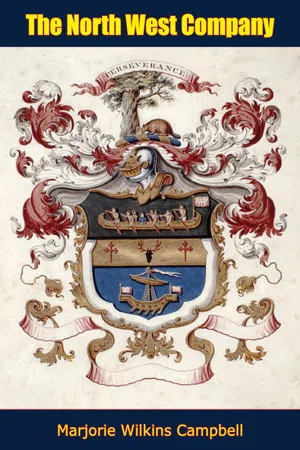
In 1779 a group of independent fur traders from Montreal banded together to form the North West Company; this was a trading expedient and no one could have foreseen its brilliant and far-reaching results. Before the North West Company name disappeared in a merger with the Hudson's Bay Company in 1821 it had spanned the continent, reached the Arctic, and traded round the Horn to China. Many of the great rivers and lakes of the North and West carry the names of the company's servants as the only memorial so far accorded them: Pond, Frobisher, Mackenzie, Thompson and Fraser are merely the best remembered of perhaps the most remarkable group of associates that Canada has seen.
"…accurate, magnificently organized, sparely written…one of the finest works of Canadian history I have ever read…These men have the most marvellous characters who ever founded and operated a business enterprise in North America."—Hugh MacLennan, award-winning Canadian author and professor of English at McGill University
- 244 pages
- English
- ePUB (mobile friendly)
- Available on iOS & Android
eBook - ePub
The North West Company
About this book
Information
Subtopic
American Civil War HistoryIndex
HistoryPART ONE — Simon McTavish
CHAPTER I — The Business of the Colony
Few people came to Montreal in winter. As soon as the St. Lawrence and Ottawa Rivers froze the town’s only highways were closed, usually from early December until April. Perhaps a hardy adventurer might buck the deep drifts on the trail from Three Rivers, on snowshoes or by cariole, and occasionally officials brought despatches or news from Quebec. During the unsettled years of the American War of Independence even Albany merchants avoided the long trip north to Montreal in winter. As the outpost of civilization at the edge of the forest that stretched no man knew how far to the northwest, for four months of the year the town might never have existed.
Most winters, Montrealers took their isolation for granted. They were used to snow drifts which blocked several of the sixteen gates and half hid the twenty-foot crenelated stone walls surrounding the town; they knew the lovely sight of church spires glistening like inverted icicles against the great expanse of endless white, while smoke rose in blue-grey plumes above every tin-covered roof on the streets of snug stone houses and log cottages. Sometimes on still moonlit nights frost split the St. Lawrence ice with a sound like the report from a musket, and then even the snow-blanketed mountain—in summer close and protecting—became remote and aloof.
Of necessity the town’s nine thousand inhabitants made their own social life right through to spring thaw, as they depended on their resources for everything else. By four o’clock most business was over in the shops and warehouses along St. Paul Street. Lights twinkled out across the snow from several taverns and from the stone houses on fashionable Notre Dame. As soon as darkness had settled, lanterns appeared. The jingle of sleigh bells proclaimed some local festivity, a ball at the Château de Ramezay, private dinners or card parties, family gatherings, church socials or a concert. At Christmas and New Year’s French and English, military and merchant, fur-trader’s wife and wife of clerk or voyageur in billowing skirts and furs or in shawls and homespun, bowed and curtseyed as they wished one another good health and good fortune for the coming year. Only toward the beginning of March did men and women alike turn toward the snow-covered mountain, seeking a sign that spring was coming, the first faint greying of that shining whiteness. In March everyone talked about the spring thaw, and the lottery. For as long as the oldest French inhabitant remembered there had always been a lottery on the day when the ice would go out of the St. Lawrence.
In 1779, even on New Year’s Day, the festivities were less gay than usual. And with good reason. Last year licences for the fur-trading ventures to the southwest and the northwest had been issued late. This year, it was rumoured, the governor at Quebec would issue no licences at all on the ground that only by such restrictions could he ensure that no goods would reach the rebels. Faced with possible disaster, several merchants prepared a petition, had it signed by the majority of their associates and made the long trip to Quebec. With the fur trade bringing the colony an annual revenue of not less than £200,000, surely the governor must realize that the merchant-traders needed every gun and every gallon of rum for legitimate business. But though they had doubts about the granting of their petition, all during January and February those remaining in Montreal worked as usual in their cold warehouses. Determined to be prepared they sorted and baled trade goods for the coming season, carefully checking every item against well-thumbed lists, for each venture must depend solely on supplies transported to the interior by canoe. In other warehouses, equally cold, piles of pelts were baled ready for shipment to the fur sales in London. Toward the end of March visits were made to the little farms along the rivers for canoe-building materials and to see about engaging voyageurs.
Already goods sledded the nine miles from the town’s west gate were piled high at Lachine. The days lengthened and the ice broke free. James Bannerman wrote to his partner Simon McTavish at Detroit, “I assure you that it is doubtful when passes for the Upper Country will be granted or if they will be granted”. Still there was no word from the governor. When at last he finally bowed to the merchants’ petition, the season was too late for canoes to reach their destination before freeze-up. No trade goods would reach the many posts in the interior for the winter of 1779-80.
Outwardly, during the summer, Montreal looked much the same as usual after the merchandise had been returned from Lachine to the warehouses in Montreal. Along the north shoreline of the St. Lawrence, below the town, Indian canoes lay beached like a vast length of unevenly-worked blanket stitching. A couple of tall ships rode at anchor off shore, discharging their cargoes of kegs and bales into a succession of small boats or onto the bowed shoulders of wading men. Strings of noisy οx-carts lurched up the climbing, rutted streets to the warehouses, piled high with cases of guns, kegs of ball and shot, bales of strouds and calico, kettles and knives and beads; all, with the exception of the beads which came from Italy, were manufactured in England. And when August slipped into the warm, glowing days of September, the most exciting sound in the town’s entire year flashed along every street and into every home: “The first canoes have arrived!”
The first canoes from the Indian country had reached Lachine. The first trader was back, safe after more than seventeen months’ complete absence of news. Soon there would be others. Soon the nine-mile rutted trail bypassing the rapids shrieked with the noise of more ungreased wooden wheels, each ox-cart now piled high with packs of strong-smelling pelts.
Suddenly the town burst into life. Voyageurs swarmed every narrow street like boys just out of school, excited to be home again, bursting with yams and boastings, drinking too much rum, intoxicated by the sight of white girls. The little stores could not supply them with all the new knives and gay shirts and presents they craved while they had silver in their pouches.
Was this to be the last year these voyageurs would swagger through the streets of Montreal with money for grog or to buy a few acres on which to start homes of their own? Were all the men who had built up the expanding fur trade, French and English alike, to go bankrupt? Was Montreal’s history, over a century long now, finished? Were the shuttle movements of ship and canoe on which the town depended, and of which it was the very core, at an end?
Desperately the merchants had sent off the previous year’s pelts before the ships sailed down the St. Lawrence; they had stored the new season’s trade in their warehouses. Some, well aware that next year’s returns were already doubtful, had paid their men depressed wages. And now, while the maples on the mountain burst into flame and St. Helen’s Island in the St. Lawrence looked like a glowing gem, they turned to their own grim situation. Simon McTavish’s partner, James Bannerman, gave up in disgust and returned to the Old Country, where several others were inclined to follow him. But most had no intention of quitting. Most determined to carry on, meeting the enormous risks as best they could. Their only way out lay in petitioning the governor from a strong, united front. They had discussed it for months. Now several of the small partnerships decided to take definite steps. They would join together in a single group, the North West Company.
Not all of the small partnerships in Montreal were in favour of coalition, nor believed that it would influence the governor. But those who did join the little group significantly included the partners in the pool which Alexander Henry had mentioned as being on the Lower Saskatchewan in 1775. The co-partnership provided for sixteen shares, two each held by local firms: Todd & McGill, Ben. & Jos. Frobisher, McGill & Paterson, McTavish & Co., Holmes & Grant, Wadden & Co., McBeath & Co.; and one share each held by Ross & Co. and Oakes & Co.
The first three partnerships included men already so closely associated as to be almost one. They had been in business in Montreal for several years and though each was comparatively young, all were able and respected men. The last five were smaller concerns, George McBeath having as his partner the American trader, Peter Pond. Simon McTavish, whose new partner was Patrick Small, grand-nephew of a governor of Guernsey, was already marked by his business associates as a man who would get somewhere.
Son of John McTavish of Fraser’s Highlanders, Simon had been born in Stratherrick, Scotland, in 1750. He sailed for the New World at thirteen, and was apprenticed in New York, probably to the fur trade. At twenty, his seven years of apprenticeship over, he set himself up in business in a small way at Albany, and was soon partner with Bannerman, forwarding rum on the Great Lakes. From the day he arrived at Montreal in the summer of 1774, he was part of the town. By the time the North West Company was formed, five years later, he was a mature young man, tall and with the lean good looks of his proud Highland ancestors; he had already admitted to a love of good wine, good oysters and pretty girls and that he was “always like a fish out of water when not in love”. His grasp of New World business and Montreals position as hub of the shuttle movements westward to the interior and eastward to the markets of London and Western Europe had taken him on more than one voyage across the Atlantic to buy merchandise and to arrange credit. When he had returned to London in 1776 with the pelts worth £15,000, he had also visited the family and birthplace he had dreamed of ever since he left Scotland at thirteen. His sister was now Ann McTavish McGillivray, with young sons who soon would need an education and an opportunity to find careers for themselves, no easy accomplishment in Scotland at the time. Simon even then determined to bring many of his relatives to the New World where opportunities seemed boundless.
But meantime, as well as travelling to the old land, he must go each year to Michilimackinac or the new inland depot on Lake Superior. Though he had not been beyond Grand Portage himself, he had made it his business to get a good working knowledge of the geography and trade conditions of both the nearer southwest or Mississippi trade and that of the northwest where he had earlier supplied Peter Pond.
In common with his colleagues, McTavish had little capital to put into the new concern. Though his investment was made up largely of trade goods and canoes, he was from the beginning potentially as important a member as any in the new group, the first joint-stock company in Canada and probably on the continent.
By the first of the new year the partners of the new North West Company had the satisfaction of knowing that their co-partnership had brought Montreal’s depressed conditions to the attention of the authorities. During 1780 the little walled town received one of her rare wintertime visitors, Charles Grant, a prosperous and respected merchant of Quebec, appointed by Governor Sir Frederick Haldimand to make a complete report on the fur trade.
Never in Montreal’s already long record for warm hospitality did a visitor receive more enthusiastic entertainment. Among his hosts were Charles Chaboillez, born in the interior near Michilimackinac, and whose seven daughters were to provide wives for at least two prominent North West Company partners; by that time, too, Alexander Henry and James McGill were about to marry pretty daughters of their Canadien associates, and everywhere Grant found the pleasant mingling of French and English tongues. Along with good dinners and card parties and suppers he received the utmost co-operation in preparation of his report. The merchants showed him figures to prove that the town did in fact annually contribute over £200,000 in new business to the colony’s economy. They provided shrewd comments on the political dangers involved in curtailing the fur trade; if denied the European goods on which they had learned to rely, the natives might well consider the British beaten by the Americans or even by the Spanish still on the Lower Mississippi. In either case Britain would lose not only the business involved, but the entire territory to the westward. Finally Charles Grant was given every opportunity to study the situation of the merchants themselves, as well as the inevitable plight of the people in and about the town who were dependent on the industry.
Prior to the government’s embargo on private shipping on the Great Lakes, the merchants had shipped rum by bateau from Niagara or Detroit to Michilimackinac and Grand Portage. Now this heavy cargo, along with other heavy merchandise, must be carried by canoe up the Ottawa River. They had soon discovered, the Montreal merchants told the commissioner, that the government’s ships gave no priority to trade goods; often valuable cargoes were left on docks, to be spoiled or pillaged, and with no hope of recompense. Inevitably, if cargoes must be shipped by the Ottawa, only by issuing licences on time could the business be maintained and increased. Indeed the business could actually provide employment for every man in the colony. Already upwards of two hundred canoes were needed each spring to carry goods westward from Lachine; each canoe by the time it reached Grand Portage having cost the merchants concerned £750, much of it for wages to canoemen and warehousemen and for canoes and provisions. And each year more territory was being discovered, thereby not only extending the potential fur-trade country, but bringing more business to Montreal.
Grant returned to Quebec, a long, cold journey after the warmth and comforts of the snug stone houses in Montreal, with a bulky report for the governor. Haldimand, himself long a resident of the colony, studied the report closely, pausing now and again to remark pointedly on the enormous quantities of rum and other trade goods employed, perhaps extravagantly, by the merchant-fur-traders; he must continue to consider the advice of military men in charge of the colony’s defence, and their determination to guard against the possibility of goods falling into rebel hands. But in the end the objective of the first North West Company was achieved. In the spring of 1780 licences were issued, and on time.
All Montreal, it seemed, moved to Lachine on the day when the first canoes set out for the northwest. Spring was in the air and the first willow buds not yet opened as the voyageurs arrived. They came swaggering, smoking their short pipes, each dressed in his best shirt and cap, a gaily coloured ceinture flèche a-swing above his “carraboo” breeches. Their cheery French, laced with a few expressive Indian and English phrases, was the language of the trade. One or two canoemen had signed on as far away as Quebec, a few at Three Rivers or Sorel. Most came from the small farms along the rivers near Montreal, and in the early years of the English fur trade some at least would be back in time to help with the harvest. Each carried his brightly painted paddle, the badge of office of a pork-eater, a gift from a father who had spent the best years of his life in the adventurous life of a voyageur or, perhaps, fashioned by himself during long winter evenings while his thoughts lingered over the girl on the next farm.
They were the mangeurs du lard—the pork-eaters who lived on dried corn and fat pork on the trip between Montreal and Grand Portage. They were gay, tough, skilled and indispensable to the fur trade, as they well knew. One, past seventy, boasted what each of these short, stocky, sentimental men in his heart believed:
“I could carry, paddle, walk and sing with any man I ever saw. I have been twenty-four years a canoeman, and forty-one in service; no portage was ever too long for me. Fifty songs could I sing. I have saved the lives of ten voyageurs. Have had twelve wives and six running dogs. I spent all my money on pleasure. Were I young again, I should spend my life the same way over. There is no life so happy as a voyageur’s life!”
Yet a voyageur had little enough money to spend—on pleasure or on a small strip farm beside one of the rivers he loved. If he became a steersman he might get 300 livres a year—a livre was roughly a shilling following the English conquest—or 350 livres as a guide. To this would be added a blanket, a shirt and a pair of trousers, a little tobacco, the daily ration of a pound of dried corn and fat pork, and a tot of rum when the bourgeois saw fit. A man who could sing could count on an extra livre or so.
Year after year it happened the same way. The gentlemen arrived at Lachine by calash or on horseback, accompanied by Montreal friends who would see them off. Before embarking they enjoyed an enormous farewell luncheon of sturgeon, venison, bear steaks, probably some good nippy cheese and invariably a generous quantity of the finest Madeira. While they feasted their French clerks saw to the final lading of the craft, though often a bourgeois left his meal to see how things were going where the new thirty-six-foot long, six-foot wide canoes bobbed at the waterside.
“Careful with that keg...watch that bung or you’ll break the seal....Do you not yet know how to stow a bow pack?” The bourgeois’ authoritative voice was always the dominant sound at Lachine.
Gradually, one after another, the canoes were loaded until no...
Table of contents
- Title page
- TABLE OF CONTENTS
- DEDICATION
- AUTHOR’S ACKNOWLEDGEMENTS
- PRINCIPAL PEOPLE IN THE BOOK
- PROLOGUE
- PART ONE - Simon McTavish
- PART TWO - William McGillivray
- EPILOGUE - Pro Pelle Cutem
- NOTES ON AUTHORITIES
- REQUEST FROM THE PUBLISHER
Trusted by 375,005 students
Access to over 1.5 million titles for a fair monthly price.
Study more efficiently using our study tools.
Frequently asked questions
Yes, you can cancel anytime from the Subscription tab in your account settings on the Perlego website. Your subscription will stay active until the end of your current billing period. Learn how to cancel your subscription
No, books cannot be downloaded as external files, such as PDFs, for use outside of Perlego. However, you can download books within the Perlego app for offline reading on mobile or tablet. Learn how to download books offline
Perlego offers two plans: Essential and Complete
- Essential is ideal for learners and professionals who enjoy exploring a wide range of subjects. Access the Essential Library with 800,000+ trusted titles and best-sellers across business, personal growth, and the humanities. Includes unlimited reading time and Standard Read Aloud voice.
- Complete: Perfect for advanced learners and researchers needing full, unrestricted access. Unlock 1.5M+ books across hundreds of subjects, including academic and specialized titles. The Complete Plan also includes advanced features like Premium Read Aloud and Research Assistant.
We are an online textbook subscription service, where you can get access to an entire online library for less than the price of a single book per month. With over 1.5 million books across 990+ topics, we’ve got you covered! Learn about our mission
Look out for the read-aloud symbol on your next book to see if you can listen to it. The read-aloud tool reads text aloud for you, highlighting the text as it is being read. You can pause it, speed it up and slow it down. Learn more about Read Aloud
Yes! You can use the Perlego app on both iOS and Android devices to read anytime, anywhere — even offline. Perfect for commutes or when you’re on the go.
Please note we cannot support devices running on iOS 13 and Android 7 or earlier. Learn more about using the app
Please note we cannot support devices running on iOS 13 and Android 7 or earlier. Learn more about using the app
Yes, you can access The North West Company by Marjorie Wilkins Campbell in PDF and/or ePUB format, as well as other popular books in History & American Civil War History. We have over 1.5 million books available in our catalogue for you to explore.