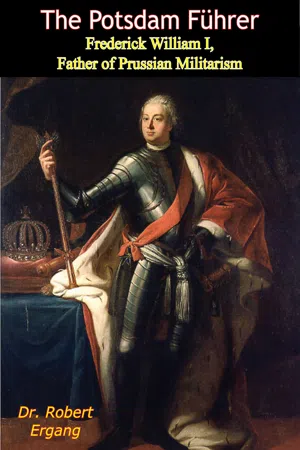
First published in 1941, this is a biography of Frederick William I (1688-1740), known as the "Soldier-King," who was the King of Prussia and Elector of Brandenburg from 1713 until his death, and the father of Frederick the Great, who (following his father's death in 1740) would go on to hold the longest reign of any Hohenzollern king.
Born in Berlin to Frederick I of Prussia, who had acquired the title King for the margraves of Brandenburg, and Sophia Charlotte of Hanover, he ascended the throne in 1713 and promptly sold most of his fathers' horses, jewels and furniture; he did not intend to treat the treasury as his personal source of revenue the way Frederick I and many of the other German Princes had. During his own reign, Frederick William I did much to centralize and improve Prussia. He replaced mandatory military service among the middle class with an annual tax, established schools and hospitals, and resettled East Prussia (which had been devastated by the plague in 1709).
The king encouraged farming, reclaimed marshes, stored grain in good times and sold it in bad times. He concerned himself with every aspect of his relatively small country, planning to satisfy all that was needed for Prussia to defend itself. His rule was absolutist and he was a firm autocrat. He practiced rigid, frugal economy, never started a war, and led a simple and austere lifestyle, in contrast to the lavish court his father had presided over.
Dr. Robert Ergang's biography is based on an extensive use of source as well as secondary materials, and includes many personal anecdotes of Frederick William I, which altogether make this a book that is sure to hold the interest of scholars and the general reader alike.
"Amid the great flood of hastily-written and poorly-conceived works about Prussia and Germany, it is a great pleasure to find such a scholarly and well-written book as that of Professor Ergang…"—W. O. Shanahan, "The Review of Politics," Jan. 1942.
- 218 pages
- English
- ePUB (mobile friendly)
- Available on iOS & Android
eBook - ePub
About this book
Trusted by 375,005 students
Access to over 1.5 million titles for a fair monthly price.
Study more efficiently using our study tools.
Information
Subtopic
19th Century HistoryIndex
HistoryCHAPTER ONE—Introduction
THE HISTORY of Prussia presents the novelty of a group of unpromising little provinces speedily growing up in the eighteenth century to a great kingdom which in the nineteenth united Germany under its rule. The major factor in this rise was the strength and the efficiency of its military forces. So large a part did successful war play in the rise of Prussia that Mirabeau was moved to declare: “War is the national industry of Prussia.”{1} Emperor William II himself proclaimed the Prusso-German army “the rock on which rests the might and greatness of Germany.”{2} It was by means of his army that Frederick the Great made Prussia not only the rival of Austria for leadership in Germany but also a first-rate power in the councils of Europe. In the nineteenth century Prussia was able to accomplish the work of German unification by virtue of its efficient army, aided by the cunning of Bismarckian statecraft. A national assembly, sitting at Frankfurt in 1848–1849, had endeavored to unify Germany by peaceful methods, but the attempt failed. Gustav Freytag, the Prussian historian and playwright, who seemed to feel as early as 1848 that the question of German unity could not be solved by peaceful methods, wrote in Die Grenzboten:
If it should be necessary for Prussia to solve this problem herself and to march against Germans and their foreign allies; then we shall carry out our will against all conspiracies, nay against all Europe. We are accustomed to battling with the whole world and to risking everything in order to achieve everything. And perhaps that is what distinguishes us Prussians from other Germans; we are ready to shed the last drop of blood to have our way...We do not fear, for we are a nation of warriors.{3}
Bismarck himself saw no other road to German unity than the defeat of German particularism and foreign opposition by force of arms. “The great questions of the day,” he said to the Prussian diet in 1862, “cannot be settled by speeches—that was the great mistake of 1848 and 1849—but by blood and iron.”{4} In 1891 Emperor William II said in retrospect: “The soldier and the army, not parliamentary majorities or parliamentary resolutions, have welded together the German Empire. My trust is in the army.”{5}
During the years immediately following 1871 the Prussian spirit was infused into German life as a whole. Prussian discipline became the keynote of the new state. The German army was, in fact, Prussianized so completely that Von Treitschke could say: “What is our German imperial army? It is undoubtedly the Prussian army.”{6} In addressing a battalion of the German army William II proudly stated: “The spirit of this battalion is the good old Prussian one. It is my wish and hope that it will remain so.”{7} Gradually the spirit of the German people was also militarized, until that Prussian discipline which Prince von Bülow styled “one of the greatest of German virtues,”{8} became an all-pervading attitude. “It was one of the outstanding characteristics of German thoroughness,” Werner Bruck writes, “that this idea of a military machine permeated the whole social life, public and private, and even to a certain degree, influenced German culture. This militarism has rightly been called the cement that bound the whole structure of society into an entity.”{9} In short, the new German Empire became the prolongation of the shadow of Prussia.
The task of converting the German people as a whole to the Prussian military point of view was not undertaken solely by professional militarists. Many philosophers, teachers, historians, and writers contributed much of their energy to this cause. These men did not tire of proclaiming the righteousness and the necessity of war and of expounding the “logic” and the “virtue” of the Machtpolitik (policy of power) which Bismarck had expressed in the words: “Might makes right; war is a law of nature.”{10} The most fanatical and at the same time the most popular exponent of the philosophy of militarism was Heinrich von Treitschke. “War,” he stated, “is political science par excellence. Over and over again it will be demonstrated that it is only in war a people becomes in very deed a people.”{11} Armed conflict between nations was to him a permanent feature of civilized life. “In this eternal conflict of separate states,” he wrote, “lies the beauty of history. The wish to do away with this rivalry is simply unintelligent.”{12} Upon the ideas expressed by Von Treitschke, Friedrich von Bernhardi avowedly based his book Germany and the Next War, the purpose of which was to intoxicate the German people with the love of war.
War [he asserted] is a biological necessity of the first importance, a regulative element in the life of mankind which cannot be dispensed with...Our people must learn to see that the maintenance of peace never can or may be the goal of a policy...The inevitableness, the idealism, and the blessings of war, as an indispensable and stimulating law of development, must be repeatedly emphasized. The apostles of the peace idea must be confronted with Goethe’s manly words:
Dreams of a peaceful day?
Let him dream who may!
“War” is our rallying cry,
“Onward to victory!”{13}
Such statements were repeated over and over again until they were deeply impressed on the German mind. When the debacle came in 1918, many thoughtful Germans concluded that the ideals they had been taught were false. The men who drew up the Weimar constitution went so far as to include the following article: “In every school the educational aims must be moral training, public spirit, personal and vocational fitness, and, above all, the cultivation of German national character and of the spirit of international reconciliation.” From the outside the Allied Powers sought to curb the military spirit of Germany by limiting the total strength of the German army to one hundred thousand men (Article 160 of the Treaty of Versailles). As Stresemann put it: “In place of the military service that has entered into our very flesh and blood we are to form a paid professional army.”{14} To prevent the training of fresh men each year as a means of building up a large trained reserve, it was stipulated in the Treaty of Versailles that each man in the German army must serve for a period of twelve years. But the spirit of Prussian militarism with which the German people had been so deeply imbued by tradition and practice could not suddenly be extinguished. It was kept alive not only in the German army, small as it was, but also in many semi-military organizations, including the Nazi Brownshirts, the Steel Helmets, the Volunteer Labor Corps, the Hosts of the Cross, the Vikings, and the Tannenberg League. These and other organizations gave at least partial military training to hundreds of thousands of young men. Nor did the war prophets become extinct. For example, in 1920 Oswald Spengler wrote: “War is the eternal form of higher human existence; states exist for the purpose of waging war.”{15}
With the accession to power in 1933 of the National Socialist Party the worship of the old Prussian idols was resumed in full. The government began feverishly to build huge armaments and to revive the spirit of militarism. An army in itself, Herr Hitler told the German people, was not enough; they must also have the proper military spirit. “The question of how we can regain German power,” he wrote in Mein Kampf, “is not: how can we manufacture arms? It is: how can we create the spirit which renders a people capable of bearing arms? Once this spirit dominates a people it will find a thousand paths each of which leads to the necessary armament.”{16} The traditions to which he would return are those of Prussia. “Was not Germany [he asked] a marvellous example of an empire built entirely upon a policy of power? Prussia, the germ cell of the Reich, was created by a brilliant heroism, not by financial or commercial affairs, and the Reich itself was again but the most magnificent achievement of a policy of power and of military valor.”{17} He demanded the re-establishment of the old Prussian principle of authority from above and obedience from below. “This principle,” he stated, “which in its time made the Prussian army the most wonderful instrument of the German people, must in the future become the principle of the structure of our whole conception of the State.”{18} He further prescribed that a glorification of the triumphs of war be inculcated in the young. “We want to train them,” the Führer said, “to veneration for our old army, which they shall think about and reverence again and in which they must see the personification of the greatest performance our German people have achieved.”{19} These precepts have been carried out, and Prussian militarism has been revived in all its phases.
The history of militarism in modern Prussia begins with the accession of Frederick William the Great Elector to the rule of Brandenburg-Prussia in 1640. He it was who first organized a small standing army which served as an instrument of aggrandizement as well as of protection. But the real father of the army of modern Prussia is King Frederick William I (1713–1740), who by dint of persistent effort managed to organize a military force that was the fourth largest of Europe in size and the first in efficiency. This army he made the conscious instrument of power politics. He believed, as Napoleon later put it, that God is on the side of the big battalions; that the larger a State’s army, the larger the role that State can play in international politics and the more it can exploit other States. As crown prince he had already stated his unqualified belief in force and ridiculed the efforts of his father’s ministers to gain territory by diplomacy. “They say,” he wrote, “that they will obtain land and people for the king with the pen; but I say it can be done only with the sword.”{20}
More than this, Frederick William I is the founder of Prussian militarism, that militarism which involves the subordination of all interests of the State to military ends. In other words, he organized the Prussian State strictly for purposes of military power. Theretofore nations had merely subscribed to the maintenance of armies, but Frederick William converted all Prussia into a vast military organization and applied the whole intelligence of the nation either directly or indirectly to military affairs. More Prussian soldiers! Better Prussian soldiers! This was the goal of most of his policies. To this end he geared industry, commerce, taxation, and agriculture—in fact, almost every phase of national life. So completely did he center the interests of the Prussian State in the army that contemporaries were wont to say: “Prussia is not a State which possesses an army, but an army which possesses a State.”
Nor did he stop at drilling his army. He also imposed upon his officials a discipline no less severe than that of the army, and through them he subjected his people as a whole to a hard, nay hardening, discipline. Under his rule Prussia, as the liberals later expressed it, became “the land of the corporal’s stick.” The State he bequeathed to his son, Frederick the Great, was the product of drill and discipline not only in military matters but in every other phase of life. No modern nation had previously been drilled so thoroughly in the habits of duty, obedience, and sacrifice. In brief, he cast the whole Prussian nation into a military mold, fixing on his subjects military habits which have continued to characterize Prusso-Germans to this day.
Besides organizing a powerful army and militarizing his subjects, Frederick William also consolidated the Hohenzollern rule. He finished the task, started by the Great Elector, of depriving the nobles of the power they had exercised in the government, establishing an absolutism such as even Louis XIV did not enjoy. As the means of carrying out his autocratic will he created the Prussian bureaucracy and impressed upon it, as already stated, those habits of unquestioning obedience, conscientious performance of duty, and strict attention to detail which made the Prussian official unique. This body of officials gave to the widely scattered Hohenzollern territories an efficient administration as well as an inner unity.
Furthermore, it was Frederick William who in Pr...
Table of contents
- Title page
- TABLE OF CONTENTS
- DEDICATION
- ACKNOWLEDGMENTS
- CHAPTER ONE-Introduction
- CHAPTER TWO-The Prussian Court at the Opening of the Eighteenth Century
- CHAPTER THREE-Frederick William the Man
- CHAPTER FOUR-Frederick William Becomes King
- CHAPTER FIVE-The Building of the Army
- CHAPTER SIX-The Regiment of Giants
- CHAPTER SEVEN-Frederick William Creates the Prussian Bureaucracy
- CHAPTER EIGHT-Frederick William’s Attempts at Judicial Reform
- CHAPTER NINE-Education and Toleration
- CHAPTER TEN-Frederick William the Mercantilist
- CHAPTER ELEVEN-Frederick William as Diplomatist
- CHAPTER TWELVE-Frederick William Militarizes His Son
- CHAPTER THIRTEEN-A Victorious General Succeeds the Military Organizer
- BIBLIOGRAPHY
- REQUEST FROM THE PUBLISHER
Frequently asked questions
Yes, you can cancel anytime from the Subscription tab in your account settings on the Perlego website. Your subscription will stay active until the end of your current billing period. Learn how to cancel your subscription
No, books cannot be downloaded as external files, such as PDFs, for use outside of Perlego. However, you can download books within the Perlego app for offline reading on mobile or tablet. Learn how to download books offline
Perlego offers two plans: Essential and Complete
- Essential is ideal for learners and professionals who enjoy exploring a wide range of subjects. Access the Essential Library with 800,000+ trusted titles and best-sellers across business, personal growth, and the humanities. Includes unlimited reading time and Standard Read Aloud voice.
- Complete: Perfect for advanced learners and researchers needing full, unrestricted access. Unlock 1.5M+ books across hundreds of subjects, including academic and specialized titles. The Complete Plan also includes advanced features like Premium Read Aloud and Research Assistant.
We are an online textbook subscription service, where you can get access to an entire online library for less than the price of a single book per month. With over 1.5 million books across 990+ topics, we’ve got you covered! Learn about our mission
Look out for the read-aloud symbol on your next book to see if you can listen to it. The read-aloud tool reads text aloud for you, highlighting the text as it is being read. You can pause it, speed it up and slow it down. Learn more about Read Aloud
Yes! You can use the Perlego app on both iOS and Android devices to read anytime, anywhere — even offline. Perfect for commutes or when you’re on the go.
Please note we cannot support devices running on iOS 13 and Android 7 or earlier. Learn more about using the app
Please note we cannot support devices running on iOS 13 and Android 7 or earlier. Learn more about using the app
Yes, you can access The Potsdam Führer by Dr. Robert Ergang in PDF and/or ePUB format, as well as other popular books in History & 19th Century History. We have over 1.5 million books available in our catalogue for you to explore.