- 376 pages
- English
- ePUB (mobile friendly)
- Available on iOS & Android
eBook - ePub
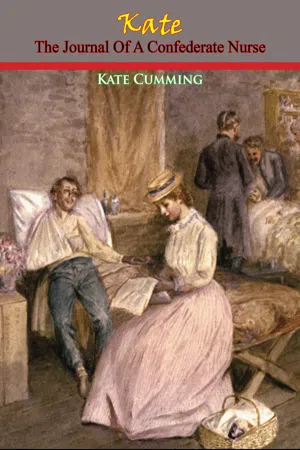
Kate: The Journal Of A Confederate Nurse
About this book
This fascinating journal of Kate Cumming, one of the first women to offer her services for the care of the South's wounded soldiers of the bloody Civil War, represents a detailed record of her activities and thoughts as a nurse. Spanning the time she was assigned to her first post in Okolona, Mississippi in April 186, working under Doctor S. H. Stout, a progressive military physician committed to the employment of women in hospitals, until May 29, 1865, this book provides a solid look behind the lines of Civil War action in depicting civilian attitudes, army medical practices, and the administrative workings of the Confederate hospital system.
Information
Subtopic
19th Century HistoryIndex
HistoryVII: ATLANTA, NEWNAN
September 9, 1863.—Arrived at Newnan, Georgia, this morning about 8 o’clock.
We left Dalton yesterday morning, reaching Atlanta at 6 o’clock p. M. On our arrival we saw numbers of families around the depot, in tents and old cars—refugees, who had been driven from their homes by the enemy. Some of them had left home on the advance of our army, as wherever it is there is a scarcity of provisions.
We put up at the Atlanta Hotel. Dr. Young, whom the shells at Chattanooga had put under the necessity of changing his abode, and Major Proctor, spent the evening with us. Major Proctor was very low-spirited, as he thought his chance of getting to his home in Kentucky less than ever. General Bragg, as a rule, is not a favorite with Kentuckians, as they think he had no good reason for leaving Kentucky when he did; but he was little spoken about that evening.
Dr. Young’s indignation was so great against the extortioners and speculators, that he had none left for anyone else. He was bitter in the extreme, which it is not much to be wondered at, when we think of how he and others have given up homes, friends, and everything dear to them for the cause, and find such Shy locks preying on the very heart-blood of our country; and it is enough to make even the “stones cry out.” Dr. Young told us that our money was more depreciated in Atlanta than in any place in the Confederacy. He said that for himself, “if the Confederacy fell, he would think it an honor to sink with it and its money in his pocket, rather than to have made his thousands.
We found Atlanta full of the “gilt-lace gentry;” a sure sign, they say, “there will be a battle soon.” If General Bragg is a strict disciplinarian, why is it that nearly every place we go to is filled with officers; apparently in good health, and doing nothing?
We left our sick at different posts on the road.
Newnan seems to be a very nice little town; it is the capital of Coweta County, and is forty miles south-west of Atlanta, on the West Point road.{94} We are at the Coweta Hotel, a very pleasant one, kept by Colonel Colyer [Colyar] of Tennessee, a member of congress. He has been driven from his home, and, for want of something better to do, has turned hotel-keeper. The fare is very good, but we had no wheat-bread for breakfast, and I am not southern enough to like corn-bread.
The first thing we were told on our arrival was, that the citizens did not like the idea of the hospitals coming here. This seems strange; it cannot be that these people have no relatives in the army, as we know how nobly Georgia has come forward at every call for troops; and have we not heard of their bravery on every battlefield in Virginia?
Well, if they have relatives in the army, do they not expect they stand a chance of being sick or wounded, and that, unless hospitals are provided for them, these same relatives would be in a terrible state, and denounce the government and everybody connected with it?
I do not doubt but that they would be very much displeased if they were to hear that the people in some of the towns in Virginia, where most of the Georgia troops are, were opposed to having hospitals among them for the benefit of those troops. True, a hospital is not the most pleasant place in the world, where we have stern war, stripped of all its glory, and nothing but the sad realities presented—fell disease, with all its noxious vapors, and the poor, emaciated frames—men who went forth to the army, flushed with health and strength, but now, by wounds and disease, made nearly as helpless as infants. But what are we to do? Let the men suffer?
I sincerely trust that it is mere idle talk we have heard, and that the people here have not forgotten, “Do unto others as you would have them do unto you.”
The next thing we were told was, that there is great hostility shown to the refugees in this place. Can this really be the case? But if the former is true, then the latter may be. If the enemy are culpable, who have driven these people from their homes, and forced them to seek others among strangers, how much more so are those persons who are now living, surrounded with all the comforts of home. True, in a measure, all are suffering now; but sympathy costs nothing...
If these people would only think of what may be their own fate; for if we are to judge from the signs of the times, the war is far from being over, and if for no other reason than that they may need the same kindness shown to themselves, they ought to show all they can to the strangers....
Dr. Gamble and his surgeons have been out all day in search of hospital accommodations, and have succeeded in getting room for one thousand patients. They have taken nearly all the large buildings and stores. It astonishes me to see how cheerfully our men go to work again to fix up more hospitals.
I observed the people on the cars coming down, and that everybody seemed to take their trials as a matter of course. Suffering has made them strong. It is said, the only grumblers we have are those who stay at home and have had no reason to feel the war.
September 13.—Went to the Methodist Church; heard an excellent sermon.
All are on the tiptoe of expectation, watching the development of General Bragg’s movements. He is marching his army into Georgia, having abandoned Chattanooga and Cumberland Gap; the latter place has been given up without firing a gun. Tennessee is now wholly at the mercy of the enemy.
Hundreds of troops are daily passing from Virginia to reinforce Bragg, of whom many are now predicting great things, saying that all he needed was plenty of men, which he has never had, and that the general he has had to contend against here outwitted General Lee in Western Virginia. Besides, the troops our men have to fight against are the Western ones, in bravery much superior to those that are opposed to the Virginia army.
But I am satisfied that both armies are brave enough for our good, as our losses have proved, and opened our eyes to the disagreeable fact, that one of our men is not equal to five of the enemy, as we at first thought. No one for a moment will say that our troops have not fought with a determination and bravery that have never been surpassed perhaps in any army, and that they have not always been opposed to at least double their numbers. Still, “honor to whom honor is due.” I have never spoken to any of our men on the subject, who have not told me that the enemy have exhibited a bravery and determination worthy of a better cause.
I have wondered at this, as I thought the race to which we all belong—the Anglo-Saxon one—never could make good soldiers without they were fighting for principle; or, in other words, had good consciences, and felt that their honor was at stake. We all know that the enemy have nothing of that kind to fight for. We have never wished to subjugate them or to take away their liberties, but have begged like suppliants, to be left to ourselves, with the sin of slavery (?) on our own shoulders.
Mrs. Williamson and myself have determined, that no matter how fine our hospital may be, or nice the place, not to fix our hearts on it; for if we do, we shall certainly have to run; although I cannot see how we are to move further south, for, as the saying is, we are almost at the “jumping-off place.” If we should make a move north, we would gladly leave a palace, no matter what trouble it would give; as then we should know our cause was succeeding.
It is rumored that Forrest has had a fight near Ringgold. We are quite anxious about some of our attendants and hospital stores, which were left behind.
Dr. Bemiss is very much annoyed about two of his men having deserted. One of them, from Tennessee, was an excellent man. I asked Dr. Bemiss how he thought such a man could desert. He answered, nothing would have made him except an earnest appeal from his wife, and that the women were the cause of nearly all the desertions. This is certainly not very complimentary to us, nor to the women of ‘76 and Sparta, to whom our men are constantly comparing us.
September 17.—We have nothing arranged in the hospital, but it is filled with sick; many of them are on the floors. Mrs. Williamson and myself have two small rooms. One is used as a dining-room, sitting-room, and for making toddies, eggnogs, etc. A number of the officers we had at the Springs have followed us here, and they eat at our table for the present. They are to have a hospital set apart for them, as it is thought a better plan than having distinctions made where the privates are in the matter of rooms, and eating at separate tables. The doctors all seem to dislike having the care of them.
Dr. McAllister has been persuaded to accept the honor by the promise of some valuable piece of furniture from the other hospitals. Dr. McAllister is a strict disciplinarian, and I am told the officers do not like him on that account. The doctors object to officers because, they say, they are apt to dictate, and expect much more attention than the privates. I have heard surgeons say they would rather attend five privates than one officer. For my own part, I have never known any difference; have treated them the same as privates, and received kind treatment in return.
Mrs. Johnston, one of the ladies of the place, called on us. She told me of a lady from whom she thought I could procure some milk. Her little boy went with me to show me where the lady lived; he is a pretty little fellow, and very talkative. He related quite a number of stories in his childish way; among other things, he told me a story about some, to use his own words, “mean old refugees.” I asked him if he did not like refugees. He looked at me in astonishment, and said, “No; who would like refugees?” I tried to get him to tell me why they were not to be liked; this he could not do, but seemed to think I ought to know what everybody else did.
September 19.—We have received news that a battle has commenced. A number of surgeons from this post have been ordered to the front. Drs. Rhea and Bateman will go from our hospital. We regret losing them, as we have so many sick.
On hearing of the commencement of a battle it sends a thrill of horror through me, and especially such a one as it is said this will be. Both armies have been collecting all the forces they could muster, intending to put their strength in the conflict. It will send many a gallant spirit away to that land “from whence no traveler returns.”
I must try and dismiss this gloomy subject, as we have much to do. I feel it is a great blessing, and keeps our thoughts from wandering to the bloody drama.
We had numbers of sick come in last night. As it is impossible to attend to them all, immediately after they come in, I go around to visit them, and from having seen so many, can nearly always tell at a glance who are most in need of special care.
Mrs. Johnston went round with me this morning. I passed a fine, healthy-looking man, and I thought he was one who was out of place there, and ought to be back with the army. I had passed him without speaking, and saw a tear in his eye; so curiosity made me go back to find out who he was. He had been three years in the service, and this was his first visit to a hospital. He had been injured by the upsetting of a train. So much for judging from appearances.
September 20.—Mrs. Williamson and myself went to the Presbyterian Church this morning; heard a very good sermon from the pastor. He gave a glowing description of the glories of heaven, but spoiled it by saying, with bitterness, that there would be no taking churches there for hospitals. It was rather too much rancor to be used in such a place, and in a scene like the one he was describing.
All the churches here have been taken for hospital purposes, and this is the last Sunday service will be held in that one. When I looked around and saw how neat everything was in it, and thought of the ruin which would be wrought in making it ready for patients, I could not wonder that he was annoyed, and more so as I do not think there is any necessity for taking them at present, as I know there are more buildings which we could get; for instance, a young ladies’ college, and I have no doubt others; so at present they are not really needed; and, without that, I think we should not take them. We act as if churches were built rather for our amusement than the worship of the living God. H...
Table of contents
- Title page
- TABLE OF CONTENTS
- PREFACE
- ILLUSTRATIONS
- EDITOR’S INTRODUCTION
- KATE CUMMING’S ITINERARY IN THE CONFEDERATE HOSPITAL SERVICE
- AUTHOR’S INTRODUCTION
- I: OKOLONA, CORINTH
- II: OKOLONA
- III: MOBILE
- IV: RINGGOLD, DALTON, CHATTANOOGA
- V: CHATTANOOGA, MOBILE
- VI: KINGSTON, CHEROKEE SPRINGS
- VII: ATLANTA, NEWNAN
- VIII: NEWNAN, MOBILE
- IX: WEST POINT, AMERICUS, MACON
- X: MOBILE
- XI: GRIFFIN
- XII: NEWNAN
- XIII: MOBILE
- REQUEST FROM THE PUBLISHER
Trusted by 375,005 students
Access to over 1.5 million titles for a fair monthly price.
Study more efficiently using our study tools.
Frequently asked questions
Yes, you can cancel anytime from the Subscription tab in your account settings on the Perlego website. Your subscription will stay active until the end of your current billing period. Learn how to cancel your subscription
No, books cannot be downloaded as external files, such as PDFs, for use outside of Perlego. However, you can download books within the Perlego app for offline reading on mobile or tablet. Learn how to download books offline
Perlego offers two plans: Essential and Complete
- Essential is ideal for learners and professionals who enjoy exploring a wide range of subjects. Access the Essential Library with 800,000+ trusted titles and best-sellers across business, personal growth, and the humanities. Includes unlimited reading time and Standard Read Aloud voice.
- Complete: Perfect for advanced learners and researchers needing full, unrestricted access. Unlock 1.5M+ books across hundreds of subjects, including academic and specialized titles. The Complete Plan also includes advanced features like Premium Read Aloud and Research Assistant.
We are an online textbook subscription service, where you can get access to an entire online library for less than the price of a single book per month. With over 1.5 million books across 990+ topics, we’ve got you covered! Learn about our mission
Look out for the read-aloud symbol on your next book to see if you can listen to it. The read-aloud tool reads text aloud for you, highlighting the text as it is being read. You can pause it, speed it up and slow it down. Learn more about Read Aloud
Yes! You can use the Perlego app on both iOS and Android devices to read anytime, anywhere — even offline. Perfect for commutes or when you’re on the go.
Please note we cannot support devices running on iOS 13 and Android 7 or earlier. Learn more about using the app
Please note we cannot support devices running on iOS 13 and Android 7 or earlier. Learn more about using the app
Yes, you can access Kate: The Journal Of A Confederate Nurse by Kate Cumming, Richard Barksdale Harwell in PDF and/or ePUB format, as well as other popular books in History & 19th Century History. We have over 1.5 million books available in our catalogue for you to explore.