- 571 pages
- English
- ePUB (mobile friendly)
- Available on iOS & Android
eBook - ePub
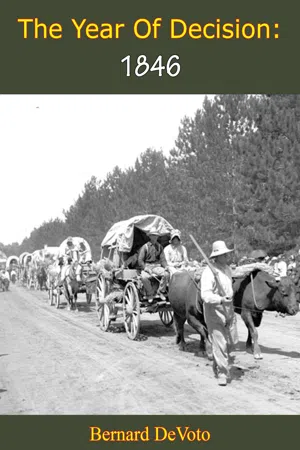
The Year Of Decision: 1846
About this book
This book tells many fascinating stories of the U.S. explorers who began the Western march from the Mississippi to the Pacific, from Canada to the annexation of Texas, California, and the Southwest lands from Mexico. It is the penultimate book of a trilogy which includes Across the Wide Missouri, for which DeVoto won both the Pulitzer and Bancroft prizes in 1948, and The Course of Empire, which won the National Book Award for Nonfiction in 1953. DeVoto's narrative covers the expanding Western frontier, the Mormons, the Donner party, Fremont's exploration, the Army of the West, and takes readers into Native American tribal life.
Information
Subtopic
American Civil War HistoryIndex
HistoryREQUEST FROM THE PUBLISHER
Thank you so much for reading our book, we hope you really enjoyed it.
As you probably know, many people look at the reviews before they decide to purchase a book.
If you liked the book, could you please take a minute to leave a review with your feedback?
60 seconds is all I’m asking for, and it would mean the world to us.
Thank you so much,
Pickle Partners Publishing
{1} Really from the southern tip of Prince of Wales Island.
{2} From his journal, December 3, 1846: “In the evening F. read Frémont’s Expedition to the Rocky Mountains in 1842; highly interesting and exciting. What a wild life, and what a fresh existence! But, ah, the discomforts!”
{3} The Aricara, the Assinniboin, the northern Arapaho, and most of all the Blackfeet.
{4} The opinion of scholars, which has changed before this, is again that the returning Astorians learned about South Pass and traveled it—from west to east. Such descriptions as they print do not closely describe South Pass, but it is neither my business nor my interest to question them. At any rate, the Ashley party under Jedediah Smith, certainly the first white men to travel the Pass from the east, were the effective discoverers. They made it known and the rest followed—from their passage, not that of the Astorians.
{5} With Markhead, La Bonte, Hatcher, and the Seventh Baronet of Grandtully in Ruxton’s Life in the Far West, 1848. This statement is tolerably arbitrary. Stewart himself published a novel called Altowan in ’46, two years before Ruxton’s book. Mike Fink and Rose had been celebrated in the magazines still earlier and various romances had introduced characters modeled on the mountain man. But genuine portraiture begins with Ruxton.
{6} Stein’s words in Conrad’s Lord Jim.
{7} This map reading, from Polk’s Diary for February 13, is substantially repeated on February 16 and exhibits Polk’s—but by no means Atocha’s—ignorance of the country he was trying to acquire. The Colorado, of course, flows west only through a part of Arizona; mainly it flows south. The description could be given meaning only by concluding that Atocha meant to offer Polk everything he wanted except the southern half of the present state of California.
{8} For a discussion of Joseph Smith’s psychosis, see Bernard DeVoto, “The Centennial of Mormonism,” in Forays and Rebuttals, 71 ff.
{9} Certainly from 1833.
{10} The beehive, which is a device of Mormon iconography and appears on the state seal of Utah, was a Fourierist symbol.
{11} Speculation in real estate was a strong part of Mormonism from the very beginning. Under Young in Utah fictitious land values came to be capitalized as the society developed on its strong base, and so they were a legitimate instrument of colonization. But in the earlier periods in Ohio, Missouri, and Illinois, the Mormon enterprises in real estate were, quite simply, a theocratic phase of the westward-marching land boom of the frontier. Remember that the promise of landownership was always the strongest appeal the Mormon missionaries had to make to Europe’s poor.
{12} Sterling Price, who also enters the narrative later on, was in charge of them.
{13} Leaving the lake after his brief exploration of it, Frémont says nothing about the country thereabout as a place of settlement but does highly recommend Bear River Valley. “The bottoms are extensive; water excellent; timber sufficient; the soil good and well adapted to the grains and grasses suited to such an elevated region. A military post and a civilized settlement would be of great value here; and cattle and horses would do well where grass and salt so much abound. . . .” Practically everyone who had ever written about the Bear River had said the same thing, including Jim Clyman (who met the Mississippi Saints on his way east in ’46). No one, in fact, could help making that observation the moment he saw the oasis of Soda Springs. Coming back to the Great Basin the following summer, Frémont got to Utah Lake but did not go back to Great Salt Lake. His report says, “In the cove of mountains along its eastern shore the [Utah] lake is bordered by a plain where the soil is generally good, and in greater part fertile; watered by a delta of prettily timbered streams. This would be an excellent locality for stock farms; it is generally covered with good bunch grass and would abundantly produce the ordinary grains.” A couple of pages later he sums up his judgment of the entire Great Basin in a properly celebrated passage which accurately predicts its future.
A later controversy between Frémont and Brigham Young deals with an ambiguous passage (p. 273 of the report) in which Frémont seems to mistake Utah Lake for an arm of Great Salt Lake. It was certainly foolish of Frémont not to make the two-day ride which would have settled the matter. He answers Young’s accusation in Memoirs of My Life but with the same mingling of vagueness and dishonesty that characterizes so much else of that book.
{14} There is no dependable evidence whatever to support the attractive speculation that the hard-headed Young did in fact send out a small exploring party to the Great Basin in ’46. I have always considered such a party one of the musts of American history, and between Young’ arrival at Council Bluffs and the closing in of winter there was plenty of time for such a party to go to Salt Lake Valley and return. In Coutant’s History of Wyoming the statement is made (and it has been repeated in newspapers and elsewhere) that such a party was in fact sent out under the guidance of two veteran mountain men, Jim Beckwith and O. P. Wiggins. Coutant’s authority was two letters by Wiggin which are now in the library of the Nebraska State Historical Society Not one of the six Mormons whom Wiggins names as composing the party can be identified in any of the Mormon rolls open to me, however and various students who have access to the Church library are unable to identify them there. The same students assure me that there is no allusion of any kind to such an exploration in any of the records of the Church. The idea must be dismissed as speculation. It remains true, however, that no man was ever more skillful than Young at keeping his left hand, even if that hand were the Quorum of the Twelve, from knowing what his right hand was doing. I shall not be altogether amazed if eventually it appears that someone did go to the valley in ’46, like the six whom Joshua sent into Canaan, to spy out the land. The idea is herewith tendered to those who are making novels about the Mormons a leading American industry.
{15} There were many respiratory diseases. Strain and exposure made the Saints an easy prey to pneumonia. An epidemic of whooping cough traveled with them across Iowa, killing many children. The “black canker” which so many journals mention was probably sometimes scurvy, sometimes diphtheria, and sometimes septic sore throat. Scurvy and other ailments resulting from malnutrition were, of course, extremely common.
{16} This is the true Council Bluffs of Lewis and Clark, fifteen miles upriver from the present Iowa city of that name.
{17} Duly adapted in the City of the Lord, which Joseph Smith, Jun., and his city planners worked out on paper.
{18} The date of Frémont’s letter is in dispute. Camp concludes that it was written at this time.
{19} An unfortunate vagueness in Clyman’s journal makes it uncertain just whom the party consisted of. When they were all together again on April 28, several thought it was still “impracticable to cross the mountains at this time.” Clyman says, “several of us are However verry anxious to try and assertain that fact,” and the next day he and the party he continued with started out. Mr. Charles L. Camp, Clyman’s editor, writes me that he believes that eleven or twelve men, two women, and two children stayed behind to make the later crossing (various later entries in the journal which need not be cited here support this reading), and that this party went by way of Fort Hall and is the one which will be mentioned later on. Mr. Camp believes that the seasoned old Greenwood, who was “going out to catch emigrants and was in no hurry,” was among those who stayed behind. The important thing for our purpose, however, is that Hastings and Hudspeth were in the advance party—by this reading necessarily reduced to seven or eight men, one woman, and a boy—with whom Clyman traveled.
{20} Like the log cabin, the covered wagon is a classic American symbol. But, Hollywood notwithstanding, it was not standardized. In any train, even a Santa Fe freight caravan, wagons were likely to differ widely. Nevertheless, by 1846 some evolution and standardization had occurred. Think of the Santa Fe freight wagon (which had the easier passage to ma...
Table of contents
- Title page
- TABLE OF CONTENTS
- DEDICATION
- ACKNOWLEDGMENTS
- PREFACE
- CALENDAR FOR THE YEARS 1846-1847
- INVOCATION
- I-BUILD THEE MORE STATELY MANSIONS
- II-THE MOUNTAIN MAN
- III-PILLAR OF CLOUD
- IV-EQUINOX
- V-SPRING FRESHET
- INTERLUDE-DOO-DAH DAY
- VI-OH SUSANNA!
- VII-“CAIN, WHERE ARE THY BROTHERS?”
- INTERLUDE-WORLD OF TOMORROW
- VIII-SOLSTICE
- IX-THE IMAGE ON THE SUN
- X-SONOROUS METAL
- XI-CONTINENTAL DIVIDE
- INTERLUDE-FRIDAY; OCTOBER 16
- XII-ATOMIZATION
- XIII-TRAIL’S END
- XIV-ANABASIS IN HOMESPUN
- XV-DOWN FROM THE SIERRA
- XVI-WHETHER IT BE FAT OR LEAN: CANAAN
- XVII-BILL OF REVIEW‒DISMISSED
- STATEMENT ON BIBLIOGRAPHY
- REQUEST FROM THE PUBLISHER
Trusted by 375,005 students
Access to over 1.5 million titles for a fair monthly price.
Study more efficiently using our study tools.
Frequently asked questions
Yes, you can cancel anytime from the Subscription tab in your account settings on the Perlego website. Your subscription will stay active until the end of your current billing period. Learn how to cancel your subscription
No, books cannot be downloaded as external files, such as PDFs, for use outside of Perlego. However, you can download books within the Perlego app for offline reading on mobile or tablet. Learn how to download books offline
Perlego offers two plans: Essential and Complete
- Essential is ideal for learners and professionals who enjoy exploring a wide range of subjects. Access the Essential Library with 800,000+ trusted titles and best-sellers across business, personal growth, and the humanities. Includes unlimited reading time and Standard Read Aloud voice.
- Complete: Perfect for advanced learners and researchers needing full, unrestricted access. Unlock 1.5M+ books across hundreds of subjects, including academic and specialized titles. The Complete Plan also includes advanced features like Premium Read Aloud and Research Assistant.
We are an online textbook subscription service, where you can get access to an entire online library for less than the price of a single book per month. With over 1.5 million books across 990+ topics, we’ve got you covered! Learn about our mission
Look out for the read-aloud symbol on your next book to see if you can listen to it. The read-aloud tool reads text aloud for you, highlighting the text as it is being read. You can pause it, speed it up and slow it down. Learn more about Read Aloud
Yes! You can use the Perlego app on both iOS and Android devices to read anytime, anywhere — even offline. Perfect for commutes or when you’re on the go.
Please note we cannot support devices running on iOS 13 and Android 7 or earlier. Learn more about using the app
Please note we cannot support devices running on iOS 13 and Android 7 or earlier. Learn more about using the app
Yes, you can access The Year Of Decision: 1846 by Bernard DeVoto in PDF and/or ePUB format, as well as other popular books in History & American Civil War History. We have over 1.5 million books available in our catalogue for you to explore.