"Of all General Fuller's brilliant books, this is the masterpiece."—B. H. Liddell Hart
"A thrilling portrayal of Alexander's military career and genius."—American Historical Review
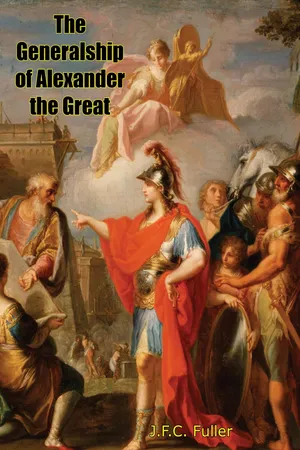
In his brief and meteoric life (356-323 B.C.), the greatest of all conquerors redirected the course of world history. Here, General J. F. C. Fuller, one of the premier military historians of the twentieth century, vividly portrays the astonishing successes of Alexander the Great, focusing on his brilliant battle strategies and his political savvy.
The first half of the book, "The Record," describes—in Fuller's trademark concise and gripping style—Alexander's character and training, the structure of his army, and the geography of the world that determined the strategy of conquest. "The Analysis" dissects the great battles, from Granicus to Hydaspes, and concludes with two chapters on Alexander's statesmanship.
In clear, spirited prose. Fuller illuminates the many facets of Alexander's genius and the enduring legacy of his empire.
- 328 pages
- English
- ePUB (mobile friendly)
- Available on iOS & Android
eBook - ePub
The Generalship of Alexander the Great
About this book
Information
Topic
HistoireSubtopic
Histoire antiquePART I — THE RECORD
1 — THE BACKGROUND
Decay of the City-States
When, as is conjectured, those tribes of Indo-European stock to become known to history as the Greeks percolated into the mountain-tangle of the Balkans to settle in its more fertile valleys, they formed pockets of agricultural communities, each cut off from the other. At first each tribal group of villages was congregated closely around its leader’s stockaded stronghold, or acropolis; but later, to enhance their protection, the villages were walled in and together with the acropolis became a fortified town. Thus originated the city-state or polis, each a minute nation{1} in which citizenship was commonly based on descent from the original conquerors: the citizens possessed all real property, exercised all political rights and performed all military duties. The key to society throughout the heroic age was the tribe and its clans: ‘Separate thy men by tribes, by clans’, says Nestor to Agamemnon, ‘that clan may bear aid to clan and tribe to tribe.’{2}
Each city was a sovereign power with its own king, laws, army, and gods, and each citizen owed allegiance to his city and to no other. The exceptions to this general rule were four regions, each roughly a geographical unit; the kingdoms of Sparta and Argos, which together occupied a considerable part of the Peloponnese; the Attic peninsula, in which Athens absorbed its little city kingdoms; and Boeotia, where the city-states, though not absorbed, fell under the leadership of Thebes.
The political institutions of Homeric times show that the king, as leader of his tribe, was guided by a council of his chiefs, and that his decisions were brought before the Assembly, or gathering of the folk, for ratification. The king was chief priest, chief judge, and supreme war lord; he claimed descent from the gods, and was protected by a bodyguard of his companions, as in after times Danish and Saxon kings were by their housecarls.
The political life of the Greek cities was one of nearly endless intercity war, or of civil discord (stasis) within their walls. Plato points out that these inter-city wars were largely caused by over-population,{3} at times relieved by emigration. It was a life of restless ambitions, personal jealousies, party factions and endless cattle raiding; maritime commercial rivals were in a state of constant war. In the seventh century B.C., the poet Archilochus described the freebooter’s life at sea: ‘In my spear is kneaded bread, in my spear is the wine of Asmarus and I lie upon my spear as I drink.’{4}
Because the citizens lived for war,{5} they had no time for peaceful occupations, which were relegated to serfs, slaves, and metics (aliens). The division between the citizen-soldier and the agricultural labourer formed two main classes, the nobles and the peasants, and the struggle between them became the decisive problem in city politics. After the eighth century B.C., as republics replaced the vanishing clan monarchies, there emerged from the class struggle the forms of government commonly identified with the Greek city-states—aristocracy, oligarchy, democracy, and tyranny; and a point to note is that with the exception of Sparta where a dual monarchy was adopted,{6} no Hellenic city developed a stable form of government.
There were no bonds between the cities except the common language and the great athletic festivals, held under religious auspices and open to all Hellenes. Of these the most noted were the Olympic Games, founded traditionally in the eighth century B.C. and held every fourth year in honour of Olympian Zeus, and the Pythian Games in honour of Apollo of Delphi, which early in the sixth century B.C. were placed under the management of the Amphictyonic Council.{7} Only the dire threat to all city-states by the Persians, under Xerxes (485–465 B.C.) which was brought to naught at Salamis and Plataea in 480 and 479 B.C., produced some semblance of common patriotism and caused the rise of the Athenian empire with its Periclean dream of union. In the Peloponnesian War (431–404 B.C.) that empire was destroyed, and its policy of union failed because, as Sir Ernest Barker points out, both Athens and her allies, ‘equally trammelled by the thought of the city-state, could not arise to the conception of a great non-civic state united in a common citizenship…because her citizenship meant—and could only mean—Athenian birth and a full participation in Athenian local life and ways and temper: on their side they could not have accepted the gift if it had been offered, because their citizenship of their cities meant just as much to them’.{8}
The Peloponnesian War, which involved nearly all the city-states, was disastrous to Hellenic polity. By destroying the Athenian empire it upset the balance of power between Greece and Persia, and in 386 B.C. the Sparto-Persian alliance caused the shameful King’s Peace, or Peace of Antalcidas, dictated to the Greek states by Artaxerxes II (404—358 B.C.). By its terms the Asiatic Greek cities and Cyprus were abandoned to Persia, the leadership of Sparta within Greece was acknowledged, and any state which did not accept the peace was to be compelled by Persia to do so. Thus the Great King became the arbiter of Greece with the right of perpetual interference.
Equally momentous, this ‘Thirty Years War’ of the Hellenic age sowed seeds of decay within the cities. Not only did it ruin the agricultural industry of Attica and throw thousands of her peasant farmers into the ranks of the unemployed, but during the long struggle the old militias, the backbone of the city system, through constant service became increasingly professionalized. Although adventurous Greek soldiers and freebooters had hired themselves to foreign princes long before the Persian invasion,{9} and early Greek tyrants had used mercenaries as bodyguards, not until the Peloponnesian War did the opportunity arise for their employment on a large scale. By the opening of the fourth century B.C. the ordinary Greek citizen militias were so completely outclassed by professional mercenaries that the latter became a typical feature in Greek warfare. There were two results of this: the first was that as mercenaries were not bound by allegiance to any city-state they sold their services to the highest bidder and so became the means whereby democracy could be violently subdued by autocracy; the second was that their services became so eagerly sought after that in the fourth century most of the Persian army infantry was composed of Greek mercenaries. For his expedition against his elder brother Artaxerxes II, in 401 B.C., Cyrus the Younger recruited some 13,000 Greek mercenaries, of whom more than half were poverty-stricken Arcadians and Achaeans.{10} After his defeat at Cunaxa, the remnants of this army retired to the Troad under Xenophon and turned professionals, ‘and from them’, writes Sir William Tarn, ‘dates the growth in Greek history of a world separate from the city-state, the world of mercenaries’.{11}
Thucydides tells us that when the Peloponnesian War broke out the Athenian citizens were ever-ready to brave danger and suffer fatigue and privations for the glory of Athens. He makes the Corinthians say of them: ‘…their only idea of a holiday is to do what the occasion demands, and to them laborious occupation is less of a misfortune than the peace of a quiet life. To describe their character in a word, one might truly say that they were born into the world to take no rest themselves and give none to others.’{12} But as the defence of the cities became more and more dependent upon mercenaries, the ordinary citizen felt military service a burden; he became increasingly pacific and immersed himself in industrial and professional pursuits—in money-making. So pronounced was this change that in order to guarantee a quorum at the meetings of the Athenian Assembly payment of each citizen attending was introduced, and to maintain the unemployed tranquil they were given free seats at the theatre. ‘The city was ceasing to be’, writes Sir Ernest Barker, ‘a partnership in high achievement and noble living: it was becoming a commercial association for the distribution among its members of dividends which they had not earned.’ {13}
Reforms of the Philosophers
The decline in morale of the city-state, coupled with the devastation resulting from endless inter-city warfare, shocked the Greek conscience and was rendered vocal by the philosophers, whose speculations, like those of Voltaire, Rousseau, Kant, and others in eighteenth-century Europe, initiated a period of enlightenment which did not reinvigorate but rotted what remained of the crumbling polity of the city-state. The more outstanding of these would-be reformers were Socrates (469–399 B.C.), Plato (429–347 B.C.), and Aristotle (384–322 B.C.).
What these philosophers were unable to understand was that the problem was not the reform of the constitution of the city in accordance with an ideal archetypal polis but to expand the circumference of the city until it included all the Hellenic states in Greece, and thereby to create an Hellenic unity and brotherhood. Of Socrates, the earliest in date of the three, all we know of him, as he left nothing in writing, is what has been recorded by Plato, Xenophon, and Aristophanes. He conceived that he had a heavenly mission to educate all and sundry, and Xenophon tells us that—like Joan of Arc—he was directed by divine voices.{14} His tedious dialectics of question and answer must have confused the minds of many of his hearers, and should Plato’s dialogues represent his views correctly, then there would seem to have been adequate reason why the conservative Athenians looked upon him as a dangerous visionary and corrupter of youth.{15}
This becomes apparent when we turn to Plato’s Republic and Laws, in which are described the Socratic constitution of the archetypal city-state, the heavenly pattern toward which all reforms were to be directed. The proposals made in these books may be compared with a mixture of the ideas of Calvin, Robespierre, Marx, and Lenin, and the whole summed up as ‘Transcendental Bolshevism’, which must have been as repellent to Athenian democrats of the fifth and fourth centuries B.C. as Marxian Bolshevism is to Western democrats today.
In this supernal, self-contained, self-sufficient, and self-controlling city-state, the citizens were divided into two classes, the governors and the governed. The former, called ‘Guardians’, were philosopher soldiers, female{16} as well as male; the latter, the proletariat, craftsmen and menial labourers, who were disenfranchised. So that they might devote all their time to righteousness, the Guardians were deprived of all property, lived in common, fed at the public tables, possessed no money, and were supported by the proletariat. Their wives and children were also held in common; the marriages were regulated, no child knew his father or mother, and all this in order that the state might be one family.{17}
Among the common people, nothing was left to the caprice of individuals; their marriages, fixed between thirty and thirty-five years of age for men and between sixteen and twenty for girls, were controlled by a board of women so that the population might be kept at a uniform level, and all promiscuous unions were strictly forbidden. A Nocturnal Council was established as a Committee of Public Safety, as well as Curators of the Law—a species of secret police—whose task was to hound down heretics. Spying was universal and all wrong-doing reported to the authorities. Also, we read, he who endeavoured ‘to second the authorities in their work of repression, he is the great and perfect citizen’.{18}
Other regulations were that all foreign travel was forbidden to citizens under forty years of age, and then only under licence; on their return they ‘shall explain to their juniors how inferior are the ways of other nations to the institutions of their own land’.{19} Drinking of wine was prohibited; poets were forbidden to circulate any verses that had not been censored by the Curators, no lending on usury was allowed, no internal currency was to be exported, no citizen was to possess a private shrine in h...
Table of contents
- Title page
- TABLE OF CONTENTS
- PREFACE
- ILLUSTRATIONS
- MAPS AND DIAGRAMS
- PART I - THE RECORD
- PART II - THE ANALYSIS
- EPILOGUE-THE VALUE OF HISTORY
- REQUEST FROM THE PUBLISHER
Trusted by 375,005 students
Access to over 1.5 million titles for a fair monthly price.
Study more efficiently using our study tools.
Frequently asked questions
Yes, you can cancel anytime from the Subscription tab in your account settings on the Perlego website. Your subscription will stay active until the end of your current billing period. Learn how to cancel your subscription
No, books cannot be downloaded as external files, such as PDFs, for use outside of Perlego. However, you can download books within the Perlego app for offline reading on mobile or tablet. Learn how to download books offline
Perlego offers two plans: Essential and Complete
- Essential is ideal for learners and professionals who enjoy exploring a wide range of subjects. Access the Essential Library with 800,000+ trusted titles and best-sellers across business, personal growth, and the humanities. Includes unlimited reading time and Standard Read Aloud voice.
- Complete: Perfect for advanced learners and researchers needing full, unrestricted access. Unlock 1.5M+ books across hundreds of subjects, including academic and specialized titles. The Complete Plan also includes advanced features like Premium Read Aloud and Research Assistant.
We are an online textbook subscription service, where you can get access to an entire online library for less than the price of a single book per month. With over 1.5 million books across 990+ topics, we’ve got you covered! Learn about our mission
Look out for the read-aloud symbol on your next book to see if you can listen to it. The read-aloud tool reads text aloud for you, highlighting the text as it is being read. You can pause it, speed it up and slow it down. Learn more about Read Aloud
Yes! You can use the Perlego app on both iOS and Android devices to read anytime, anywhere — even offline. Perfect for commutes or when you’re on the go.
Please note we cannot support devices running on iOS 13 and Android 7 or earlier. Learn more about using the app
Please note we cannot support devices running on iOS 13 and Android 7 or earlier. Learn more about using the app
Yes, you can access The Generalship of Alexander the Great by J.F.C. Fuller in PDF and/or ePUB format, as well as other popular books in Histoire & Histoire antique. We have over 1.5 million books available in our catalogue for you to explore.