Until the first publication of the Geography of Intellect in 1963, the study of human intelligence, its distribution and causes, had been confined to inaccessible scholars' journals. With the publication of works by Carleton S. Coon, Ernst Mayr and others—dealing with the evolution of man and his various sub-groups—has grown a strong popular interest in the findings of anthropological science:
What has made man? Why do his civilizations rise and fall? How can we make certain that our current rate of material progress is maintained or increased, that we do not fall into the graveyard of civilizations wherein are buried Periclean Greece, Imperial Rome, Post-Inquisition Spain, Islamic civilization and the monstrous Nazi regime?
"No one can read Nathaniel Weyl without realizing the has is clearly a man of intellectual honesty, attempting to perform a signal service for us all."—NATIONAL REVIEW
"So lucid and admirable a style"—NEW REPUBLIC
"Professor Possony is an admirable historian, and his book is a careful and well-documented account."—THE ANNALS
"Dr. Possony—deeply steeped in general sociology—stands out among the younger historians whose work has commanded attention in Europe and in this country."—THE NEW LEADER
- 301 pages
- English
- ePUB (mobile friendly)
- Available on iOS & Android
eBook - ePub
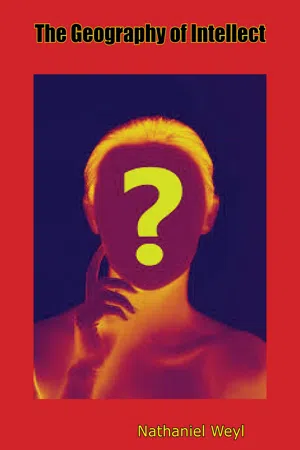
The Geography of Intellect
About this book
Information
Topic
GeschichteSubtopic
AltertumREQUEST FROM THE PUBLISHER

Thank you so much for reading our book, we hope you really enjoyed it.
As you probably know, many people look at the reviews before they decide to purchase a book.
If you liked the book, could you please take a minute to leave a review with your feedback?
60 seconds is all I’m asking for, and it would mean the world to us.
Thank you so much,
Muriwai Books
{1} Thomas Jefferson to Henri Gregoire, Washington, February 25, 1809. This is reproduced inter alia in Basic Writings of Thomas Jefferson, editor Philip Foner, (Garden City: Halcyon House, 1950), p. 682.
{2} In a contribution to the Summer 1961 issue of Daedalus, Journal of the American Academy of Arts and Sciences, devoted to “Evolution and Man’s Progress,” James F. Crow, Professor of Medical Genetics at the University of Wisconsin, made some pertinent comments on this point. In an article entitled “Mechanisms and Trends in Human Evolution, Crow stated that the experience of animal breeders suggests that it probably would be easier, by selection, to change the intellectual or other aptitudes of the population than to change the incidence of disabling disease or sterility.” Dr. Crow added: “Since society owes so much to a small minority of intellectual leaders, a change in the proportion of gifted children would probably confer a much larger benefit on society than would a corresponding increase in the population average. These potential leaders would probably produce enough change in cultural and other environmental influences to be worth considerably more than the contribution of their genotypes to the genetic average. It has frequently been suggested that when artificial insemination is used, because of sterility or genetic disease in the husband, the donors might be selected from men of outstanding intellectual or artistic achievement.” Daedalus, op. cit., 429-430.
{3} By this, we mean, not the destruction of the artificial aristocracies of birth, but the liquidation of the aristoi (that is to say, the best). We have in mind Thomas Jefferson’s distinction between the traditional aristocracy and the “natural aristocracy of virtue and talents.” v. Thomas Jefferson to John Adams, October 28, 1813, in Foner, op. cit., pp. 714-715.
{4} Daedalus, ibid., 467.
{5} Ernst Mayr, Animal species and Evolution (Cambridge: Harvard university Press, 1963), p. 649.
{6} Translated by Arnold Toynbee and reproduced in his Greek Historical Thought (New York: New American Library, 1952), pp. 143-4. Our emphasis, N.W. and S.P.
{7} Toynbee, ibid., p. 145.
{8} Ibid.
{9} The Spirit of the Laws (New York: Hafner, 1949), pp. 293-4.
{10} Ibid., p. 239.
{11} .Ibid., p. 240.
{12} Ibid.
{13} David Hume, Essays (London: Ward, Lock & Co.), Essay xx: Of National Characters, p. 122.
{14} “I am apt to suspect the Negroes to be naturally inferior to the Whites. There scarcely ever was a civilized nation of that complexion, nor even any individual eminent either in action or speculation. No ingenious manufacturers amongst them, no arts, no sciences. On the other hand, the most rude and barbarous of the Whites, such as the ancient Germans...
Table of contents
- Title page
- TABLE OF CONTENTS
- PREFACE
- I - The Study of Intellect in History
- II - The Emergence and Significance of Race
- III - Climatic Cycles and Civilizations
- IV - Scribes, Priests and Intellectual Elites
- V - The Greeks, Romans and Jews
- VI - The Winnowing of Intellect in the Post-Classical Era
- VII - Intelligence Tests and Intellectual Elites
- VIII - Racial Patterns in Intelligence and Leadership
- IX - Somatic Differences Among Races
- X - Character Structure and Social Dynamism
- XI - The Creative Minority and World Power
- XII - The Loyal, the Unloyal and the Disloyal
- XIII - Inequality and the Free Society
- REQUEST FROM THE PUBLISHER
Trusted by 375,005 students
Access to over 1.5 million titles for a fair monthly price.
Study more efficiently using our study tools.
Frequently asked questions
Yes, you can cancel anytime from the Subscription tab in your account settings on the Perlego website. Your subscription will stay active until the end of your current billing period. Learn how to cancel your subscription
No, books cannot be downloaded as external files, such as PDFs, for use outside of Perlego. However, you can download books within the Perlego app for offline reading on mobile or tablet. Learn how to download books offline
Perlego offers two plans: Essential and Complete
- Essential is ideal for learners and professionals who enjoy exploring a wide range of subjects. Access the Essential Library with 800,000+ trusted titles and best-sellers across business, personal growth, and the humanities. Includes unlimited reading time and Standard Read Aloud voice.
- Complete: Perfect for advanced learners and researchers needing full, unrestricted access. Unlock 1.5M+ books across hundreds of subjects, including academic and specialized titles. The Complete Plan also includes advanced features like Premium Read Aloud and Research Assistant.
We are an online textbook subscription service, where you can get access to an entire online library for less than the price of a single book per month. With over 1.5 million books across 990+ topics, we’ve got you covered! Learn about our mission
Look out for the read-aloud symbol on your next book to see if you can listen to it. The read-aloud tool reads text aloud for you, highlighting the text as it is being read. You can pause it, speed it up and slow it down. Learn more about Read Aloud
Yes! You can use the Perlego app on both iOS and Android devices to read anytime, anywhere — even offline. Perfect for commutes or when you’re on the go.
Please note we cannot support devices running on iOS 13 and Android 7 or earlier. Learn more about using the app
Please note we cannot support devices running on iOS 13 and Android 7 or earlier. Learn more about using the app
Yes, you can access The Geography of Intellect by Nathaniel Weyl in PDF and/or ePUB format, as well as other popular books in Geschichte & Altertum. We have over 1.5 million books available in our catalogue for you to explore.