This book, first published in its present form 1951, is a collection of reminiscences by Isaac Jefferson, a tinsmith, blacksmith, and nailer at Monticello, and valued, enslaved artisan of U.S. President Thomas Jefferson. In the 1840 census he was recorded as Isaac Granger, a free man working in Petersburg, Virginia, and it was there that the Rev. Charles Campbell interviewed him and went on to publish his memoirs under the name of Isaac Jefferson in 1847.
"The reminiscences are confined to what Isaac saw and heard. They recount the simple events which even an illiterate slave, possessed of normal sight and hearing at the time of the events, could intelligently observe. Isaac Jefferson was obviously not mistreated by his masters. He did not, however, indulge in nostalgia about the "good old days." The very simplicity of his story is its best watermark of authenticity."—Introduction by Rayford W. Logan
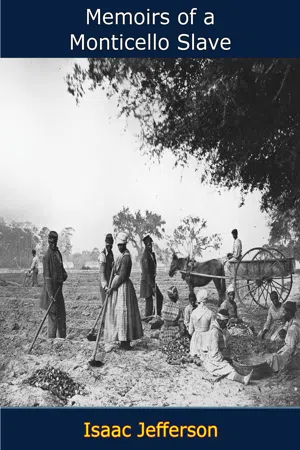
eBook - ePub
Memoirs of a Monticello Slave
As Dictated to Charles Campbell in the 1840's by Isaac, One of Thomas Jefferson's Slaves
- 56 pages
- English
- ePUB (mobile friendly)
- Available on iOS & Android
eBook - ePub
Memoirs of a Monticello Slave
As Dictated to Charles Campbell in the 1840's by Isaac, One of Thomas Jefferson's Slaves
About this book
Information
Subtopic
American Civil War HistoryIndex
HistoryCHAPTER 1
Isaac Jefferson was born at Monticello: his mother was named Usler (Ursula{3}) but nicknamed Queen, because her husband was named George & commonly called King George. She was pastry-cook & washerwoman: Stayed in the laundry. Isaac toated wood for her: made fire & so on. Mrs. Jefferson would come out there with a cookery book in her hand & read out of it to Isaac’s mother how to make cakes tarts & so on.
Mrs. Jefferson was named Patsy Wayles{4}., but when Mr. Jefferson married her she was the widow Skelton, widow of Batter (Bathurst) Skelton. Isaac was one year’s child with Patsy Jefferson: she was suckled part of the time by Isaac’s mother. Patsy married Thomas Mann Randolph{5}. Mr. Jefferson bought Isaac’s mother from Col. Wm Fleming of Goochland. Isaac remembers John Nelson an Englishman at work at Monticello: he was an inside worker, a finisher. The blacksmith was Billy Ore; (Orr?) the carriage-maker Davy Watson: he worked also for Col. Carter of Blenheim, eight miles from Monticello. Monticello-house was pulled down in part & built up again some six or seven times. One time it was struck by lightning. It had a Franklin rod at one eend. Old master used to say, “If it had’nt been for that Franklin the whole house would have gone.” They was forty years at work upon that house before Mr. Jefferson stopped building.
CHAPTER 2
Mr. Jefferson came down to Williamsburg in a phaeton made by Davy Watson. Billy Ore did the iron-work.{6} That phaeton was sent to London & the springs &c was gilded. This was when Mr. Jefferson was in Paris. Isaac remembers coming down to Williamsburg in a wagon at the time Mr. Jefferson was Governor. He came down in the phaeton: his family with him in a coach & four. Bob Hemings drove the phaeton: Jim Hemings was a body-servant: Martin Hemings—the butler. These three were brothers: Mary Hemings & Sally, their Sisters. Jim & Bob bright mulattoes, Martin, darker. Jim & Martin rode on horseback. Bob went afterwards to live with old Dr. Strauss in Richmond & unfortunately had his hand shot off with a blunderbuss. Mary Hemings rode in the wagon. Sally Hemings’ mother Betty was a bright mulatto woman & Sally mighty near white: She was the youngest child. Folks said that these Hemings’es was old Mr. Wayles’ children. Sally was very handsome: long straight hair down her back. She was about eleven years old when Mr. Jefferson took her to France to wait on Miss Polly. She & Sally went out to France a year after Mr. Jefferson went. Patsy went with him at first, but she carried no maid with her. Harriet one of Sally’s daughters was very handsome. Sally had a son named Madison, who learned to be a great fiddler. He has been in Petersburg twice: was here when the balloon went up—the balloon that Beverly sent off.
Mr. Jefferson drove faster in the phaeton than the wagon. When the wagon reached Williamsburg Mr. Jefferson was living in the College (of Wm & Mary) Isaac & the rest of the servants stayed in the Assembly-house—a long wooden building. Lord Botetourt’s picture (statue) was there. The Assembly-house had a gallery on top running round to the College. There was a well there then: none there now. Some white people was living in one eend of the house: a man named Douglas was there: they called him Parson Douglas.{7} Mr. Jefferson’s room in the College was down stairs. A tailor named Giovanni an Italian lived there too: made clothes for Mr. Jefferson & his servants. Mrs. Jefferson was there with Patsy & Polly (Maria). Mrs. Jefferson was small: She drawed from old Madam Byrd{8} several hundred people & then married a rich man. (Bathurst Skelton). Old master had twelve quarters seated with black people: but mighty few come by him: he want rich himself—only his larnin. Patsy Jefferson was tall like her father; Polly low like her mother & longways the handsomest: pretty lady jist like her mother: pity she died—poor thing! She married John W Eppes—a handsome man, but had a hare-lip.
Jupiter & John drove Mr. Jeffersons coach & four: one of em rode postilion: they rode postilion in them days. Travelling in the phaeton Mr. Jefferson used oftentimes to take the reins himself & drive. Whenever he wanted to travel fast he’d drive: would drive powerful hard himself. Jupiter & John wore caps & gilded bands. The names of the horses was Senegore, Gustavus, Otter, Remus, Romulus & Caractacus Mr. Jefferson’s riding-horse.
CHAPTER 3
After one year the Government was moved from Williamsburg to Richmond. Mr. Jefferson moved there with his servants, among em Isaac. It was cold weather when they moved up. Mr. Jefferson lived in a wooden house near where the Palace (Governor’s house) stands now. Richmond was a small place then: not more than two brick houses in the town: all wooden houses what there was. At that time from where the Powhatan house now stands clear down to the Old Market was pretty much in pines. It was a wooden house shedded round like a barn on the hill, where the Assembly-men used to meet, near where the Capitol stands now. Old Mr. Wiley had a saddler-shop in the same house. Isaac knew Billy Wiley mighty well—a saddler by trade: he was doorkeeper at the Assembly. His wife was a baker & baked bread & ginger-cakes. Isaac would go into the bake-oven & make fire for: she had a great big bake oven. Isaac used to go way into the oven; when he came out Billy Wiley would chuck wood in. She sometimes gave Isaac a loaf of bread or a cake. One time she went ...
Table of contents
- Title page
- TABLE OF CONTENTS
- INTRODUCTION
- NOTE ON THE TRANSCRIPTION
- CHAPTER 1
- CHAPTER 2
- CHAPTER 3
- CHAPTER 4
- CHAPTER 5
- CHAPTER 6
- CHAPTER 7
- CHAPTER 8
- CHAPTER 9
- CHAPTER 10
- CHAPTER 11
- CHAPTER 12
- CHAPTER 13
- CHAPTER 14
- CHAPTER 15
- CHAPTER 16
- CHAPTER 17
- CHAPTER 18
- CHAPTER 19
- CHAPTER 20
- BIBLIOGRAPHICAL NOTE
- REQUEST FROM THE PUBLISHER
Trusted by 375,005 students
Access to over 1.5 million titles for a fair monthly price.
Study more efficiently using our study tools.
Frequently asked questions
Yes, you can cancel anytime from the Subscription tab in your account settings on the Perlego website. Your subscription will stay active until the end of your current billing period. Learn how to cancel your subscription
No, books cannot be downloaded as external files, such as PDFs, for use outside of Perlego. However, you can download books within the Perlego app for offline reading on mobile or tablet. Learn how to download books offline
Perlego offers two plans: Essential and Complete
- Essential is ideal for learners and professionals who enjoy exploring a wide range of subjects. Access the Essential Library with 800,000+ trusted titles and best-sellers across business, personal growth, and the humanities. Includes unlimited reading time and Standard Read Aloud voice.
- Complete: Perfect for advanced learners and researchers needing full, unrestricted access. Unlock 1.5M+ books across hundreds of subjects, including academic and specialized titles. The Complete Plan also includes advanced features like Premium Read Aloud and Research Assistant.
We are an online textbook subscription service, where you can get access to an entire online library for less than the price of a single book per month. With over 1.5 million books across 990+ topics, we’ve got you covered! Learn about our mission
Look out for the read-aloud symbol on your next book to see if you can listen to it. The read-aloud tool reads text aloud for you, highlighting the text as it is being read. You can pause it, speed it up and slow it down. Learn more about Read Aloud
Yes! You can use the Perlego app on both iOS and Android devices to read anytime, anywhere — even offline. Perfect for commutes or when you’re on the go.
Please note we cannot support devices running on iOS 13 and Android 7 or earlier. Learn more about using the app
Please note we cannot support devices running on iOS 13 and Android 7 or earlier. Learn more about using the app
Yes, you can access Memoirs of a Monticello Slave by Isaac Jefferson in PDF and/or ePUB format, as well as other popular books in History & American Civil War History. We have over 1.5 million books available in our catalogue for you to explore.