Includes Civil War Map and Illustrations Pack – 224 battle plans, campaign maps and detailed analyses of actions spanning the entire period of hostilities.
"This is one of the finest accounts of a campaign penned by a Federal soldier. . . . A stellar work of Civil War history—a classic.—The Civil War in Books. Joshua Lawrence Chamberlain was a Maine college professor who entered the Union Army in 1862. He fought with the Twentieth Maine at Antietam, Fredericksburg, Chancellorsville, Gettysburg, Spotsylvania, and Cold Harbor and was awarded the Congressional Medal of Honor for his role at Little Round Top. In the campaigns described here, Chamberlain commanded a brigade in the Fifth Corps in the Army of the Potomac during the final days of the war. His eyewitness account takes us past Lee's surrender to show the beginnings of Reconstruction." - Print ed.
Chamberlain had a most successful military career capped by being chosen to command the Union troops who were present when the Army of Northern Virginia lay down their arms. His account of the final Virginia campaign is superb. He was as great a writer as he was a fighter. - Albert Castel, Civil War Times Illustrated.
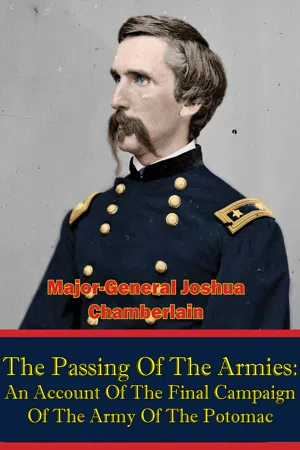
eBook - ePub
The Passing Of The Armies: An Account Of The Final Campaign Of The Army Of The Potomac,
Based Upon Personal Reminiscences Of The Fifth Army Corps [Illustrated Edition]
- 510 pages
- English
- ePUB (mobile friendly)
- Available on iOS & Android
eBook - ePub
The Passing Of The Armies: An Account Of The Final Campaign Of The Army Of The Potomac,
Based Upon Personal Reminiscences Of The Fifth Army Corps [Illustrated Edition]
About this book
Information
Subtopic
19th Century HistoryIndex
HistoryChapter 1: The Situation.
It was a dreamy camp along the lines investing Petersburg in the winter following the “all-summer” campaign of 1864,—that never-to-be-forgotten, most dismal of years. Although shadowed at the very beginning by melancholy tokens of futile endeavor and grievous losses,—consolidations of commands which obliterated the place and name of proud and beloved corps and divisions, flags made sacred by heroic service and sacrifice of noble manhood now folded away with tender reverence, or perhaps by special favor permitted to be borne beside those of new assignments, bearing the commanding presence of great memories, pledge and talisman of unswerving loyalty, though striking sorrow to every heart that knew their history,—yet this seemed not to make for weakness but rather for settled strength. We started out full of faith and hope under the new dispensation, resolved at all events to be worthy of our past and place.
Now all was over. The summer had passed, and the harvest was but of death. New and closer consolidations, more dreary obliterations, brought the survivors nearer together.
For this dismal year had witnessed that ever repeated, prolific miracle,—the invisible, ethereal soul of man resisting and overcoming the material forces of nature; scorning the inductions of logic, reason, and experience, persisting in its purpose and identity; this elusive apparition between two worlds unknown, deemed by some to be but the chance product of intersecting vortices of atoms and denied to be even a force, yet outfacing the solid facts of matter and time, defying disaster and dissolution, and, by a most real metempsychosis, transmitting its imperishable purpose to other hearts with the cumulative courage of immortal energies.
Give but the regard of a glance to the baldest outline of what was offered and suffered, given and taken, lost and held, in that year of tragedy. That long-drawn, tête baissee (bull-headed), zig-zag race from the Rapidan to the Appomattox; that desperate, inch-worm advance along a front of fire, with writhing recoil at every touch; that reiterated dissolving view of death and resurrection: the Wilderness, Spottsylvania, the North Anna, Cold Harbor, Petersburg; unspoken, unspeakable history. Call back that roseate May morning, all the springs of life a thrill, that youthful army pressing the bridges of the Rapidan, flower of Northern homes, thousands upon thousands; tested in valor, disciplined by experience, hearts swelling with manly courage, confident trust, and supreme devotion,—to be plunged straightway into hell-like horrors; the murderous maze where desperate instinct replaced impossible tactics; men mowing each other down almost at hand-reach, invisible each to each till the flaming muzzles cut lurid windows through the matted brush and bramble walls, and underneath the darkened woods low-lying cannon and bursting shells set the earth itself on fire, and wrapped in winding sheets of flame unnumbered, thick-strewn bodies of dead and dying, never to be found or known on earth again.
Then the rushing, forced flank-movements, known and overmatched by the ever alert enemy; followed by reckless front attacks, where highest valor was deepest loss; buffetings on bloody angles; butcherings in slaughter pens,—all the way down to the fateful Chickahominy once more — a campaign under fire for twenty-seven days and nights together; morning reports at last not called for, and when we asked explanation our superiors answered,—confidentially, lest it seem disloyal: “Because the country would not stand it, if they knew.”
What wonder that men who have passed through such things together,—no matter on which side arrayed,—should be wrought upon by that strange power of a common suffering which so divinely passes into the power of a common love.
A similar fate befell the new hope kindled by Grant’s sudden change to a new base of operations,—a movement bold if not hazardous, being practically a change of front under fire for the whole army on a grand scale. Skillfully withdrawing from the enemy’s front by secret orders and forced marches, swiftly crossing the James River on transports and pontoons, hurrying forward to strike a surprise on weakly-defended Petersburg, and thus cut Lee’s main communications and turn his entire position-seemed good generalship. But the bold plan and generous following stultified by confusion of understandings and supine delays of subordinates, brought all to nought once more with terrible recoil and reckoning. Then the long slow fever of profitless minor action and wasteful inaction, with the strange anomaly of a mutual siege; crouching in trenches, skulking under bombproofs and covered ways, lining parapets where to show a head was to lure a bullet, picketing a crowded hostile front where the only tenure of life was the tacit understanding of a common humanity, perpetual harassing by spasmodic raid or futile dash, slow creepings flankward yet never nearer the main objective;—such was the wearisome, wearing experience, month after month, the new year bringing no sign nor hope that anything better could be done on that line than had been so dearly and vainly tried before.
The resultant mood of such a front was not relieved by what reached us from the rear. The long-suffering, and helpless grief of homes; the sore-tried faith and patience of the whole North almost faltering; recruiting disenchanted, supplemented by enormous bounties and finally by draft and conscription; newspapers jeering at the impotence of the army; self-seeking politicians at the Capitol plotting against the President; hosts of spoilsmen at all points seizing advantage of the country’s distress, enriching themselves out of the generous, hard-earned offerings to meet her needs and repair her losses; cabal and favoritism in places of power, perpetrating a thousand injustices upon officers and soldiers in the field;—through all this, seen and known and felt, from first to last, these men of the Army of the Potomac,—godlike, if something short of sainthood,—this army, on which the heaviest brunt had fallen and was to fall, held up its heart where it could not hold up its head; with loyalty unswerving, obedience unquestioning, courage that asks not cheer, and devotion out-vying all that life holds dearest or death most terrible.
This army-but what army? Is this identity a thing of substance, or spirit, or of name only? Is this the army which bright as its colors thronged the bridges of the Rapidan on that May morning less than a year before, and vanished into the murk of the Wilderness? Or is it scarcely the half of them; stern-faced by realities, saddened and perchance also strengthened by visions of the lost, the places of these filled by fresh youth’s vicarious offering, united as one by the comradeship of arms and strong with the contagion of soul?
But perhaps this vein of emotion is tiresome. Let us seek relief in figures,—which some people regard as the only reliable facts.
The number of men of all arms present for duty equipped in the Army of the Potomac at the opening of Grant’s campaign, as shown by the consolidated morning reports of May 4, 1864, was 97,162. In the Annual Report of Secretary Stanton, November 22, 1865, this total is stated as 120,384. He evidently takes the number as borne upon the rolls in his office, which by no means always agrees with the field lists of those present for duty equipped, the absent on leave or detail, or otherwise, being usually at a high percentage of the total. The careful compilation of Adjutant-General Drum made from official field returns at this time gives the number present for duty equipped at 97,273-in remarkable agreement with the figures taken in the field.{1} The number of men available for battle in the Fifth Corps at the start was 25,695. The character of the fighting in this campaign may be shown, however dimly, by citing here the report of our Corps field hospital for one day only, that of the engagement at Laurel Hill, May 8, 1864: “Admitted to hospital, 3001; of whom 106 were from other corps; 27 Confederates; 107 sick. Sent to the rear, 2388; fell into the hands of the enemy, 391; died in hospital, 121; left 206, of whom 126 were able to walk in the morning.”
Or take the totals treated in the field hospital alone for the first nine days of the campaign. Number admitted, 5257; sent to the rear, 4190; died in hospital, 179; fell into hands of the enemy, 787. Adding to this the number killed outright, not less than 1200, and the “missing,” a list we do not like to analyze, not less than 1555, makes a total loss in the Corps of more than 7000 men. And the casualties of the six weeks from the Rapidan to the James bring the total to 16,245. This is 3398 more than half the present for duty at the start.
The records of the Medical Inspector of the Fifth Corps show the number admitted to the field hospitals alone from May 5th to June 19th to have been II, 105 of the Corps, besides many from other corps and not a few Confederates. Reckoning the killed outright as 2200, and the missing as 4000,—which is quite within the fact, makes a total of casualties for this period 17,305.
Taking another source of information, we find in the Adjutant-General’s Report of losses in the Corps as given in the official returns of regiments for the same period, the killed as 1670; the wounded 10,150; the missing, 4416,—a total of 16,235. Taking the additional wounded given in the field hospital records, 955,—who would not appear on the regimental morning reports,—we reach the total of 17,190. The difference in these figures is remarkably slight considering that they come from sources so distinct.
And the restless, fruitless fighting before Petersburg during the remainder of that year brought the total loss in the Corps up to 18,000,—this being almost a thousand more than two thirds of the bright faces that crossed the Rapidan in the starlight of that May morning, now gone down to earth, or beneath it,—and yet no end!
Colonel W. H. Powell in his History of the Fifth Corps, published since the above was written, gives this total loss as 17,861. It does not appear whether he takes into account the losses of the Corps in the assault of June 18th on the salient covering the Norfolk Railroad and the Jerusalem Plank Road. Owing to the casualties among commanders, the action of that day has never been adequately reported. Colonel Powell had no data on which to base a just account of the overture of Forts Sedgwick and Mahone,—surnamed by the performers Fort Hell and Fort Damnation.
Glance now at the record of the whole army. Those treated in the field hospitals up to the end of October were officially reported as numbering 57,498, and to the end of December, 68,840.{2} Some of these, no doubt were cases of sickness, a no less real casualty; but taking the ratio of one fifth the wounded as indicating the number of the killed outright, we reach a total of 59,000 men killed and wounded in this campaign up to October 31, 1864. This is to take no account of the “missing,” —a list governed by no law of ratios, but determined by the peculiar circumstances of each battle; always a list sad to contemplate, made up by no means of skulkers and deserters, but mostly of those who had been placed by the incompetence of commanders or thrown by the vicissitudes of battle into positions where they were helpless, and fell into the hands of the enemy as prisoners, or some too brave spirits that had cut their way through the enemy’s lines, or others still who had been left wounded and had crawled away to die. But adding here to the 59,000 killed and wounded given above the 6000 more lost in the various operations around Petersburg up to March 28, 1865, and counting the missing at the moderate number of 10,000 for this period, we have the aggregate of 75,000 men cut down in the Army of the Potomac to mark the character of the service and the cost of the campaign thus far.
If any minds demanding exactitude are troubled at the slight discrepancies in these reports, they may find relief in a passage in the Report of Surgeon Dalton, Chief Medical Officer of Field Hospitals for this campaign. He says of his experience with the treatment of disabled men in the field:
It is impossible to convey an accurate idea of the number of sick and wounded who have received attention in this hospital,—that following the army. Hundreds passed through under circumstances which rendered it impossible to register their names or even accurately estimate their numbers. So unremitting were the calls for professional duty during the first fortnight that it was impossible to prepare morning reports, and it was not until the 10th of May that even a numerical report was attempted. From that date the daily reports show that from the 16th of May to the 31st of October, 1864, there have been received into this hospital and treated for at least forty-eight hours, 68,540 sick and wounded officers and men.{3}
I have often thought it would be profitable reading for some if a competent observer would recount the scenes at the rear of a fighting army removing from the field after a great battle. A glimpse of this was given at Fredericksburg in ‘62.
But to throw light on our present topic by one more comparison, let us turn to the records of the Confederates for this campaign. According to the careful investigations of General Humphreys, the number of effective men in Lee’s army, including cavalry, at the opening of Grant’s campaign, was not less than 62,000; and at the opening of the spring campaign of ‘65, not less than 57,000. The accuracy of this is undoubted.
The striking fact is thus established that we had more men killed and wounded in the first six months of Grant’s campaign, than Lee had at any one period of it in his whole army. The hammering business had been hard on the hammer.
If these conclusions seem to rest too much on estimates (although in every case inductions from unquestioned fact), let me offer the solid testimony of General Grant in his official report of November 1, 1864. He gives the casualties in the Army of the Potomac from May 5th to October 30th as: killed 10,572; wounded, 53,975; missing, 23,858;—an aggregate of 88,405, a result far more striking than those adduced, and more than confirming the statement of our losses as by far exceeding the whole number of men in Lee’s army at any time in this last campaign.{4}
I offer no apology for this long survey of figures. There is abundant reason for it for the sake of fact, as well as occasion in existing sentiment. Among other interesting reflections, these facts and figures afford useful suggestions to those easily persuaded persons of the South or elsewhere, who please themselves with asserting that our Western armies “did all the fighting.” Lorgnettes will get out of order-especially to the cross-eyed.
The aspect in which the men of our army have been presented has been mainly that of their elementary manhood, the antique virtues that made up valor: courage, fortitude, self-command. It is not possible to separate these from other personal activities of perhaps higher range than the physical; because, in truth, these enter largely into the exercise and administration of manhood. It seems now to be an accepted maxim of war that the “moral” forces-meaning by that term what we call the spiritual, pertaining specially to the mind or soul-far outweigh the material. Few would now claim that “victory is always with the heaviest battalions.” All great contests are inspired by sentiments, such as justice, pity, faith, loyalty, love, or perhaps some stirring ideal of the rightful and possible good. Even the commoner instincts partake of this nature: self-respect, sanctity of the person, duty and affection towards others, obedience to law, the impulse to the redress of injury, vengeance for outrage. Something of this entered into our motive at first. But deeper tests brought deeper thought. In the strange succession of reverses greater reaches were disclosed; sentiments took on their highest sanction. Our place in human brotherhood, our responsibility not only in duty for Country, but as part in its very being, came impressively into view. Our volunteer soldiers felt that they were part of the very people whose honor and life they were to maintain; they recognized that they were entitled to participate so far as they were able, in the thought and conscience and will of that supreme “people” whose agents and instruments they were in the field of arms.
This recognition was emphasized by the fact that the men in the field were authorized to vote in the general election of President of the United States, and so to participate directly in the administration of the government and the determination of public policy. The result of this vote showed how much stronger was their allegiance to principle than even their attachment to McClellan, whose personal popularity in the army was something marvelous. The men voted overwhelmingly for Lincoln. They were unwilling that their long fight should be set down as a failure, even though thus far it seemed so. The fact that this war was in its reach of meaning and consequent effect so much more than what are commonly called “civil wars,” —this being a war to test and finally determine the character of the interior constitution and real organic life of this great people,—brought into the field an amount of thoughtfulness and moral reflection not usual in armies. The Roman army could make emperors of generals, but thoughtful minds and generous hearts were wanting to save Rome from the on-coming, invisible doom.
But volunteers like ours were held by a consciousness not only rooted in instinctive love and habitual reverence but also involving spiritual and moral considerations of the highest order. The motive under which they first sprung to the front was an impulse of sentiment,—the honor of the old flag and love of Country. All that the former stood for, and all that the latter held undetermined, they did not stop to question. They would settle the fact that they had a country and then consider the reasons and rights of it. There was, indeed, an instinctive apprehension of what was involved in this; but only slowly as the struggle thickened, and they found their antagonists claiming to rest their cause on principles similar to their own, they were led to think more deeply, to analyze their concrete ideals, to question, to debate, to test loyalty by thoughts of right and reason. We had opportunity to observe the relative merits of Regulars and Volunteers. Two rather divergent opinions had been common as to the professional soldiers of the rank and file. One was that they were of inferior grade as men; the other that they were vastly superior as soldiers to any volunteers. It must be allowed that the trained soldier has the merit of habitual submission to discipline, obedience to orders, a certain professional pride, and at least a temporary loyalty to the cause in which he is engaged. The superior efficiency of the regular over the volunteer is generally asserted. But this is founded more on conditions than on character. It derives its acceptance from the fact that volunteers are called out in an exigency, and take the field in haste, without experience or preparation, or even knowledge of the conditions pertaining to the art of war. They answer some call of the heart, or constraining moral obligation. But these volunteers may in due time become skilled in all these re...
Table of contents
- Title page
- TABLE OF CONTENTS
- Biographical Note.
- Introductory.
- PORTRAITS AND MAPS
- Chapter 1: The Situation.
- Chapter 2: The Overture.
- Chapter 3: The White Oak Road.
- Chapter 4: Five Forks.
- Chapter 5: The Week Of Flying Fights.
- Chapter 6: Appomattox.
- Chapter 7: The Return Of The Army.
- Chapter 8: The Encampment.
- Chapter 9: The Last Review.
- Chapter 10: Sherman’s Army.
- Chapter 11: The Disbandment.
- Military order of the Loyal Legion of the United States: headquarters Commandery of the State of Maine.
Trusted by 375,005 students
Access to over 1.5 million titles for a fair monthly price.
Study more efficiently using our study tools.
Frequently asked questions
Yes, you can cancel anytime from the Subscription tab in your account settings on the Perlego website. Your subscription will stay active until the end of your current billing period. Learn how to cancel your subscription
No, books cannot be downloaded as external files, such as PDFs, for use outside of Perlego. However, you can download books within the Perlego app for offline reading on mobile or tablet. Learn how to download books offline
Perlego offers two plans: Essential and Complete
- Essential is ideal for learners and professionals who enjoy exploring a wide range of subjects. Access the Essential Library with 800,000+ trusted titles and best-sellers across business, personal growth, and the humanities. Includes unlimited reading time and Standard Read Aloud voice.
- Complete: Perfect for advanced learners and researchers needing full, unrestricted access. Unlock 1.5M+ books across hundreds of subjects, including academic and specialized titles. The Complete Plan also includes advanced features like Premium Read Aloud and Research Assistant.
We are an online textbook subscription service, where you can get access to an entire online library for less than the price of a single book per month. With over 1.5 million books across 990+ topics, we’ve got you covered! Learn about our mission
Look out for the read-aloud symbol on your next book to see if you can listen to it. The read-aloud tool reads text aloud for you, highlighting the text as it is being read. You can pause it, speed it up and slow it down. Learn more about Read Aloud
Yes! You can use the Perlego app on both iOS and Android devices to read anytime, anywhere — even offline. Perfect for commutes or when you’re on the go.
Please note we cannot support devices running on iOS 13 and Android 7 or earlier. Learn more about using the app
Please note we cannot support devices running on iOS 13 and Android 7 or earlier. Learn more about using the app
Yes, you can access The Passing Of The Armies: An Account Of The Final Campaign Of The Army Of The Potomac, by Major-General Joshua L. Chamberlain in PDF and/or ePUB format, as well as other popular books in History & 19th Century History. We have over 1.5 million books available in our catalogue for you to explore.