- 192 pages
- English
- ePUB (mobile friendly)
- Available on iOS & Android
eBook - ePub
About this book
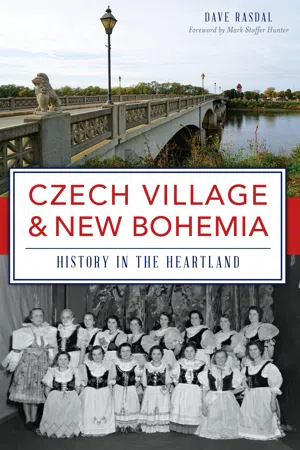
Beginning in the 1870s, thousands of Bohemians flocked to Cedar Rapids in search of a better life. Czech immigrants courageously overcame the difficult conditions of the local packinghouse and the challenge of creating a new home. They maintained a strong cultural identity with Czech music, literature and an undying dedication to family. In the wake of a devastating flood in 2008, the people of Czech Village and New Bohemia re-imagined traditional principles to forge a remarkable resurgence toward a promising future. Author Dave Rasdal travels from the Charles Bridge to the Bridge of Lions in a celebration of Czech heritage and history in Cedar Rapids.
Information
Subtopic
North American HistoryIndex
History1
INTO THE 1870S
IMMIGRATION AND THE AMERICAN DREAM
In 1870, just twenty-four years after Iowa became a state, its fledgling government spent $30,000 to convince restless Europeans that “the Beautiful Land” between two rivers could make their dreams come true. The 106-page brochure published in a multitude of languages, however, said nothing about the arduous journey required to reach what today has been dubbed “the Heartland” of America.
Frank Peremsky, who came to Cedar Rapids in 1856 by himself before his twentieth birthday, would have told of an ocean voyage long and lonely.
Thomas Korab, seven when his family dragged him across the continent in 1854, told tales of hunting wild rabbits for food and leading ox-driven carts through dangerous rivers and streams.
And Frank Svec, a twenty-something-year-old veteran of war in Bohemia when he arrived in the mid-1860s with his bride, Rose Kventensky Svec, and their two very young sons, Frank Jr. and Joseph, undoubtedly learned that cutting down trees to fuel steam-driven locomotives was as difficult as working the metal mines in his homeland.
For early Bohemian immigrants to Cedar Rapids and the surrounding area, life wasn’t a leisurely and wealthy fantasy. But it held promise.
In 1846, when Iowa became the nation’s twenty-ninth state, it had few roads and fewer bridges. The first pioneers of 1837 followed rivers and streams, if they didn’t actually float handmade rafts on the waters, to their new homes. Those who came later, like Korab and his family, crossed flowing rivers at their own peril, for often, if someone built a rudimentary bridge, high water soon washed it away. Often these pioneers waited days for a river level to subside so they could ford it. A short journey today required an eternity then.
“The trip took twelve weeks,” recalled Thomas Korab who published a diary in 1925 about his family’s immigration from Moravia to farmland southeast of Cedar Rapids.
It was a stormy voyage and it made an impression, not only on me, but upon my parents.
When we finally arrived in New York my father saluted the boat in tribute to it for bringing us safely here. We arrived at the Lorences, who lived in Racine, Wisconsin…in November, 1854. They were harvesting corn. We could go no further because it was too late in the year. We lived in a log cabin; three families lived there. My father cut wood in the forest.
As soon as spring arrived, my uncle came, by foot, to act as our guide from Wisconsin to Iowa. We bought a wagon and oxen and departed. The trip took two weeks. With us, in two other wagons, also came the Dostals and Lorences. It was the latter part of April, there was no grass, roads were bad, and it was very frosty. While the others went on, I was sent to one farm to buy something to eat and I got a loaf of bread fresh from the oven…My uncle had a gun and whenever he saw a rabbit, he shot it. After a while, we finally came to the Lorences and Zvaceks, east of Ely.
Thus, Thomas Korab’s family became early Bohemian settlers south of Cedar Rapids, where he would marry, have two children and farm eighty acres. On their journey across the Mississippi River they didn’t even find a bridge—the first one at Dubuque was constructed in 1868.
BRIDGES AND CULVERTS
Today, Iowa has more bridges and culverts per square mile than any state in the nation. The reason is twofold. First, the Mississippi and Missouri Rivers that form the state’s east and west boundaries are fed by hundreds of tributaries. And second, because Iowa’s topography is basically flat, surveyors platted the 310- by 200-mile state with a grid system of mostly straight roads every mile, east–west and north–south. Where road met water, in went a culvert or up went a bridge so that, in most cases, traveling from Point A to Point B was a straight line.
For immigrants from Bohemia, a bridge was the least of their worries. In March 1848, revolutionary action against the Habsburg Austrian Empire, of which Bohemia belonged, once again resulted in fighting on the home soil. A long history of wars and revolutions prompted many natives—who correctly predicted future fighting and bloodshed—to leave their homeland in search of peace and tranquility, land ownership and equality, opportunity and prosperity.
One man, Joseph Sosel, was packed into a wooden barrel in 1848 and smuggled out of Austria because the government had put a price on his revolutionary-minded head. A scholarly attorney, Sosel had unsuccessfully led Bohemian students in an uprising for political rights and more freedom. As the first Czech attorney to settle in the United States, according to multiple sources, Sosel eventually came to Cedar Rapids by way of Wisconsin as did so many Czech immigrants in the 1850s. They often rode in stagecoaches that followed the Military Road, a furrow dug into the wild prairie in 1839 that turned into a muddy mess every spring. Enhanced by a few bridges in the 1840s, this crooked trail meandered from Dubuque to Iowa City, the territorial capital and soon-to-be seat of state government, from 1840 to 1857. By the 1850s, the swiftest stages could complete the seventy-five-mile route in three days.
When Bohemians arrived in Iowa’s wide-open territory, they came upon white settlements freshly founded by the adventurous, the industrious and, sometimes, the dishonest. One of the latter, it seems, was Osgood Shepherd, who, in 1838, became Cedar Rapids’ first permanent settler of European descent. By one account, he jumped William Stone’s claim and commandeered Stone’s log cabin on the east bank of the Cedar River in what today is the heart of the city—First Street and First Avenue Southeast.
Shepherd, described in the 1878 history of Linn County as “a large man, shrewd and cunning, and of more than average intelligence,” opened his home as a tavern. With red hair, a rugged constitution and eyes “piercing as that of a snake,” he reportedly surrounded himself with outlaws. The story has long been told of Shepherd’s penchant for stealing horses and hiding them among thickets of trees on an island in the Cedar River, an island that decades later would, ironically, become home to the city’s government as well as the courts of Linn County and its jail.
By 1850, the population of Cedar Rapids had yet to reach four hundred. Most of the early inhabitants, originally from Great Britain, Norway, Sweden, Germany and France, had trekked west from the likes of Ohio, Indiana and Illinois or had sailed up the Mississippi River from New Orleans. Some were genuinely happy with what they found in Iowa while others simply gave up the strenuous search for nirvana when they found the new wide-open prairies satisfactory.
GOLD RUSH INFLUENCE
Cedar Rapids experienced a nice growth spurt when the westward movement gained momentum after James W. Marshall struck gold in 1848 at Sutter’s Mill in California. Since news traveled slowly in those days, it wasn’t until 1849 that Bohemians learned of the fortunes in California. Combined with the spoils of war and poor economic times, this prompted twenty-five thousand adventurous Bohemians to leave behind what little they had, including family members, in search of roads paved with gold.
Of course, by the time new European immigrants reached American shores, thousands of gold diggers on the continent had picked the mines nearly clean. While an estimated 300,000 fortune seekers reached their destination in the years to follow, thousands more realized that the weeks-long journey over huge mountains and across hundreds of unbridged waterways wouldn’t be worth the effort. These people, too, abandoned their golden fantasies to follow more realistic avenues toward success.
By 1856, the population of Cedar Rapids had quadrupled to 1,600, of which 400 were Bohemians. Most of these immigrants arrived in southern Linn County and northern Johnson County as they veered off the Military Road. Soon, some of them began the short migration to Cedar Rapids, where they settled along the east side of the Cedar River, downstream several blocks from the site of Osgood Shepherd’s log house. Shepherd, it seems, moved to Wisconsin in 1841 and was killed there in a railroad accident. But it was this year, 1856, that Cedar Rapids revised its seven-year-old charter and officially became a city in many historians’ eyes. And it was here, along today’s Seventh Avenue, that the first bridge in Cedar Rapids to cross the Cedar River was constructed in 1857.
Prior to 1857, travelers and merchants who wished to cross the river did so in the winter when it was frozen, waited for the river level to subside in the spring and the fall or took a ferry, explained Luther A. Brewer and Barthinius L. Wick in their 1911 book History of Linn County Iowa: From Its Earliest Settlement to the Present Time. They explained that use of the river had been popular since 1839, when keel boats plied their trade, and that it reached a new level when the first steamboat, The Maid of Iowa, brought a few settlers to Cedar Rapids in June 1846. Steamboats in a variety of shapes and sizes, including The Uncle Tobey with a two-hundred-ton cargo in 1853, traveled the Cedar River through the 1850s.

An artist’s copy of an 1859 map of Cedar Rapids shows the street names originally given when the city was platted. At right, Crocker Street on the east side of the river would become Fourteenth Avenue Southeast in the New Bohemia district. It was later connected by a bridge over the Cedar River to May Street (today’s Sixteenth Avenue Southwest) that runs through the “Rural Square” that would become part of Czech Village. Courtesy of the Cedar Rapids Gazette.
David W. King, one of the area’s most industrious entrepreneurs and founder of a village named Kingston on the west bank of the Cedar River across from Cedar Rapids, operated the semblance of a toll bridge. He charged customers to cross the river along his trail “when the boulder in the river near the Watrous mill was visible.” In 1848, King secured official rights to operate a ferry for the next ten years with the “exclusive privilege for the space of one mile on either side.”
As King prospered, city leaders began talk in 1853 of erecting a bridge that would be free for everyone. While early efforts at bridging the river may have been noble, Mother Nature had other ideas.
First, in the winter of 1856–57, three prominent Cedar Rapids businessmen received state legislative approval to form a bridge building board, raised $20,000 and completed the bridge at Seventh Avenue. That spring, however, they watched it wash away in a flood. The real tragedy was the death of two sisters with the surname of Black who were carried away with the bridge.
Second, a floating bridge completed in the fall of 1857 across the Cedar River at First Avenue fell victim to a rapidly flowing ice gorge the following spring.
For a while, the chore of crossing the river reverted back to the ferry man, until the winter of 1859–60, when a group of businessmen whose last names soon became synonymous with success in Cedar Rapids—among them Greene, Earle, Steadman, Higley and Daniels—erected a toll bridge. Tolls ranged from a quarter for a wagon pulled by a double team of horses to a nickel per head for driven cattle and a penny for each pedestrian.
In the meantime, “Little Bohemia” grew downriver, and Czech attorney Joseph Sosel became a neighborhood leader. He arrived in 1858 with Jacob Polak, who settled about ten miles southeast of Cedar Rapids. Since Sosel could speak English, he became a trusted adviser to the Bohemian immigrants for business and legal dealings with Cedar Rapids residents of other nationalities. It was also said that while Sosel remained true to his homeland, he insisted that his countrymen observe the laws and customs of their new country.
PRAISE FOR BOHEMIANS
“These people have always made good citizens,” wrote Brewer and Wick in their 1911 history when they called Bohemians the most important foreign element in Linn County.
They possess the desirable faculty of adapting themselves readily to new environments. Without destroying their own vigorous vitality, they grasp quickly the best there is in our thought and mode of life. They have borne nobly their share of the burdens incident to the establishment of new centers of civilization and of progress. They have acted their part in our civic life. They have adapted themselves to and have adopted our institutions. They have helped and are helping to make the county and the city centers of growth and prosperity.
One man, Anton Sulek, summed up Bohemian sentiments to a “T” when, in Hoosier Grove in Johnson County near the Linn County border on an elevated spot, he christened his land “Hradek”—“Little Castle.”
Whether these early immigrants settled in the country or in the city, one of the first tasks was to build their own “dream castles.” Early houses were generally built out of logs with an ample supply of lumber, although an occasional sod home appeared on the prairie. While roofs might be thatched, they were usually made of four-foot-long wooden shingles held in place by logs laid on top of them. Since furniture was scarce at first, immigrants often hewed their own. Beds were bundles of straw piled on the floor with a featherbed, often transported from the old country in a large chest, lovingly spread out on top.
In this manner, “Little Bohemia” grew slowly at the southeast edge of Cedar Rapids into the 1860s and through the end of the American Civil War. Even though the Homestead Act of 1862 enabled immigrants, as long as they had never “borne arms against the U.S. Government,” to homestead 160 acres for $1.25 per acre, much of the land in and around Cedar Rapids had been claimed. As a result, Bohemian immigrants bought farmland for $4.00 or $5.00 per acre and often in smaller 100-acre or 80-acre tracts that were still twice as large as any land they’d owned in the old country. The cost of property in town, as it is today, was more expensive, although it could be acquired by trading an old horse or other goods, including an occasional rifle and ammunition, for it.
While the outbreak of the American Civil War in 1861 no doubt had some Bohemians thinking they’d mistakenly made a long journey from one battleground to another (no battles were fought on Iowa soil), many of them were ready, willing and able to fight. No fewer than seventeen Bohemians from Cedar Rapids enlisted in the Union army—among them, Frank Renchin, the first to sign up despite living in Iowa only seven years.
“The United States had their quota of Bohemian patriots and it is to their credit that they did not shirk their duty, in fact, though many were not even citizens at the time of the Civil War, they performed their duty just as if America had been the land of their birth,” wrote Sarka B. Hrbkova in “Bohemians Have Done Much for Cedar Rapids,” published in the Cedar Rapids Republican Semi-Centennial Magazine June 10, 1906 edition.
Other enlistees included men with solid Czech surnames that resonate in the community today: J.F. Bednar, Joseph Wendel, Joseph Podhajsky, John Maly, Joseph Zahradnik, Wesley Horak, Frank Dolezal and Frank Peremsky.
Yes, Frank Peremsky, who immigrated to Cedar Rapids in 1856, married in 1861 and enlisted in the Sixth Iowa Cavalry of the Union army in September 1862. Born in Bohemia in January 1837, he was featured in the 1906 stories by Hrbkova as he approached his seventieth birthday. He came from Massachusetts through Wisconsin after learning “there were two or three Bohemian families in a village in Iowa in a vicinity in which the Indians were not so fierce as elsewhere.”
So of course, the Sixth Iowa Cavalry was assigned to the western states to fight against Indians who were trying to take advantage of the United States being at war with itself. Though Peremsky returned with more proficient use of the English language, he would also carry for the rest of his life “an injured limb in which he received a wound in 1864 and which has disabled him at times, for active or heavy work.”
The only Civil War casualty among the Bohemians was Frank Woitishek, who died of disease on July 18, 1863, in Vicksburg, Mississippi, fully two weeks after the Confederate forces surrendered to General Ulysses S. Grant in that bloody battle. His manner of death was not unusual—an estimated two of every three war deaths were due to disease.
War’s end was about the time Frank and Rose Svec arrived in Iowa with their two sons. They would have three more children: John, Mary and Stephen. By the time their granddaughter Marie Melvina Svec (John’s daughter) compiled the family history in 1984, they, with more than four hundred descendants through se...
Table of contents
- Front Cover
- Half Title
- Title Page
- Copyright
- Dedication
- Contents
- Foreword
- Acknowledgements
- Introduction
- 1. Into the 1870s: Immigration and the American Dream
- 2. 2008: The Great Flood
- 3. The Early 1900s: The Next Generations
- 4. 1918: The Great War—“Free at Last”
- 5. 1930s: The Great Depression
- 6. 1939: World War II
- 7. 1960s: The Mall, Another Flood and Other Things
- 8. 1980s: The Packinghouse Packs It In
- 9. 1995: The Three Presidents
- 10. 2000: Old Becomes New
- 11. Today: Resurgence
- Appendix: Eat Like a Czech
- Bibliography
- About the Author
Trusted by 375,005 students
Access to over 1.5 million titles for a fair monthly price.
Study more efficiently using our study tools.
Frequently asked questions
Yes, you can cancel anytime from the Subscription tab in your account settings on the Perlego website. Your subscription will stay active until the end of your current billing period. Learn how to cancel your subscription
No, books cannot be downloaded as external files, such as PDFs, for use outside of Perlego. However, you can download books within the Perlego app for offline reading on mobile or tablet. Learn how to download books offline
Perlego offers two plans: Essential and Complete
- Essential is ideal for learners and professionals who enjoy exploring a wide range of subjects. Access the Essential Library with 800,000+ trusted titles and best-sellers across business, personal growth, and the humanities. Includes unlimited reading time and Standard Read Aloud voice.
- Complete: Perfect for advanced learners and researchers needing full, unrestricted access. Unlock 1.5M+ books across hundreds of subjects, including academic and specialized titles. The Complete Plan also includes advanced features like Premium Read Aloud and Research Assistant.
We are an online textbook subscription service, where you can get access to an entire online library for less than the price of a single book per month. With over 1.5 million books across 990+ topics, we’ve got you covered! Learn about our mission
Look out for the read-aloud symbol on your next book to see if you can listen to it. The read-aloud tool reads text aloud for you, highlighting the text as it is being read. You can pause it, speed it up and slow it down. Learn more about Read Aloud
Yes! You can use the Perlego app on both iOS and Android devices to read anytime, anywhere — even offline. Perfect for commutes or when you’re on the go.
Please note we cannot support devices running on iOS 13 and Android 7 or earlier. Learn more about using the app
Please note we cannot support devices running on iOS 13 and Android 7 or earlier. Learn more about using the app
Yes, you can access Czech Village & New Bohemia by Dave Rasdal in PDF and/or ePUB format, as well as other popular books in History & North American History. We have over 1.5 million books available in our catalogue for you to explore.