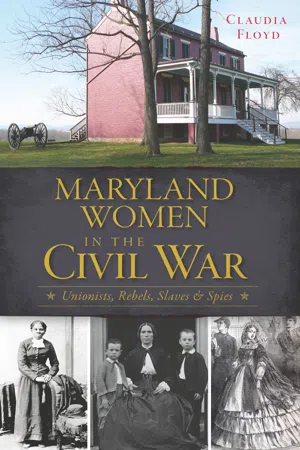
On July 9, 1864, young Mamie Tyler crouched in a cellar as Union sharpshooters above traded volleys with Confederate forces. After six excruciating hours, she emerged to nurse the wounded from the Battle of Monocacy. This was life in a border state and the terrifying reality for the women of Maryland. Western Maryland experienced some of the worst carnage of the war, and women turned their homes into hospitals for the wounded of Antietam, South Mountain and Gettysburg. In Baltimore, secessionists such as Hetty Carry fled arrest by Union troops. The Eastern Shore's Anna Ella Carroll plotted military strategy for the Union, and Harriet Tubman led hundreds of slaves to freedom on the Underground Railroad. Author Claudia Floyd draws on letters and memoirs to chronicle their stories and present a fascinating and nuanced portrait of Maryland women in the Civil War.
- 144 pages
- English
- ePUB (mobile friendly)
- Available on iOS & Android
eBook - ePub
About this book
Information
Topic
HistoireChapter 1
Geography and Destiny
Our town and surrounding neighborhood resemble a vast military camp. Soldiers are seen in every street and guards on almost every corner.7
—Hagerstown newspaper, June 19, 1861
Maryland is often called “America in miniature,” not only because its culture mingles elements of both North and South but also because of its diverse geographical features. Although it is one of the smaller states (forty-second in size), it encompasses land extending from the Atlantic coastal plain through the Piedmont and the Appalachian ridges and valleys all the way to the Appalachian Plateau. Maryland’s topography ranges from shoreline marshes at sea level on the Eastern Shore to the heights of the Eastern Continental Divide in Garrett County. The state is a central component of the watershed of the Chesapeake Bay, the nation’s largest and most economically vital estuary. Maryland’s tidal rivers etch pathways into the land on both sides of the bay, facilitating naval access, while its rugged mountains represent some impediment to travel and the transportation of goods.
Maryland’s geography played a crucial part in determining its status when the Civil War began in 1861. Because the Old Line State circled the District of Columbia on three sides, its control was imperative for the Union’s ongoing effort to protect its capital from a Confederate attack. Baltimore, the largest city south of the Mason-Dixon line at that time, was a hub for the B&O Railroad, a port for international trade and an urban center with industries, major shipbuilding facilities and commerce. Maryland’s locale and its geographic features played a significant role in the internal debate over secession in the first few months of 1861. Many of the state’s key political figures, including Governor Thomas Hicks and Congressman John Pendleton Kennedy, argued convincingly that, “the state had no defensible northern frontier. Confederate Maryland would be the first region to be swept by recurrent war and would lie on a boundary as unfriendly to slavery as Canada’s.”8 The state’s vulnerability, resources and strategic importance, operating in conjunction with the existence of a large, organized and active secessionist minority in its midst, led Union authorities to consider it an essential prize for them to capture early in the Civil War. Major General Benjamin Butler, keenly aware of this fact, seized Annapolis in April 1861, and Federal troops then embarked on a successful takeover of Baltimore and other parts of Maryland. This Union occupation, coupled with the state’s border location, heavily impacted the lives and influenced the wartime actions of its women and their families.

1864 Johnson map of Maryland and D.C. Geographicus, PD-US.
Baltimore’s strategic significance from a military standpoint was apparent to anyone with a basic knowledge of geography. Major General Lew Wallace, when he was designated by Lincoln in 1864 to be commander of the Middle Department, paid fifteen cents for his Rand McNally map in order to confirm that his primary mission was protector of the city because “Baltimore was the front gate to Washington.” As he noted:
Nothing could be plainer, it seemed to me, than that with Baltimore in the hands of the enemy there was an end to communication with Washington by land; whether from the north or west; because Baltimore was the meeting place of the great railways…without which the situation demanding haste, not a barrel of flour, not a company of infantry, not a gun could be rushed to the capital.9
At the time Wallace formulated his theory, he did not realize that it would soon be tested by yet another enemy invasion of the state.
During the course of the Civil War, all or part of the Union Army of the Potomac and the Confederate Army of Northern Virginia used the thin strip of Maryland land between Virginia and Pennsylvania as a thoroughfare for their troops. “Through this corridor passed approximately three-quarters of a million Union and Confederate soldiers.”10 Military personnel in three major campaigns—Antietam (fall of 1862), Gettysburg (summer of 1863) and the Maryland–D.C. raid of Jubal Early (summer of 1864)—crossed the Potomac River and trespassed through towns, farms and villages in the Maryland countryside, disrupting and transforming the lives of civilians. As the war progressed, there was a marked broadening of objectives, targets, geographical scope and technological means—all creating the first of America’s total wars, where the lines between the battlefield and the home front were increasingly blurred. Marylanders found Union gunboats patrolling the bay and their tidal rivers, soldiers bivouacked in their backyards and the thunder of batteries from South Mountain and as far away as Manassas permeating into their homes.
Those civilians living on or near the Potomac River were well aware of their heightened vulnerability to disruption due to war-related activities. The experiences of Martha Elizabeth Harris early in the war illustrated this point. She resided on a farm in southern Maryland’s Leonardtown, where her family grew tobacco and raised turkeys and chickens for market. Her husband, Benjamin G. Harris, was elected to the U.S. House of Representatives (1863–67) and had the distinction of being censured for treasonous statements and later sentenced by military tribunal to three years in prison for violating the Fifty-sixth Article of War (harboring rebel soldiers). Despite the relative isolation of Leonardtown, Harris family members had a front-row seat to a great deal of activity during the war due to their proximity to that thin geographical membrane that separated Union-occupied Maryland from the South. Just weeks after the war began, Martha complained that the blockade was affecting their ability to travel and to receive information and provisions.11 When she tried to get to Baltimore in July 1861, she was unable to do so because the Union had commandeered all the boats. She and her husband were challenging the authorities by providing refuge to some traveling Confederate activists, despite the frequent arrests in their community. She noted, “We have a lady with us now who was fired at on her way across the Potomac from Virginia, the boat seized, and she herself subjected to the most humiliating search.”12 Those who sought a safe haven in her home had to contend with the presence of Union troops in their area, a situation that lasted until June 1862. When the soldiers left, she witnessed crossings of the river nearly every night, bringing refugees and news of Southern victories or defeats to her family and to neighbors, who previously had been virtually cut off from war information due to their location and mail censorship.

Detail of a Finley map showing the corridor of war in central and Appalachian Maryland. Geographicus, PD-US.

Potomac River crossing at Williamsport. Harper’s Weekly.
Families living farther west than Harris also contended with the disruptions and disturbances resulting from their proximity to the Potomac River. Anna Howell Kennedy Findlay, a Hagerstown resident whose mother worked with the Sanitary Commission to aid Union soldiers, expressed disgust at the Confederate guerrilla forces that crossed the river to sabotage the C&O Canal and the B&O Railroad and to wreak havoc on their lives by pillaging food and supplies. She testified to frequent skirmishes in the streets in 1864 and on “some days changed rulers three or four times, according to the strength of the squads of cavalry.”13 The city of Cumberland, located on the south branch of the Potomac, was particularly susceptible to a guerrilla raid such as that conducted by McNeill’s Rangers in the middle of the night early in 1865. While residents slept peacefully in their beds amid a strong Union presence of a reported 8,000 infantry, 2 batteries of artillery and 150 cavalry, the Confederates coerced the countersign out of a picket, went into town, kidnapped two generals and stole their horses before making their way back into Virginia. According to a participant, Basil William Spalding, General Lee called it the most daring raid of the war.14
But the impact of such raids was minor compared to the three major military invasions that brought the catastrophic dimensions of war home to so many Marylanders residing in the southern, central and western parts of the state. During the Antietam campaign of September 1862, Marylanders living between Hagerstown and Frederick witnessed some of the most horrifying features of the war. Catherine Susannah Thomas Markell, a Frederick resident whose husband was a dry goods proprietor, initially enjoyed socializing with the upper echelon of the Army of Northern Virginia in their first invasion of Maryland. On September 8, 1862, she served dinner for Brigadier General William Barksdale and staff and tea for Major General Lafayette McLaws. In the following days, she visited Generals Robert E. Lee, Thomas “Stonewall”Jackson and James Longstreet and got to host the popular favorite Brigadier General James Ewell Brown (J.E.B.) Stuart as he sang songs, gave her a plume from his hat and signed her autograph album. But the Federals arrived soon after and brought the reality of warfare with them. Artillery fire from cannons east of Patrick Street killed several people and took out a chunk of her front railing. She and her family fled to the cellar, where they encountered a concealed old Confederate soldier seeking shelter from the bombardment.15 When Union general George McClellan’s forces took possession of the town, they raised the stars and stripes. Ann Schaeffer, a staunch Federal supporter, could not suppress her relief: “Good lord! Could I believe the sight that dear flag would ever affect me thus! Unconsciously I screamed, shouted, jumped for joy.”16 When McClellan himself arrived, she saw people scurrying down the street to clasp his hand, obstructing his passage in their enthusiasm for the turnover in occupiers.17

The Pry family house served as General McClellan’s headquarters and hospital at the Battle of Antietam. Author’s collection.
In nearby Funkstown, unionist Angela Kirkham Davis’s life was turned upside down by the arrival of the rebel forces. While her neighbors had previously treated her (a transplanted Yankee from New York) with nothing but kindness, some emboldened Confederate sympathizers now threatened to burn her family’s general store and run them out of town.18 Her husband fled to Pennsylvania, fearing that he would be arrested, while rebel soldiers raided their store. She provided them with water, although some of the men demanded that she drink it first to assure them that it was not poisoned. When Longstreet and his men set up camp in town, she bemoaned her isolation and was unable to eat or sleep. “You have no idea what a terrible feeling this is,” she wrote. “It seemed as if there were a dark, thick, high impenetrable wall between us and the rest of mankind. A great deal worse than the Chinese wall.”19

Angela Kirkham Davis’s house was used as a Civil War hospital. Author’s collection.
Davis must have heard the horrendous sounds of war nearby from the initial fighting on South Mountain that resulted in numerous casualties when Union forces sought to penetrate the formidable barrier and reach the heart of Lee’s army. Among the wounded at Crompton’s Gap on September 14 was Sergeant George B. Bernard, a Confederate who was captured, paroled and then released along with some of his comrades. At that juncture, two daughters of Mr. James Giddings, a staunch Southern supporter, provided them with an escort on horseback as Bernard and his friends were taken by wagon to Giddings’s home in Frederick County for recovery and rehabilitation. The scrawny, starving men could not believe their good fortune as they were served their first full meals in quite a while. As the sergeant explained, “A servant came with an inquiry whether I would have more. I wanted more—much more. I felt ashamed of myself for eating so much and declined.”20 While those like Bernard, who had fallen at South Mountain, were receiving medical treatment or burial, Marylanders who waited anxiously for word of further military action found the suspense soon over.
Confederate forces that had been dispersed to Harper’s Ferry and a number of towns in Washington County eventually found their way “into the Neck, where the Potomac bends to the east below Sharpsburg. Here was destined to be the great contest of the rebellion.”21 In this location, Confederate lieutenant Henry Kyd Douglas, an aide to General Stonewall Jackson, encountered a friend of his, Savilla Miller, on the porch of her father’s house in Sharpsburg in the midst of what would become the single bloodiest day in the Civil War. “At that time the firing was very heavy, and ever and anon a shell would explode over the town or in the streets, breaking windows, knocking down chimneys, perforating houses and roofs.” He asked Savilla to seek shelter, but she said that she would remain as long as the Confederate army was between her and the enemy. (Although she did go inside for part of the day, she was at her post when the fighting ended.) Douglas later called Savilla Miller “the only person who in the battle of Sharpsburg was never driven back a foot.”22 His own estate of Ferry Hill on the Maryland side of the Potomac was severely damaged in the battle, with his father, mother and sister virtual prisoners inside their home.23 Nearby, some terrified residents had fled to the caves in the limestone cliffs that towered over the river and provided some protection from the bombardment of artillery fire.
A Hagerstown newspaper, Herald of Freedom and Light, called Washington County “one vast hospital” in the aftermath of the slaughter: “From Hagerstown to the southern limits of the county wounded and dying soldiers are to be found in every neighborhood and in nearly every house. Houses and barns are filled with them and nearly the whole population is ministering to their wants.” In the same issue of that publication, a journalist noted that many of the rebel dead remained unburied for days after the battle ended and that “the stench for miles around was almost intolerable.”24 The termination of the battle left a huge responsibility and burden for the local population. The Middletown Valley Register observed that nearly e...
Table of contents
- Front Cover
- Half Title
- Title Page
- Copyright
- Contents
- Acknowledgements
- Introduction
- 1. Geography and Destiny
- 2. Free, Slave and In-Between
- 3. The Despot’s Heel: The Union Occupation
- 4. Women’s Political Participation
- 5. The She Rebels: Maryland’s Confederate Women
- 6. Three Shades of Red, White and Blue: Maryland’s Unionist Women
- 7. The Aftermath
- Notes
- Bibliography
- About the Author
Trusted by 375,005 students
Access to over 1.5 million titles for a fair monthly price.
Study more efficiently using our study tools.
Frequently asked questions
Yes, you can cancel anytime from the Subscription tab in your account settings on the Perlego website. Your subscription will stay active until the end of your current billing period. Learn how to cancel your subscription
No, books cannot be downloaded as external files, such as PDFs, for use outside of Perlego. However, you can download books within the Perlego app for offline reading on mobile or tablet. Learn how to download books offline
Perlego offers two plans: Essential and Complete
- Essential is ideal for learners and professionals who enjoy exploring a wide range of subjects. Access the Essential Library with 800,000+ trusted titles and best-sellers across business, personal growth, and the humanities. Includes unlimited reading time and Standard Read Aloud voice.
- Complete: Perfect for advanced learners and researchers needing full, unrestricted access. Unlock 1.5M+ books across hundreds of subjects, including academic and specialized titles. The Complete Plan also includes advanced features like Premium Read Aloud and Research Assistant.
We are an online textbook subscription service, where you can get access to an entire online library for less than the price of a single book per month. With over 1.5 million books across 990+ topics, we’ve got you covered! Learn about our mission
Look out for the read-aloud symbol on your next book to see if you can listen to it. The read-aloud tool reads text aloud for you, highlighting the text as it is being read. You can pause it, speed it up and slow it down. Learn more about Read Aloud
Yes! You can use the Perlego app on both iOS and Android devices to read anytime, anywhere — even offline. Perfect for commutes or when you’re on the go.
Please note we cannot support devices running on iOS 13 and Android 7 or earlier. Learn more about using the app
Please note we cannot support devices running on iOS 13 and Android 7 or earlier. Learn more about using the app
Yes, you can access Maryland Women in the Civil War by Claudia Floyd in PDF and/or ePUB format, as well as other popular books in Histoire & Histoire de la guerre de Sécession. We have over 1.5 million books available in our catalogue for you to explore.