Includes 6 detailed plans and maps
Sudan was afire with flame and revolt in 1883 as the Islamic revolution headed by the self-proclaimed Mahdi gained followers and captured districts. The British government not wanting to be involved in the costly suppression of the rebellion ordered Egypt to abandon its administration of the Sudan in December 1883. The British government asked General Gordon, former Governor-General of Sudan, to go to Khartoum and aid in the evacuation of Egyptian soldiers, civilian employees and their families. Britain withdrew its troops from the Sudan until Khartoum was the last outpost remaining under British control.
Gordon differed with the British government's decision to abandon the Sudan. He thought that the Islamic revolt had to be crushed for fear that it might eventually overwhelm Egypt. He based this on the Mahdi's claim of dominion over all Islamic lands. Defying orders from the British government to withdraw, General Gordon, leading a garrison of 6,000 men, began the defence of Khartoum. On March 18, 1884, the Mahdist army laid siege to the city. The rebels stopped river traffic and cut the telegraph line to Cairo. Khartoum was cut off from resupply, which led to food shortages, but could still communicate with the outside world by using messengers. Under pressure from the public, in August 1884, the British government decided to reverse its policy and send a relief force to Khartoum. So the scene was set for the story of the epic, brave, but ultimately futile attempt to relieve Khartoum here related by the War Correspondent Alexander Macdonald who accompanied the British column.
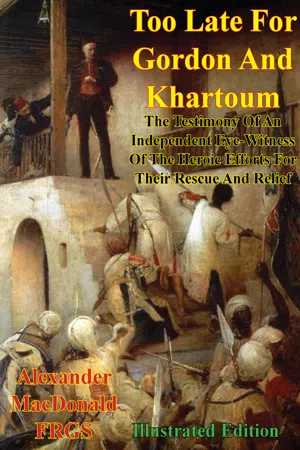
eBook - ePub
Too Late For Gordon And Khartoum;
The Testimony Of An Independent Eye-Witness Of The Heroic Efforts For Their Rescue And Relief [Illustrated Edition]
- 292 pages
- English
- ePUB (mobile friendly)
- Available on iOS & Android
eBook - ePub
Too Late For Gordon And Khartoum;
The Testimony Of An Independent Eye-Witness Of The Heroic Efforts For Their Rescue And Relief [Illustrated Edition]
About this book
Trusted by 375,005 students
Access to over 1.5 million titles for a fair monthly price.
Study more efficiently using our study tools.
Information
Subtopic
British HistoryIndex
HistoryTOO LATE FOR GORDON AND KHARTOUM.
CHAPTER I.
INTRODUCTORY.
EARLY in October 1832 disquieting rumours began to circulate in Cairo relative to the state of affairs in the Egyptian provinces in the Soudan. The false prophet, of whose appearance there we had already heard, had, it was said, made great progress since our communications with that region had been interrupted by the rebellion of Arabi, and having gathered round him a number of Arab tribes, he had raised the standard of revolt against the Khedive.
This startling news naturally toned down our elation over the decisive results of Tel-el-Kebir, and made it very probable that more battles would have to be fought before the work we had undertaken for Egypt could be accomplished. A greater than Arabi in many respects had arisen to trouble us in a region whose geographical position made it more difficult to reach than bad been the scene of our recent successful military operations. It was also apprehended that after capturing Khartoum he might advance down the Nile and draw after him the whole Mussulman population. And there were good reasons for this apprehension, for subsequent to Arabi’s overthrow the masses in Egypt proper were quite open to the seductive influences of a successful native leader, especially if he came clothed with the prestige of the predicted prophet, who when he appeared would revive Islamism and extend it over the whole world.
At first it was very difficult to trace these alarming reports to any trustworthy source, on account of the reticence maintained about them in official circles. They however daily gained strength, and soon their substantial correctness was admitted to the writer by Riaz Pasha, the minister for the interior. Later on it became known that Lord Granville had received a memorandum drawn up by Sir Charles Wilson respecting the Soudan, which described affairs there as being in the greatest disorder.’ It also included the following telegram from Khartoum, dated September 17: ‘Owing to telegrams sent by Arabi Pasha to the Soudan ordering people not to recognise the authority of the Khedive, revolt had broken out in the country, and the pretended Mahdi had gained more adherents. ... The Governor of the Soudan asks for 10,000 Remington rifles to be sent in order to arm a force under Said Pasha to crush the Mahdi....The Mahdi is now two hours from Kordofan (Obeid), and has a large force.’. . .
This, Sir Charles says, must be regarded as a favourable account of the state of affairs then existing, and therefore he deemed it advisable to send two English officers to the Soudan to report on the state of the country and the steps which will be necessary to ensure its pacification. He further says that as the Mahdi can approach Egypt by routes only traversible by small bodies of troops at a time, a small disciplined force could block him easily; but he adds, ‘At present, however, if the Mahdi attempts a forward movement, there is no Egyptian force to meet him.’
At the very outset of our intervention in the affairs of Egypt we were thus confronted by difficulties of an embarrassing character. As the welfare of the whole country was now seriously endangered by the rebellion which had broken out in the Soudan, it appeared to be the duty of her Majesty’s Government to deal with it as it had dealt with that of Arabi. Unless it did, then the task of pacifying Egypt and reorganising its administration could not be so easily or so satisfactorily accomplished as had been anticipated when it was undertaken.
There seemed so little reason at Cairo at the time to doubt that her Majesty’s Government would shirk the new responsibility which had been thrust upon them, that some of my military friends there busied themselves in arranging the details of a campaign to smash the Mahdi.
Burt these were not the views entertained by the more stolid diplomatists in Downing Street with respect to the scope of British responsibility for the welfare of Egypt, for they denied all obligation to restore order in the Soudan, announcing their intention to pursue a policy of absolute non-interference in its affairs. But the Gladstone Cabinet found it impossible to maintain this position, and the disastrous results which followed their attempts to do so fully justified the warnings they had received on the subject from competent authorities in England and Egypt.
The events and circumstances which eventually compelled this active interference in the affairs of the Soudan are matters of too recent history to require any further reference to them here than may add to the interest of our narrative. It is therefore now only proposed to recall the attention of our readers to such of the incidents in that history as have a direct bearing on General Gordon’s last mission to Khartoum, and which not only necessitated the expedition undertaken for his rescue, but also seriously contributed to its failure. Our first reference is to the destruction of Hicks Pasha’s army. When the news of this disaster reached Cairo on November 24, 1883, Sir Evelyn Baring informed Lord Granville that General Stephenson and Sir Evelyn Wood with himself were of the opinion that the successes of the Mahdi were a source of danger to Egypt, which would be increased if Khartoum fell, and that it now seemed impossible to hold that town.
To this communication Lord Granville replied that her Majesty’s Government could do nothing in the matter that would throw on them any responsibility for military operations in the Soudan.
This despatch from Downing Street was crossed by another from Cairo, telling his Lordship that the Egyptian Government, finding it impossible to hold the Soudan, had decided upon withdrawing their garrisons and falling back on Egypt proper.
It is not necessary here to refer to the discussions which then ensued between Sir Evelyn Baring and Cherif Pasha, and which ended in the Egyptian Government placing itself entirely in the hands of our Government, with the suggestion that either Turkish troops should be employed to save the Eastern Soudan for Egypt, or that the whole country should be abandoned to the Sultan. We come therefore to January 9, 1884, when Sir E. Baring telegraphed to Lord Granville that all doubts about the necessity for withdrawing from Khartoum were removed by the decided opinion of Colonel Coetlogon, late Governor of Khartoum, who recommended an immediate withdrawal from that town, and asserted that if it was ordered at once it could be safely effected.
It was then proposed that Abdel-Kader, minister of war, ‘should proceed to the Soudan and superintend the withdrawal of its endangered garrisons, and Egyptian officials and their families.’ He agreed to do so on condition that the intention of abandoning the country should not be openly avowed, for in his opinion any such avowal would prevent the success of his mission. Her Majesty’s Government not acceding to this request, he declined the task, although General Gordon had already informed them that the moment it was known we had given up the game in the Soudan, everyone would go over to the Mahdi.
The name of General Gordon had, early in December 1883, been mentioned in connection with this hazardous undertaking, but Sir Evelyn Baring seems then to have assumed that he would not be acceptable to the Egyptian authorities on account of the movement in the Soudan being a religious one. If appointed to a high office there, he said it was feared the Mussulman tribes who were loyal to the Government would go over to the Mahdi. It is difficult to ascertain whether this view was that of our able representative at the time or not, for, so far as experience goes, the incompleteness of the despatches published in the Blue Books often puzzles those who devote themselves to their perusal. Still, if General Gordon had then been asked to proceed to the Soudan, he could have reached Khartoum from Palestine, through Cairo, on January I, 1884, and before the Mahdi had had time to take advantage of his defeat of Hicks’s army.
When he left London for Khartoum on January 18, 1884, the whole Press of the country, while heartily recognising his mission as a step in the right direction, expressed a unanimous opinion that the late hour at which his mission had been undertaken endangered its success. It was hardly fair, therefore, for Sir E. Baring, in view of the difficulties against which General Gordon had to contend on his arrival at Khartoum, to say that the Press had altogether over-estimated his personal influence and the prestige of his name in the Soudan. If his heroic mission was not entirely successful, it was not the man who was to blame, but this fatal delay in despatching him on it.
The instructions which General Gordon carried with him from London were to report to her Majesty’s Government on the military situation in the Soudan, and on measures for the security of the Egyptian garrisons still holding positions in that country, and for the safety of the European population in Khartoum, and further upon the best mode of evacuating the interior of the Soudan, and best securing the safety and administration by the Egyptian Government of the ports on the coast of the Red Sea.
On his arrival at Cairo the Egyptian Government gave full discretionary power to General Gordon to retain the troops then in the Soudan for such reasonable period as he might think necessary, in order that the abandonment of the country might be accomplished with the least possible risk to life and property.
Lord Granville, on recapitulating to Sir E. Baring on March 28, 1884,{1} the circumstances under which General Gordon was sent to Egypt, said that ‘her Majesty’s Government, bearing in mind the exigencies of the occasion, concurred in instructions which virtually altered General Gordon’s mission from one of advice to that of executing, or at least directing the evacuation not only of Khartoum, but of the whole of the Soudan, and were willing that General Gordon should receive the very extended powers thus conferred upon him by the Khedive, to enable him to execute his difficult task.’
We have also at the same time this admission, that in a matter involving such complexity and depending so much on local circumstances, it was to be expected that General Gordon might be obliged to modify, and alter his views on his arrival at Khartoum as to the details and even some of the material features of the course to be pursued in order to attain the main objects in view. Her Majesty’s Government have been anxious that in this respect he should have the largest discretion.’
Lord Granville, while admitting that the circumstances with which General Gordon had to deal were no doubt difficult, and might change from day to clay, thus attempts to qualify the responsibility of her Majesty’s Government towards him, by declaring that ‘it certainly was not in contemplation that the duties to be assigned to General Gordon should be of a nature which would require the despatch of a British expedition to support or extricate him.’ Nor did General Gordon himself ask for any such aid or interference on his behalf when he undertook his hazardous mission. For example, when asked by the Government for advice about the Eastern Soudan, after Baker Pasha’s defeat, he told them that they should do nothing beyond summoning the chiefs of the tribes to meet him at Khartoum, in order to arrange for the independence of the Soudan. The very day after they had (Feb. 13, 1884) received this communication from him, they gave orders for the despatch of General Graham’s first expedition to Suakim, and thus, at the very outset, not only took an important part of the Soudan question out of his hands, but seriously added to the difficulties of his mission by taking from it its pacific character.
Immediately after his arrival at Khartoum, General Gordon informed Sir E. Baring that he found two-thirds of its people terrorised over by one-third; and that, in place of supporting the terrorised majority, ‘our’ undisguised intention was to get the Egyptian employés out of the Soudan,’ and asks him ‘whether this partial evacuation of the Soudan fulfils your desires. If it does,’ he adds, ‘then you must act by Indian Moslem troops by Wady Halfa; and do so at once my sending troops there.’
Evidently reasoning from the state of feeling between the one-third terrorisers, and the two-thirds of the terrorised, and the influences from the Mahdi’s camp, he further says
You must be aware that a conspiracy up here is more to be feared than any outward revolt.’
On February 29 he sends this warning:—
‘There is not much chance of improvement, and every chance of its getting worse, for we have nothing to rely upon.’
In March several telegraphic despatches from General Gordon disclose the increasingly dangerous position he then occupied at Khartoum. The rebels, by a daring march to the Nile, had interrupted his communications with Berber, cutting off eight hundred of his troops who were stationed at Halfaya. In one of these despatches, dated March 14, he says: ‘Should we even succeed in getting the Shaggiehs from Halfaya, it will be about the utmost we can do beyond annoying the enemy by skirmishing. We can do nothing against the superiority of numbers. Happily you have three steamers at Berber to help any forward movement.’
From this it is evident that General Gordon concluded that General Graham had been sent to co-operate with him by reopening his communications with Berber. Others of these despatches show that the mutiny of his soldiers, or the treachery of their officers, might at any moment deliver him and the brave companion of his enterprise, Colonel Stewart, into the hands of their cruel enemies.
Early in April Lord Granville was informed that the number of rebels surrounding Khartoum was increasing, that all the population south of Shendy had joined the revolt, and that the population north of Shendy were ready to do likewise. He was also further informed that the rebels were in communication with the Bishareen Arabs with a view to besieging Berber itself, and that its governor, Hassan Khalifa, had asked for reinforcements. Baring tells Lord Granville that unless these reinforcements are sent to him Berber will fall into the hands of the rebels, and that this could seriously affect Gordon’s position.
In order to meet this crisis Mr. Egerton informed Lord Granville that, in the opinion of Nubar Pasha and our generals in Egypt, an Anglo-Egyptian force could be sent for the relief of the town, and that in the meanwhile its governor should be encouraged to hold out by the assurance that material British aid would, as soon as possible, be given to him. Instead, however, of acting upon this suggestion, his Lordship instructed Mr. Egerton to send messengers by Berber and Dongola, or by other routes, to General Gordon, asking him to keep her Majesty’s Government informed, to the best of his ability, as to the immediate danger to which Khartoum might be exposed, and informing him that, to be prepared for any such danger, he should advise them as to the amount and composition of the force that would be necessary, under the circumstances, to secure his removal, and as to the route by which it should approach Khartoum, and the time at which its despatch should be undertaken. He was further to be informed that it was not intended to supply him with Turkish or other forces for military expeditions, because these would be at variance with the pacific policy of his mission to the Soudan, and that if with this knowledge he continued at Khartoum the Government wished him to state to us the cause and intention with which he so continues.’
With the full facts of General Gordon’s perilous position staring them in the face, who could suppose that they would have sent such a message to him? No wonder he ridiculed it when it was received.{2} Had he not told them that he was hemmed in by determined men, and could not carry out his mission without some aid from the outside? Was it not clearly enough stated by him in some of the despatches we have quoted, that his way of escape had been closed by the relentless army of the pseudo Mahdi? There is sufficient evidence that they did so understand his position at the time this message was despatched to Gordon. Lord Granville, in a communication to Mr. Egerton on May 15, virtually admits they did understand him, for he says in that communication: ‘It is clear that General Gordon’s object in asking for these troops [Turkish] is to effect the withdrawal of the Soudan garrisons by military expeditions, and to effect the collapse of the Mahdi.’ He even admits that his military operations in the vicinity of Khartoum may be taken to be for the defence of the place.’ Why then call in question his good faith by asking from him a virtual pledge that the troops asked for by him will not be used for any other purpose save his withdrawal? Gordon seems to feel this keenly, as will be seen from an entry in his Journal.{3} Beneath this message there seems also to lurk the unworthy suspicion that because General Gordon holds ...
Table of contents
- Title page
- TABLE OF CONTENTS
- PREFACE.
- MAPS AND PLANS.
- CHAPTER I.
- CHAPTER II.
- CHAPTER III.
- CHAPTER IV.
- CHAPTER V.
- CHAPTER VI.
- CHAPTER VII.
- CHAPTER VIII.
- CHAPTER IX.
- CHAPTER X.
- CHAPTER XI.
- CHAPTER XII.
- CHAPTER XIII.
- CHAPTER XIV.
- CHAPTER XV.
- CHAPTER XVI.
- CHAPTER XVII.
- CHAPTER XVIII.
- CHAPTER XIX.
- CHAPTER XX.
- APPENDICES.
Frequently asked questions
Yes, you can cancel anytime from the Subscription tab in your account settings on the Perlego website. Your subscription will stay active until the end of your current billing period. Learn how to cancel your subscription
No, books cannot be downloaded as external files, such as PDFs, for use outside of Perlego. However, you can download books within the Perlego app for offline reading on mobile or tablet. Learn how to download books offline
Perlego offers two plans: Essential and Complete
- Essential is ideal for learners and professionals who enjoy exploring a wide range of subjects. Access the Essential Library with 800,000+ trusted titles and best-sellers across business, personal growth, and the humanities. Includes unlimited reading time and Standard Read Aloud voice.
- Complete: Perfect for advanced learners and researchers needing full, unrestricted access. Unlock 1.5M+ books across hundreds of subjects, including academic and specialized titles. The Complete Plan also includes advanced features like Premium Read Aloud and Research Assistant.
We are an online textbook subscription service, where you can get access to an entire online library for less than the price of a single book per month. With over 1.5 million books across 990+ topics, we’ve got you covered! Learn about our mission
Look out for the read-aloud symbol on your next book to see if you can listen to it. The read-aloud tool reads text aloud for you, highlighting the text as it is being read. You can pause it, speed it up and slow it down. Learn more about Read Aloud
Yes! You can use the Perlego app on both iOS and Android devices to read anytime, anywhere — even offline. Perfect for commutes or when you’re on the go.
Please note we cannot support devices running on iOS 13 and Android 7 or earlier. Learn more about using the app
Please note we cannot support devices running on iOS 13 and Android 7 or earlier. Learn more about using the app
Yes, you can access Too Late For Gordon And Khartoum; by Alexander Macdonald F.R.G.S. in PDF and/or ePUB format, as well as other popular books in History & British History. We have over 1.5 million books available in our catalogue for you to explore.