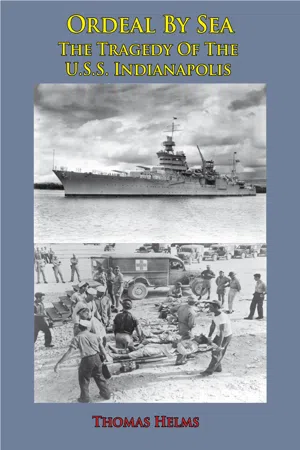
July 30, 1945: The heavy cruiser U.S.S. Indianapolis was sunk by a torpedo. 1,196 men went into the water. When rescue arrived five days later, only 317 remained. What happened during those five terrible days? Full of harrowing personal accounts from survivors, and written by a veteran who served aboard the cruiser before the attack, Ordeal by Sea chronicles the stark human drama and sensational aftermath of one of the worst disasters in naval history. The story of the doomed mission was immortalized in the film Jaws as Quint remembers the intense, brutal and awful experience of the sailors as sharks tore into the floating survivors. Thirst and hunger were also added to the sailors torments as they wondered if the would be rescued from the merciless sea, their bravery and indomitable spirit is captured in this brillitant book.
A dramatic and gripping read.
- 162 pages
- English
- ePUB (mobile friendly)
- Available on iOS & Android
eBook - ePub
Ordeal By Sea; The Tragedy Of The U.S.S. Indianapolis
About this book
Information
Subtopic
European HistoryIndex
HistoryTHREE — LAST WATCH
NIGHT or day the most important part of any ship is the navigation bridge, for here is the brain that must remain sharply alert from the moment the ship gets under way until she is once more at anchor.
The evening watch was slowly wearing on. At just about 2230 the moon officially rose, but no one aboard the Indianapolis saw it because of the thick cloud cover in the eastern sky. During that watch there were somewhere between ten and fifteen officers and enlisted men on duty. High above number two turret the bridge was far removed from the rumble and hum of engines and motors and the swish and splash of waves racing along the side of the hull. It was a quiet part of the ship, as the bridge usually is except in time of storm or battle. It was a place of charts and dials and instruments. Simple instruments like the magnetic compass, almost as old as the science of navigation itself, stood beside the more modern gyro compass. There was the radarscope with its thin finger of yellow light sweeping endlessly in a clockwise rotation feeling the surface of the sea for miles in all directions, forever searching for some solid object that would leave a pip or tiny smear of light in the wake of the moving finger. Then there was the fathometer, an instrument that constantly reminded the navigator of the depth of the water over which he was sailing. Tonight the water was deep. In fact the Indianapolis had just passed a few miles north of the Challenger Deep—the deepest spot in any ocean of the world. Seven miles of nothing but water. If Mount Everest were sheered off at sea level and dropped into Challenger Deep it would sink and still be covered by a mile of water. But as the ship continued on her westward course the ocean bottom began slowly to rise. By the middle of the midwatch the fathometer was recording fifteen hundred fathoms separating the ship's keel from the bottom—about two miles down.
There was not much to do on a night like this. The helmsman kept the ship on course. Talkers—sound power men with headphones and a microphone—were in frequent contact with the engine rooms. Radio Central, the various radar control centers and other important points about the ship.
Lieutenant Richard Banks Redmayne, the ship’s new engineering officer was on the bridge during the evening watch as supervisor of the watch under instructions. He had stood no bridge watches until the Indianapolis departed from Guam. The tall, angular twenty-six-year-old naval officer from Westwood, Massachusetts, would celebrate his twenty-seventh birthday in just ten days. He had been at sea almost constantly since he had reached voting age. He had graduated from the Massachusetts Maritime Academy in 1941 as an officer, and when war clouds began to gather over the United States he transferred to the U.S. Navy as an ensign. On another fateful Sunday, 7 December 1941, he had found himself as chief engineer on a converted four-piper, the U.S.S. Hulburt, at Pearl Harbor. There was not much for an over-aged destroyer to do while the sky was full of enemy planes except shoot back and hope for the best.
After 7 December, Redmayne moved out to other areas of the Pacific. He participated in the Aleutian Campaign before joining the Indianapolis in February 1945. He was shortly made senior assistant engineering officer and was aboard during the Iwo Jima campaign, carrier raids off Japan and the pre-invasion bombardment of Okinawa, where the Indianapolis was damaged by a kamikaze and forced to return to the States for repairs. It was when the ship reached Pearl Harbor on what was to be her final westward crossing in July that Lieutenant Redmayne had taken over the duties of Chief Engineer from Commander Glen F. DeGrave.
Lieutenant Redmayne enjoyed the evening watch. He was confident he had done a good job in bringing the Indianapolis safely and quickly to Tinian and then on to Guam and he knew that the other officers respected him for it. Tonight he had spoken briefly with Captain McVay during one of the skipper's frequent trips to the bridge before retiring to his emergency cabin shortly after eleven o’clock. The ship’s gunnery officer. Commander Stanley W. Lipski, was in charge of the bridge as supervisor of the watch, and Redmayne found this Annapolis graduate with two years duty on the Indianapolis pleasant company.
Commander Lipski was what might have been termed a sailor’s sailor. He could have easily stayed safely ashore during the war. In fact the Navy Department urgently requested that he stick glued to the chair behind a desk in the confines of Washington because he was an expert in the Russian language and had so many other qualifications that would make him valuable ashore. Stanley Lipski took a dim view of desks. He was a qualified gunnery officer and felt his talents could best be utilized on the open sea aboard a man o' war. He had put up a paper and red tape battle to abandon his desk and be voluntarily shoved up into the Forward Area.
The zero hour was rapidly approaching.
Through the wave-dashed orifice of the I-58 a squat brown man with slanting eyes was hungrily sizing up his approaching target. There was excitement aboard the submarine, and clustered about the Captain were the Kaiten pilots begging for permission to be launched against this enemy ship. These fanatical young submariners, like their air-borne brother the kamikaze pilot, had sprung into existence during the war. The Kaiten was, in effect, a midget submarine weighing about eight tons. The entire forward section was the explosive warhead of a huge torpedo with the pilot and the power plant occupying the after section. The Kaiten could travel a maximum distance of about thirty miles and had a top speed of twenty knots. Once launched from the mother sub, there was no turning back. The suicide submarine was equipped with a small periscope that allowed the pilot to keep his target in sight until the final moment when torpedo and ship exploded. Should he miss his target, the pilot was doomed anyway. But his end would not be the glorious death so appealing to the Japanese warrior. He would simply continue running until the fuel supply was exhausted, then slowly the human torpedo would sink and as it went deeper and deeper, the mounting pressure would cave in the bulkheads and the pilot would suffocate.
Even before Pearl Harbor, Commander Hashimoto had known war and death while he served on the Yangtze River in gunboats and mine sweepers. There was something about him that resisted the urge to send his countrymen on a certain suicide mission if the job could be successfully accomplished by mechanical means. He told the Kaiten pilots to stand by and instructed his torpedo officer to prepare for a run of fifteen hundred yards and to make ready to fire six torpedoes fan-wise when he gave the order.
Lieutenant Redmayne left the bridge a few minutes before midnight. Making his way down to the wardroom, he found it quiet. He looked into the pantry where the steward's mate of the watch was leaning across a table reading an out-of-date magazine. There was the smell of coffee from a pot gently fuming on a hot plate in the corner. Looking up from his magazine, the steward’s mate asked the engineering officer if there was anything he wanted. Redmayne had not had enough supper, so the on-duty steward’s mate made him a ham sandwich. Not anything to brag about—just a slice of boiled ham between two slices of bread with a little mustard on one side. While Lieutenant Redmayne was sipping his coffee, Ensign John Woolston also dropped by the wardroom pantry for a midnight repast, and the two talked briefly.
By five minutes before midnight, more than two hundred men and officers had gone off watch and an equal number had taken their places. They came and went from all parts of the ship and carried with them a wide variety of rates and ranks.
There were thirty-nine seagoing marines aboard and while they had been hard pressed to guard that mysterious box that housed the first atomic bomb from Frisco to Tinian, the pressure was off of them now, but they still had a few watches to stand.
Marine Private First Class Giles McCoy walked aft to the ship’s brig under the fantail, relieved the marine who had been on duty, and then checked on his two prisoners who were quietly serving out their time behind bars. Both were sleeping, so McCoy pulled a magazine out of his hip pocket and made himself as comfortable as he could on an empty bunk. All around him in the darkened compartment sailors were sleeping, but there was the dim glow of a battle light on the bulkhead over his head and he settled down to while away the next four hours. It was just as well that he had not selected this night to make any deep inroads into Anthony Adverse or Gone with the Wind, because he had only a precious few minutes to read.
Back behind number two stack in Sky Aft, Ensign Harlan Twible and Lieutenant (j.g.) Leland Jack Clinton began to wonder, as the midnight hour approached, why they had not been relieved. It was not anything unusual, however, even for officers. The same thing went on in every department, and gunner’s mates, chief petty officers and boot seamen had the same problem. Lieutenant Clinton told Ensign Twible to hold the fort while he went below to be sure their reliefs had been aroused. It could have been Twible who elected to go, for there was certainly no protocol connected with such a chore. But Clinton went and Twible stayed.
Gunner’s Mate First Class Johnny Fitting of the Fifth Division was relieved some fifteen minutes before the hour of midnight and hurried down to his bunk in the crew’s berthing quarters. Fitting had enlisted with his boyhood friend Joseph L. Nichols the day after the Japanese struck Pearl Harbor in 1941. Five days later they were on their way to the San Diego Naval Training Station and they would not see their home state of Idaho for nearly four years. Fitting was to be a gunner’s mate, while Nichols would stick to the deck division and earn the rate of boat swain's mate second class.
The two had been on the Indianapolis since they left boot camp in Diego. When she had returned to the States for repairs, they were both granted leave and returned to the north central village of Kooskia, Idaho, on the Clearwater River. For Nichols and Fitting it was not just an average wartime leave with plenty of fried chicken and lemon meringue pies. These two sailors were going to marry sisters. This they did and after much too limited honeymoons they hurried back to California and checked in aboard the ship that had been “home” to them from almost the beginning of World War II.
As gunner's mate first class, Johnny Fitting was earning enough pay to invest in an electric fan. There was a 110 outlet just above his bunk, and as a first-class petty officer he indulged in this modicum of comfort. Sunday night, however, he found that someone had “borrowed” the outlet adapter needed to supply the necessary current for his small fan.
“Damn it!” he fumed. “Hey, Joe, did you see who got my plug?”
But Nichols, in the bunk below his, was already asleep. Since there was no way to make the fan work. Fitting rolled up his bedding and carried it topside. Boatswain's Mate Nichols and Gunner's Mate Fitting had been at one another’s side throughout the entire war in the Pacific. Strange the workings of fate.
2400 hours. The beginning of a new day on the Navy’s big twenty-four-hour clock—30 July 1945! Coxswain Edward Keyes, as boatswain's mate of the midwatch, made a quick count. There were thirteen officers and enlisted men on the bridge.
The ship's damage control officer. Lieutenant Commander Kyle C. Moore, was supervisor of the mid-watch. He had been aboard the Indianapolis for three years and had qualified as supervisor of the watch only a year earlier. With the initials of K.C., Moore could not escape the nickname of “Casey” the moment he entered the service. The Navy has a wonderful ability for changing names. Once aboard ship, one ceases to go up and down stairs because the stairs have become ladders. No longer is there a floor beneath the feet because all level surfaces on which one walks are decks. Walls suddenly become bulkheads, dining room tables are mess tables and bathrooms become heads. Consequently, the Navy does not let a man escape a nickname if there is anything about his name or physical make-up that might possibly suggest one. Big two-hundred-and-fifty-pound men are always known as Tiny. A man who makes a practice of reading books immediately becomes known as Professor. The sailor who is overly addicted to beer while ashore on liberty just naturally acquires the handle of Suds. Of course all radiomen are generically known as Sparks, and young ensigns fresh out of Annapolis are referred to as Shavetails.
Casey Moore had no objection to his nickname. In fact, he was proud of it because he knew that men of the Navy seldom bother to give a nickname unless they liked the man in question. He loved the Navy and was glad the men and his fellow officers liked him. An ex-newspaperman and photographer from Knoxville, Tennessee, he was skilled with a camera and on many occasions Admiral Raymond A. Spruance had called on him to record permanently on celluloid scenes at Tarawa, Kwajalein, Saipan and a dozen other places where the Admiral's flagship took part in action.
The war wore on and Casey Moore rose in rank. He was forced to set aside his camera as his duties as damage control officer became more complex and time-consuming. Tonight he looked at the crew on the bridge with him. He had not drawn a bad lot. His OOD was Lieutenant John I. Orr, a competent officer with three years of sea duty behind him. Lieutenant Orr knew what war was about. Just before boarding the Indianapolis, he had been aboard the U.S.S. Cooper (DD 695) when she was torpedoed and sunk in Ormoc Bay. Orr’s junior OOD, Lieutenant (j.g.) Paul L. Candalino, and Ensign Paul T. Marple had been aboard for only a few weeks, but he did have some seasoned enlisted men on the bridge with him. There was Donald F. Mack, the bugler, Edward Keyes, boatswain's mate, and Jimmy French, quartermaster.
Moore made a quick tour of the bridge and satisfied himself that the lookouts were qualified and alert. He noted that the helmsman was keeping the ship on her true heading of 262 degrees. Orders to cease zigzagging had gone into effect during the evening watch, and now the clean clipper bow of the Indianapolis was pointed straight toward the island of Leyte in the Philippines. True, the moon would appear briefly at intervals as scudding clouds left an opening here and there, but certainly not long enough for an enemy submarine to line up her torpedo
Shortly after 2300 hours, Captain McVay had made his final tour of the bridge and was now retired in his emergency cabin on the port side of the bridge aft. Commander Johns Hopkins Janney, the ship's gunnery officer, was also asleep in a similar compartment on the opposite bridge
With qualified officers and enlisted men on the bridge there was not much to worry about. After all the war was almost over. Hitler and Mussolini had fallen flat on their ugly faces in Europe, and Tojo was the next to go. A few months earlier Japanese submarines and kamikaze planes had been a real threat to any shipping in the forward area. Now, with B-29 bombing raids on Japan occurring almost daily and naval bombardment biting into the very heart of the home islands, the bulk of the Imperial submarine Navy was ranging less far afield with each passing day.
Midnight—a moderately heaving sea and clouds covering a half moon now nearly three hours old. The Indianapolis, with her 9,950 ton displacement spread over 610 feet, sliced her way westward into what must forever be referred to as an approximate position of 134 degrees 48 minutes East and 12 degrees 2 minutes North. The exact latitude and longitude will never be known because at 0001, or just one minute after midnight, death in the form of a monstrous blast occurred near the bow on the starboard side of the ship. The Indianapolis shook and seemed to stagger under the blow. All thirteen men on the bridge suddenly found themselves on the deck. Even as they tried to regain their footing, they were knocked down again by a second explosion of the same magnitude just aft of number two turret almost directly below the navigation bridge in the vicinity of the fortieth frame of the ship. A wall of dull orange fire fringed with a seething hellish halo of inky black smoke belched up from the guts of the cruiser and with it a geyser of exploded water leaping higher than the ship itself.
In his emergency cabin behind the bridge, Captain McVay was hurled to the deck. As he struggled to a standing position, his mind was rapidly trying to put things together. He had been aboard when the Indianapolis was struck by a kamikaze plane months earlier—but this was not kamikaze area and besides, it was the middle of a dark night hundreds of miles from the nearest land. Quickly assimilating the sensations and comparing them with existing facts, he knew there were still several other very real and equally serious possibilities. The ship could have struck a pair of floating mines or a boiler, maybe two, might have exploded. After all, th...
Table of contents
- Title page
- TABLE OF CONTENTS
- DEDICATION
- FOREWORD
- Illustrations
- ONE - WAKE OF A WARSHIP
- TWO - INTO THE NIGHT
- THREE - LAST WATCH
- FOUR - “SOMEBODY HELP ME”
- FIVE - “THEY’LL FIND US TODAY”
- SIX - THE LONG WAIT IS OVER
- SEVEN - CONCLUSION
- APPENDIX
- ILLUSTRATIONS
Trusted by 375,005 students
Access to over 1.5 million titles for a fair monthly price.
Study more efficiently using our study tools.
Frequently asked questions
Yes, you can cancel anytime from the Subscription tab in your account settings on the Perlego website. Your subscription will stay active until the end of your current billing period. Learn how to cancel your subscription
No, books cannot be downloaded as external files, such as PDFs, for use outside of Perlego. However, you can download books within the Perlego app for offline reading on mobile or tablet. Learn how to download books offline
Perlego offers two plans: Essential and Complete
- Essential is ideal for learners and professionals who enjoy exploring a wide range of subjects. Access the Essential Library with 800,000+ trusted titles and best-sellers across business, personal growth, and the humanities. Includes unlimited reading time and Standard Read Aloud voice.
- Complete: Perfect for advanced learners and researchers needing full, unrestricted access. Unlock 1.5M+ books across hundreds of subjects, including academic and specialized titles. The Complete Plan also includes advanced features like Premium Read Aloud and Research Assistant.
We are an online textbook subscription service, where you can get access to an entire online library for less than the price of a single book per month. With over 1.5 million books across 990+ topics, we’ve got you covered! Learn about our mission
Look out for the read-aloud symbol on your next book to see if you can listen to it. The read-aloud tool reads text aloud for you, highlighting the text as it is being read. You can pause it, speed it up and slow it down. Learn more about Read Aloud
Yes! You can use the Perlego app on both iOS and Android devices to read anytime, anywhere — even offline. Perfect for commutes or when you’re on the go.
Please note we cannot support devices running on iOS 13 and Android 7 or earlier. Learn more about using the app
Please note we cannot support devices running on iOS 13 and Android 7 or earlier. Learn more about using the app
Yes, you can access Ordeal By Sea; The Tragedy Of The U.S.S. Indianapolis by Thomas Helm in PDF and/or ePUB format, as well as other popular books in History & European History. We have over 1.5 million books available in our catalogue for you to explore.