Includes over 200 maps, plans, diagrams and uniform prints
Lt.-Col. Theodore Ayrault Dodge was a soldier of long and bloody experience, having served with the Union Army of the Potomac during the American Civil War losing one of his legs during the battle of Gettysburg. After the end of the war he settled down in retirement to write, he produced a number of excellent works on the recently ended Civil War and his magnum opus "A History of the Art of War", tracing the advances, changes and major engagements of Western Europe. His work was split into twelve volumes, richly illustrated with cuts of uniforms, portraits and maps, each focussing on periods of history headed by the most prominent military figure; Alexander, Hannibal, Caesar, Gustavus Adolphus, Frederick the Great and finally Napoleon. Napoleon and the period which he dominated received such care and attention that Dodge wrote four excellent, authoritative and detailed volumes on him.
This second volume explores the beginning of Napoleon's ascension to the title of Emperor of the French and his defeat of all of the powers of Europe to his apogee of power in 1807. Napoleon's thunderous campaign in Italy in 1800, his lightning campaign that culminated at Austerlitz in 1805 see the Emperor in his full pomp scattering his Austrian and Russian foes. Concluding this volume are his campaigns against the Prussians and Russians in 1806 and 1807, despite defeating his enemies roundly in battle his own finely trained Grande Armée was starting to be bled to death.
A well written, expansive and excellent classic.
eBook - ePub
Napoleon: a History of the Art of War Vol. II
from the Beginning of the French Revolution to the End of the 18th Century [Ill. Edition]
- 375 pages
- English
- ePUB (mobile friendly)
- Available on iOS & Android
eBook - ePub
Napoleon: a History of the Art of War Vol. II
from the Beginning of the French Revolution to the End of the 18th Century [Ill. Edition]
About this book
Information
Subtopic
British HistoryIndex
HistoryXXXII. — A NAPOLEONIC MANOEUVRE. SEPTEMBER AND OCTOBER, 1806.
NAPOLEON had calculated right on Prussia not mobilizing in season to help at Austerlitz; but the Prussian people was much wrought up and cried for war. The French army had not been withdrawn from Germany, but remained along the upper Danube. Napoleon would have preferred peace, but the Prussian king was finally forced by the war party to give the French notice to evacuate Germany by a given day. Napoleon had concentrated two hundred thousand men in the Main country. The Prussians and Saxons had much smaller forces on the Saale. Napoleon was ready, the Prussians were not. Accepting their ultimatum as a challenge, Napoleon moved forward on the Saale, in three columns, from such a direction that his lines of retreat on the Rhine and the Danube were both kept open, while he so turned the Prussian left as to be nearer Berlin, after the battle he proposed to deliver, than they were. The beauty of this strategic manoeuvre is unsurpassed. The Prussians sadly underrated the great soldier. They had forgotten what war is. Forging ahead rapidly, Napoleon struck the divided Prussians at Jena and Auerstädt on the same day. He bad expected to fight them in one body, but while he met the smaller Prussian right at Jena, Davout encountered the larger Prussian left, which was seeking to recover its communications at Naumburg.
AFTER the Peace of Presburg was signed, the French armies did not, as had been expected, at once return homeward. Under cover of one political pretense or another, they remained in southern Germany, partly, indeed, on Austrian soil, where they were fed at the expense of other nations, and were unquestionably a continuing threat to European peace. Napoleon’s eye never left the Grand Army, nor did his interest slacken in keeping up the strength of the cadres, and in treating the several divisions as if he expected at any moment again to put them into the field. It was indeed his keenest pleasure to work towards the perfecting of his army corps. In August, 1806, the army lay mostly in Bavaria, Soult being on the Inn, Davout near Nördlingen, Bernadotte in Ansbach and Nürnberg, Ney on the Iller and upper Danube, Lefebvre on the lower Main, Augereau in Frankfort. The forces on German soil were not far short of two hundred thousand men, and they stood under supreme command of Berthier, whose headquarters was in Munich.
Austria was still in a questionable attitude: but the holding of Passau and Braunau on her frontiers kept her quiet.
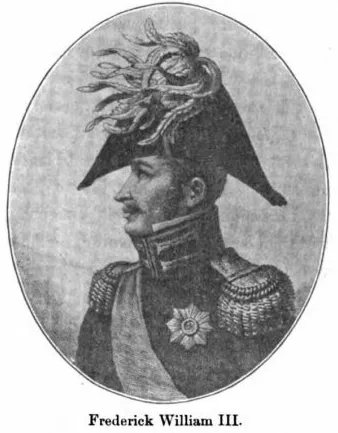
Prussia had originally been a strictly national Protestant country, with a homogeneous population. When she acquired her share of Poland, she added a questionably useful population to her stanch Brandenburgers, and ceased to be relatively as strong. It was distinctly in the line of French policy to keep on good terms with Prussia, and to this end, as a bait, Napoleon had offered her Hanover. England, on the other hand, had offered Prussia the lands southwest of Cleves, bounded by a line drawn from Antwerp to Luxemburg. Between these offers Frederick William had to choose. It was a difficult choice, for though Napoleon’s offer was decidedly better than that of England, the Prussian people did not take kindly to an alliance with Napoleon. Yet Prussia did provisionally occupy Hanover. The Confederation of the Rhine was, however, a constant menace to Prussia, as well as the seizure of Wesel, Essen and Werden, and the presence in Germany of the French armies. The feeling was further embittered by the trial and execution of Palm of Nürnberg for printing a pamphlet against Napoleon and the Grand Army.
Where the French armies were, the average citizen had to be careful of what he did. On the 5th of August, 1806, from St. Cloud, Napoleon wrote Berthier, “My Cousin, I imagine that you have had the editors of Augsburg and Nürnberg arrested. My intention is that they shall be brought before a military commission and shot within twenty-four hours. It is not an ordinary crime to spread libels in places where the French armies are, to excite the inhabitants against them. It is a crime of high treason. The sentence shall be to the effect that wherever there is an army, the duty of the chief being to watch for its security, such and such individuals, convicted of having attempted to raise the inhabitants of Swabia against the French army, are condemned to death.” This was certainly a high-handed way of looking at the matter.
Acts of this nature have helped engender the habit of laying the blame of all the Napoleonic wars at the door of the emperor. This is only in part a correct view. The wars were the natural sequence of the conditions produced by the French Revolution, the result of which he was working out, and of the corresponding jealousy of French successes and of the sudden rise of this non-divine ruler. Yet it is true that the wars were in part due to Napoleon; and though he may at this time have striven to avoid war,—while having his own way, perhaps,—it is evident that he looked on war as constantly possible for the purpose of advancing the interests of France. In his letter to Berthier from Paris, February 8, he said: You can write them (Ney, Soult and Davout) a little confidential letter to tell them that everything is not finished with the Prussians, ... that they are to hold themselves always ready, that everything should be reorganized, and that nothing should escape them.” On the 14th he wrote Berthier to order Bernadotte to occupy Ansbach in the name of the King of Bavaria, as the Prussian troops had been occupying Hanover according to the treaty; that good discipline was to be maintained there, and they were “to speak with great praise of the King of Prussia, and to pay all the compliments usual in these conditions.” ... Mortier was to be moved up to sustain Bernadotte. Davout was to go to Eichstädt and Ney to Augsburg. “Let everyone be on his guard, and remain at his post. I alone know what I am to do.” ... The King of Bavaria, said he, was not .to mix himself up in this Ansbach matter, “so as not seriously to irritate Prussia.”
On March 21 Napoleon ordered that none of the French corps should repass the Rhine; yet on March 22 a decree provided that the troops in France should be put on a peace footing. And on the 4th of April he wrote to the King of Prussia a flattering letter in which he says: “War against Prussia has never been possible by any act of mine.” Even if disingenuous, as many will assume, yet these advances distinctly made towards peace, and they were intended so to do. On August 6, 1806, Napoleon wrote to Soult: “The peace with Russia and the negotiations that I have with England make me believe that all will calm itself, and that a profound peace will succeed all these warlike movements. But I none the less have reinforced my army.” On the 17th he wrote to Berthier, “We must seriously think of the return of the Grand Army, because it seems to me that all doubts as to Germany are quieted.” On the 26th he ordered Berthier to so arrange the dispositions of troops that the French would be the least possible in contact with the Prussian territory. And Berthier was to spread abroad in every way the idea that the French troops were returning home. “You will in effect put in march a few artillery wagons, and you will give the heavy baggage a movement towards the Rhine. Give orders that nothing which is at Strasburg or Mayence shall pass the Rhine.” And on the 3d of September he again wrote him: “I was about to send you orders for the return of the army when I learned that the Emperor of Russia ,had refused to ratify the treaty. We must wait a few days to see what will happen....Meanwhile, do nothing....Send some emissaries, some Polish officers, to the Russian frontier to see what is being done.”
Again, matters shortly appeared to improve, so that, on September 4, Napoleon wrote Berthier that leave of absence might be given to several officers, and that be might take one himself. All this by no means looks as if Napoleon desired to force a conflict. It rather bears the impress of a desire for peace on what seemed to him fair conditions; but meanwhile nothing was to be relaxed which was essential to sustain French claims. No one can dispute the good policy of this line of conduct. Never ruler used peace to prepare for war more consistently than Napoleon. And now he exhibited his wonted activity.
On September 5 he wrote to Berthier: “My Cousin, send some officers of engineers to make good reconnoissances at every risk on the debouches and the roads which lead from Bamberg to Berlin. Eight days after I shall have given the order, my armies, whether that of Frankfort, or that of Passau, or that of Memmingen, are to be concentrated at Bamberg in the principality of Baireuth.... From the frontiers of Bamberg I estimate ten days’ march to Berlin. Tell me what is the nature of the country on the right and left, that of the roads and of the obstacles the enemy could present. What is the Saale River, and the Elster, at Gera? ... You will send intelligent officers to Dresden and Berlin by different routes. They are to go and ask on your part ... what signify the movements and concentrations of the Prussian troops. They are to say that you appear very disquieted at all these movements, not having received from Paris corresponding orders....They are to stop everywhere on the route to breakfast, dine, sleep. They are not to travel at night, and can thus study carefully the locality. Give me also details about the Spree. I have no need to say that the greatest prudence is necessary to gather these facts, for I have no designs on Berlin. I desire to be furnished with these details solely to be ready. I imagine that between Bamberg and Berlin there is no fortress except Magdeburg.”
Within a few days the Prussian war-cloud became dark. The Russian army was cantoned on the Niemen, of no immediate use to the Prussians, though certain to come to their assistance later; for the French and Russians were still nominally at war, and Napoleon was striving to bring about action by Turkey against Russia, to keep the latter from nearer Continental fields. The situation found Napoleon ready to act. On September 10 he wrote Berthier from Paris: “My Cousin, the movements of Prussia continue to be very extraordinary. They need to receive a lesson. I am having my horses start to-morrow, and in a few days my Guard. They leave under the pretext of the Diet of Frankfort.” And on the same day, to Caulaincourt: “Have all my field-glasses arranged. Have sixty horses start to-morrow from my stables, among them eight of those which I ride. This is to be done with all possible mystery.” It was but a short step for the emperor from peace to war.
Prussia had placed herself in grave danger by not stopping to reckon, as Napoleon always did, the thousands she could promptly raise in men, and the days’ marches they must make to be of real use on the strategic theatre. Apparently remembering only Rossbach, her leaders held the French army, and even Napoleon, at a cheap rate, and acted accordingly; while the emperor’s first step had been to send officers out to study up the proposed field of campaign with all its topographical values, and to formulate his plan. On the 9th of September he wrote Berthier: “If I made war against Prussia, my base and line of operation would be Strasburg, Mannheim, Mayence to Würzburg, where I have a strong place, so that my convoys, the fourth day of their departure from Mannheim or Mayence, would be in security at Würzburg.” He then speaks of Forchheim, between Nürnberg and Bamberg, as another convenient place. Beyond Würzburg he did not definitely choose a secondary base, but he sent out other officers to report on all such places between the Main and the Elbe as might serve on this occasion the same purpose as Augsburg and Braunau had done in 1805, in his march on Vienna.
On September 12 he wrote to the King of Prussia: “Monsieur mon Frère, I have received Your Majesty’s letter. The assurances you give me of your sentiments are so much the more agreeable in that what has taken place the last fifteen days gave me occasion to doubt them. If I were constrained to take arms to defend myself, it would be with the greatest regret that I should employ them against the troops of Your Majesty. I should consider this war as a civil war, so much are the interests of our states bound together.... I must tell Your Majesty never will war be begun by me, because if that were so I should consider myself as a criminal. It is thus I call a sovereign who makes a fancy war, not justified by the policy of his state.”
But despite this pacific assurance, which is also deemed disingenuous by many, but which is rather a distinct bid for peace, the emperor relaxed no effort. He at once began shifting the several corps into positions more available for the projected work; and on September 19 orders were sent Berthier stating that the King of Holland would be at Wesel October 2 with his army corps, that Augereau was to assemble in Frankfort, Lefebvre to advance from Schweinfurt on Königshofen, Davout, Bernadotte and Murat on Bamberg, Soult to come on to Amberg, and Ney to be at Ansbach. Berthier was to make headquarters in Würzburg, but not to let it be known that Napoleon was coming. The emperor had at first proposed to leave Soult on the Inn as a threat to Austria, but now he deemed him essential on the fighting-line.

All these marches were to be completed by October 3; meanwhile a reserve corps was being organized by Kellermann at Mainz, and the Guard was transported by post from Paris to the same city. This body, by order to Bessières,—of the 19th,—was to be composed of and a formidable body, capable of being used to marked effect on the field of battle.
2 regiments of m...
Table of contents
- Title page
- TABLE OF CONTENTS
- XXI. - THE FIRST CONSUL. 1800.
- XXII. - MARENGO. JUNE 14, 1800.
- XXIII. - MOREAU IN GERMANY. 1800.
- XXIV. - THE REVOLUTIONARY WARS END. 1801.
- XXV. - THE EMPEROR. MAY, 1804, TO SEPTEMBER, 1805.
- XXVI. - FORMATION FOR BATTLE.
- XXVII. - ULM. SEPTEMBER AND OCTOBER, 1805.
- XXVIII. - ULM TO VIENNA. OCTOBER 20 TO NOVEMBER 13, 1805.
- XXIX. - VIENNA TO BRUNN. NOVEMBER 14 TO 30, 1805.
- XXX. - AUSTERLITZ. DECEMBER 2, 1805.
- XXXI. - GAUL AND TEUTON. 1806.
- XXXII. - A NAPOLEONIC MANOEUVRE. SEPTEMBER AND OCTOBER, 1806.
- XXXIII. - JENA AND AUERSTÄDT. OCTOBER 14, 1806.
- XXXIV. - A NAPOLEONIC PURSUIT. OCTOBER, 1806.
- XXXV. - PULTUSK. NOVEMBER AND DECEMBER, 1806.
- XXXVI. - EYLAU. JANUARY TO MAY, 1807.
- XXXV. - HEILSBERG AND FRIEDLAND. MAY TO JUNE, 1807.
- REQUEST FROM THE PUBLISHER
Trusted by 375,005 students
Access to over 1.5 million titles for a fair monthly price.
Study more efficiently using our study tools.
Frequently asked questions
Yes, you can cancel anytime from the Subscription tab in your account settings on the Perlego website. Your subscription will stay active until the end of your current billing period. Learn how to cancel your subscription
No, books cannot be downloaded as external files, such as PDFs, for use outside of Perlego. However, you can download books within the Perlego app for offline reading on mobile or tablet. Learn how to download books offline
Perlego offers two plans: Essential and Complete
- Essential is ideal for learners and professionals who enjoy exploring a wide range of subjects. Access the Essential Library with 800,000+ trusted titles and best-sellers across business, personal growth, and the humanities. Includes unlimited reading time and Standard Read Aloud voice.
- Complete: Perfect for advanced learners and researchers needing full, unrestricted access. Unlock 1.5M+ books across hundreds of subjects, including academic and specialized titles. The Complete Plan also includes advanced features like Premium Read Aloud and Research Assistant.
We are an online textbook subscription service, where you can get access to an entire online library for less than the price of a single book per month. With over 1.5 million books across 990+ topics, we’ve got you covered! Learn about our mission
Look out for the read-aloud symbol on your next book to see if you can listen to it. The read-aloud tool reads text aloud for you, highlighting the text as it is being read. You can pause it, speed it up and slow it down. Learn more about Read Aloud
Yes! You can use the Perlego app on both iOS and Android devices to read anytime, anywhere — even offline. Perfect for commutes or when you’re on the go.
Please note we cannot support devices running on iOS 13 and Android 7 or earlier. Learn more about using the app
Please note we cannot support devices running on iOS 13 and Android 7 or earlier. Learn more about using the app
Yes, you can access Napoleon: a History of the Art of War Vol. II by Lt.-Col. Theodore Ayrault Dodge in PDF and/or ePUB format, as well as other popular books in History & British History. We have over 1.5 million books available in our catalogue for you to explore.