Includes The Bombing Of Japan During World War II illustrations pack with 120 maps, plans, and photos
"Masuo Kato, an American educated Japanese newspaper man, represented the Domei news agency in Washington from 1937 to 1941, was repatriated in the first exchange. and served thereafter in Domei head. quarters in Tokyo. This little book, written following Japan's surrender with the assistance of an American occupation officer, reflects the attitudes of the "Westernized" Japanese.
The author indicates his skepticism over Japan's policies of aggression, but describes his own participation in her wartime propaganda machine. One cannot fail but question the degree to which such an individual now accepts American occupation policies.
The book gives a graphic account of wartime conditions in Japan. It tells of the changes in political leadership, terminating in the maneuvering of figures around the Throne preceding unconditional surrender. Kato attributes the acceptance of defeat by the people in large measure to the Emperor's radio appeal for maintenance of order."— John Masland, Dartmouth College
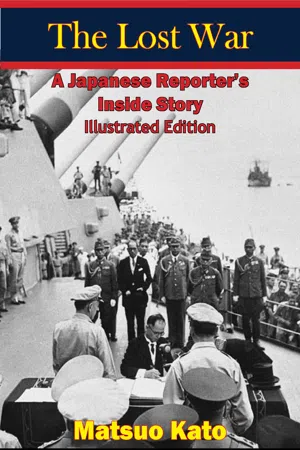
- 331 pages
- English
- ePUB (mobile friendly)
- Available on iOS & Android
eBook - ePub
About this book
Information
Subtopic
European HistoryIndex
HistoryXIII — The Last Days
In the fortnight between Japan’s surrender and the arrival of the first occupation troops, most of the Japanese people went mechanically about their daily affairs, partly because there was nothing else to do, and there were few surface manifestations of the change from war to peace. The newspapers and radio attempted to bring to the public many of the facts of their situation long suppressed by a succession of militaristic governments, and the Emperor’s appeal for maintenance of order was repeated over and over.
“The hardships and sufferings to which our nation is to be subjected hereafter,” the Emperor had said, “will be certainly great. We are keenly aware of the inmost feelings of all of you, our subjects. However, it is according to the dictate of time and fate that we have resolved to pave the way for a grand peace for all the generations to come by enduring the unendurable and suffering what is insufferable.
“Having been able to safeguard and maintain the structure of the Imperial state, we are always with you, our good and loyal subjects, relying upon your sincerity and integrity. Beware most strictly of any outbursts of emotion that may engender needless complications or any fraternal contention and strife that may create confusion, lead you astray, and cause you to lose the confidence of the world.”
The rescript was written in language that the ordinary Japanese could understand much better than that of previous rescripts—it set a precedent in that respect which is still being followed—and that fact increased the importance it had in the amazingly uneventful transition from war to surrender.
Tokyo street scenes in those two weeks reminded me more of China than of the Japan I had always known, instead of the industrious activity usually to be seen in the streets of Tokyo during the war, there were everywhere idle groups of people, huddling together in the ruins of a once great city, watching the sky and the passers-by, waiting for what might happen next. Everywhere around them reconstruction waited too, but there was no leadership that could have overcome that mass inertia; the leaders were sunk in the same kind of apathy; the very fabric of Japanese political life had dissolved overnight. Tears were soon over. There were only vacant, dull stares for many days.
If there was one emotion which pervaded the moral atmosphere of that period it was a sense of relief that the worst had now come, relief that the fighting was over and relief from the ever present fear of death from the skies. Russia’s declaration of war and the atomic bomb had proved to be the divine wind, the Kami Kaze of history, that had been counted upon to accomplish a miracle for the people of Japan. The divine wind had brought victory for the Allies, but it had released the Japanese people from a nightmare. In a way it was like a miraculous and unexpected cure after a long illness.
The newspapers attempted to furnish some sort of leadership, but the sudden change from war to peace found them as unprepared and as uncertain of the future as everyone else. In their new-found relative freedom they were like a canary that suddenly released from its cage after years of imprisonment, has forgotten how to fly and is still unable to effect the escape for which it has longed.
To Prince Higashikuni, who had been charged with the task of effecting an orderly surrender to the Allies, should go a share of the credit for the smoothness with which the occupation was effected. Although his Cabinet was short-lived, lasting only about fifty days, it was able to take the necessary measures to accomplish the surrender and permit a bloodless occ...
Table of contents
- Title page
- TABLE OF CONTENTS
- I - Empire in Ashes
- II - Failure of a Mission
- III - Why Japan Struck
- IV - Washington December 7, 1941
- V - Empire in the Building
- VI - Three Wars in One
- VII - The Leaders
- VIII - Psychological Warfare
- IX - The Sinews of War
- X - Culture in Bondage
- XI - Terror by Fire
- XII - Unconditional Surrender
- XIII - The Last Days
Trusted by 375,005 students
Access to over 1.5 million titles for a fair monthly price.
Study more efficiently using our study tools.
Frequently asked questions
Yes, you can cancel anytime from the Subscription tab in your account settings on the Perlego website. Your subscription will stay active until the end of your current billing period. Learn how to cancel your subscription
No, books cannot be downloaded as external files, such as PDFs, for use outside of Perlego. However, you can download books within the Perlego app for offline reading on mobile or tablet. Learn how to download books offline
Perlego offers two plans: Essential and Complete
- Essential is ideal for learners and professionals who enjoy exploring a wide range of subjects. Access the Essential Library with 800,000+ trusted titles and best-sellers across business, personal growth, and the humanities. Includes unlimited reading time and Standard Read Aloud voice.
- Complete: Perfect for advanced learners and researchers needing full, unrestricted access. Unlock 1.5M+ books across hundreds of subjects, including academic and specialized titles. The Complete Plan also includes advanced features like Premium Read Aloud and Research Assistant.
We are an online textbook subscription service, where you can get access to an entire online library for less than the price of a single book per month. With over 1.5 million books across 990+ topics, we’ve got you covered! Learn about our mission
Look out for the read-aloud symbol on your next book to see if you can listen to it. The read-aloud tool reads text aloud for you, highlighting the text as it is being read. You can pause it, speed it up and slow it down. Learn more about Read Aloud
Yes! You can use the Perlego app on both iOS and Android devices to read anytime, anywhere — even offline. Perfect for commutes or when you’re on the go.
Please note we cannot support devices running on iOS 13 and Android 7 or earlier. Learn more about using the app
Please note we cannot support devices running on iOS 13 and Android 7 or earlier. Learn more about using the app
Yes, you can access The Lost War: by Masuo Kato in PDF and/or ePUB format, as well as other popular books in History & European History. We have over 1.5 million books available in our catalogue for you to explore.