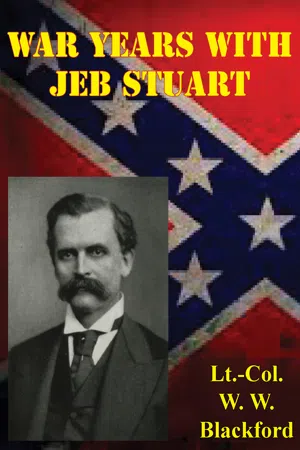
"Characterized by precision of statement and clarity of detail, W.W. Blackford's memoir of his service in the Civil War is one of the most valuable to come out of Robert E. Lee's Army of Northern Virginia. It also provides a critically important perspective on one of the best-known Confederate cavalrymen, Major General J.E.B. Stuart.
Blackford was thirty years old when the war began, and he served from June 1861, until January, 1864, as Stuart's adjutant, developing a close relationship with Lee's cavalry commander. He subsequently was a chief engineer and a member of the staff at the cavalry headquarters. Because Stuart was mortally wounded in 1864, he did not leave a personal account of his career. Blackford's memoir, therefore, is a vital supplement to Stuart's wartime correspondence and reports.
In a vivid style, Blackford describes the life among the cavalrymen, including scenes of everyday camp life and portraits of fellow soldiers both famous and obscure. He presents firsthand accounts of, among others, the battles of First Bull Run, the Peninsular campaign, Second Bull Run, Antietam, Fredericksburg, Gettysburg, the Wilderness, and Cold Harbor, and describes his feelings at witnessing the surrender at Appomattox."-Print ed.
- 273 pages
- English
- ePUB (mobile friendly)
- Available on iOS & Android
eBook - ePub
War Years With Jeb Stuart
About this book
Information
Subtopic
19th Century HistoryIndex
HistoryIII — 1862
The fields were so muddy that it was impossible to drill, and our picket duty was light; so after attending to the routine of camp duty, time hung heavily. First Lieut. Reese Edmundson and myself occupied a cabin and I amused myself mostly by reading. I had my stable close by and had the floor laid with flattened logs, and Comet used to annoy me sometimes by his pawing to keep warm.
But we were not to be allowed to occupy our huts until the cold weather was entirely over, for events were in progress in the camp of the enemy indicating an early opening of the campaign from another direction. McClellan, who now commanded the Federal army, proposed to attack from the direction of Fort Monroe and in March began transferring his army thither by water, making a demonstration in force towards our position at Manassas, which the cavalry was called upon to meet and delay.
At Manassas, with the usual bad management of our people, vast accumulations of supplies had been made, and great quantities of baggage belonging to the troops, containing clothing which was very valuable to them, had been stored. When the demonstration was made, General Johnston had everything burned and evacuated the place. This may have been the right thing to do, but I have always doubted it. It seems to me he might have met their force, saved his supplies and still have reached the Peninsula in time. But he was always great on retreats. I am sure General Lee would never have sacrificed all that property without striking a blow. As the enemy approached, the cavalry set fire to all the corn cribs. I mean our cavalry. I burned with my own hands a great many, while falling back before their advance. My brother Charles’s regiment was operating next to ours, and he rode over one day to dine with me, but that day our rations were short and I could offer him nothing but parched corn. Here, right within our lines and close to the camps, quantities of grain were stored on the farms and we, all the winter, were drawing from Richmond and the interior; and it had all to be burned to keep it out of the hands of the enemy. This may have been West Point science, but to ordinary mortals it looked not wise. At Manassas there were huge piles of bacon burned, as high as a house. The flames did have a curious look, a sort of yellow and blue mixed, and the smell of fried bacon was wafted for twenty miles. The loss of clothing to the men was a very serious one, for many had enough stored there to have lasted them through the war. They advanced as far as Bealton and then withdrew to join the troops going to the Peninsula.
It was here Mosby first attracted attention. He had been cut off from the ford, and we thought captured, but he went off in the woods to one side and then, during the night, found out that they were withdrawing and came across early the next day with the information, and Stuart immediately followed them. Mosby was then Adjutant of our regiment, the 1st Virginia, Warren Hopkins having been promoted to a colonelcy of some regiment in the West.
Johnston now moved down with his army to the Peninsula near Yorktown, where Magruder had a small force holding McClellan in check. During the time we were engaged in meeting this advance demonstration on Manassas, the weather was very bad—snow and sleet and rain—and we had to bivouac in it all. One night in particular I remember as the severest I passed during the war. We had been skirmishing all day in the sleet, and the ground was covered with snow. Long after dark we went into bivouac in a pine wood, expecting to be protected from the cold wind by its shelter, and did not notice that the tops of the tall slender trees were so heavily laden with sleet that they bent way over, sometimes almost to the ground. We halted along the line of a worm fence whose rails afforded plenty of fuel, and we had plenty of corn for the horses, taken from the cribs we had been burning all day, and plenty of rations, largely composed of the poultry and eggs which, from purely patriotic motives, we had removed from the temptation to the enemy.
The cheerful fires soon illumined the sparkling forest around us. Coffee pots and frying pans diffused a delicious odor. Chickens were broiling over the coals, eggs popping in the ashes, while the men resumed their cheerfulness as they warmed and dried their weary limbs and contemplated the feast approaching. But a disaster was hanging over us, literally. When the heat rose through the heavy masses of sleet suspended in the treetops, its icy bonds were loosed and all of a sudden down it came like an avalanche, upsetting the coffee pots and frying pans and extinguishing every spark of fire in camp. Again and again they were rekindled until, absolutely worn out, we had to eat our food as it was, half cooked, and get what sleep we could stretched on the cold snow. Once during this time, when we had built brush shelters for the night and had roaring fires burning in front and I was eating my supper, General Stuart rode by and, finding out whose quarters they were, dismounted and spent the night with me. I was delighted to have him and contrived to make him quite comfortable. We had plenty of leaves to lie on, the brush shelter kept off the wind and the fire kept us warm. He and I combined our blankets and slept together.
On the march to the Peninsula we passed Dewberry and Edgewood in Hanover county and I called to see my kinspeople at those places. Great numbers of people assembled on the streets of Richmond to see Stuart and his now famous cavalry pass through. We went in along Franklin Street to the capitol square and then out along Broad Street. The windows, doors and sidewalks were crowded with ladies waving their handkerchiefs. I met Mr. Robertson and shook hands with him just as we left Franklin Street; we had not met since I left home and I was very glad to see him. My wife was in town, and after reaching camp I came in to see her but had to go on the next day with the command.
After reaching the lines at Yorktown, the long expected reorganization of the army took place. To have disorganized the army in presence of the enemy in that way was a fearful risk to run, and a more enterprising man than McClellan would not have let it pass. All discipline was suspended and every company became the theatre for the arts of the demagogue. I remember passing a company in camp one morning when the roll was being called; not a man turned out, but answered to their names from their beds, the orderly-sergeant walking up and down the tents to awake those still sleeping. One telling point in favor of a candidate was that he would not “expose his men,” as they called it; namely, would not make them fight.
There may have been inefficient officers in the army, and doubtless there were, but they could have been gotten rid of in other ways. To introduce the element of democracy into an army, and to strike down numbers of the best men in it, was an injury to the morale of the troops which they never got over. If one set of officers had become unpopular by establishing discipline and had been turned out by a reorganization, why might not another set be served the same way in the future? The lesson was taught: Keep in with your men, whatever the consequences, if you don’t want to be turned out some day. The officer felt that he owed his place to certain of the men who voted for him, and these men felt they had made him an officer. Could anything have been more destructive to discipline?
In my company they had found out that Jones’s scheme was impracticable, and the orderly-sergeant, Connaly Litchfield, who was running for the office of Captain, formed a new platform, equally impracticable, of course, but it served its turn about as most party platforms do; and as this was a miniature party election, they must have a platform, though it was never to be heard of afterwards. So the platform upon which the orderly-sergeant stood was to get the company converted into an artillery company, to accomplish which he claimed influence, and to get it out from under Stuart’s command, against whom Jones had diffused his dislike among the men. I could hear him canvassing from my tent. It was not that he wanted the captaincy on his own account—oh, no! but he did want to be transferred to the Artillery and the men knew that I would not agree to this, for I was a Stuart man, etc., etc.
To solicit votes among the private soldiers was a thing I could not bring myself to do, and I made no effort in that direction, and Connaly Litchfield, the orderly-sergeant, was elected.
I returned to Richmond and was at once commissioned Captain of Engineers, and reported for duty to Colonel (afterwards General) Stevens, Chief Engineer Officer of the army, or rather reported to General Gilmer, who was Chief Engineer Officer of the army, and by him was ordered to report to Colonel Stevens, Chief Engineer Officer of Johnston’s army. My commission dated May 26, 1862. Capt. Alfred Rives was in charge of the Engineer Bureau in Richmond, but how wretchedly tame the routine of an office up in the fourth story looked after the stirring scenes in which I had participated, and I was glad to get away to the army again, which had now come to Richmond. General Stevens’ headquarters were five miles from town, near General Johnston’s.
Going into army headquarters one day, I found General Stevens and a number of general officers, mostly old army officers, sitting in one of the rooms of the country house they occupied, talking about the danger we were in of McClellan’s suddenly throwing a force across the James River below Drewry’s Bluff and marching up to Richmond, while our men would have to go all the way up to Richmond to cross on the bridges there, and then come down to meet him, for we had no means of crossing the river nearer than that place, and they were all lamenting that we could not build a bridge near Drewry’s Bluff.
I listened for some time and felt some diffidence in expressing an opinion in such company, for I then still thought West Point men knew all about war. But as they talked, and as I began to see the importance of the thing, I reflected upon what might be done. At last I said to Colonel Stevens that I thought a pontoon bridge might be built just where they wanted it, above Drewry’s Bluff, by using the schooners and canal boats in the docks in Richmond, of which there were many. He asked me where he could get timber to connect them. I told him I thought there could be found enough, of a suitable kind, in the lumber yards and where they were building some large mills in the city. Then he asked me a great many questions about how I could get anchors and how to make a draw for boats to pass through. After thinking a little, he told me to wait there a while; and he went into the next room, and in the course of half an hour came out and handed me a paper. It was an order to proceed to build a bridge above Drewry’s Bluff, about one mile, at the most suitable place, without delay. I was thunderstruck, but I was in for it and must do the best I could. I was to have carte-blanche to take anything I wanted except men from the army, and those I could not take. I then asked for and was furnished orders to the provost marshal in Richmond to impress any number of men, not in the army, I might call on him for, and also any canal boats, steamboats or vessels, and any material.
By the time the papers were ready, it was midday and I started for Richmond, a little nervous about the responsibility I had brought upon myself, though I felt quite sure I could succeed. I saw at once that organization was the first thing to see to in so large a force of laborers as would be required; that I must find men who had been accustomed to managing large bodies of laborers in the kind of work required, and moreover men who knew the resources of Richmond in skilled labor and material. As I rode up to town I classified in my mind the sorts of work that would be needed. There would be carpentry, of course, and there would be a good deal of handling of boats and cordage, so men in these lines must be found. On reaching Richmond, I called on some of the leading businessmen, stated my orders, explained the pressing emergency, and gave my views of what was wanting in skilled men as managers in the two departments before mentioned.
They all said at once there were two men who would meet these requirements pre-eminently, one, a contractor for building houses, and a carpenter by trade; the other, a shipbuilder who had a shipyard across the river; both men of large experience and great energy and skill.
These men were sent for, and I explained the situation to them and told them I would pay them well for their labor; they agreed to serve, but would not accept anything more than a moderate and usual price. We then discussed details. They said all their skilled men were enlisted in the army, but these, I told them, we could not get. They then said there were some skilled men in town over military age, and these I told them to get without delay and at any price necessary to secure them. The carpenter said there was plenty of suitable lumber in town and he knew where to find it. We then made a list of all the steamboats in port and all the drays in town. The shipbuilder said there would be a deficiency of anchors, for it would require two to each boat or vessel, one up and the other downstream to provide for ebb and flow of tide, and as canal boats had no anchors there would be a large deficiency. I then told him we must get blocks of stone as a substitute, and on examination we found suitable stones at the stonecutters’ yards about the city. I assigned to the shipbuilder the duty of getting all the schooners and canal boats out of the docks and basin into the river below Rocketts and of loading each canal boat with the blocks of stone required for its two anchors, and to the carpenter the duty of getting the lumber loaded upon each schooner and canal boat that would be required to build the span between it and the next boat to it in the bridge, so that there would be no confusion of transfer of lumber after all was afloat.
By this time it was late in the afternoon. I then went to the provost marshal, showed him his orders, and told him I wanted five hundred able-bodied men placed in confinement that night ready for work the next morning, and he said he would place them in a warehouse on the dock under guard until I was ready for them, and furnish a guard to go down with them on the fleet, and a guard to keep them at work while in the city. He then sent out a guard and swept the town, beginning above and landing the haul at the warehouse at Rocketts a little after dark: considerably over five hundred men, white and black, but mostly black. There was quite a commotion among the fashionables at their dining-room servants’ absence at tea time that evening. I also gave the provost marshal the list of the drays and steamboats to impress and have ready for duty on the dock at sunrise next day. I then went to the commissary’s and ordered him to have three days’ rations for five hundred men on the dock at the same time.
I then went to Mr. Robertson’s house on Franklin Street, where my wife was, and was on the dock long before daybreak the next morning, where my two excellent assistants, the carpenter and shipbuilder, soon joined me. I have forgotten the names of these two men after so long a time, but must try to get them and record them, for they did valuable service on this occasion. I had their names among the papers destroyed in Lynchburg.
By three o’clock that evening the boats and schooners were all loaded and on the river, the men and rations on board, and five steamers, with steam up, ready. The fleet of schooners and canal boats was then divided between four of the steamers to tow down to the site of the bridge, while I reserved the largest steamer for my headquarters, from whose elevated upper deck I could see everything. After getting everything started, I went on down to the site of the proposed bridge as fast as the boat could go, to select an anchorage two or three hundred yards above; and here was temporarily anchored the flotilla with plenty of space for a steamer to pass among them in selecting those to use during the progress of the work. I then kept two steamers and discharged the rest. One steamer was to be held in reserve to run up to Richmond for anything that might be wanted, and the other, the one I had for headquarters, was to select and bring the vessels or boats to the bridge as they were wanted.
I began at each bank and built towards the middle, where the draw was to be for the passage of boats to and from the fortifications at Drewry’s Bluff. The canal boats were put next the banks and the schooners in the middle of the river. I gave the shipbuilder charge of one end and the carpenter the other, and I selected and brought to them the boats as they needed them. Each boat was loaded with all the lumber required for its span and each had some men on board, so all I had to do was to tow the boat or vessel to a point twenty yards above the place it was to occupy; the men on board then heaved overboard the large stone anchor and let her down to the line of the structure by paying out the cable. She was then pulled sideways to the last boat put in, the floor joists were then fastened to the last boat and the new boat pushed back to its place and the joists secured to her. The planking was then spiked down and that span was finished. As we were to work all night, I made them keep a bright fire burning on every deck of the fleet, so the whole river was as light as day. I also detailed plenty of cooks whose duty it was to keep an abundance of cooked food and plenty of strong coffee for the men to help themselves to at pleasure. In this way I kept them in good heart and they worked like beavers.
I stood on the hurricane deck of my boat the whole time, excepting a nap between times stretched out on the deck, passing boats first to one side and then to the other, getting up a rivalry between the two ends, and when one kept me waiting I would blow the whistle until they were ready to receive their boat and this would set the other end to cheering. The weather was fortunately fine.
The draw was built as follows: The largest schooner was selected for the draw in the center. Flaps were hinged to the vessels on each side of her; when these were let down the bridge was continuous; when raised, and the vessel floated out, an opening was left for traffic on the river.
Soon after breakfast I found that we were making such rapid progress that the bridge would be finished before night; so to enable me to say in my report that it had actually been tried, I sent off and got a four-mule wagon and had it waiting. I also had a courier on horseback waiting and my report to General Johnston ready written. When the last plank was laid, I mounted the wagon and drove across at four o’clock in the afternoon, and off galloped the courier with the report.
General Johnston wrote me an answer with his own hand, congratulating me on my success in the achievement. This letter, I am sorry to say, was burned after the war, together with so many other papers about the war, when my office was burned in Lynchburg.
I spent a couple of days longer there with a portion of the force, strengthening and improving the structure, and then returned to Engineer headquarters, turning the bridge over to the Engineer Bureau in Richmond, of which Capt. A. L. Rives was the chief.{2}
About a week after this, there came a great flood in James River and I received an order stating that the bridge had been washed away and directing me to rebuild it at once. I went at once to secure the two foremen, two steamboats, and a force of laborers, and went to the spot. The canal boats and schooners were still near by but torn from their anchorage and twisted and tangled in a fearful manner, many swept entirely out of the channel, out upon the sheet of water covering the low grounds. The first thing to do was to tow these last out into deep water before the fall of water left them high and dry. This was done, and after three days the bridge was in place again.
On my return I was ordered over to Petersburg to relieve Capt. Chas. H. Dimmock of the command of the construction of the fortifications around that place. This was my old friend Charley Dimmock, with whom I had served as an engineer on the Virginia & Tennessee Railroad. It seems that he and the commanding officer of the troops, ordered there to occupy his fortifications, had quarrelled about the construction of the works, and I had been sent in consequence. I found he was in the right, and I not only did not want to supersede him...
Table of contents
- Title page
- TABLE OF CONTENTS
- DEDICATION
- Illustrations
- Introduction
- Preface
- I - Early Years
- II - 1861
- III - 1862
- IV - 1863
- V - 1864
- VI - 1865
- Appendix
Trusted by 375,005 students
Access to over 1.5 million titles for a fair monthly price.
Study more efficiently using our study tools.
Frequently asked questions
Yes, you can cancel anytime from the Subscription tab in your account settings on the Perlego website. Your subscription will stay active until the end of your current billing period. Learn how to cancel your subscription
No, books cannot be downloaded as external files, such as PDFs, for use outside of Perlego. However, you can download books within the Perlego app for offline reading on mobile or tablet. Learn how to download books offline
Perlego offers two plans: Essential and Complete
- Essential is ideal for learners and professionals who enjoy exploring a wide range of subjects. Access the Essential Library with 800,000+ trusted titles and best-sellers across business, personal growth, and the humanities. Includes unlimited reading time and Standard Read Aloud voice.
- Complete: Perfect for advanced learners and researchers needing full, unrestricted access. Unlock 1.5M+ books across hundreds of subjects, including academic and specialized titles. The Complete Plan also includes advanced features like Premium Read Aloud and Research Assistant.
We are an online textbook subscription service, where you can get access to an entire online library for less than the price of a single book per month. With over 1.5 million books across 990+ topics, we’ve got you covered! Learn about our mission
Look out for the read-aloud symbol on your next book to see if you can listen to it. The read-aloud tool reads text aloud for you, highlighting the text as it is being read. You can pause it, speed it up and slow it down. Learn more about Read Aloud
Yes! You can use the Perlego app on both iOS and Android devices to read anytime, anywhere — even offline. Perfect for commutes or when you’re on the go.
Please note we cannot support devices running on iOS 13 and Android 7 or earlier. Learn more about using the app
Please note we cannot support devices running on iOS 13 and Android 7 or earlier. Learn more about using the app
Yes, you can access War Years With Jeb Stuart by Lieutenant Colonel W. W. Blackford C.S.A. in PDF and/or ePUB format, as well as other popular books in History & 19th Century History. We have over 1.5 million books available in our catalogue for you to explore.