Includes over 110 illustrations charting the history of the US Navy PT Boats.
"The destiny of our country has been inextricably interwoven with the sea. This was never more true than in the giant World War II that involved all seas and most of mankind. To fight the sea war we needed many types of ships, large and small, from aircraft carriers and battleships to PT boats.
"Small though they were, the PT boats played a key role. Like most naval ships, they could carry out numerous tasks with dispatch and versatility. In narrow waters or in-fighting close to land they could deliver a powerful punch with torpedo or gun. On occasion they could lay mines or drop depth charges. They could speed through reefs and shark infested waters to rescue downed pilots or secretly close the shore to make contacts with coast watchers and guerrilla forces. PT boats were an embodiment of John Paul Jones' words:
"I wish to have no connection with any ship that does not sail fast for I intend to go in harm's way."
"Naval strength must function from shore to shore and on inland waters where the mobility and flexibility provided by ships can be employed to support land operations. PT boats filled an important need in World War II in shallow waters, complementing the achievements of greater ships in greater seas. This need for small, fast, versatile, strongly armed vessels does not wane. In fact it may increase in these troubled times when operations requiring just these capabilities are the most likely of those which may confront us.
"The thorough and competent account herein of over-all PT boat operations in World War II, compiled by Captain Robert Bulkley, a distinguished PT boat commander, should therefore prove of wide interest. The widest use of the sea, integrated fully into our national strength, is as important to America in the age of nuclear power and space travel as in those stirring days of the birth of the Republic."–President John F Kennedy.
![At Close Quarters; PT Boats In The United States Navy [Illustrated Edition]](https://img.perlego.com/book-covers/3020722/9781786252067_300_450.webp)
eBook - ePub
At Close Quarters; PT Boats In The United States Navy [Illustrated Edition]
- 509 pages
- English
- ePUB (mobile friendly)
- Available on iOS & Android
eBook - ePub
At Close Quarters; PT Boats In The United States Navy [Illustrated Edition]
About this book
Information
Subtopic
European HistoryIndex
HistoryPart I — Into Action—Pearl Harbor and the Philippines
1. THE LINEUP
WHEN JAPANESE planes attacked Pearl Harbor on the morning of December 7, 1941, there were three squadrons of PT’s in the U.S. Navy. Motor Torpedo Boat Squadron I, commanded by Lt. Comdr. William C. Specht,{1} had 12 boats based at Pearl Harbor, all of which opened fire on the attackers.
Motor Torpedo Boat Squadron 2, under Lt. Comdr. Earl S. Caldwell, was in the New York Navy Yard, completing the fitting out of 11 boats which, loaded on the aircraft ferry ships Hammondsport and Kitty Hawk, were to leave New York 10 days later to augment the defenses of the Panama Canal. These boats were not to meet the enemy until nearly a year later, when, with desperate optimism, they were to stand out night after night in the path of the mighty Tokyo Express at Guadalcanal.
Motor Torpedo Boat Squadron 3, six boats commanded by Lt. John D. Bulkeley, had arrived in Manila Bay on September 28. During the 4 dark months of the hopeless defense of the Philippines, the officers and men of Squadron 3 carried the fight to the enemy with determination and shining courage until the boats could fight no more.
Until war came, PT’s in the U.S. Navy were an untried type. They had never met the test of action, and no standard doctrine for their employment had been established. But by the end of January, 1942, Rear Adm. Francis W. Rockwell, Commandant of the 16th Naval District, was able to write from Corregidor, “These boats are proving their worth in operations here, having sunk two ships of three to five thousand tons and three landing boats.”
These boats did prove their worth: the Navy built more of them. On December 7, 1941, there were 29 PT’s; on December 7, 1943, there were more than 29 squadrons. PT’s met the Tokyo Express at Guadalcanal. They cut enemy barge supply lines in the upper Solomons and along the New Guinea coast. They torpedoed German cargo lighters in the Mediterranean, and overcame E-boats in gunnery duels in the English Channel. They contributed to the rout of Japanese task forces in the Battle of Surigao Strait, and successfully countered vicious Kamikaze attacks at Mindoro. Under cover of darkness they freely landed agents, scouts, and reconnaissance parties throughout the Solomons, New Guinea, and the Philippines, and on the coasts of France and Italy. PT’s were in more frequent contact with the enemy, and at closer range, than any other type of surface craft. They specialized in close-range, close-to-shore attack, and everywhere demonstrated that they could hurt the enemy with proportionately small damage to themselves.
2. “THEY LOOK LIKE JAPS”
On the morning of December 7, 1941, six PT’s, the 20, 21, 22, 23, 24, and 25, were moored at the Pearl Harbor Submarine Base in three nests of two boats each, alongside and ahead of the YR-20, a covered barge which served, for lack of anything better, as tender for Squadron I. Aboard the barge the boat crews were eating breakfast. The Squadron Duty Officer, Ens. N. E. Ball, USNR, was standing on the edge of the barge. Looking out across Kuahua Island, he saw planes in the sky, and watched them idly for a moment as they started to dive toward Battleship Row and Ford Island just beyond. Then four things happened, almost simultaneously. Ensign Ball recognized Japanese insignia on the wingtips; a chief petty officer at his elbow remarked, “They look like Japs”; the first bomb dropped, and Ensign Ball plunged into the messhall, shouting, “MAN THE GUNS!”
PT’s in those days were lightly gunned—two pairs of .50-caliber machine-guns mounted in power-driven turrets, but in a matter of seconds all were firing. Joy Van Zyll de Jong, GM1c, and George B. Huffman, TM1c, who had been sitting on the deck of PT 23, got a slight head start on the men from the messhall. They vaulted into the 23 boat’s turrets and claimed first blood with hits on a low-flying plane carrying one torpedo, which crashed in flames near Kuahua Island. They also hit a torpedo plane flying over Magazine Point. It burst into flames and fell near Halawa, behind the Submarine Base.
Across Southeast Loch from the Submarine Base, about halfway to Ford Island, the other six boats of the squadron were being loaded aboard the USS Ramapo, an oiler, for shipment to the Philippines. PT’s 27, 29, 30, and 42 were in cradles resting on the Ramapo’s deck. PT’s 26 and 28 were in cradles on the dock beneath the huge hammerhead crane which had been about to hoist them aboard the oiler. To reduce fire hazard during shipment, the gasoline tanks of all six PT’s had been blanketed with carbon dioxide. Consequently the crews could not start the gasoline engines to compress the air which in turn forced oil through cylinders to move the power turrets. The boat crews quickly cut the hydraulic lines, freeing the turrets from the brake of residual hydraulic pressure. Then each pair of .50-caliber machine-guns went into action with a four-man crew: one man to fire the guns, two men to slew the turrets around by hand, and an officer to direct and coordinate the slewing and firing. The Ramapo’s guns were firing, too. Though her starboard 3-inch guns were blanked off by the hammerhead crane on the dock, they managed to fire from time to time, to the acute discomfort of the crews of the PT’s in cradles on the dock, whose decks were just high enough to catch the muzzle blast. One bomb struck near the port bow of the Ramapo, midway between the repair ship Rigel in the berth ahead and the heavy cruiser New Orleans opposite. The PT’s, undamaged, poured out more than 4,000 rounds of .50 caliber. They appeared to be hitting Japanese planes, but so many ships were firing simultaneously that it would be futile to attempt to make specific claims.
3. MANILA BAY
The Ramapo was to have carried those six boats to Manila Bay, to be transferred to Squadron 3. But the Japanese descended so swiftly on the Philippines and with such concentrated force that shipping anything into Manila Bay was out of the question. The boats were put back into the water at Pearl Harbor, leaving Squadron 3 to do the best it could with its six boats, PT’s 31, 32, 33, 34, 35, and 41.
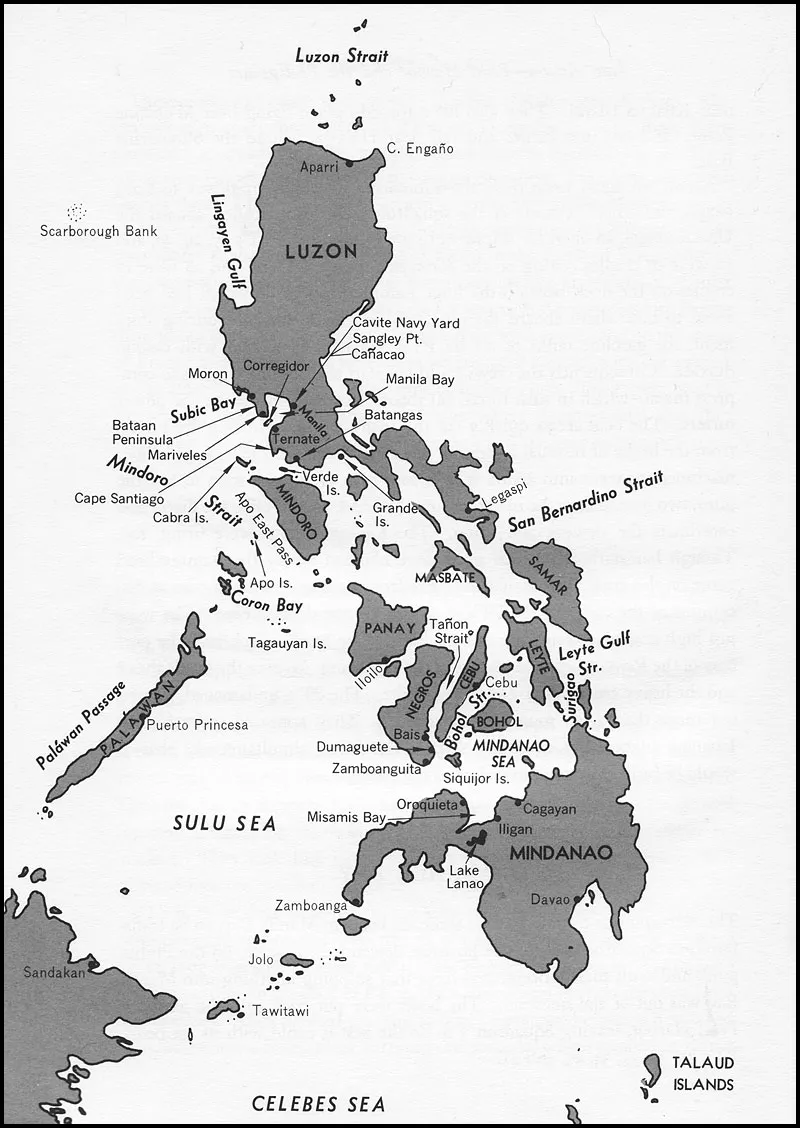
The Philippines
The PT’s of Squadron 3, based at the Cavite Navy Yard, went into action on December 10, when the Japanese made their first heavy air attack in the Manila Bay area. The air raid warning system was working well that day, giving the boats plenty of time to get underway into Manila Bay, where they could maneuver freely. The first planes started bombing Nichols Field at 1247.{2} A few minutes later a wave of some 35 started to work over shipping in Manila Bay. It was high-level bombing, 20,000 feet, well beyond the range of the PT’s .50-caliber machine-guns and the pair of-30-caliber Lewis guns which the Squadron 3 boats had installed in single mounts on the forward deck. Then five bombers peeled off deliberately and started to dive on the PT’s. Theoretically, it was possible for a PT to wait until a diving plane reached its release point, and then, by putting the wheel hard over, to avoid the bomb. The boats proved the theory—not a bomb came close. Besides, PT 31 claimed to have shot down two planes and PT 35 one.
The first bomb fell on the Navy Yard at 1314. For more than an hour thereafter, 3 waves of 27 bombers each swept over, out of antiaircraft range, dropping their explosives at will. Practically every bomb fell within the Navy Yard limits, with direct hits on the powerplant, dispensary, torpedo repair shop, supply office, warehouse, signal station, commissary store, barracks, officers’ quarters, and several ships, tugs, and barges along the waterfront. The entire yard and one-third of the city of Cavite were ablaze.
PT’s could outmaneuver the planes; their spares and equipment could not. The only spares saved were nine engines which John Bulkeley had had the foresight to store in private garages in Manila. Of these, three were lost on January 2 when Manila was invaded. Of the other six, subsequently lightered to Corregidor, two were lost on January 9 when the Corregidor North Dock was bombed. The last four had to be left on Corregidor when the squadron departed in March. Nearly as serious as the loss of spares was the loss of thousands of drums of 100-octane gasoline.
The destruction of the Navy Yard was so complete that all remaining facilities had to be set up in new locations, well dispersed in anticipation of future air raids. Squadron 3 moved to Sisiman Bay, a little cove just east of Mariveles Harbor on the southern tip of the Bataan Peninsula, but not until after the boats had done yeoman service on the afternoon of December 10 transporting wounded from the Navy Yard to the hospital at Cañacao.
4. THE FLEET WITHDRAWS
The first few weeks at Sisiman Bay were discouraging. The squadron took over a small fishing dock and a few native nipa huts ashore. Each morning John Bulkeley visited headquarters to receive orders for the night’s operations. The boats made routine, non-productive patrols of the Bataan coast north of Manila Bay, and along the Batangas Peninsula to the south, as far as Verde Island. Doctrine demanded that PT’s patrol in two- or three-boat sections, so that if one boat should find itself in trouble, there would be another at hand to give assistance. But because there were so few boats, so few spares, so little gasoline, prudence had to make concessions. Seldom could more than one PT be spared for a patrol. Often one PT was accompanied by a YP, a small patrol vessel, either the Maryanne, the Perry, or the Fisheries II, or, until they departed from the area, one of two four-stack destroyers, the Pillsbury and the Peary. As the Japanese closed their net, nerves became tense and there were false reports of sightings along the Bataan coast. Many fruitless PT searches resulted.
PT’s required constant maintenance. The only repair facilities available were the old submarine tender Canopus, anchored at Mariveles, which turned out miracles of improvisation for the boats, and the drydock Dewey which lifted each boat in turn. PT 32 had an accidental explosion in the engine room. She was out of action for weeks.
During December most of the Asiatic Fleet moved south. The Japanese had command of the air and bombed Manila at will. Rear Admiral Rockwell moved his headquarters to Corregidor on December 21. Three days later he had a final conference with Adm. Thomas C. Hart, Commander in Chief Asiatic Fleet, at Admiral Hart’s headquarters in the Marsman Building in Manila. During the conference the Marsman Building was bombed three times. Admiral Rockwell learned that Admiral Hart was moving south to be with the operating fleet, leaving Admiral Rockwell in command of all naval forces in the Manila area. On his return to Corregidor that evening, Admiral Rockwell found that Gen. Douglas MacArthur, President Manuel Quezon, and Francis B. Sayre, American High Commissioner to the Philippines, had also moved to the Rock.
On Christmas night Admiral Hart departed on the submarine Shark. Manila was about to be declared an open city, so Admiral Rockwell sent his aide, Lt. (jg.) M. M. Champlin, USNR, to arrange for destruction of gasoline and oil stores in the city. Lieutenant Champlin accomplished this with the help of oil company executives in Manila.
On December 26 Admiral Rockwell reported to General MacArthur for duty. During the day Japanese planes made determined efforts to sink gunboats, PT’s, and especially the destroyers Pillsbury and Peary. Unwilling to risk the destroyers further, Admiral Rockwell ordered them south on the 27th. On December 28, the day Manila was declared an open city, Admiral Rockwell decided in conference with Capt. John Wilkes, Commander Submarines Asiatic Fleet, that “due to the increasing danger and difficulty of service in Mariveles, shortage and limitation of fuel and total lack of rest for personnel between patrols, as well as the likelihood of the Japanese blocking Manila Bay entrance,” the basing of submarines in the area was no longer practicable. Captain Wilkes, his staff, and his submarines departed at the end of December, leaving behind the tender Canopus and the submarine rescue vessel Pigeon to serve as advance operating facilities for...
Table of contents
- Title page
- TABLE OF CONTENTS
- TABLE OF CONTENTS
- FOREWORD
- Introduction
- In Memoriam
- Preface
- Part I - Into Action-Pearl Harbor and the Philippines
- Part II - Development-A New Type Emerges
- Part III - Guadalcanal and Beyond-The Solomons Campaign
- Part IV - Southwest Pacific-Conquest of New Guinea
- Part V - The Aleutians-A Battle Against Weather
- Part VI - The Mediterranean-Torpedo War
- Part VII - The English Channel-D-Day and After
- Part VIII - South-West Pacific-Return to the Philippines
- Postscript
- Appendix A - Composition of the Squadrons
- Appendix B - PT Losses
- Appendix C - Awards and Citations
- Appendix D - Casualties
- A Note on Sources
Trusted by 375,005 students
Access to over 1.5 million titles for a fair monthly price.
Study more efficiently using our study tools.
Frequently asked questions
Yes, you can cancel anytime from the Subscription tab in your account settings on the Perlego website. Your subscription will stay active until the end of your current billing period. Learn how to cancel your subscription
No, books cannot be downloaded as external files, such as PDFs, for use outside of Perlego. However, you can download books within the Perlego app for offline reading on mobile or tablet. Learn how to download books offline
Perlego offers two plans: Essential and Complete
- Essential is ideal for learners and professionals who enjoy exploring a wide range of subjects. Access the Essential Library with 800,000+ trusted titles and best-sellers across business, personal growth, and the humanities. Includes unlimited reading time and Standard Read Aloud voice.
- Complete: Perfect for advanced learners and researchers needing full, unrestricted access. Unlock 1.5M+ books across hundreds of subjects, including academic and specialized titles. The Complete Plan also includes advanced features like Premium Read Aloud and Research Assistant.
We are an online textbook subscription service, where you can get access to an entire online library for less than the price of a single book per month. With over 1.5 million books across 990+ topics, we’ve got you covered! Learn about our mission
Look out for the read-aloud symbol on your next book to see if you can listen to it. The read-aloud tool reads text aloud for you, highlighting the text as it is being read. You can pause it, speed it up and slow it down. Learn more about Read Aloud
Yes! You can use the Perlego app on both iOS and Android devices to read anytime, anywhere — even offline. Perfect for commutes or when you’re on the go.
Please note we cannot support devices running on iOS 13 and Android 7 or earlier. Learn more about using the app
Please note we cannot support devices running on iOS 13 and Android 7 or earlier. Learn more about using the app
Yes, you can access At Close Quarters; PT Boats In The United States Navy [Illustrated Edition] by Captain Robert J. Bulkley Jr. in PDF and/or ePUB format, as well as other popular books in History & European History. We have over 1.5 million books available in our catalogue for you to explore.