![]()
1
RELIEF FROM HARD TIMES
In the fall of 1936, Henry Larson was going back home. However, before he left, he wanted to sum up his experiences in Wisconsin. Henry was not a tourist; nor was he a longtime resident ready for retirement. He was a CCC boy who had been stationed at Devil’s Lake State Park. He had been through an incredible adventure, but it had been one that he shared with hundreds of other young men at the lake. He had only a few lines in the camp newspaper in which to explain:
After twenty-three months of service…the lessons I have learned are many. I have learned the value of discipline and why it is so necessary. I have learned to cooperate with my fellow workers but at the same time to be independent and stand on my own two feet. [Also] the value of good health and clean living, fair play and good sportsmanship and what it really means.6
It was an unexpected statement of maturity coming from a person barely out of his teens. Unfortunately, Henry did not detail the experiences he had been through. Yet it is possible to understand and tell his story through the mutual adventures of the people he worked with and those who came after him. It’s not a complete picture, but it is one that is representative of what went on at dozens of CCC camps in Wisconsin during the Great Depression.
When Henry left the CCC in 1936, the nation was in the midst of the worst economic crisis in its history. In the old days, these troubles were called “panics” and were often short-lived. This time, the bad times were hanging on too long, and worse still, nobody knew when or if the good life would be coming back. The word panic was replace by another term—depression.
The economic health of Wisconsin was more than ever tied to agriculture. To be sure, many farmers got through the economic storm and brought in a harvest each fall without much help from the government. But there was a feeling in the land that if a significant number of farmers were in trouble, then problems were certain to come along sooner or later for everyone else. Such fears were well founded considering that slightly over 21 percent of the American workforce was employed in agriculture in 1930.7
As bad as things were on the farm, they were equally as desperate in the cities. National unemployment reached its peak at 25 percent of the workforce in the spring of 1933. It didn’t drop below 10 percent until 1942. One-third of those still on the job were working part time. The average wage in a manufacturing job in 1929 was over $24.50 per week. By 1933, it had fallen to $16.65. Automobile production fell by one-third from 1929 to 1932. Other industries related to cars were naturally affected when the auto assembly line slowed. For example, production of iron and steel fell by 60 percent compared to pre-crash days. Production by machine toolmakers went down by almost two-thirds.8
Throughout America, the anthem of the times was “Brother, can you spare a dime?” with frustration and occasional desperation as hallmarks of everyday life. Men who had known work throughout their entire adult lives were weighed down by the thought that family members were counting on the man of the house to make things right. It was a heavy burden.
Another kind of burden and frustration in the workforce was found among young men—many just graduated from high school. Concern for them was well founded. With few employable job skills in a shrinking market, their chance of finding work was gone almost before it started. Each day, young teenagers had to compete with adults for even part-time work. It was not surprising that during the Depression, unemployment among young people and those over sixty years of age was significantly higher compared to the regular workforce. Older teenagers began to think about their stations in life. Guilt overcame many young men. They were old enough to help and felt it was their duty to do something to support the family. But they weren’t sure what that duty entailed.
They roamed the sidewalks of their hometowns, peering into storefronts. Having recently graduated from high school, or in some cases dropped out of school, they had few prospects. What vocational or trade skills they may have had were often picked up working around the house or farm. It wasn’t enough. U.S. representative Thomas Amlie saw it happening around the courthouse square in his southern Wisconsin hometown of Elkhorn: “The young people will gather in the morning, hang around, just sit there until it is time to go home for dinner or for supper, very much the same as the retired farmers have been doing for over eighty years.”9
When Franklin D. Roosevelt became president in 1933, he was determined to take bold action to turn the economy around by offering the nation a “New Deal.” Early in his presidency, Roosevelt talked Congress into creating a number of agencies, all designed to bring relief to a certain segment of the economy. Historians called them an “alphabet soup” because the new agencies were best known through their initials. Among them were the AAA (Agriculture Adjustment Administration), PWA (Public Works Administration) and NRA (National Recovery Administration).10
The Emergency Conservation Work (ECW) law was the official title of the new conservation legislation, but everyone came to know it as the Civilian Conservation Corps. Many people would later say that it was the best-remembered and most successful program of the Great Depression years. Its premise was simple and direct. Roosevelt’s idea was to hire and train an army of young men who would work outdoors in the forests, parks and farms of America. The program would not only give hope, training and employment to America’s youth, but it would also take a giant stride toward conservation and preservation of the country’s natural resources. In the few short weeks following the new president’s inauguration, the organizational wheels began to turn, and the CCC opened its doors for business.
President Franklin D. Roosevelt, seated third from right, and dignitaries visit a CCC camp in the Shenandoah Valley, Virginia, in August 1933. Seated next to the president (wearing the dark necktie) is Robert Fechner, national director of the CCC. Seated next to Fechner is Harold Ickes, secretary of interior, which also has jurisdiction over the National Park Service. Courtesy Franklin D. Roosevelt Presidential Library, Hyde Park, New York.
Getting the word out and recruiting young men was the first order of business. The rules of eligibility changed slightly as the program evolved during the 1930s, but there were some basic requirements at the beginning. Enrollment in the CCC was open to unemployed, unmarried young men between the ages of eighteen and twenty-five. The men were paid thirty dollars per month, twenty-five dollars of which was sent to parents or relatives back home. Knowing that twenty-five dollars was sent home each month also meant that the young recruit was taking responsibility for family affairs. Devil’s Lake enrollee David Rouse was one of thousands who knew the money that was sent home would be put to good use. “My mother made a down payment on a new washing machine with her first twenty-five-dollar check. With six children to care for, she needed it badly.”11 Likewise, Milwaukee-area native Emil Pradarelli understood the importance of joining the CCC to help the family:
There was no work for my father in 1937 so the money that was sent home by the CCC was just about the only money coming in for them. They used it to pay household expenses, and believe me, they appreciated every dollar.12
Enrollment in the CCC was for a period of six months, but the young man could reenlist again for a maximum total of one year. Later, terms of enrollment were expanded to allow for six-month reenlistments up to two years total time. Technicalities in the law eventually allowed a few skilled enrollees to stay beyond the two-year limit. For newcomers, the standard practice immediately after signing enrollment papers and taking a physical exam was to head off for fitness training at a military facility and then on to a camp with about two hundred other enrollees (as they were called in official reports) as part of a company unit.13
For administrative purposes, the country was divided into “corps” areas. Wisconsin, Illinois and Michigan were grouped together to form the Sixth Corps. State government agencies worked with the U.S. Department of Labor to develop a type of quota system to determine the number of enrollees needed in each region. The effect of this regional-style organization was to group new recruits in companies with other young men from the same state or geographic corps area. Knowing many of the boys would be away from home for the first time, organizers thought the system would increase camaraderie and local pride by keeping them relatively close to home. But that quickly changed, given the rural nature of conservation projects matched with the urban populations looking for work. Ultimately, there were no guarantees that enrollees would be able to join the CCC and serve in camps near their hometowns.
Young Alfred Krueger was a sickly child who grew up in Baraboo, Wisconsin. He joined the CCC out of a need to help his family, but he also joined to build up his body and improve his fitness. At that time, recruits were given an opportunity to request a particular camp assignment, and administrators generally granted the request when “practicable.” If a camp roster were full, for example, it would not be possible to send a new recruit to that camp. Young Alfred apparently signed up at an inconvenient time for officials, for instead of assigning him to the Devil’s Lake camp a few short miles down the road, he was sent to the northern woodlands to Camp Sawyer in appropriately named Winter, Wisconsin. Regrettably, Alfred never made it to Devil’s Lake as a CCC enrollee. Furthermore, his true feelings about his duty station remained unknown because he purposely never said anything about being passed over for an assignment at his beautiful hometown park.14
Each young man had his own reasons for joining the CCC, most of them associated with the need for money plus the desire for personal independence. However, in many cases, there was a special story that guided certain young men toward CCC enrollment. Most of those stories are lost to history, but there are a few that survive and add a special twist to the usual reasons for joining up. One such case was Hiram Calkins, “Hi” to all his friends. In 1939, Calkins was barely getting by as a gravedigger in Poynette, Wisconsin. During his long off-hours, he spent time at the Super ice cream shop in nearby Portage. There he met Helen Peterson, a lovely young high school senior. Their courtship did not go well, and a destructive argument followed. Hi declared he was breaking off the relationship and, in a pique of anger and showmanship, declared to Helen that he was joining the CCC and going far away. Reminiscent of the young lads who left behind broken romances and joined the French Foreign Legion, Hi made good on his promise and signed up. Like the Foreign Legion soldiers of old, Hi believed his experience in a new land would make Helen pine for him as time went on. Hi believed his service would make him a more mature and appealing catch. The countless reasons why young men were motivated to sign up for the CCC will never be known, but it seems almost certain that at least a few other young men were drawn to the CCC as a means of dealing with broken hearts. For Hi, his CCC camp assignment was just down the road at Devil’s Lake, and he and Helen would happily reunite during his service.15
Wisconsin and Devil’s Lake State Park. Courtesy Ty Moore.
All camps, no matter where they were located, were assigned a coded number for administrative purposes. The designation was based on which agency of government was going to direct the work at each camp. For example, F-34-W at Blackwell denotes a national forest camp (F) whose supervising agency was the U.S. Forest Service. The camp was assigned a number (34) and state letter (W; not always used) denoting the state of Wisconsin. Camps operating in state parks and supervised by the National Park Service used “SP” followed by the appropriate camp number.
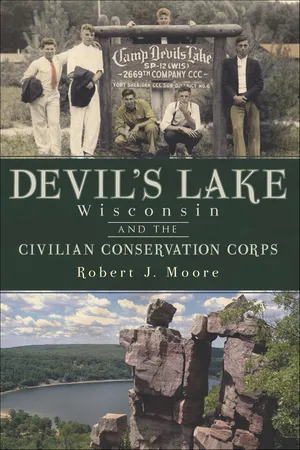
Regardless of name or number, a company of two hundred men was assigned to each camp. Assignments of company numbers also followed a pattern. In a company like #604, the first number signified the Sixth Corps area of the country, with the other numbers simply counting as a sequential number as the units were set up. In companies of four digits, such as 2669, the second number from the left equaled the corps area. With thousands of camps scattered all over the country, the numbering system for both camps and companies was easy to follow for the men and easy to track for CCC administrators. For example, Company 2669 was assigned to camp SP-12. The company number would always remain the same, no matter where the unit was assigned. As for SP-12 the first letters of the camp signified a state park, followed by the park number. In this case, all men of the company knew SP-12 by its geographic name—Devil’s Lake.
The U.S. Army had primary control over the young men who enrolled in the program, yet there were important exceptions. While the army operated the camps and had control over where the men would live and eat, nearly all job assignments, work supervision and skills training were handled by the U.S. Forest Service, National Park Service or Soil Conservation Service—otherwise known as the “technical services.” Camps would eventually be set up in all states, and various government agencies and technical services would be active in all those states.
It seemed logical and natural that the Forest Service and National Park Service would be first in line to request and supervise work from the CCC. The nature of their mission of conservation and preservation was a perfect fit for the kind of work the young men would be doing as part of the new relief agency. Indeed, the Forest Service and National Park Service had a bureaucracy already in place to process and begin jobs immediately. The National Park Service wasted no time in presenting its requests for CCC work at the national parks and monuments throughout the United States. The big advantage for the NPS was that it already had a general master plan that outlined development requirements in the parks. Now, with new manpower available, National Park director Horace Albright instructed individual park officials to quickly come up with their own specific lists of work projects for their specific locations. Those early requests focused on projects at the big parks out West, like Grand Teton, Glacier, Yosemite and Grand Canyon.16
It was assumed that state park officials would work with NPS officials to get CCC workers, but since everything was new, there was confusion about how that would actually happen. The legal authority to include state and municipal parks in planning was solidly in place, but exactly how those parks could benefit, and more importantly, who would control the projects and purse strings relating to CCC work, was uncharted territory to NPS administrators. Unlike the Forest Service, the National Park Service had little experience in sharing information and coordinating preservation and conservation efforts with state park officials.
Complicating matters was the fact that most states did not have a long-standing (or any), formal state park program. Even if they did, many did not have proper planning standards that would have work projects in the park integrate into a master plan for development. In response, the NPS created a completely new department, the Branch of Planning and State Cooperation, later renamed the State Park Division of the ECW, to officially bring the state parks into the NPS planning and work program so they could take advantage of CCC labor. The move to create a new planning department to accelerate work programs at the state parks was necessary and noble, but of course it made no difference to states without parks systems of their own.
A plus for Wisconsin was that it not only had a state parks system, but it also had a system based on the recommendations of one of the top landscape architects in the United States. John Nolen would make his career reputation in the field of urban...