When this important work was originally published in 1950--the first book in this country on anxiety--it was hailed as a work ahead of its time.
This book is the result of several years of exploration, research, and thought on one of the most urgent problems of our day. Clinical experience has proved to psychologists and psychiatrists generally that the central problem in psychotherapy is the nature of anxiety. To the extent that we have been able to solve that problem, we have made a beginning in understanding the causes of integration and disintegration of personality.
But if anxiety were merely a phenomenon of maladjustment, it might well be consigned to the consulting room and the clinic and this book to the professional library. The evidence is overwhelming, however, that men and women of today live in an "age of anxiety." If one penetrates below the surface of political, economic, business, professional, or domestic crises to discover their psychological causes, or if one seeks to understand modern art or poetry or philosophy or religion, one runs athwart the problem of anxiety at almost every turn. There is reason to believe that the ordinary stresses and strains of life in the changing world of today are such that few if any escape the need to confront anxiety and to deal with it in some manner.
This study seeks to bring together in one volume the theories of anxiety offered by modern explorers in different areas of our culture, to discover the common elements in these theories, and to formulate these concepts so that we shall have some common ground for further inquiry. If the synthesis of anxiety theory presented here serves the purpose of producing some coherence and order in this field, a good part of the writer's goal will have been achieved.
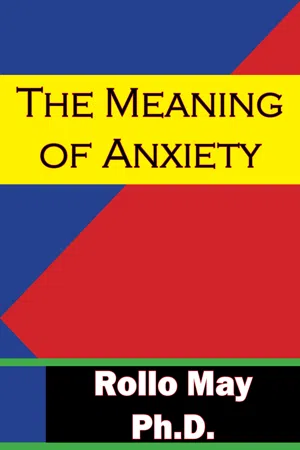
- 369 pages
- English
- ePUB (mobile friendly)
- Available on iOS & Android
eBook - ePub
The Meaning Of Anxiety
About this book
Information
Subtopic
History & Theory in PsychologyIndex
PsychologyChapter 1— INTRODUCTION
“Now there are times when a whole generation is caught...between two ages, two modes of life, with the consequence that it loses all power to understand itself and has no standards, no security, no simple acquiescence.”
—Herman Hesse, Steppenwolf.
1. CENTRALITY OF THE PROBLEM OF ANXIETY IN OUR DAY
Every alert citizen of our society realizes, on the basis of his own experience as well as his observation of his fellow-men, that anxiety is a pervasive and profound phenomenon in the middle of the twentieth century. The alert citizen, we may assume, would be aware not only of the more obvious anxiety-creating situations in our day, such as the threats of war, of the uncontrolled atom bomb, and of radical political and economic upheaval; but also of the less obvious, deeper, and more personal sources of anxiety in himself as well as in his fellow-men—namely the inner confusion, psychological disorientation, and uncertainty with respect to values and acceptable standards of conduct. Hence to endeavor to “prove” the pervasiveness of anxiety in our day is as unnecessary as the proverbial carrying of coals to Newcastle.
Since the implicit sources of anxiety in our society are generally recognized, our task in this introductory chapter is somewhat more specific. We shall point out how anxiety has emerged, and has to some slight extent been defined, as an explicit problem in many different areas in our culture. It is as though in the present decade the explorations and investigations in such diverse fields as poetry and science, or religion and politics, were converging on this central problem, anxiety. Whereas the period of two decades ago might have been termed the “age of covert anxiety”—as we hope to demonstrate later in this chapter—the present phase of our century may well be called, as Auden and Camus call it, the “age of overt anxiety.” This emergence of anxiety from an implicit to an explicit problem in our society, this change from anxiety as a matter of “mood” to a recognition that it is an urgent issue which we must at all costs try to define and clarify, are, in the judgment of the present writer, the significant phenomena at the moment. Not only in the understanding and treatment of emotional disturbances and behavioral disorders has anxiety become recognized as the “nodal problem,” in Freud’s words; but it is now seen likewise to be nodal in such different areas as literature, sociology, political and economic thought, education, religion, and philosophy. We shall cite examples of testimony from these fields, beginning with the more general and proceeding to the more specific concern with anxiety as a scientific problem.
In Literature.—If one were to inquire into anxiety as exhibited in the American literature, say, of 1920 or 1930, one would be forced in all probability to occupy oneself with symptoms of anxiety rather than overt anxiety itself. But though signs of open, manifest anxiety were not plentiful in that period, certainly the student could find plenty of symptomatic indications of underlying anxiety. Vide, for example, the pronounced sense of loneliness, the quality of persistent searching—frantically and compulsively pursued but always frustrated—in the writings of a novelist like Thomas Wolfe. {1}
In 1950, however, our inquiry is simpler because anxiety has now emerged into overt statement in contemporaneous literature. W. H. Auden has entitled his latest poem with the phrase which he believes most accurately characterizes our period, namely, The Age of Anxiety. {2} Though Auden’s profound interpretation of the inner experience of the four persons in this poem is set in the time of war—when “necessity is associated with horror and freedom with boredom” {3}—he makes it very clear that the underlying causes of the anxiety of his characters, as well as of others of this age, must be sought on deeper levels than merely the occasion of war. The four characters in the poem, though different in temperament and in background, have in common certain characteristics of our times: loneliness, the feeling of not being of value as persons, and the experience of not being able to love and be loved, despite the common need, the common effort, and the common but temporary respite provided by alcohol. The sources of the anxiety are to be found in certain basic trends in our culture, one of which, for Auden, is the pressure toward conformity which occurs in a world where commercial and mechanical values are apotheosized:
“We move on
As the wheel wills; one revolution
Registers all things, the rise and fall
In pay and prices....{4}”
“...this stupid world where
Gadgets are gods and we go on talking,
Many about much, but remain alone,
Alive but alone, belonging—where?—
Unattached as tumbleweed. {5}”
And the possibility facing these persons is that they too may be drawn into the mechanical routine of meaninglessness:
“...The fears we know
Are of not knowing. Will nightfall bring us
Some awful order—Keep a hardware store
In a small town....Teach science for life to
Progressive girls—? It is getting late.
Shall we ever be asked for? Are we simply
Not wanted at all? {6}”
What has been lost is the capacity to experience and have faith in one’s self as a worthy and unique being, and at the same time the capacity for faith in, and meaningful communication with, other selves, namely one’s fellow-men. {7}
The French author, Albert Camus, in a phrase parallel to Auden’s, designates this age as “the century of fear,” in comparison with the seventeenth century as the age of mathematics, the eighteenth as the age of the physical sciences, and the nineteenth as that of biology. Camus realizes that these characterizations are not logically parallel, that fear is not a science, but “science must be somewhat involved, since its latest theoretical advances have brought it to the point of negating itself while its perfected technology threatens the globe itself with destruction. Moreover, although fear itself cannot be considered a science, it is certainly a technique.” {8}
Another writer who graphically expresses the anxiety and anxiety-like states of people in our period is Franz Kafka. The remarkable surge of interest in the 1940’s in the writings of Kafka is important for our purposes here because of what it shows in the changing temper of our time; the fact that increasing numbers of people are finding that Kafka speaks significantly to them must indicate that he is expressing some profound aspects of the prevailing experience of many members of our society. In Kafka’s novel The Castle,{9} the chief character devotes his life to a frantic and desperate endeavor to communicate with the authorities in the castle who control all aspects of the life of the village, and who have the power to tell him his vocation and give some meaning to his life. Kafka’s hero is driven “by a need for the most primitive requisites of life, the need to be rooted in a home and a calling, and to become a member of a community.” {10} But the authorities in the castle remain inscrutable and inaccessible, and Kafka’s character is as a result without direction and unity in his own life and remains isolated from his fellows. What the castle specifically symbolizes could be debated at length, but since the authorities in the castle are represented as the epitome of a bureaucratic efficiency which exercises such power that it quenches both individual autonomy and meaningful interpersonal relations, it may confidently be assumed that Kafka is in general writing of those aspects of his bourgeois culture of the late nineteenth and early twentieth centuries which so elevated technical efficiency that personal values were largely destroyed.
Herman Hesse, writing less in literary symbols than Kafka, is more explicit about the sources of modern man’s anxiety. He presents the story of Haller, his chief character in the novel Steppenwolf, as a parable of our period. {11} Hesse holds that Haller’s—and his contemporaries’—isolation and anxiety arise from the fact that the bourgeois culture in the late nineteenth and early twentieth centuries emphasized mechanical, rationalistic “balance” at the price of the suppression of the dynamic, irrational elements in experience. Haller tries to overcome his isolation and loneliness by giving free rein to his previously suppressed sensuous and irrational urges (the “wolf”), but this reactive method yields only a temporary relief. Indeed, Hesse presents no thoroughgoing solution to the problem of the anxiety of contemporaneous Western man, for he believes the present period to be one of those “times when a whole generation is caught...between two ages.” That is to say, bourgeois standards and controls have broken down, but there are as yet no social standards to take their place. Hesse sees Haller’s record “as a document of the times, for Haller’s sickness of the soul, as I now know, is not the eccentricity of a single individual, but the sickness of the times themselves, the neurosis of that generation to which Haller belongs...a sickness which attacks...precisely those who are strongest in spirit and richest in gifts.” {12}
In Sociological Studies.—The emergence of awareness of anxiety as an overt sociological problem in an American community during the third and fourth decades of our century is seen when we compare the Lynds’ two studies of Middletown. {13} In the first study, made in the 1920’s, anxiety is not an overt problem to the people of Middletown, and the topic does not appear in the Lynds’ volume in any of its explicit forms. But anyone reading this study from a psychological viewpoint would suspect that much of the behavior of the citizens of Middletown was symptomatic of covert anxiety—for example, the compulsive work (“businessmen and workingmen seem to be running for dear life” in the endeavor to make money {14}), the pervasive struggle to conform, the compulsive gregariousness, (vide the great emphasis on “joining” clubs), and the frantic endeavors of the people in the community to keep their leisure time crammed with activity (such as “motoring”), however purposeless this activity might be in itself. {15} But only one citizen—whom the Lynds describe as a “perspicacious” observer—looked below these symptoms and sensed the presence of covert apprehension: of his fellow townsmen he observed, “These people are all afraid of something; what is it?” {16}
But the later study of the same community made in the 1930’s presents a very different picture: overt anxiety is now present. “One thing everybody in Middletown has in common,” the Lynds observe, “is insecurity in the face of a complicated world.” {17} To be sure, the immediate, outward occasion of anxiety was the economic depression; ...
Table of contents
- Title page
- TABLE OF CONTENTS
- PREFACE
- ACKNOWLEDGMENTS
- PART I - MODERN INTERPRETATIONS OF ANXIETY
- Chapter 1- INTRODUCTION
- Chapter 2 - PHILOSOPHICAL PREDECESSORS TO MODERN THEORIES OF ANXIETY
- Chapter 3 - ANXIETY INTERPRETED BIOLOGICALLY
- Chapter 4 - ANXIETY INTERPRETED PSYCHOLOGICALLY
- Chapter 5 - ANXIETY INTERPRETED CULTURALLY
- Chapter 6 - SUMMARY AND SYNTHESIS OF THEORIES OF ANXIETY
- PART II - CLINICAL ANALYSIS OF ANXIETY
- Chapter 7 - CASE STUDIES DEMONSTRATING ANXIETY
- Chapter 8 - CONCLUSIONS FROM THE CASE STUDIES
- APPENDIX
- BIBLIOGRAPHY
Trusted by 375,005 students
Access to over 1.5 million titles for a fair monthly price.
Study more efficiently using our study tools.
Frequently asked questions
Yes, you can cancel anytime from the Subscription tab in your account settings on the Perlego website. Your subscription will stay active until the end of your current billing period. Learn how to cancel your subscription
No, books cannot be downloaded as external files, such as PDFs, for use outside of Perlego. However, you can download books within the Perlego app for offline reading on mobile or tablet. Learn how to download books offline
Perlego offers two plans: Essential and Complete
- Essential is ideal for learners and professionals who enjoy exploring a wide range of subjects. Access the Essential Library with 800,000+ trusted titles and best-sellers across business, personal growth, and the humanities. Includes unlimited reading time and Standard Read Aloud voice.
- Complete: Perfect for advanced learners and researchers needing full, unrestricted access. Unlock 1.5M+ books across hundreds of subjects, including academic and specialized titles. The Complete Plan also includes advanced features like Premium Read Aloud and Research Assistant.
We are an online textbook subscription service, where you can get access to an entire online library for less than the price of a single book per month. With over 1.5 million books across 990+ topics, we’ve got you covered! Learn about our mission
Look out for the read-aloud symbol on your next book to see if you can listen to it. The read-aloud tool reads text aloud for you, highlighting the text as it is being read. You can pause it, speed it up and slow it down. Learn more about Read Aloud
Yes! You can use the Perlego app on both iOS and Android devices to read anytime, anywhere — even offline. Perfect for commutes or when you’re on the go.
Please note we cannot support devices running on iOS 13 and Android 7 or earlier. Learn more about using the app
Please note we cannot support devices running on iOS 13 and Android 7 or earlier. Learn more about using the app
Yes, you can access The Meaning Of Anxiety by Rollo May Ph.D. in PDF and/or ePUB format, as well as other popular books in Psychology & History & Theory in Psychology. We have over 1.5 million books available in our catalogue for you to explore.