- 83 pages
- English
- ePUB (mobile friendly)
- Available on iOS & Android
eBook - ePub
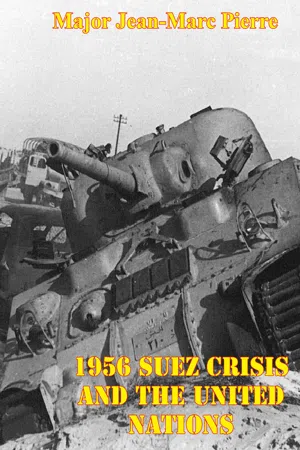
1956 Suez Crisis And The United Nations
About this book
The 1956 Suez Crisis is the first example of a pre-emptive strike after World War II. The episode provides lessons about the lengths to which nations will go to secure their interests and the limits of the United Nation's influence. How the UN uses its power is the point of contention. In 1956, Great Britain, France, and Israel believed the organization would protect their security interests through the unbiased maintenance of international law. Yet, as common in the Cold War, UN action was hampered. A war began and ended with a cease-fire in fifty-five hours. Three militarily superior armies won their tactical fights but were strategically defeated. Most notably, the influence of global authority shifted to the superpowers. Through all this, the UN changed its mission and purpose. The primary question therefore is did the UN resolve the 1956 Suez Crisis? Resolution had to include a status quo ante bellum, the return to the existing system before the war, or the recognition of a new international Regime. The UN's ability to resolve such crises directly affects its legitimacy in the international community.
Information
Subtopic
Middle Eastern HistoryIndex
HistoryCHAPTER 1 — INTRODUCTION
General Introduction
For centuries, international law recognized that nations need not suffer an attack before they can lawfully take action to defend themselves against forces that present an imminent danger of attack. Legal scholars and international jurists often conditioned the legitimacy of preemption on the existence of an imminent threat -most often a visible mobilization of armies, navies, and air forces preparing to attack. (Bush 2002, 15)
In an interview at the end of 2003, United Nations (UN) Secretary-General Kofi Annan reflected on the challenges facing the UN following Operation Iraqi Freedom (OIF). The United States (US)-led war to overthrow Iraqi dictator Saddam Hussein ended over twelve years of diplomacy since the 1991 Persian Gulf War. Kofi Annan assumed that the circumstances by which the OIF coalition went to war, the American doctrine of preemptive war, put the UN at its most significant crossroad since 1945.
By 2003, Iraq had violated seventeen UN resolutions, had expelled UN weapons inspectors, and had funded suicide bombings in Israel. The administration of President George W. Bush, fresh from its victory in Afghanistan and armed with the 2002 National Security Strategy, was determined to enforce the UN resolutions. The UN’s response to the looming war, mused Annan, crippled its effectiveness in dealing with other longstanding disputes and possibly its credibility as an organization that worked by consensus: “Those who are opposed to war could not understand that we could not stop the war and those who were for the war were upset that we did not support it.” He further demurred that preemptive war was “never mentioned in the [UN] Charter and [was] something the organization had never dealt with before” (Annan interviewed by Shawn, December 2003).
Contrary to Mr. Annan’s assertions, the UN had precedents of unsanctioned preemptive strikes from which to refer. For example, preemption was the casus belli (reason for war) in the Arab-Israeli War (1967), Bosnia (1995), and Kosovo (1999). The first preemptive strike in the postmodern era, however, was in the Suez Crisis in 1956 when a British, French, and Israeli coalition launched an attack into Egypt to depose Colonel Gamal Abdel Nasser. Nasser, like Saddam Hussein of Iraq, was an authoritarian dictator who seized power through a coup d’état. Both men sponsored cross border terrorism against Israel. Both men routinely violated UN resolutions. Both faced strikes when opposing parties no longer found utility in diplomacy. The 1956 war and OIF are reminders that political disputes can digress into open conflict. As Carl Von Clausewitz famously said in his treatise, On War, “War is nothing but the continuation of policy with other means” (Clausewitz 1976, 69).
It will be event in this study that when the Tripartite Coalition (just like the OIF Coalition) could not achieve their political ends through the diplomatic channels, open warfare became their only recourse. Unlike the failed Operation Musketeer, OIF succeeded in overthrowing the Iraqi regime. Annan believed that OIF and the very doctrine of preemption could be “seen as a precedent that other governments [could] use” (Annan interviewed by Shawn, December 2003). Four contemporary examples to consider are: Pakistan or India could use preemption as a justification to wage war over Kashmir; the two Koreas could explode to preempt an invasion across the demilitarized zone; Israel could use preemption to attack its many regional antagonists —Syria, Iran, or the Palestinian Liberation Organization; and Russia could attack the former Soviet republics.
In light of the implications of preemption, if the UN does not acknowledge its role as the main interlocutor in the world community, preemption could lead to the unilateral use of force in trouble spots around the world, such as Kashmir, Abkhazia, Nagorno-Karabakh, the Koreas, and the former Soviet Union. The United Nations should therefore review the circumstances of the 1956 Suez Crisis, to understand how genuine divisions amongst its members impair effectiveness.
Background
From the start, the Suez Crisis was never a problem between Egypt and two, or even three, powers only: it concerned a very large part of the world. (Eden 1960, 548)
President Franklin Delano Roosevelt first used the moniker United Nations in the 1 January 1942 “Declaration by United Nations” when a twenty-six nation coalition joined to defeat the Axis Powers. He later declared after the February 1945 Yalta Conference that the attendees had agreed to end unilateral action, polar alliances, and power blocs. The United Nations would be the alternative to the failed League of Nations. That year at the UN Conference on International Organization in San Francisco, fifty countries met to draft the UN Charter. Its founding nations signed the charter on 26 June 1945 based on the 1944 Dumbarton Oaks Conference and the organization officially came to life on 24 October 1945.
However, liberal institutions exist under the permission of the practitioners of Realpolitik. Within weeks of Yalta, Josef Stalin built his Soviet power bloc in Central and Eastern Europe. In response to the communist bloc, the Western alliance built their own power bloc as part of the cordon sanitaire, the North Atlantic Treaty Organization (NATO), the South East Asia Treaty Organization (SEATO), and the Baghdad Pact. By the end of the 1940s and well into the 1950s, the frictions of the Cold War ended hopes of a cooperative Regime. When the Cold War moved into the Middle East the Anglo-French-Israeli invasion of Egypt appeared a historic inevitability.
Despite the existence of the UN, several wars including the 1956 Suez War erupted. Fighting did not happen without cause. After World War II, the politics of the Middle East changed dramatically. The most significant event was the creation of Israel in 1948 which divested the Palestinian inhabitants of their territory. Arab countries took up the Palestinian cause in the first Arab-Israeli War of 1948. The resultant armistice of 1949 designed a ceasefire not peace. Consequently, border incidents between Egypt and Israel continued.
As for the British and French in 1956, they each developed heated disputes with Colonel Gamal Abdel Nasser and his Egyptian junta. When the plan to finance the Aswan Dam failed, the dictator nationalized the Anglo-French owned Suez Canal Company. Arguably, this was the casus belli of their entry into what was truly an Egyptian-Israeli war.
Historic Overview
The Isthmus of Suez is a land bridge in eastern Egypt joining the continent of Africa and Asia (See figure 1). The creation of the modern Suez Canal was the Herculean undertaking of Count Ferdinand Marie de Lesseps from 1859 to 1869. De Lesseps built the canal for the La Universelle du Canal Maritime de Suez (Universal Company of the Maritime Suez Canal). Four years later, the Suez Canal Company incorporated with $40 million in capital stock jointly owned by the French government and the Ottoman Empire.
The immediate strategic importance of the inland waterway cannot be underestimated. It allowed the European powers to reach colonies in East Africa, India, and the Pacific Rim without having to negotiate the Horn of Africa. The British House of Commons saw such value in the system that in 1875 they agreed to purchase controlling shares in the Suez Canal Company for £3,976,582 (Kinross 1969, 274-275). Egypt thereafter became the focal point of British Middle East policy, supplanting the declining Ottoman Empire; Egypt soon became a protectorate of Great Britain.

In 1881, the nationalist Egyptian Army Colonel, Ahmed Arabi, led a revolt with the slogan “Egypt for the Egyptians!” In a series of events presaging the ascendancy of Nasser, Arabi seized power. European stakeholders grew concerned that a radical Egyptian government would default on its debts, seize the canal, and upturn the status quo of international commerce. Great Britain and France soon decided that their intervention was “an absolute necessity” to protect their vital interest. The British Parliament dispatched its army; France’s weak government waffled on authorizing force. Consequently, Great Britain intervened unilaterally (Kinross 1969, 278).
On 19 August 1882, a British expeditionary force seized the Suez Canal with the aid of British reinforcements from India. They quickly defeated Arabi’s forces at the Nile Delta and the following day the British force occupied Cairo. Queen Victoria gained total control of Egypt. France’s failure to act decisively in her national strategic interest left Egypt open for Great Britain to takeover.
The internationality of the Suez Canal was codified six years later. Under the terms of the 1888 Convention of Constantinople, the waterway was to remain open as a neutral passage for merchant ships of all nations in times of peace and war. Great Britain was the guarantor of the Canal’s neutrality. Its management was the responsibility of the newly formed Suez Canal Company.
In the 1950’s, Great Britain still had a vested interest in the Suez Canal. It was her link to the British dependencies in the Pacific. The British government also held the largest financial stake in the Suez Canal Company. For France, on top of the French dispute over the canal, the government in Paris loathed Nasser’s active support of Algerian revolution. As for Israel, her grievance with Egypt dated back to the 1948 War up to the terrorist attacks originating from Egyptian camps in the Sinai. Their Anglo-French-Israeli alliance of convenience formed in October 1956 to save the European economic interest and ensure Israeli national preservation.
On 29 October 1956, the Israeli Operation Kadesh started as a precursor for the Anglo-French Operation Musketeer. British and French troops joined the offensive on 4 November. The international community shocked at the brazen use of force compelled a ceasefire fifty-five hours later. After repairs, the canal reopened in early 1957. An agreement between Egypt and the shareholders of the Suez Canal Company paid shareholders approximately $81 million in six annual installments.
The gravity of this crisis should not be underestimated. Just like 1914 on the eve of the World War I, the convergence of alliances had the potential for a world war. Within weeks of signing the UN Charter in 1945, the Soviet Union formed the communist power bloc, the Warsaw Pact. Using this as leverage, the Soviets supported Egypt politically, economically, and militarily. They made threats ranging from the introduction of a Soviet “volunteer” army to assist Egypt (something similar to the Chinese “volunteers” in the Korean War) to Soviet Foreign Minister Bulganin’s veiled threat of bombing London and Paris (Longgood 1957, 155).
In the west, the North Atlantic Treaty Organization (NATO) formed to counterbalance the Warsaw Pact. The Western powers also succored Israel during its formative years. Despite President Dwight D. Eisenhower’s intense opposition to the invasion, when the Soviet Union began their saber rattling, Eisenhower was prepared to destroy the Soviet Union. The superpowers had the will and capability to fight each other in 1956 if brought to the point of war.
Added to the Middle Eastern problems, the world faced the prospect of another continental war when the Hungarian Crisis flared. On 23 October 1956, a week before the invasion of Egypt, students and workers took to the streets of Budapest, Hungary demanding the removal of Soviet control. As the allied invasion of Egypt progressed, the Kremlin answered the Hungarian challenge on 4 November in an event similar to the later crackdown in China’s 1989 Tiananmen Square Massacre. Covered by the confusion in the UN Security Council over the Suez Canal, Soviet tanks rumbled through Budapest streets and by many estimates killed 30,000 Hungarians; 200,000 people fled their country. By 14 November, Hungary was once more a Marxist outpost.
The events of 1956 were the first true test of the effectiveness of the UN system since the Korean War (1950-1953). In 1950, the body joined to resist the North Korean invasion of South Korea and uphold the rule of international law. Similarly, in 1956, the UN joined to determine which actors had violated international law and how best to respond.
By the end of the crisis, Israel won substantial gains. They stopped the terrorist attacks, they destroyed Egypt’s new Soviet weapons, and more importantly, the new Jewish nation established itself as a highly professional and credible military power under leaders such as the Israeli Defense Force (IDF) Chief of Staff Moshe Dayan.
Egypt’s tactical defeats were translated into success. Egypt gained the sympathy of the UN General Assembly now inundated with third world nations that voted as an anti-western bloc. More importantly, Nasser’s prestige rose in the Arab world. Like Saddam Hussein in 1991, Gamal Nasser had stood up to the world’s greatest powers and survived. Soon Nasser met his strategic objective of removing Europeans from Egypt. British military garrisons lost all mandates in Egypt established under previous agreements. Nasser’s nationalization policies seized all European holding in the country and forced the flight of most foreigners from Egypt by the end of the 1950s. Gamal Nasser had succeeded in meeting Ahmed Arabi’s 1881 nationalist goal of having “Egypt for the Egyptians!”
The fortunes of Great Britain and France, in contrast, were dismal after the war. Both governments collapsed with the resignation of British Prime Minister Anthony Eden and ouster of French Premier Guy Mollet. Both nations saw the precipitous downfall of their colonial holdings around the world. Their economies and alliances with America were in turmoil. For the French, the Nasser-sponsored Algerian insurrection continued to humiliate the Fourth Republic as surely as the Suez operation, their 1954 defeat in Indochina, and their surrender to the Nazis in 1940.
The Research Question
Given the Cold War, the events in the 1956 Suez Canal Crisis brought humanity to the point of world war. Although the major fighting ended in fifty-five hours, the primary question is: Did the UN resolve the 1956 Suez Crisis? In order to answer the research question, this thesis answers three secondary questions: (1) What was the relevance of the UN as a system of international order? (2) Was the reaction to the tripartite invasion effective? (3) Did the UN resolve the underlying issues that caused the war?
Scope
The scope of the thesis will include the principal parties to the dispute: Egypt, Britain, France, Israel, and the United Nations. It must also include the outside influencers, such as the US, the Soviet Union, and Hungary.
Assumptions
This study makes three assumptions: there is an international “Regime,” standing international laws and agreements comprise that Re...
Table of contents
- Title page
- TABLE OF CONTENTS
- ABSTRACT
- ACKNOWLEDGMENTS
- ILLUSTRATIONS
- TABLES
- CHAPTER 1 - INTRODUCTION
- CHAPTER 2 - LITERATURE REVIEW
- CHAPTER 3 - Methodology
- CHAPTER 4 - HISTORICAL SETTING
- CHAPTER 5 - STRATEGIC ANALYSIS
- CHAPTER 6 - CONCLUSION AND RECOMMENDATIONS
- REQUEST FROM THE PUBLISHER
- ACRONYMS
- REFERENCES
Trusted by 375,005 students
Access to over 1.5 million titles for a fair monthly price.
Study more efficiently using our study tools.
Frequently asked questions
Yes, you can cancel anytime from the Subscription tab in your account settings on the Perlego website. Your subscription will stay active until the end of your current billing period. Learn how to cancel your subscription
No, books cannot be downloaded as external files, such as PDFs, for use outside of Perlego. However, you can download books within the Perlego app for offline reading on mobile or tablet. Learn how to download books offline
Perlego offers two plans: Essential and Complete
- Essential is ideal for learners and professionals who enjoy exploring a wide range of subjects. Access the Essential Library with 800,000+ trusted titles and best-sellers across business, personal growth, and the humanities. Includes unlimited reading time and Standard Read Aloud voice.
- Complete: Perfect for advanced learners and researchers needing full, unrestricted access. Unlock 1.5M+ books across hundreds of subjects, including academic and specialized titles. The Complete Plan also includes advanced features like Premium Read Aloud and Research Assistant.
We are an online textbook subscription service, where you can get access to an entire online library for less than the price of a single book per month. With over 1.5 million books across 990+ topics, we’ve got you covered! Learn about our mission
Look out for the read-aloud symbol on your next book to see if you can listen to it. The read-aloud tool reads text aloud for you, highlighting the text as it is being read. You can pause it, speed it up and slow it down. Learn more about Read Aloud
Yes! You can use the Perlego app on both iOS and Android devices to read anytime, anywhere — even offline. Perfect for commutes or when you’re on the go.
Please note we cannot support devices running on iOS 13 and Android 7 or earlier. Learn more about using the app
Please note we cannot support devices running on iOS 13 and Android 7 or earlier. Learn more about using the app
Yes, you can access 1956 Suez Crisis And The United Nations by Major Jean-Marc Pierre in PDF and/or ePUB format, as well as other popular books in History & Middle Eastern History. We have over 1.5 million books available in our catalogue for you to explore.