- 173 pages
- English
- ePUB (mobile friendly)
- Available on iOS & Android
eBook - ePub
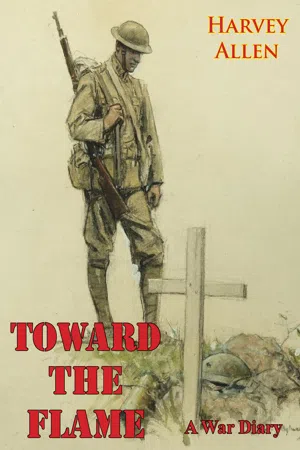
Toward The Flame: A War Diary
About this book
Chronicles the experiences of the Twenty-Eighth Division in the summer of 1918 through the eyes of Lieutenant Hervey Allen and men, made up primarily of Pennsylvania National Guardsmen, who saw extensive action on the Western Front. The story begins with the 28th marching inland from the French coast and ends with their participation in the disastrous battle for the village of Fismette. Allen was a talented observer, and the men with whom he served emerge as well-rounded characters against the horrific backdrop of the war.
Information
Subtopic
Military BiographiesIndex
HistoryCHAPTER I — ROUTE MARCHING
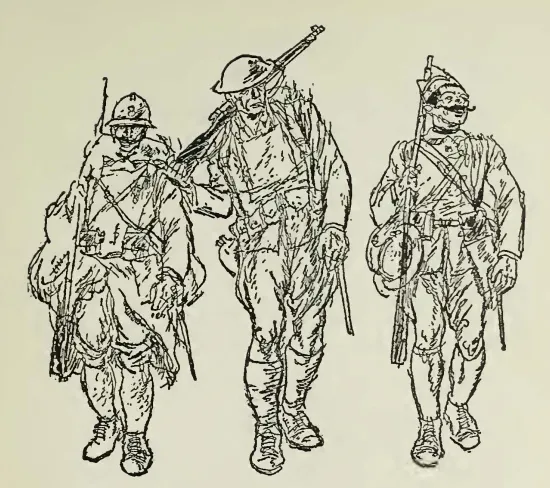
CAN ANY one who took part in those route marches in France from the sea to the front ever forget them? It seems to me that we were always marching along those splendid, shaded, French roads with a gridiron of sunshine falling through the tree trunks that stretched their endless, double row along the white ribbon that disappeared forever and forever over the edge of the next hill. Here, there was a bright space and a row of stumps where the necessities of war had cut down the precious shade of the highway, and then, we were entering a long vista where the branches met in a Gothic arch overhead.
It was like a river flowing through a tunnel, a river of men.
There is a glimpse of the major and his adjutant on horses ahead; blotches of sunshine on the brown khaki, like spots of paint on an autumn leaf; a tangle of rifles at all angles and positions; the sweating neck of the man in front of you, and the ceaseless swing of legs like the drivers of some gigantic engine.
That was the way it looked in the summer before we had much rain.
Then there were ten-minute halts, just long enough for you to get stiff, but welcome nevertheless. And what a throwing away of cigarette butts when the word came to fall in! Then another plod of twenty minutes, with that pack-strap and belt giving you a toothache in the back, till the single long blast of the bugle called the next halt and the brown squares of men disappeared off the white road like magic—always to the right—so the important little side cars and the colonels’ automobiles could dash up and down.
So it went many and many a time.
The route from St. Denis-Rebais to Petit Villiers, which was to be our next halting place, lay through the town of Rebais, twisting around through the narrow streets in a confusing fashion so that our connecting files had a busy time of it. It is no light thing to turn a wrong corner when a whole division is following you. Explanations might, to say the least, be impracticable, so I was very glad to see the figure of our connecting file at each corner and hear a well-known voice say, “This way, lieutenant,”—then column right or left—and there was the rear of “A” company with the smoking cooker just disappearing around the next corner of the street.
The whole population turned out to see us. Women held up their babies to Les braves Américains as we went by down the streets between the shuttered stone houses. We remarked the absence of any cheap cries or “home town” cheers; only a tense exclamation once in a while, or the fierce exhortation of some wounded poilu. For the most part there was complete silence, except for the everlasting ring of steel boot-nails on hard stones.
There was a sameness, a uniformity, about our army that was new to the French, used to so many different styles of uniforms; a Saxon vigor and sternness, too, which for all their dash and gallantry, our Latin allies lacked. This was a bigger race of men passing, company after company, regiment after regiment, brigade and division.
Rebais was not a very large town so it was not long before we were out of its streets, and marching up and down the light rises of the low, undulating, cultivated country that lay beyond. Here for the first time we became conscious that we were really near the front. Miles away against the skyline hung a captive balloon; the whole air was constantly vibrating like a sympathetic bell with the whirring sound of planes, too high to be visible; and suddenly there was the far-off powder-puff burst of anti-aircraft shells about the “sausage,” followed a long while later by faint double reports. They were the first we had seen and heard. “So that was the front up there!” Men looked at each other significantly.
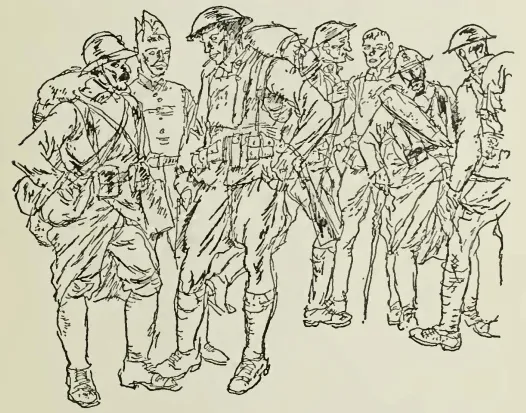
Presently the road zigzagged down into a steep valley with a stream, a bridge, and an empty, gaping town at the bottom, where we made a halt. The mess sergeant brought me the unpleasant news that the fire had gone out in our senile rolling kitchen; the old grates couldn’t stand the jolting of the road. But since I knew this meant that the faithful’ kitchen detail must have put up a brave but losing fight, I could not have much to say except to join in with a few hearty blessings on its former hapless owners, H. M. Royal Scots.
Nevertheless, the news was unwelcome. The men expected to be fed, and they looked to the officers to feed them. To feed, clothe, equip, and pay the men,—that is about all a line officer can do anyway,—pictures of sword flourishers in battle notwithstanding. Excuses make cold fare, and I had visions of our outfit sitting alongside the road while “A” company and “C” company fed full. A look into the boilers, however, with pieces of half-raw meat and potatoes floating in the lukewarm water, convinced me that nothing could be done, for just’ about that time we were on the move again. Such little things as this are what make the soldier’s life “so romantic,” housekeeping on the flowing road with 250 ravenous children.
The deserted town we passed through looked very desolate and lonely. It was the first place we had seen which the inhabitants had abandoned, and it gave one much the same sensation as passing through a cemetery at night. The village had not been shelled, but the balance was being held so precariously at Château-Thierry just then that a good many of the villages were being deserted. Any day the line might swing one way or the other. Here the inhabitants had left.
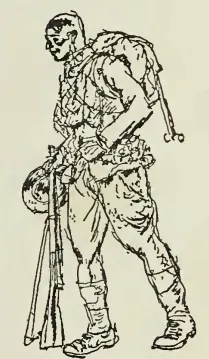
We toiled up the steep road toward the plateau on the other side of the valley, and finally made a halt near the top, where the subject of lunch once more became acute. The men began to look suspiciously at our “fireless” cooker, and I began to contemplate making a dicker for some hot coffee with Captain Williams of “A” company, when something occurred which drove all ideas of eating completely out of our minds.
There were no iron rations used on the sly that day!
“The colonel desires to see you and Lieutenant Shenkel, sir,” said the colonel’s chauffeur as he drove up in the commanding officer’s car. “Jump in.” I knew the “old man” must want to see us pretty badly if he sent his car, and as we whirled up the road, I anxiously passed in review my conduct of the last few days, which I am bound to say had been that of an officer and a gentleman. I glanced at Shenkel, who looked as innocent as ever. Well, we should soon know—here was the colonel now.
He was standing by the roadside with the adjutant and Captain Law,{1} where they had been having a hurried bite to eat, and he looked at us rather gravely as we came up and saluted him.
“The French general commanding at Château-Thierry has asked for two platoons from the 28th Division to cooperate with the French in an attack which is to take place tonight at Hill 204,” said the colonel. “I have sent for you because we want this regiment to participate, and I am going to send one platoon from ‘A’ company under Lieutenant Bentz and one from ‘B’ company under you, Lieutenant Shenkel. You and the company commander can decide what platoon it is to be. We cannot conveniently get in touch with the other battalions now, there is no time to lose, so both platoons will go from this battalion.”
We both saluted and fairly ran down the road back to the company. Of course, Shenkel would take his own platoon, the second. We lined them up on the road and made a close inspection of equipment.
It was surprising even in a well-equipped company how many little things were lacking here and there—now that the actual test had come. I stripped one or two men in the other platoons of their ammunition in order to supply missing clips where they were necessary, picked out the best automatic rifles and extra magazines; changed a few rifles which were rather suspect, and made one or two shifts in the personnel. In ten minutes the chosen platoon was ready. Then we told the men what was before them.
Instantly the lads of the other platoons crowded around and for a minute or two there was a great handshaking, exchange of keepsakes and little notes—“Mail that to Bess, will you, Jim, and write them home....” There was a spirit and enthusiasm, and yet a realization and lack of sentimentality about it that was fine to see. The men hardly seemed to realize that it was “good-bye” until they were swung into column and actually began to march. Then there was a storm of handshakes and farewells and cheers as they swung up the road to join the platoon from “A” company which had already gone on ahead. Over a third of them never came back. That was one thing you learned at the front; to be glad to see people when you met them, just in case...
A few minutes later, after the excitement cooled down, the main column got under way, and in about an hour we reached our new billet, Le Petit Villiers.
“B” company was lucky at this little town, since we had billets with lots of straw and a barn or so. I found a real house with a fine room for an office, and had the cooker just in front in a cow’s “bedroom,” that cow having gone the way of all flesh some time previously, to judge by the evidence. We buried her, while the cooks prepared a big meal, with fish for the officers, obtained by throwing a hand grenade in the creek near by—a trick we learned from the French soldiers detailed with us. Then we set up the cots and the company field desk in a room of the old farmhouse which had a pretty view across an orchard, the red roofs of the village peeping over the trees just beyond.
Here the men played baseball at leisure times, and in a field near by one of the companies pitched pup tents, as there were not enough billets to go around. Battalion headquarters took up their office just across the hall, where we could hear their typewriters clicking all day, for even at this time there was a good deal of “paper-work” going on.
Our stay of about a week in this town was a godsend, as during the captain’s absence I got the company thoroughly reorganized. Handling 250 men is no joke. I put my “headquarters platoon” in fine shape—mechanics, runners, cooks, and clerks, and appointed some more good non-commissioned officers, of whom there cannot be too many. It seems impossible that Pennsylvania politics could reach to France, even in a guard regiment, but they did. In the old (lays, a lot of the men had been appointed non-commissioned officers to salve up the folks at home in the fourth ward, or for some such reason, and it was necessary to change this now. I tried to get the right man in the right place.
Very soon the new order of things began to tell.
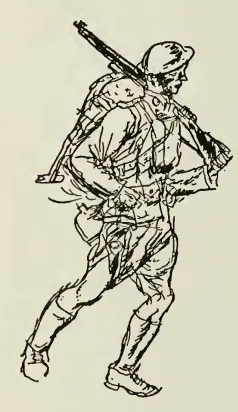
When a runner left company headquarters for any platoon, things started to happen right way. This was very necessary. We would often get an order to move, and turn out in the middle of the night, carts harnessed and all loaded, only to have the order countermanded after standing around in the chill of the night for an hour. Sometimes this happened two or three times a night. Few can imagine what this does to the morale of an outfit. Making up packs in pitch darkness, loss of sleep, scrambling and hunting around for things in the dark—as, of course, a light might bring down a bomb, is a real trial. But it finally got to be almost a joke. Soon we could turn out and turn in in no time, and that, I suppose, was what they wanted.
Regimental headquarters at this billet was at an old “farm-château.” This was the last place the band played. I went over to see the colonel. He and the adjutant had a room with some of those gigantic beds with funereal urns carved at the top. The big court was full of cows, sheep, chickens, and soldiers, with messengers going and coming. The large headquarters company camped just outside. Officers were shaving under the trees; the cookers were in full blast. Above all other sounds was the incessant noise of wagons, trucks, side cars, and artillery going and coming from the front along the highway near by, one of the great French national routes.
At night the noise of wheels was the most characteristic sound of war-time France. It sounded like a river in flood, washing and rolling its stones over the jagged boulders of its bed. At dawn all this ceased. The wagons were backed into the nearest bois, covered with branches and leaves, and the horses tied to trees. All the men disappeared; that is, the French did. The “Yanks” went wandering around like a plumbers’ picnic until they had enough men killed off to “get ‘vise.” Our military police, the “M.P.’s,” directed traffic.
Petit Villiers was a scattered hamlet, two or three disconnected little villages or groups of red-roofed houses among fields and orchards, rambling along green lanes that branched off at various angles from the main road. Battalion headquarters, where we had our company kitchen, was an old stone farmhouse situated on a crossroads about the center of the hamlet. It was here that I slept and had the company office with the field desk. The platoons were billeted on straw in various barns and empty sheds. One platoon was down at the extreme end of the village in a hay-filled barn. But its lieutenant had a real bed, a deep feather bed, in an old peasant’s house with spiral stone stairs and heavy black oak rafters. Madame was still living there, dressed in her white cap and sabots. She would, if encouraged, bring a little hot water with which to shave. The few chickens about were guarded most jealously, and eggs—an egg was a prize, indeed !
Our men were most forbearing i...
Table of contents
- Title page
- TABLE OF CONTENTS
- DEDICATION
- PREFACE
- PREFACE TO THIS EDITION
- CHAPTER I - ROUTE MARCHING
- CHAPTER II - BEHIND THE FRONT
- CHAPTER III - IN THE VALLEY OF THE SHADOW
- CHAPTER IV - THE MARCH TO CHÂTEAU-THIERRY
- CHAPTER V - A DAY AT CHÂTEAU-THIERRY
- CHAPTER VI - ON THE EDGE OF THE BATTLE
- CHAPTER VII - GERMAN DUGOUTS
- CHAPTER VIII - COURPOIL
- CHAPTER IX - AN AIR BATTLE
- CHAPTER X - A REST IN THE WOODS
- CHAPTER XI - A GRAVE IN THE WOODS
- CHAPTER XII - ANOTHER NIGHT MARCH
- CHAPTER XIII - THE MARCH TO THE VESLE, AND FISMES
- CHAPTER XIV - INTO THE PIT
- CHAPTER XV - A WILD DAY
- CHAPTER XVI - OVER THE BRIDGE
- CHAPTER XVII - OVER THE RIVER AGAIN
- CHAPTER XVIII - LAST HOURS IN FISMETTE
- Addenda
Trusted by 375,005 students
Access to over 1.5 million titles for a fair monthly price.
Study more efficiently using our study tools.
Frequently asked questions
Yes, you can cancel anytime from the Subscription tab in your account settings on the Perlego website. Your subscription will stay active until the end of your current billing period. Learn how to cancel your subscription
No, books cannot be downloaded as external files, such as PDFs, for use outside of Perlego. However, you can download books within the Perlego app for offline reading on mobile or tablet. Learn how to download books offline
Perlego offers two plans: Essential and Complete
- Essential is ideal for learners and professionals who enjoy exploring a wide range of subjects. Access the Essential Library with 800,000+ trusted titles and best-sellers across business, personal growth, and the humanities. Includes unlimited reading time and Standard Read Aloud voice.
- Complete: Perfect for advanced learners and researchers needing full, unrestricted access. Unlock 1.5M+ books across hundreds of subjects, including academic and specialized titles. The Complete Plan also includes advanced features like Premium Read Aloud and Research Assistant.
We are an online textbook subscription service, where you can get access to an entire online library for less than the price of a single book per month. With over 1.5 million books across 990+ topics, we’ve got you covered! Learn about our mission
Look out for the read-aloud symbol on your next book to see if you can listen to it. The read-aloud tool reads text aloud for you, highlighting the text as it is being read. You can pause it, speed it up and slow it down. Learn more about Read Aloud
Yes! You can use the Perlego app on both iOS and Android devices to read anytime, anywhere — even offline. Perfect for commutes or when you’re on the go.
Please note we cannot support devices running on iOS 13 and Android 7 or earlier. Learn more about using the app
Please note we cannot support devices running on iOS 13 and Android 7 or earlier. Learn more about using the app
Yes, you can access Toward The Flame: A War Diary by Hervey Allen in PDF and/or ePUB format, as well as other popular books in History & Military Biographies. We have over 1.5 million books available in our catalogue for you to explore.