Quentin Roosevelt was the youngest son of President Theodore Roosevelt, a man greatly admired by his colleagues, popular with his fellow World War One fliers, possessed with great ability, flair and intellectual ability. Sadly his life was destined to be brash, brave, brilliant and all too short. On the entry of America in to the First World War in 1917, Quentin dropped out of college to join the newly formed 1st Reverse Aero Squadron. His first services were on the ground at the famous Issoudun training base, but he demanded and received his pilot's wings transferring into 95th Aero Squadron part of 1st Pursuit Group, the aerial gladiators of the American Airforce. His flying career was not to last long, his contemporary, the famous flying ace Eddie Rickenbacker commented his flying style was bordering on the suicidal with a great contempt for danger;
"He was reckless to such a degree that his commanding officers had to caution him repeatedly about the senselessness of his lack of caution. His bravery was so notorious that we all knew he would either achieve some great spectacular success or be killed in the attempt. Even the pilots in his own flight would beg him to conserve himself and wait for a fair opportunity for a victory. But Quentin would merely laugh away all serious advice."
He claimed his first victory only a day after his squadron was posted to Touquin and the front lines; but he was shot down a mere four days later.
His letters were collected by his brother Kermit, who lovingly and carefully edited into this book which gives a picture of his headstrong, dashing brother poignantly including the many letters of tribute from Quentin's fellow flyers.
An excellent and vivid excellent snapshot of a young tyro in the American Air Force of the First World War.
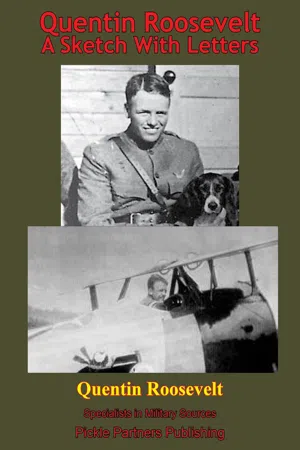
- 129 pages
- English
- ePUB (mobile friendly)
- Available on iOS & Android
eBook - ePub
Quentin Roosevelt - A Sketch With Letters
About this book
Information
Subtopic
Military BiographiesIndex
HistoryCHAPTER I—BEFORE THE WAR
QUENTIN ROOSEVELT was born in Washington on November 19, 1897, six months before his father enlisted for the war to free Cuba. As a boy he attended the public schools in Washington. The last year of his father’s second term as president he went to the Episcopal High School at Alexandria, Virginia.
The following summer—that of 1909—he spent in Europe. He had always been interested in mechanics, and in a letter to Ambler Blackford, a son of the principal of the school, he tells of his first sight of an airplane.
We have had a wonderful time here and seen lots. We were at Rheims and saw all the aeroplanes flying, and saw Curtis who won the Gordon Bennett cup for swiftest flight. You don’t know how pretty it was to see all the aeroplanes sailing at a time. At one time there were four in the air. It was the prettiest thing I ever saw. The prettiest one was a monoplane called the Antoinette, which looks like a great big bird in the air. It does not wiggle at all and goes very fast. It is awfully pretty turning.
Isn’t Notre Dame wonderful? I think anything could be religious in it. And the Louvre, I think it would take at least a year to see it. I have some of the pictures. I think the little Infanta Margarita by Velazquez is the cunningest thing I ever saw, and I think they are all very beautiful. We have been to Rouen and everywhere.
***
Tell S. that I am sending him a model of an aeroplane that winds up with a rubber band. They work quite well. I have one which can fly a hundred yards, and goes higher than my head!
Much love to all from QUENTIN.
That autumn on his return to this country he entered Groton School as a first former. His bent for mechanics, which was not inherited, and his love of reading, which was inherited, found expression in the school magazine. Quentin became an editor and also worked as typesetter and general overseer in the more practical part of publishing. It was in the printing-room that he enjoyed himself most when at Groton.
In January, 1915, with the World War launched upon its first winter, he wrote the following story for The Grotonian:
“ONE MAN WITH A DREAM “
“The train stopped with a jerk, the doors flew open, and the crowd surged out toward the street. I made my way slowly to the taxi stand and hailed a waiting machine. ‘4 West fifty-seventh street, and make it fast,’ I said. The man glanced at me quickly, hesitated, and then said, ‘Why that’s John Amsden’s house, isn’t it
“’Yes,’ I said, ‘make it in less than ten minutes and you get a fiver.’
“The machine started to the street, dove around the corner into thirty-fourth, and then across. The traffic seemed strangely crowded:—we barely moved behind a stream of street cars and autos. Finally came Broadway and I saw the reason. Herald Square was packed with people,—a tense, silent crowd, all watching the bulletin boards. I strained to catch a glimpse and made out, under the flaring arc lights, ‘10.45—Drs. Waring and McEwen report John Amsden is doing as well as can be expected. He is partially conscious.’
“I hammered on the window of the taxi stand, as the man turned, cried to him to hurry. The traffic was still blocked, however, and we were hemmed in. I looked at the board again. Another notice was being rolled up. ‘11—Condition slightly improved.’ Strained faces in the crowd relaxed. I could see one man turning to another and clapping him on the back, a smile of relief on his face. So that was the reason. That was why I had received the telegram, ‘John needs you. Come at once.’
“The traffic began to move, and soon we were racing up Fifth Avenue, 42nd, 48th, St. Patrick’s Cathedral,—at last 57th. Two policemen guarded the entrance of the street. I was evidently expected, for they let me through with a glance at my card.
“The door was open, and I went into the familiar hallway with its carved oak stairs. The contrast was startling. Outside the crowded streets;—inside, dead silence. I went upstairs. Low voices came from the back of the house. Someone inside was speaking:—’It must have been that speech in Union Square that did it. The Doctors say it is pneumonia. His system is so overworked that he can’t fight the disease.’
“Another man spoke up, ‘Something had to crack. No man can work at fever heat for weeks on end.’
“I pushed open the door and entered. Three men were seated before the fire, all of them men whom I knew. My cousin Arthur, who was a reporter on the Globe, Charles Wright, the actor, and Pearson, the critic. Arthur sprang to his feet as I entered. ‘I’m afraid it’s too late, Cousin Fred,’ he said, ‘the Doctors have given orders that no one is to see him.’
“Hopeless, I sat down. Why had I gone away? I might have known something would happen to him.
“‘Tell me,’ I said.
“‘There’s not much to tell,’ said Pearson. He would speak at that mass meeting in Union Square Friday. It was drizzling a little and he caught a chill. That and overwork brought on pneumonia. That’s about all.’
“We lapsed into silence, each thinking of the man above who was fighting for breath. The fire flickered, and then died out. Arthur spoke up:
“‘You were with him. Tell us about it.’
“‘It was like a dream,’ I said, ‘A dream come true.
“‘John Amsden and I roomed together at college. I think that was the beginning of our friendship. He never did much there, that is, in any serious way. He worked a little, went to every dance in or out of Boston, and that was about all. He had not the physique for an athlete, and though he had several things published in the Advocate, he gradually let it drop, and never tried for editor. He did not have to work for a living, for his father’s millions were waiting for him so there was no incentive. People said that he had lost what little capacity he had ever had for work while in college.
“‘After college he led the life that all those lead who belong to the class reformers and Socialists call the idle rich. His winters were spent in Aiken or Palm Beach; his summers in Europe, with interludes of Meadowbrook and Tuxedo. I doubt if he ever did anything more than this for twelve years. Even his friends, who always claimed that he would some day develop, gave up hope. He seemed to have arrived at the end of his development.
“‘Last summer we arranged to go abroad together for a bicycle trip through Holland and Belgium. That was in July. August found us in Belgium, travelling slowly from place to place. To make a long story short, we were caught in the whirlwind of the war. We saw the fall of Liege and we followed in the track of the invader as he tramped through Belgium. We saw towns levelled, cathedrals shelled, smelt the smell of the battle-field, saw the fleeing people, homes burned, husbands and fathers gone, the soldier dead, his rifle in his hand, the priest with his crucifix,—we saw it all.
“‘To John it was a revelation. He had never before felt the horror of death, never seen the human soul apart from its polished covering. What death he had seen had been decorous, honored, attended with peace and quiet. He had barely realized the fact that suffering existed,—that the horrors of war were any more than a novelist’s term.
“‘Following in War’s path had brought it all home to him with an appalling nearness. All the sorrows he had never known, all the emotions he had never felt, he went through it all, saw the feelings of people, not mirrored in a book or veneered by etiquette, but sharp, bitter, unconquerable. In him it brought out all the character that had lain hid. All the crusader spirit of his ancestors came to the top. He was fired with it. In his reaction he thought of his former life almost with loathing. It seemed to him almost unbelievable that America could be callous to the suffering, to the horror of what he saw before his very eyes. He felt he was chosen, that it was his duty to tell of Belgium.
“‘He decided quite suddenly. “I’m going back, Fred,” he said, “to tell the people at home about this. They must understand, they must help.”
“‘We made our way to the coast, as best we could, and at last got a steamer for America. On our voyage we talked of the people at home often. It never occurred to him that people would not understand, that they would not see as he did. He could not conceive of anyone remaining unmoved in the face of suffering such as we had seen.
“‘We parted at the dock. The next day, as I sat at home, the telephone rang. It was John. “Fred,” he said, “I must have a talk with you.”
“‘We agreed, finally, that I was to come over and see him.
“‘He was sitting in this room before the fire, as we are now, when I came in. In all my life I have never seen a look of utter hopelessness such as there was on his face. “It’s all wrong,” he said, “they don’t see. I can’t understand it.”
“‘He told me then, how he had been to his friends, had spoken to them, and the effect of his words. “They wouldn’t even listen to me. They wouldn’t even listen! I tried to tell about it all but they cut me short. Harry Wilding wanted to tell me about the baseball the Giants were playing. Schuyler had a scheme he wanted me to finance,—to charter a steamer and send over a cargo of silk socks to Belgium. Said it was a great opportunity now that the German market was closed.” He laughed, dully, and, pulling aside the shade pointed out the window.
“‘“There,” he said, there it is. That is the explanation. That is the American spirit; America’s countersign; her God.”
“‘I looked. A huge sign showed in electric lights:
THE NEW NATIONAL MAGAZINE
JAMES FRIED’S article on WHAT THERE IS IN THE WAR FOR THE U. S. A.
“’Yes,” said John, bitterly, “that is the acid test of the ‘Great American Nation’s’ feelings. What do we get out of it?”
“‘He gazed into the depths of the fire, and I watched the shadows come and go on his face. Suddenly his expression changed, and his eyes sparkled with the light of battle. “I have it,” he cried, “I shall write the play of the war. I shall bring war home to the people as it has never been brought before. I shall challenge the nation.”
“‘That was the beginning of his great play. He worked feverishly, at high pressure,—writing far into the night.
“In three weeks it was done. I remember the joy on his face as he came to the door. “It’s done, Fred,” he said.
“He would not let me read it, though I begged him to. The first night, so he said, was the test. He wanted me to see it then for the first time, and so I waited. As you know, Eisenstein agreed, after the first reading, to put it on as soon a company could be got together.
“‘Then, at last, came the first night. All New York seemed to be there. It had been wonderfully advertised. All over the city, great placards with the name, WAR, in red, and then JOHN AMSDEN, underneath. I had to fight my way,—but you were there—you remember.’
“Pearson nodded.
‘You remember how it was received. Not a sound from the whole packed house. Not a clap, not a cheer, not even the shuffling that a crowd of people generally make. It was a tense, uplifted audience. A woman in front of me was crying as the curtain fell, and the crowd filed out silently. No one was discussing the play in the lobby when I came out. It was too great, beyond unthinking praise. Men went home and thought over it.
“‘By morning it was famous. In every paper it appeared on the front page. Critics called it a sermon of the stage.
“‘That was four weeks ago. Since then the ...
Table of contents
- Title page
- TABLE OF CONTENTS
- FOREWORD
- ILLUSTRATIONS
- CHAPTER I-BEFORE THE WAR
- CHAPTER II-THE WAY OF THE EAGLE
- CHAPTER IV-OFFICIAL JUDGMENT
- CHAPTER V-“THE JUDGMENT OF HIS PEERS”
- CHAPTER VI-VERSES
- REQUEST FROM THE PUBLISHER
Trusted by 375,005 students
Access to over 1.5 million titles for a fair monthly price.
Study more efficiently using our study tools.
Frequently asked questions
Yes, you can cancel anytime from the Subscription tab in your account settings on the Perlego website. Your subscription will stay active until the end of your current billing period. Learn how to cancel your subscription
No, books cannot be downloaded as external files, such as PDFs, for use outside of Perlego. However, you can download books within the Perlego app for offline reading on mobile or tablet. Learn how to download books offline
Perlego offers two plans: Essential and Complete
- Essential is ideal for learners and professionals who enjoy exploring a wide range of subjects. Access the Essential Library with 800,000+ trusted titles and best-sellers across business, personal growth, and the humanities. Includes unlimited reading time and Standard Read Aloud voice.
- Complete: Perfect for advanced learners and researchers needing full, unrestricted access. Unlock 1.5M+ books across hundreds of subjects, including academic and specialized titles. The Complete Plan also includes advanced features like Premium Read Aloud and Research Assistant.
We are an online textbook subscription service, where you can get access to an entire online library for less than the price of a single book per month. With over 1.5 million books across 990+ topics, we’ve got you covered! Learn about our mission
Look out for the read-aloud symbol on your next book to see if you can listen to it. The read-aloud tool reads text aloud for you, highlighting the text as it is being read. You can pause it, speed it up and slow it down. Learn more about Read Aloud
Yes! You can use the Perlego app on both iOS and Android devices to read anytime, anywhere — even offline. Perfect for commutes or when you’re on the go.
Please note we cannot support devices running on iOS 13 and Android 7 or earlier. Learn more about using the app
Please note we cannot support devices running on iOS 13 and Android 7 or earlier. Learn more about using the app
Yes, you can access Quentin Roosevelt - A Sketch With Letters by Quentin Roosevelt, Kermit Roosevelt in PDF and/or ePUB format, as well as other popular books in History & Military Biographies. We have over 1.5 million books available in our catalogue for you to explore.