This paper examines Sherman's growth as a strategic thinker and successful strategist. It explores how his life shaped him to fill the role that he did in the Civil War and what things contributed to his development into the soldier who could plan and execute the North's strategy in the last year of the war. It also focuses on specific instances of success and failure that led him to the position from which he could influence, if not actually author, the strategy followed by the Union in the last year of the war.
It also examines what Sherman brought to his relationship with Ulysses S. Grant and how that relationship affected the evolving strategy that guided the Union Army after Grant ascended to the leadership of all Union Armies.
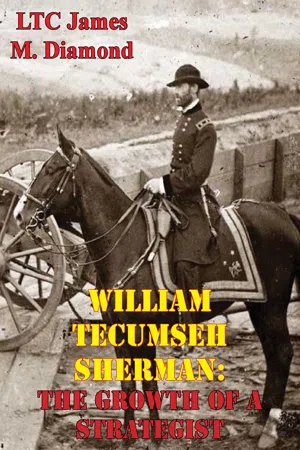
- 33 pages
- English
- ePUB (mobile friendly)
- Available on iOS & Android
eBook - ePub
William Tecumseh Sherman: The Growth Of A Strategist
About this book
Information
Subtopic
19th Century HistoryIndex
HistoryWilliam Tecumseh Sherman: Growth of a Strategist
In the opening days of the American Civil War strategic thought, in the minds of many who would lead the North’s forces, could be summed up in the three stirring words “On to Richmond!”
One who saw beyond that enticing but ultimately false course was William Tecumseh Sherman. How was it that Sherman, who had left the Army in 1853 and was serving as the President of the Louisiana Seminary of Learning and Military Academy as the war approached, was able to see what the senior military and political leaders of the North could not?
The way Sherman perceived the coming struggle, what he thought about the ends, means, and ways with which he would labor for those four bloody, terrible years was in part based on his unique personality and in part developed over years of study, travel, and experience. Those thoughts and experiences, distilled by Sherman’s quick, trenchant intellect ultimately produced a strategic vision of ways and means to achieve the military and political ends of the Union in the Civil War.
Sherman’s successful collaboration with his contemporary and commander, U. S. Grant, brought the Union victories in the field and eventually victory in the war. Sherman’s contributions to their efforts took many forms. He was a superb subordinate to Grant, aggressive in the field, quick in carrying out his orders and in accomplishing his missions. He was also able, perhaps to a greater degree than Grant, to see and understand things about this war that often escaped others.
Despite his ultimate success Sherman did not appear on the field with all of the answers and all of the authority he needed to defeat the South. Indeed, he spent the first two years of the war growing, sometimes through very painful lessons, to reach his potential as a commander and strategist. But these first two years of the war were only a continuation of a lifetime of trials, growth, observation, study, and occasional failure that finally produced the Army Commander who would contribute so much to the Union victory’ in the Civil War.
Sherman’s growth from the “tall, slim, loose jointed lad, with red hair, fair burned skin, and piercing black eyes”{1} who left his home in Lancaster, Ohio to report to West Point in 1836 to the “master grand strategist of our Civil War”{2} had many roots. These were divergent, wide ranging, and eclectic, but they all found a common home in the far reaching, ever hungry intellect, and exceptional energy of William Tecumseh Sherman.
This paper examines Sherman’s growth as a strategic thinker and successful strategist. It explores how his life shaped him to fill the role that he did in the Civil War and what things contributed to his development into the soldier who could plan and execute the North’s strategy in the last year of the war. It focuses on specific instances of success and failure that led him to the position from which he could influence, if not actually author, the strategy followed by the Union in the last year of the war.
It also examines what Sherman brought to his relationship with Ulysses S. Grant and how that relationship affected the evolving strategy that guided the Union Army after Grant ascended to the leadership of all Union Armies.
Sherman brought many things to the Union’s efforts in the Civil War. His contributions had their beginnings in his natural talent and intelligence and were shaped by training, observation, and experience. One way to view his evolution into what B. H. Liddell Hart called “a grand strategist”{3} is that Sherman’s intellect and personality were the seed from which he was to grow. The seed and all its potential was watered in his upbringing and training. It grew through his initial service in the Army and his various undertakings as a civilian. Sherman’s service in the Civil War seasoned and matured him and produced the man who would have such an effect on that war and on the Army after the war.
Sherman’s early life was relatively unremarkable for a boy growing up in the freedom of Ohio in the early nineteenth century. The major event of his young life was the death of his father when Sherman was nine years old. Nonetheless, his biographers write of a boy who passed his free time as any other youngster in Lancaster, Ohio might. When he was fourteen however, his foster father Senator Thomas Ewing advised him “to prepare for West Point.”{4} Two years later Sherman arrived at West Point with little knowledge of what awaited him there. Despite his proclivity for independent, occasionally unorthodox, thought and his tendency to accumulate demerits, Sherman adapted. He applied himself to the demands of the school, and after four years was graduated sixth in his class.{5}
His class rank was not high enough to win entry into the coveted Corps of Engineers so he selected the Artillery as his branch of service. He joined his unit, the Third Artillery, in Florida in late 1841. He was happy with his first assignment as it gave him an opportunity for what he called “active service,” in this case against the Seminole Indians who were being forcibly transplanted from Florida. The service was not as active as he would have liked, but it did offer him the opportunity to serve far away from what he described as the problems of living in “civilization.”
Sherman always enjoyed duty in the more remote districts of the land. Being away from the trials of the civilized world enabled him to be outdoors, to challenge himself physically, and to expand his never satisfied hunger for knowledge, especially for geography and topography. In a letter to a friend he wrote:
“Every day I feel more and more in need of an atlas, such as your father has at home; and as the knowledge of geography, in its minutest detail, is essential to a true military education, the idle time necessarily spent here might be properly devoted to it. I wish therefore, you would procure for me the best geography and atlas (not school) extant.”{6}
During his first Army career, from 1841 until his resignation in 1853, Sherman took every opportunity to explore the land where he happened to be. He described what he saw and what he learned in letters home, which disclose his exceptional appreciation of the land. He seemed to have a natural talent for seeing in terrain what others could not- a talent that was to serve him and his nation well in the future.
Subsequent assignments in Florida, Alabama, South Carolina, and Georgia allowed Sherman to use what leisure ...
Table of contents
- Title page
- TABLE OF CONTENTS
- ABSTRACT
- William Tecumseh Sherman: Growth of a Strategist
- Bibliography
Trusted by 375,005 students
Access to over 1.5 million titles for a fair monthly price.
Study more efficiently using our study tools.
Frequently asked questions
Yes, you can cancel anytime from the Subscription tab in your account settings on the Perlego website. Your subscription will stay active until the end of your current billing period. Learn how to cancel your subscription
No, books cannot be downloaded as external files, such as PDFs, for use outside of Perlego. However, you can download books within the Perlego app for offline reading on mobile or tablet. Learn how to download books offline
Perlego offers two plans: Essential and Complete
- Essential is ideal for learners and professionals who enjoy exploring a wide range of subjects. Access the Essential Library with 800,000+ trusted titles and best-sellers across business, personal growth, and the humanities. Includes unlimited reading time and Standard Read Aloud voice.
- Complete: Perfect for advanced learners and researchers needing full, unrestricted access. Unlock 1.5M+ books across hundreds of subjects, including academic and specialized titles. The Complete Plan also includes advanced features like Premium Read Aloud and Research Assistant.
We are an online textbook subscription service, where you can get access to an entire online library for less than the price of a single book per month. With over 1.5 million books across 990+ topics, we’ve got you covered! Learn about our mission
Look out for the read-aloud symbol on your next book to see if you can listen to it. The read-aloud tool reads text aloud for you, highlighting the text as it is being read. You can pause it, speed it up and slow it down. Learn more about Read Aloud
Yes! You can use the Perlego app on both iOS and Android devices to read anytime, anywhere — even offline. Perfect for commutes or when you’re on the go.
Please note we cannot support devices running on iOS 13 and Android 7 or earlier. Learn more about using the app
Please note we cannot support devices running on iOS 13 and Android 7 or earlier. Learn more about using the app
Yes, you can access William Tecumseh Sherman: The Growth Of A Strategist by LTC James M. Diamond US Army in PDF and/or ePUB format, as well as other popular books in History & 19th Century History. We have over 1.5 million books available in our catalogue for you to explore.