- 160 pages
- English
- ePUB (mobile friendly)
- Available on iOS & Android
eBook - ePub
About this book
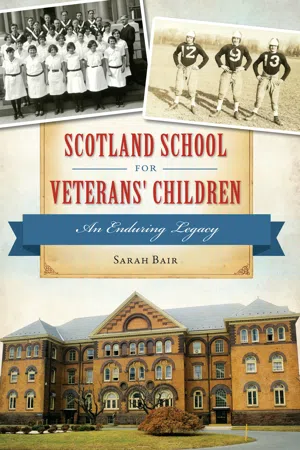
Beginning as a school for Civil War orphans, the Scotland School for Veterans' Children became a unique center for education in the heart of Pennsylvania. The school aimed to develop disciplined, patriotic and productive citizens. As the nation became engulfed in the wars of the twentieth century, the Scotland School became even more vital, with a focus on educating the children and orphans of military veterans. Though it was closed by the state in 2009, memories of the school and its community of alumni remain vibrant. Author Sarah Bair charts the history of a place where thousands of children of our nation's finest found more than just a school--they found a home.
Trusted by 375,005 students
Access to over 1.5 million titles for a fair monthly price.
Study more efficiently using our study tools.
Information
Subtopic
Education GeneralIndex
History1
Historical Overview
On March 16, 1866, Andrew G. Curtin, Pennsylvania’s Civil War governor, left his office and headed for the state capitol building to address the legislature. The war had ended almost a year earlier, but Curtin knew his state’s recovery would be long and expensive. On this day, he hoped to convince reluctant legislators to continue funding his previously established Civil War orphan education program. Pointing out that it would be unconscionable to have children fending for themselves on the streets of Pennsylvania when their brave fathers had “brought us fruits of hard fighting and gained us our victories,” Curtin reiterated the successful argument he had made two years before. At that time, during the heart of the war, he convinced legislators to supplement a $50,000 donation from the Pennsylvania Railroad Company to establish an orphan care and education program.1 With this initial approval in hand, Curtin appointed a superintendent of orphan education to oversee the program and established a decentralized system that relied largely on existing childcare institutions around the state. Orphanages and schools within the system agreed to serve Civil War orphans and comply with state guidelines in return for state funding.2 Curtin’s successful follow-up appeal to the legislature in March 1866 would be repeated at regular intervals by his successors over the next three decades. During that period, the Civil War orphan program in Pennsylvania supervised a total of forty-three institutions across the state and served almost fifteen thousand children at a cost of nearly $10 million.3 Without this system in place, the Pennsylvania Soldiers’ Orphans Industrial School (SOIS), as Scotland was originally named, would not have been established in 1895.
Legislators who approved funding for orphan care and education in 1864 believed the program would be short-lived, but a series of unanticipated enrollment extensions kept demand high for decades. By the early 1890s, with costs rising and management becoming increasingly difficult, lawmakers confronted a hard choice. They could either shut down the system, turning away eligible children, or find more efficient and costeffective ways to continue it. Among those advocating the latter, support began to grow for the construction of a centralized industrial school that could meet the needs of Civil War orphans and then be converted to a manual training school for other destitute children once the last of the orphans had left the school. Several other states, including Ohio, Indiana, Wisconsin, Iowa and Illinois, had already established homes specifically for orphans of Civil War soldiers, but, unlike Pennsylvania, these states owned and operated the facilities directly.4 To its credit, Pennsylvania cared for more soldiers’ orphans than other states did in the same period, but the decentralized system presented its own challenges, and after three decades, many legislators hoped to find a new way to keep the state’s commitment to Civil War veterans and their children.
In order to determine the feasibility of an industrial school, the commissioners of soldiers’ orphan schools, who had taken over leadership of the system from the superintendent of orphan education in 1889, set up a special committee in 1892 to explore options and make a recommendation about moving forward.5 After visiting several industrial schools around the country, the committee issued a report to the commission and the state legislature on December 15, 1892, recommending Pennsylvania build an industrial school to accommodate up to one thousand students.6 As a result of this committee’s work, Pennsylvania’s Act of 1893 authorized the creation of the Pennsylvania Soldiers’ Orphans’ Industrial School and approved funds to build and operate the school. In addition to consolidating the system under one facility and providing a home for any remaining eligible Civil War orphans in Pennsylvania, legislators saw the school as a vehicle for developing disciplined, patriotic and productive citizens who would strengthen the state’s economy.
The Act of 1893 reaffirmed admissions requirements established under previous laws and outlined admissions preferences. Parents of applicants had to have lived in Pennsylvania for five years prior to the date of application and applicants had to be under the age of fourteen. According to the law, they would be educated to the age of sixteen, but provisions allowed those students who would be fifteen or sixteen when the school opened to stay an extra two years to benefit from an industrial education. First priority for admission went to full orphans of soldiers, sailors and marines who served in the Civil War as members of Pennsylvanian commands or, having served in other commands, resided in Pennsylvania when they enlisted. Second priority went to children as described above with deceased fathers and living mothers. Children with parents who had disabilities were third priority. In the original orphan education system, veterans had to prove their disabilities stemmed directly from injuries sustained during the Civil War, but the Act of 1893 did not stipulate this. The new law also authorized the commission to purchase one hundred acres of land for the campus in an easily accessible location and to continue to operate other schools until all children could be transitioned to the new school. The commission’s annual report for 1893 showed 439 children in the system, 194 at Chester Springs, 92 at Harford, 151 at Uniontown and 2 at other schools.
EARLY YEARS7
With state authorization, the commission used $12,000 to purchase from state senator Alexander Stewart one hundred acres of land in Scotland, Pennsylvania, a small village approximately forty-five miles southwest of Harrisburg.8 The land, selected for its proximity to the central part of the state and its location on the Cumberland Valley Division of the Pennsylvania Railroad, had originally been part of a six-hundred-acre plantation called Corker Hill owned by Alexander Thompson, the first permanent settler in Scotland.9 Its proximity to Chambersburg allowed easy access to basic resources. With mature maple trees and the Conococheague Creek running through the property, the location provided a lovely setting and allowed room to expand. After acquiring the land, the commission hired an architect and accepted bids to begin construction. Although the commission requested funding to build homelike cottages for student housing—an approach favored by an increasing number of child advocates at the time—the legislature initially only provided enough funding to construct a main building, a powerhouse and an industrial plant. Lack of funding and insufficient housing plagued Scotland in its early years and undermined the original goal of closing the other schools in the system.

Cumberland Valley Railroad Station, c. 1890s.

Bridge over the Conococheague to the tree-lined school entrance.
Because the new industrial school could not accommodate all the children from the three remaining schools, the 242 initial enrollees were mostly older children between the ages of twelve and fifteen who transferred to Scotland in order to receive industrial training before exiting the system. The Act of 1893 only officially allowed children to stay in the system up to the age of sixteen, but in 1901, the legislature extended the law, allowing students who turned sixteen between January 1 and June 30 to remain at the school until June 30. Those completing their educations and exiting the system at age sixteen became known as “sixteeners.” In 1905, an amended law allowed qualified students to stay in school until the age of eighteen. Although boys and girls of all races could attend Scotland, white students representing regions from around the state formed the vast majority during this early period.
Despite the best hopes of the commission, inconsistency in leadership, funding shortages, overcrowding and myriad other challenges hampered Scotland’s first several years. Between 1895 and 1900, four different men served in the role of superintendent at Scotland. General Charles L. Young, the first of the four, joined thirty-three other employees, including four teachers, a principal, a nurse (his wife) and a local doctor, who came three days per week to provide health services.10 Young endured a difficult first year and found himself on the receiving end of considerable criticism from Frank G. Magee, the commission-appointed school inspector, who bluntly reported on poor general management as well as unrest and insubordination among male students, frequent runaways, shabby clothing and defaced property.11 In August 1896, the commission replaced Young with James M. Clark, but he fared little better, according to Magee. When the commissioners relieved Clark of his superintendent’s duties in August 1897, they replaced him with none other than Magee himself. Magee, however, had only a short time to prove that he could do better than his predecessors because he died in April 1899, less than two years into his term, and was replaced by M.L.Thounhurst, Scotland’s principal. In June 1900, Thounhurst, who had been part of the Civil War Orphan Program in various capacities for a long time and generally received high marks for competence, moved from Scotland to Chester Springs, leaving the industrial school without a superintendent once again.
In an effort to close the other schools in the system, these early leaders tried to stretch limited state dollars to pay for construction needed at Scotland. Burger and Son Construction Company completed the initial building, which housed all school operations other than the shops, and the industrial building prior to the school’s opening, but many smaller building projects and capital improvements still needed to be completed after students arrived. By the close of 1897, a machine shop, forge shop and pumping station had been built, and renovations of the property’s existing barn had begun. The school also put in a pond during the 1896– 97 school year, which spurred a long tradition of winter ice-skating and summer fishing. During the same year, Scotland added fire extinguishers and hoses and built a gun rack for firearms used by the boys in their military drills.12

Main Building SOIS, built in 1895.

Students skating on the pond, circa 1900s.
Putting in place the fire equipment proved to be fortuitous. On February 20, 1901, the school faced its first serious crisis, a fire in the engine room of the industrial building.13 Thankfully, the fire apparatus worked well, and the system of hydrants and hoses saved the nearby boiler and laundry rooms. According to the head of Scotland’s industrial department, school officials called the Chambersburg Fire Department to be sure windy conditions did not carry the fire to the main school building.14 Unfortunately, the fire destroyed the electrical system and heating pipes, leaving the school without lights or heat for a short period of time. Some industries had to be temporarily relocated.15
During the same year, Scotland faced a major health scare with a scarlet fever epidemic affecting seventy-four students. Isolated in the farmhouse turned temporary hospital, all of them survived. The commission had called on the state to fund the building of a hospital in its initial plans, and school leaders had raised concerns about healthcare facilities in several of their early reports. In 1899, for example, the medical department noted the general inadequacy of the infirmaries and pointed to a discrepancy between the quality of the boys’ and girls’ facilities. Girls could only get to their infirmary by passing through the girls’ dorm, thus exposing everyone to their illnesses.16 The scarlet fever crisis increased the pressure to build a hospital at Scotland, and by the spring of 1901, the school had secured a contract of $7,650 to build such a facility.17 The building remained in use until 1960, when it was razed and replaced in 1962 with a modern fortyeight-bed hospital.
After this initial period of struggle, the school gained stability under George W. Skinner, who served as superintendent from the summer of 1900 to 1909, and William H. Stewart, who left his position as the school’s industrial education director to serve as superintendent from 1909 to 1920. This period saw the establishment of the school’s basic infrastructure, curriculum, procedures and schedule. Daily living incorporated military drill and physical fitness for both boys and girls, academic and trades training for all students, moral training through Sunday school and chapel and regular work details. In the early days, Scotland established a strong music program, a fledgling athletic program for boys and a variety of extracurricular activities, including the school newspaper and a literary society. The daily schedule, containing few variations over the years, went as follows:
6:00 a.m.: Wake up, calisthenics for ten minutes, wash and dress for breakfast
6:30 a.m.: Breakfast followed by work detail
8:00 a.m.–8:30 a.m.: Drill or band
8:45 a.m.–11:45 a.m.: School and trades
12:00 p.m.: Lunch followed by free time
1:00 p.m.–4:00 p.m.: School and trades
4:00 p.m.–5:30 p.m.: Sports and other extracurricular activities
5:30 p.m.: Dinner followed by free time
7:00 p.m.–8:30 p.m.: Study hour for older children
9:00 p.m.: Taps and Bed

First school hospital, built in 1901 and razed in 1960.
School leaders believed this strict daily routine gave students stability and discipline.
While Superintendent Skinner established routines at Scotland, he continued to deal with overcrowding and a state legislature unwilling to invest in school expansion. The closing of Harford—the smallest of the three remaining schools—in 1899 and the transfer of students to Scotland without any new construction led to worse overcrowding. By June 1906, Scotland housed 333 students in facilities originally designed for no more than 300, prompting the Pennsylvania legislature on June 13, 1907, to approve funds to enlarge the capacity of the school. Construction began on an auditorium/ chapel, including a second-floor dormitory, near the main building. This space allowed some of the younger boys to move out of the main structure, an especially important step at the time because Uniontown closed on May 31, 1908, and approximately 100 additional students transferred to Scotland. Builders added a new kitchen to the main building that year, as well.

Auditorium built in 1907 and girls’ dormitory, added in 1912.
With the ...
Table of contents
- Front Cover
- Half Title
- Title Page
- Copyright
- Contents
- Foreword, by Frank Frame
- Alumni Note by James A. Lowe ('70) and Sally Sheaffer ('65)
- Acknowledgements
- Introduction
- 1. Historical Overview
- 2. Scotland “Kids”
- 3. Discipline, Military Tradition and Work
- 4. The School Experience
- 5. Life Outside the Classroom
- 6. Fight for Survival
- Epilogue
- Notes
- About the Author
Frequently asked questions
Yes, you can cancel anytime from the Subscription tab in your account settings on the Perlego website. Your subscription will stay active until the end of your current billing period. Learn how to cancel your subscription
No, books cannot be downloaded as external files, such as PDFs, for use outside of Perlego. However, you can download books within the Perlego app for offline reading on mobile or tablet. Learn how to download books offline
Perlego offers two plans: Essential and Complete
- Essential is ideal for learners and professionals who enjoy exploring a wide range of subjects. Access the Essential Library with 800,000+ trusted titles and best-sellers across business, personal growth, and the humanities. Includes unlimited reading time and Standard Read Aloud voice.
- Complete: Perfect for advanced learners and researchers needing full, unrestricted access. Unlock 1.5M+ books across hundreds of subjects, including academic and specialized titles. The Complete Plan also includes advanced features like Premium Read Aloud and Research Assistant.
We are an online textbook subscription service, where you can get access to an entire online library for less than the price of a single book per month. With over 1.5 million books across 990+ topics, we’ve got you covered! Learn about our mission
Look out for the read-aloud symbol on your next book to see if you can listen to it. The read-aloud tool reads text aloud for you, highlighting the text as it is being read. You can pause it, speed it up and slow it down. Learn more about Read Aloud
Yes! You can use the Perlego app on both iOS and Android devices to read anytime, anywhere — even offline. Perfect for commutes or when you’re on the go.
Please note we cannot support devices running on iOS 13 and Android 7 or earlier. Learn more about using the app
Please note we cannot support devices running on iOS 13 and Android 7 or earlier. Learn more about using the app
Yes, you can access Scotland School for Veterans' Children by Sarah Bair in PDF and/or ePUB format, as well as other popular books in History & Education General. We have over 1.5 million books available in our catalogue for you to explore.