The story of a renowned French painter who volunteered for the Army during the First World War paints a vivid picture of the horror at the front in his letters home written before his death in 1915.
"A Bestseller, remarkable for the horrors of the western front conveyed in a spirit of self-sacrifice and filial love."- A Companion to World War One ed. John Horne, Blackwell Publishing, 2012
"THE following letters were written by a young French painter who was at the front until the beginning of April, 1915, when he "disappeared" in one of the combats in the Argonne region of France. "Should he be spoken of in the present or in the past?" asks M. André Chevrillon , a friend of the soldier's family, in the preface to the French edition of this book. "Since the day when his mother and grandmother received from him his last communication, a post card bespattered with mud which announced the attack in which he fell, what a tragic silence for these two women who, during eight months, had lived only with these letters, which came almost daily. In his studio, among the pictures in which this young man had fixed his dreams and his visions of an artist, I have seen, piously arranged on a table, all the little square white sheets of this correspondence. What a speechless presence! I did not know then what a soul was there transcribed in these messages to the family hearth - a fully formed soul, which, if it had lived, I feel sure would have spread its fame and its influence far beyond this little home circle and radiated a-wide among the hearts of men.""
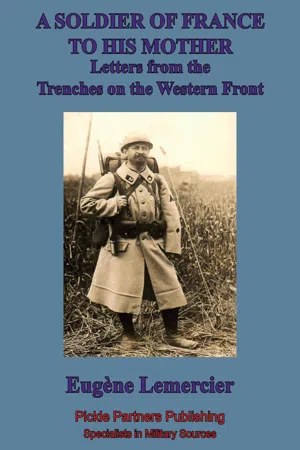
eBook - ePub
A Soldier Of France To His Mother; Letters From The Trenches On The Western Front
- 91 pages
- English
- ePUB (mobile friendly)
- Available on iOS & Android
eBook - ePub
A Soldier Of France To His Mother; Letters From The Trenches On The Western Front
About this book
Information
Subtopic
Military BiographiesIndex
HistoryA SOLDIER OF FRANCE TO HIS MOTHER
LETTERS FROM THE TRENCHES ON THE WESTERN FRONT
1914
AUGUST
August 6, 1914.
These are my first days as a soldier, and they are full of life. The fatigue is very different from what I imagined it would be. I am in a state of great nervous tension due to a lack of sleep and exercise. I am leading the existence of a bureaucrat, having been assigned for duty to what is called the Dépôt, that is to say to the military clerical force which attends to all the services even when the troops are away, and which in the end goes forward to fill up the gaps which may occur on the firing-line. What we miss most is not having any news of what is going on outside of this little town where newspapers no longer penetrate.
August 13.
Still no news, and I am told it will be so for some days to come, as the censorship is being applied with increasing rigor. Our time passes very quietly here. The weather is magnificent, and calmness and confidence are in the air. We are thinking of those who are fighting in the heat, and this thought causes us to find our own situation really too fine. The morale of these reservists is excellent.
Sunday, August 16.
I took a walk today along the banks of the Marne, in weather made all the more charming by a shower. A moment's change of this kind is very agreeable in these troubled times. We are still without any news, just as you are; but fortunately we are blessed with a lot of patience. I have found some pleasure in feasting my eyes on the landscape hereabouts, notwithstanding the invasion of red trousers and blue coats. What a fine impression, by the way, you get of the morale of these same red trousers and blue coats. We are sending many of them forward and they all accept their part tranquilly.
August 19.
The monotony of military life benumbs me; but I do not complain. The same characters with whom I was acquainted nine years ago, when I did my military service, come back to me again, more mellowed, improved and all more on a common level now than then; especially are we all now under the influence of the great events which the news from the eastern frontier keeps constantly before our minds{2}. The ordinary comradeship of the barracks gives place to a more admirable spirit of solidarity, and everybody is trying to do his best to adapt himself to the surroundings. One of the advantages of our present situation is that we can play at soldier without feeling that we are roasting our time. All these rather puerile and simple occupations now present their useful and immediately practical side; so you do everything in a calm spirit and nothing gets on your nerves. And what exerts a still further quieting effect over all these men is a deep, vague sentiment of fraternity which turns all hearts towards those who are on the firing-line. Each one feels that the little discomforts which we have to put up with are a very feeble contribution to the common welfare when compared with the terrible tribute of every sort of energy and devotion now exacted at the frontier.
August 25.
This letter precedes but little our own departure from this place. The terrible shock at the front calls for our presence with those who are fighting there already. I leave you both, Grandmother, and thee, my Mother, with the hope of seeing you again. I feel sure that you will approve my doing everything that duty demands. But nothing has happened to cause us to despair of success; France still sees clearly the part she is called upon to play in this crisis.
Please say to all those who have any love for me that I am thinking of them as I make my preparation for departure, but that unfortunately I have no time to write to anybody now. I am in the very best of health. After such a change in the situation as that about to occur, we may say that all our preceding experiences belong to a dead past. Let us have recourse to all our energy, dear Mama, to adapt ourselves to an entirely different existence, however hard it may be for both of us to do so. You may be sure that I shall not go out of my way to do things that will endanger our happiness; but I shall so act that my own conscience and yours will be satisfied. So far in this campaign I can find no fault with my conduct, and I intend to continue on those lines.
August 25.
A second letter this same day to tell you that instead of our regiment going, it is Pierre's. I had the joy to see him pass right by me while I was on guard in town and accompanied him for some one hundred yards, and then we said good-bye. I somehow feel that he and I shall meet again. The regiment left with flowers in the barrels of their guns, and singing. We both got much comfort out of thus being together to the end. That was a fine action on the part of André{3} to save the life of that soldier who was drowning. Nobody imagines all the heroism there is in France and in the intellectual youth of Paris.
This is a grave hour for us. The country is not destined to die, but its deliverance will be secured only at the price of a terrible effort. As regards our losses, I know we have had whole divisions swept away; some regiments haven't an officer left. As for how I feel about all this, you will find my opinions in the first letter sent you today. I would be ashamed to think for an instant of screening myself when the welfare of our race demands my sacrifice. My only purpose should be to carry with me a clear conscience as far as my feet can do it.
August 26.
My dear Mama: I have been made happy by reading a fine article of Maurice Barrès in the Echo de Paris, entitled “The Eagle Outflies the Nightingale.”{4} It expresses exactly my sentiments.
Though these Dépôts may contain the poorer material of our military body, much excellent energy is still left there; and though I do not yet dare to class myself as a part of this element, I do expect in the end to go to the front with it. Our regimental doctor has excused me from carrying a knapsack; but I carry it all the same in order to get myself into training; and I feel no bad effects from so doing.
The only thing I can speak to you of with perfect confidence, is my own moral and physical state, which is excellent. The real death would be to live in a conquered land, especially for me whose artistic inspirations would be killed thereby. I keep isolated as much as possible, and from the intellectual point of view I am quite intact. The fact is that the atmosphere of the barracks of today is much more endurable than it is in ordinary times. The only really disagreeable thing is that these constant changes of place and occupation drag us about from one billet to another so that our growing confidence in the military situation is being constantly checked by our thus being incessantly brought face to face with these unexpected material surroundings.
August 30.
My little Mama: Though it is true that we didn't get off yesterday, it is now only a question of hours when we start. I will not repeat what I have already said to you. I am glad you approve my course; I knew you would do so. As the moment for the final effort approaches, all weaknesses disappear. During yesterday's very hard march only one man fell out, and he was really ill. France will get out of this awful scrape with flying colors—mark my word. I can only repeat, as regards myself, what I have already said, viz., I am ready for whatever happens. But nothing can blot out our twenty-seven years of happiness. I am resolved not to regard myself as a victim singled out in advance for sacrifice. I still cling to the belief that I shall have the joy to return safe and sound; and yet I am ready to go to the limits of my strength in doing my duty, wherever it may lead. You cannot imagine how ashamed I would be if I felt that I could do more than I am doing. In the midst of all these sad things, we are still living hours of splendor where objects which were once so strange to us, now take on an august significance.
SEPTEMBER
Six a.m., September 4, in a moving train.
Here I am forty hours on a journey whose picturesqueness outbalances its extreme discomforts. The great trouble is to get any sleep, and the problem is not easily solved when you are forty men penned up in a single cattle car. At every moment the train stops to make way for trains filled with the unfortunate civil population who are being removed from the war zone. Then come the trains carrying the wounded, a fine patriotic spectacle; then those with the English army, the artillery, etc. We know nothing about what is going on, as we no longer have any newspapers and we cannot put any dependence on the rumors which circulate among the terror-stricken inhabitants of the towns we pass through. Splendid weather.
Saturday, September 5, after sixty hours in a cattle train, forty men to a car.
During the same day we followed the course of the Seine, along the borders of Fontainebleau forest, and the shores of the Loire, catching glimpses of the castle of Blois and that of Amboise. Unfortunately, night coming on we couldn't see anything more. Imagine the tender emotions which those magnificent banks of the Loire awakened in my breast!
Are you bombarded by those terrible flying machines? At those moments I think of you both, and especially of poor old grandmother, who might have been spared such sights. But let us hope for the best.
We learn from the wounded who are being brought back, that during the first days of August our general staff made some mistakes and that these faults have been pitilessly paid for; and now it is for us to repair these blunders{5}. The English troops are pouring in; we have passed numerous trains crowded with them. In a word, this war isn't going to be the mere military parade that many believed it would be, an opinion I did not share. It will stir up all the good in humanity; and I say nothing of the magnificent spectacles which will not bear directly on the war. Nothing that is good will be lost.
September 5; first stage of our journey; caged up for sixty hours and impossible to stretch oneself.
Still in contact with the iron rails and a victim of continual jolting. But after each horrible night has come, three times, the glory of the morning; and then all the fatigue vanishes as if by enchantment. We have traversed in all directions the territory of France, from the rather barren serenity of Champagne, so full of subtleties, to the rich and robust placidity of Britanny. On the way, we followed along the Loire with its sonorous and noble shores. O my beautiful native land, heart of the world where reposes what is divine on earth, what monster has fallen upon thee? Some creature jealous of thy beauty! Formerly I loved France with a sincere love which was, however, somewhat dilettantish. I loved her as an artist proud to live in the most beautiful of lands; but, to tell the truth, I loved her rather as a picture might love its frame. This present horror was necessary to awaken in me all that is filial and profound in the bonds which bind me to my native country.
September 7.
We have embarked on the great adventure without any dominant sensation unless it be a rather fine acceptance of fatality—we are ready for whatever comes—but our sensibility is kept ever on the alert by the sight of the victims, especially by the fleeing civilians. Poor souls, true exiles, or rather dead leaves flying before the whirlwind; little bodies acting a part in a great event. Whole cattle trains are loaded down with them. Into these cars are crowded these poor, desolated, up-rooted beings suddenly fallen to the level of dumb, driven cattle. Misery has stripped them of all human characteristics. We give them water to drink and food to eat and then it is that we find out what they really are. The husband will drink his fill quite forgetful of wife and children. The mother thinks of her baby, but other women take their time in enjoying their refreshments quite oblivious of the fact that others like them are thirsting and in hunger. Among these waifs of war an old woman touched me to the heart. She was a grandmother of eighty-seven, shaken and bruised by the jolts of the cars, by turns put down from and put back into these rolling cages; now trembling, now seemingly abandoned, and her head fairly swimming in the midst of it all.
September 10.
We have arrived in a region where we hear only good news{6}. We get very clearly the impression that France is saved. From the official report which succinctly and formally declares that we have met with success, down to the fantastic rumors which circulate, everything corroborates this feeling that we have gained a victory.
September 13.
Here we are at the war front, approaching the horrors of the firing-line. We have left the villages of France where peace is still slumbering. Now all is tumult and we begin to see victims right from the battle—soldiers covered with blood, mud, and grime. There are wounded, too. Those whom we first met are the least hurt—wounded in hand or arm. In the case of most of them, you discover that, along with their fatigue and suffering, is a real feeling of relief at having escaped, relatively, so cheaply. Further along, in the direction of the ambulances, a burial of the dead is under way—six bodies stretched on two carts. Flattened out and half hidden under their rags, they are being carried to a ditch dug at the foot of a cross-road calvary{7}. Priests are present though they can scarcely be said to be officiating, as they too are in uniform and not in their sacerdotal robes. A thin covering of straw and some holy water sprinkled over the bodies complete the ceremony, such as it is, and we pass on. But after all, these corpses are the fortunate ones, for they have died with some care shown them, which cannot be said of those lying further along, who have passed into the other world, dying abandoned after nights of lonely misery. From the midst of this woe arises in our hearts a deep feeling of pity, fraternity, and kindliness.
Wednesday, September 16.
In the zone of horrors. The waning twilight throws a pale hue over the road when suddenly we perceive a ditch full of the dead bodies of those who had dragged themselves there from the bordering fields—to die. They are just as they were when they fell and are already an offense to the nostrils. The increasing night makes it the harder to distinguish their nationality. But an all-embracing pity envelopes the whole mass, and for each we have this same exclamation: “Poor boy!” Such ignominies are always associated with night; then comes the...
Table of contents
- Title page
- TABLE OF CONTENTS
- DEDICATION
- PREFACE
- LETTERS FROM THE TRENCHES ON THE WESTERN FRONT
- REQUEST FROM THE PUBLISHER
Trusted by 375,005 students
Access to over 1.5 million titles for a fair monthly price.
Study more efficiently using our study tools.
Frequently asked questions
Yes, you can cancel anytime from the Subscription tab in your account settings on the Perlego website. Your subscription will stay active until the end of your current billing period. Learn how to cancel your subscription
No, books cannot be downloaded as external files, such as PDFs, for use outside of Perlego. However, you can download books within the Perlego app for offline reading on mobile or tablet. Learn how to download books offline
We are an online textbook subscription service, where you can get access to an entire online library for less than the price of a single book per month. With over 1.5 million books across 990+ topics, we’ve got you covered! Learn about our mission
Look out for the read-aloud symbol on your next book to see if you can listen to it. The read-aloud tool reads text aloud for you, highlighting the text as it is being read. You can pause it, speed it up and slow it down. Learn more about Read Aloud
Yes! You can use the Perlego app on both iOS and Android devices to read anytime, anywhere — even offline. Perfect for commutes or when you’re on the go.
Please note we cannot support devices running on iOS 13 and Android 7 or earlier. Learn more about using the app
Please note we cannot support devices running on iOS 13 and Android 7 or earlier. Learn more about using the app
Yes, you can access A Soldier Of France To His Mother; Letters From The Trenches On The Western Front by Eugène-Emmanuel Lemercier, Theodore Stanton in PDF and/or ePUB format, as well as other popular books in History & Military Biographies. We have over 1.5 million books available in our catalogue for you to explore.