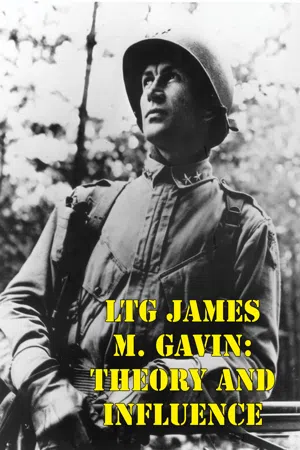
This monograph approached Lieutenant General James M. Gavin as a military theorist and explored his influence as the Army transitioned from World War II to the Cold War. Gavin's theory of future warfare required an army with capability in atomic and non-atomic warfare and he recognized the need for readiness for both limited peripheral wars and general war. His theory shaped his vision of the functions, organizations, and technology required to succeed in future conflicts. Gavin organized much of his writing around the concepts of mobility, firepower, and control that he felt were critical for future warfare. His influence shaped development of tactical nuclear weapons, missiles, air mobility, and organizational transformation following World War II and into the Cold War.
Gavin's theory of future warfare, his understanding of the Soviet threat, and his concepts of firepower, mobility, and control informed his model of how the Army should organize for future warfare. He envisioned flexible division organizations, capable of fighting dispersed over significant depth, enabled by superior air and ground mobility to deliver firepower adequate prevail on future battlefields...
The organization that epitomized Gavin's concepts was the air mobile division that developed from his sky cavalry concept. Gavin's advocacy for the air mobility concept and his specific actions to advance personnel and positions to build and refine sky cavalry and air mobility capabilities were key factors in the eventual development and acceptance of the airmobile division. While airmobile divisions and sky cavalry would likely have emerged without Gavin, his influence clearly advanced the ideas and shaped the form of the organizations.
- 59 pages
- English
- ePUB (mobile friendly)
- Available on iOS & Android
eBook - ePub
LTG James M. Gavin: Theory And Influence
About this book
Information
Subtopic
European HistoryIndex
HistorySection 1: Why He Wrote – Gavin’s Vision of Future Conflict
Gavin published Airborne Warfare in 1947 to document the refinement of airborne combat during World War II and consider future development and employment of airborne forces in light of the emergence of atomic weapons.{53} In this book, he outlined in detail the airborne operations in Sicily, Italy, Normandy, Holland, Corregidor, and Germany. Writing about the jump into Salerno, he noted:
The airborne troops had a decisive influence on the final outcome of the Salerno operation as a whole. At a moment when the scales of defeat and victory were in balance, the weight of the airborne reserves tipped them to the side of victory. … The airborne troops had a mobility and striking power that no high commander could overlook in the future. Correct and timely commitment and exploitation of such forces could turn the tide of battle.{54}
While he recognized the advantage of airborne employment, Gavin also clearly outlined the vulnerability of paratroopers facing mobile, armored opponents and the inherent isolation they faced once dropped into enemy territory. Considering those vulnerabilities, he considered the best missions for airborne forces as seizing key terrain, blocking movement of enemy reserves, rapid reinforcement, and cutting enemy lines of communication.{55} Using the Normandy invasion as evidence, Gavin described the successful employment of airborne troops against those types of missions to exploit the “great advantage of initiative” of airborne forces in relation to defenders.{56} With his background in development of the airborne concept and his experience in World War II, Gavin thus considered how to maintain the advantage that airborne forces provided to a commander.
Not content with describing the last war, Gavin envisioned movement through the air as the most important means for waging future war. In his words, “only by exploiting to its utmost the great potential of flight can we combine complete dispersion in the defense with the facility of rapidly massing for counterattack which today’s and tomorrow’s Army must possess.”{57} He considered airborne troops strategically necessary for offensive and defensive conflicts in order to seize key airheads and atomic production and delivery systems to build friendly combat power or prevent their use by enemy forces.{58} After explaining the need for airborne troops, he described the development of the tools of airborne warfare (the parachute, glider, and transport plane) and his vision of where future technical development should focus.{59} Gavin included improved anti-tank weapons, tactical vehicles, and radios in his discussion of research and development needs.{60} He also envisioned future employment of airborne divisions, corps, and armies, and outlined how an airhead seizure might progress, emphasizing the speed and initiative necessary to succeed.{61} To complete his comprehensive look at airborne warfare, Gavin reviewed division-level organizations from the World Wars and proposed a future division organization adaptable to combat on the atomic battlefield.{62} Gavin’s discussion of the ways and means of future warfare demonstrated his ability to synthesize his experience with his prediction of the nature of atomic warfare.
General Gavin followed Airborne Warfare with a series of articles for both military and popular audiences. In December 1947, he wrote "The Future of Airborne Operations,” published in Military Review. Gavin argued that airpower focused on bombers was not going to be the decisive arm of airpower because missiles could replace bombers in the strategic bombing role.{63} Rather, he anticipated that the air delivery of ground combat power would be decisive in future combat.{64} To advocate development of specialized air vehicles for future combat, Gavin compared aircraft development to that of sea craft that were purpose-built for specific tasks during amphibious operations.{65} His stated that, “to assume that the ordinary small commercial airplane can survive the spewing sea of flak that comes up from the modern battlefield is to assume that any ordinary small commercial boat could have been used to assault Utah and Omaha beaches.”{66} Gavin felt that research, development, and procurement funding focused on heavy bombers and missiles ignored the decisive role that he envisioned airmobile ground forces playing in future conflict.
Continuing his theme of air-delivered ground combat power, Gavin wrote "The Future of Armor” for Infantry Journal in January 1948. In this article, he contended that light air-transportable tanks must replace heavy tanks and he continued his advocacy for development of aircraft for tactical mobility.{67} Gavin introduced his concept of airborne armored cavalry in this article. In his words, “striking at high speed by air, and entering ground combat that requires mobility and the retention of the initiative until the decision is gained, the armored cavalry will play the decisive role in future airborne combat.”{68} He considered the leadership traits of “boldness, aggressiveness, flexibility of mind and mental as well as physical courage” that were traditionally associated with cavalry were critical for airborne combat.{69} He reviewed several fellow officers’ views on the need for air-transportable armor and discussed the requirement for the strategic mobility of armor to match the strategic mobility of the troops it supports.{70} He then described the historic pattern of firepower and mobility exchanging dominance over time, suggesting that light armored vehicles with “highly penetrative guns” may replace the heavy tank.{71} Gavin again used the historic parallel of sea power development with that of air power to explain his argument that America must continue innovation of air power to move armored divisions, employing lighter, more mobile vehicles, strategically and tactically by air.{72} In this article, Gavin argued against the trend towards increasingly heavy tanks while continuing to advocate for air-delivered combat power.
As he considered the situation unfolding on the Korean Peninsula in the summer and fall of 1950, Gavin wrote "The Tactical Use of the Atomic Bomb" in November 1950. This article represented a shift in Gavin’s focus on air mobility but demonstrated development of his thoughts regarding the emergence of atomic weapons. Gavin’s role in weapons development with the Weapons System Evaluation Group in 1949 best explains his sudden emergence as a military expert on atomic weapons.{73} He argued that the commonly held belief that atomic bombs would decisively end a war by employment “against the economy and the non-combatant elements of a nation’s population” was misguided.{74} He felt that atomic weapons represented a useful tactical option and used several examples in World War II, specifically Normandy, Iwo Jima, and Okinawa, where atomic weapons could have been useful.{75} Without claiming that tactical use of atomic bombs would end the war, he suggested that they would “contribute greatly to the common battle achievement” if employed “whenever it is possible to deliver it profitably.”{76} When reprinting this article in 1951, the editors of the Bulletin of the Atomic Scientists considered Gavin the only “prominent military expert” openly considering atomic weapons in a tactical role instead of in the strategic role normally associated with atomic bombs.{77} While Gavin’s shift in focus to firepower in the form of atomic weapons instead of air mobility was a result of his posting to the Weapons System Evaluation Group, it demonstrated his ability to envision future uses for current and emerging technologies.
In one of his most widely referenced articles, Gavin wrote for a popular audience but returned to his primary theme, air mobility, but now included trends in atomic firepower. Published by Harper’s Magazine in 1954, "Cavalry, and I Don't Mean Horses" represented Gavin’s public commentary on the shortfalls of defense spending priorities and laments the stalemate in Korea. He argued that General Walker’s Eighth Army was missing a vital element of combat power by not having air-mobile cavalry to screen in front of his forces and exploit opportunities presented.{78} Gavin introduced the concept of a “mobility differential” in this article, the idea that cavalry requires greater mobility than the forces it supports.{79} He returned to his argument from “The Future of Armor” that heavy tanks could not serve a cavalry role since they were no faster than motorized infantry were. Gavin felt that a true cavalry arm could deny the enemy surprise and return the advantage of surprise to the U.S. Army in both a Korean-style conflict or against the Soviet threat in Europe.{80} Reflecting on maneuvers with VII Corps in Europe, Gavin wrote, “All the soul-searching in the world, and the most brilliant staff cerebrations, will not conjure up tactical success in cavalry action unless the means of achieving it are provided our cavalry commanders. They do not have the means today.”{81} He argued that the means required included mobility, which the “aerial instrument” offered, but mobility was more than speed, it was the capability to deliver superior firepower.{82} Gavin closed the article with a return to the primary defense question of the day, the atomic bomb. He explained that defense against the bomb required great dispersion in the defense and mobility, through the air, to mutually support over great distance and concentrate rapidly to gain momentum for decisive battle.{83} While “Cavalry, and I Don’t Mean Horses” marked Gavin’s return to advocating greater air mobility, he clearly felt that national policy established misdirected funding priorities for research, development, and equipping the army.
Gavin returned to addressing a primarily military audience as he discussed organizing a force for fighting in atomic or non-atomic war. The Army was testing new structures to fill that dual-role, though Gavin expected that the most likely type of conflict was the “non-atomic peripheral war.”{84} He emphasized control of the reorganized force and outlined “combat commands” and “battle groups” that replaced regiments and battalions, with the new units designed for deployment in a “cellular rather than linear” fashion.{85} Gavin also described the new units as “taking advantage of every new development in communications, intelligence gathering, firepower, and above all mobility” to enable dispersed operations and rapid concentration required on future battlefields.{86} In this discussion, Gavin succinctly highlighted the need for mobility, firepower, and control while he discussed the Army’s attempts to reorganize for war on a nuclear battlefield.
In a March 1955 interview for The Army Combat Forces ...
Table of contents
- Title page
- TABLE OF CONTENTS
- Abstract
- Introduction
- Section 1: Why He Wrote - Gavin’s Vision of Future Conflict
- Section 2: Gavin’s Concepts Applied to Organizational Structures
- Section 3: Gavin’s Concepts Realized in Division-level Organizations
- Conclusion
- Bibliography
Trusted by 375,005 students
Access to over 1.5 million titles for a fair monthly price.
Study more efficiently using our study tools.
Frequently asked questions
Yes, you can cancel anytime from the Subscription tab in your account settings on the Perlego website. Your subscription will stay active until the end of your current billing period. Learn how to cancel your subscription
No, books cannot be downloaded as external files, such as PDFs, for use outside of Perlego. However, you can download books within the Perlego app for offline reading on mobile or tablet. Learn how to download books offline
Perlego offers two plans: Essential and Complete
- Essential is ideal for learners and professionals who enjoy exploring a wide range of subjects. Access the Essential Library with 800,000+ trusted titles and best-sellers across business, personal growth, and the humanities. Includes unlimited reading time and Standard Read Aloud voice.
- Complete: Perfect for advanced learners and researchers needing full, unrestricted access. Unlock 1.5M+ books across hundreds of subjects, including academic and specialized titles. The Complete Plan also includes advanced features like Premium Read Aloud and Research Assistant.
We are an online textbook subscription service, where you can get access to an entire online library for less than the price of a single book per month. With over 1.5 million books across 990+ topics, we’ve got you covered! Learn about our mission
Look out for the read-aloud symbol on your next book to see if you can listen to it. The read-aloud tool reads text aloud for you, highlighting the text as it is being read. You can pause it, speed it up and slow it down. Learn more about Read Aloud
Yes! You can use the Perlego app on both iOS and Android devices to read anytime, anywhere — even offline. Perfect for commutes or when you’re on the go.
Please note we cannot support devices running on iOS 13 and Android 7 or earlier. Learn more about using the app
Please note we cannot support devices running on iOS 13 and Android 7 or earlier. Learn more about using the app
Yes, you can access LTG James M. Gavin: Theory And Influence by Major Edward P. Gavin in PDF and/or ePUB format, as well as other popular books in History & European History. We have over 1.5 million books available in our catalogue for you to explore.