In 1973, Israel found itself fighting its fifth major war against its Arab neighbors since achieving independence 25 years previously. This was a war in which both sides designed their military strategies within the framework of the political limitations set down by the two superpowers: the United States and the Soviet Union. As a result, both sides attempted to design campaigns in which key engagements set the conditions for a successful political solution.
This paper begins with a broad overview of the conflict. It discusses three characteristics of the operational level of war: centers of gravity, culminating points, and the linkage of means and ends. It then analyzes how these characteristics significantly shaped the course of this war for both opponents. Finally, this study concludes that victory is only achieved by designing campaigns based on positive aims. For this war, the positive aim was defeating the opponent's source of strength.
- 46 pages
- English
- ePUB (mobile friendly)
- Available on iOS & Android
eBook - ePub
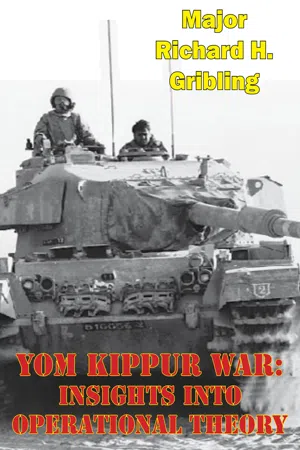
Yom Kippur War: Insights Into Operational Theory
About this book
Information
Subtopic
Middle Eastern HistoryIndex
HistoryBIBLIOGRAPHY
Books
Adan, Avraham, On The Banks of the Suez, Presidio Press, 1980.
Aker, Frank, October, 1973: The Arab-Israeli War, Connecticut: The Shoe String Press Inc., 1985.
Asher, Jerry, Duel, for the Golan, New York: William Morrow and Co. Inc., 1987.
Badri, Hassan; Maydoub, Taha; and Zohdy, Mohammed Dia, The Ramadan War, 1973, Dunn Loring: T.N. Dupuy Associates, Inc., 1978.
Brecher, Michael, Decisions in Crisis, Los Angeles: University of California Press, 1980.
Clausewitz, Carl, On War, Princeton: Princeton University Press, 1976.
Gabriel, Richard A., Operation Peace for Galilee, New York: Hill and Wang, 1984.
Herzog, Chiam, The War of Atonement October, 1973, Boston: Little Brown and Co., 1975.
Herzog, Chiam, The Arab-Israeli Wars, New York: Random House, 1982.
Jones, Archer, The Art of War in the Western World, Chicago: University of Illinois Press, 1987.
Kahalani, Avigdor, The Heights of Courage, Connecticut: Greenwood Press, 1984.
Palit, D.K. MG, Return to Sinai, India: Thomson Press, 1974.
Schnidt, Dana, Adams, Armageddon In the Middle East, New York: The John Day Company, 1974.
Shazli, Saad, LTG, The Crossing of the Suez, San Francisco: American Mideast Research, 1980.
Sherman, Arnold, When God Judged And Men Died, New York: Bantam Books Inc., 1973.
Sunday Times of London Insight Team, Insight on the Middle East War, London: Times Newspapers Limited, 1974.
Sunday Times of London Insight Team, The Yom Kippur War, New York: Doubleday and Co. Inc., 1974.
Manuals, Monographs, and Articles
US Army Field Manual 100-5, Operations, Headquarters, Department of the Army, Washington DC, 1986.
Brant, Bruce A., "Battlefield Air Interdiction in the 1973 Middle East War and its Significance to NATO Air Operations", US Army Command and General Staff College, Fort Leavenworth, Kansas, 1986.
Brower, Kenneth S., "The Yom Kip...
Table of contents
- Title page
- TABLE OF CONTENTS
- ABSTRACT
- I - INTRODUCTION
- II - HISTORICAL OVERVIEW
- III - OPERATIONAL LESSONS
- IV - CONCLUSION
- BIBLIOGRAPHY
Trusted by 375,005 students
Access to over 1.5 million titles for a fair monthly price.
Study more efficiently using our study tools.
Frequently asked questions
Yes, you can cancel anytime from the Subscription tab in your account settings on the Perlego website. Your subscription will stay active until the end of your current billing period. Learn how to cancel your subscription
No, books cannot be downloaded as external files, such as PDFs, for use outside of Perlego. However, you can download books within the Perlego app for offline reading on mobile or tablet. Learn how to download books offline
Perlego offers two plans: Essential and Complete
- Essential is ideal for learners and professionals who enjoy exploring a wide range of subjects. Access the Essential Library with 800,000+ trusted titles and best-sellers across business, personal growth, and the humanities. Includes unlimited reading time and Standard Read Aloud voice.
- Complete: Perfect for advanced learners and researchers needing full, unrestricted access. Unlock 1.5M+ books across hundreds of subjects, including academic and specialized titles. The Complete Plan also includes advanced features like Premium Read Aloud and Research Assistant.
We are an online textbook subscription service, where you can get access to an entire online library for less than the price of a single book per month. With over 1.5 million books across 990+ topics, we’ve got you covered! Learn about our mission
Look out for the read-aloud symbol on your next book to see if you can listen to it. The read-aloud tool reads text aloud for you, highlighting the text as it is being read. You can pause it, speed it up and slow it down. Learn more about Read Aloud
Yes! You can use the Perlego app on both iOS and Android devices to read anytime, anywhere — even offline. Perfect for commutes or when you’re on the go.
Please note we cannot support devices running on iOS 13 and Android 7 or earlier. Learn more about using the app
Please note we cannot support devices running on iOS 13 and Android 7 or earlier. Learn more about using the app
Yes, you can access Yom Kippur War: Insights Into Operational Theory by Major Richard H. Gribling in PDF and/or ePUB format, as well as other popular books in History & Middle Eastern History. We have over 1.5 million books available in our catalogue for you to explore.